How to Calculate Offshore Hiring Savings in 2026

TL;DR:
- Calculating offshore hiring savings involves comparing fully loaded offshore and onshore employment costs, including all hidden expenses.
- A comprehensive cost model must incorporate EOR fees, employer burdens, ramp-up, attrition, and operational overhead to produce accurate savings estimates.
Offshore hiring savings are defined as the measurable reduction in total employment costs achieved by staffing roles in lower-cost labor markets, calculated by comparing fully loaded onshore costs against fully loaded offshore costs. The phrase “calculate offshore hiring savings” describes what HR managers and business owners do when they build a cost model that goes well beyond a simple salary comparison. A complete offshore staffing cost analysis must account for Employer of Record (EOR) fees, employer tax burdens, ramp-up time, attrition, communication overhead, and severance accruals. Frameworks from Stripe Systems, WhichPayroll, and eorHQ each demonstrate that the real cost advantage of outsourcing only becomes visible once every cost driver is included. This guide walks you through exactly how to build that model.
How to calculate offshore hiring savings accurately
Calculating offshore hiring savings starts with one foundational concept: the loaded hourly rate. According to Stripe Systems, the loaded rate formula is: Base Rate + Management Overhead + Amortized Ramp Cost + Attrition Premium + Communication Tax + Quality Premium. This single metric unifies every cost driver into one number, making fair comparisons across staffing models possible.

When you apply this formula to a real scenario, the results are striking. Stripe Systems’ analysis shows an offshore loaded cost of $84/hr versus an onshore loaded cost of $189/hr for a software engineer. That gap represents genuine savings, but it only appears after you account for all the components below. Skipping any one of them produces an inflated savings estimate that will not survive contact with reality.
Here are the core components every offshore talent cost calculation must include:
- Base salary and employer contributions. This includes local payroll taxes, social security equivalents, and statutory benefits. These vary significantly by country and can add 15% to 30% on top of base salary.
- EOR service fees. WhichPayroll’s research shows EOR fees typically run $400 to $800 per employee per month. That is a fixed line item many first-time buyers forget to include.
- Employer burden and FX margin. Additional costs from employer taxes and foreign exchange spreads add another 20% to 40% on top of the EOR fee. These are not optional line items.
- Ramp-up and onboarding costs. A new offshore hire is not fully productive from day one. Amortize the cost of reduced productivity and manager time over the employee’s expected tenure.
- Attrition and replacement costs. Attrition adds $15 to $30/hr to the effective cost of an offshore role. High-turnover markets make this the single largest hidden cost in most models.
- Communication and quality overhead. Time zone gaps, coordination meetings, and rework cycles all consume productive hours. Assign a percentage tax to account for this.
- Working capital and severance accruals. WhichPayroll notes that EOR deposits and severance reserves increase the true cost of employment beyond what a simple fee-plus-salary calculation shows.
Pro Tip: Build your loaded rate model in a spreadsheet before you speak to any EOR vendor. You will negotiate better fees when you already understand the full cost structure.
How to build a spreadsheet model for offshore savings
A reliable offshore hiring savings calculator requires structured inputs, clear assumptions, and a comparison output that your finance team can audit. Follow these steps to build one from scratch.
- Collect your baseline data. Gather the annual salary for the equivalent onshore role, your current employer burden percentage, and any existing overhead costs like equipment and office space.
- Input offshore salary and statutory costs. Research the target country’s employer contribution rates. For India, this typically includes Provident Fund and Employee State Insurance contributions on top of gross salary.
- Add EOR fees. Use a monthly EOR fee in the range of $400 to $800 and multiply by 12. Add a 5% FX margin as a conservative estimate.
- Estimate ramp cost. Assume 50% productivity for the first four weeks and 75% for weeks five through ten. Calculate the cost of lost output and manager oversight during this window.
- Apply an attrition factor. If your target market has a 20% annual attrition rate, add a replacement cost equal to one to two months of fully loaded salary to your annual total.
- Add communication overhead. A conservative 10% productivity tax for cross-time-zone coordination is standard in most offshore staffing cost analysis models.
- Calculate total annualized cost per employee. Sum every line item above to get your true offshore cost.
- Compare against your onshore baseline. The difference is your gross savings. Divide by the onshore cost to get your savings percentage.
Here is a simplified comparison table to illustrate the output:
| Cost Component | Onshore (US) | Offshore (India via EOR) |
|---|---|---|
| Base salary | $120,000 | $28,000 |
| Employer burden (25%) | $30,000 | $7,000 |
| EOR fee (annual) | N/A | $7,200 |
| Ramp and attrition premium | $8,000 | $6,500 |
| Communication overhead (10%) | $5,000 | $3,500 |
| Total loaded annual cost | $163,000 | $52,200 |
| Estimated savings | ~68% |
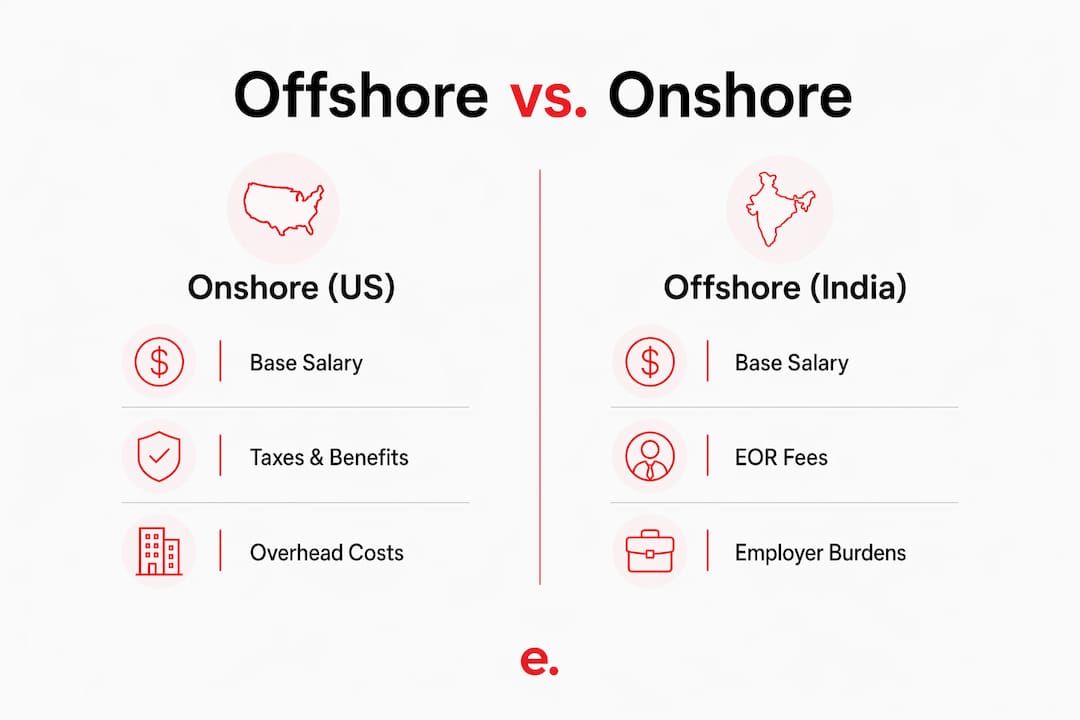
WhichPayroll’s model confirms that a $100,000 salary employee costs between $130,700 and $133,500 in total EOR employment costs before severance accrual. That benchmark is a useful sanity check for your own model.
Pro Tip: Run your model at three attrition scenarios: 10%, 20%, and 35%. The difference in total cost between the best and worst case will tell you how much your savings depend on retention. If the gap is large, invest in retention before you invest in headcount.
EOR vs. entity setup: how does the model affect your savings?
The two primary models for offshore hiring are the Employer of Record (EOR) and the direct entity setup. Each has a different cost structure, and choosing the wrong one for your headcount will erode your savings.
An EOR is a third-party company that legally employs your offshore workers on your behalf, handling payroll, compliance, and HR administration. An entity setup means you register your own legal business entity in the target country, which gives you direct control but requires significant upfront investment.
| Factor | EOR model | Entity setup |
|---|---|---|
| Upfront cost | Low (monthly fee) | High (legal, registration, compliance) |
| Per-employee cost | $400 to $800/month | Lower marginal cost at scale |
| Compliance risk | Transferred to EOR | Retained by your company |
| Breakeven headcount | Immediate | 4 to 5 employees (US); higher in Brazil and Germany |
| Flexibility | High (easy to exit) | Low (wind-down is costly and slow) |
| Management overhead | Low | High |
The breakeven headcount calculation for entity vs. EOR is: Annual Entity Cost divided by Annual EOR Fee Per Employee. eorHQ’s framework shows the US breakeven sits at four to five employees, while markets like Brazil and Germany require more headcount to justify entity costs due to higher setup and compliance expenses. This means that for most companies hiring fewer than five offshore employees, the EOR model produces better net savings.
Beyond pure cost, the EOR vs. entity decision should factor in risk transfer, management effort, and opportunity cost. Running your own entity in India or the Philippines requires dedicated HR and legal resources. That overhead rarely appears in a first-pass cost model, but it is real and material.
The benefits of offshore hiring through an EOR are most pronounced for companies in early scaling phases. You get immediate access to talent, predictable monthly costs, and zero compliance liability. As your team grows past ten or fifteen people, revisiting the entity option with a full breakeven model makes financial sense.
What common mistakes distort offshore savings calculations?
Most offshore savings estimates are wrong because they are incomplete. These are the mistakes that appear most often in practice:
- Comparing base salaries only. A $30,000 offshore salary versus a $120,000 onshore salary looks like a 75% saving. It is not. Once you add employer burden, EOR fees, and overhead, the real saving is closer to 50% to 65%. Still significant, but not the number you started with.
- Ignoring ramp-up time. Offshore savings materialize after week 10 to 12 of onboarding. Short engagements under three months rarely generate positive ROI once ramp costs are included.
- Underestimating attrition. Attrition is the most underestimated cost in offshore staffing cost analysis. A 25% annual turnover rate in a competitive tech market can add tens of thousands of dollars per role per year in replacement and retraining costs.
- Omitting FX margins and EOR deposits. EOR providers often charge a foreign exchange spread of 1% to 3% on salary payments. Combined with upfront deposits, this adds a meaningful cost that most buyers discover only after signing.
- Not updating assumptions over time. A cost model built in year one becomes inaccurate by year two. Salary benchmarks shift, attrition rates change, and EOR fees are negotiable at renewal. Treat your model as a living document, not a one-time calculation.
Pro Tip: Ask your EOR vendor for a full fee schedule in writing before you sign, including FX margin, deposit requirements, and severance reserve policy. These three items alone can shift your total cost by 8% to 12%.
How to apply offshore savings data to real business decisions
Calculating offshore hiring savings is only useful if the output drives a decision. Here is how to translate your model into strategy.
The offshore staffing cost-benefit analysis should anchor your ROI evaluation against onshore and nearshore alternatives. If your loaded offshore rate is $52,000 annually versus $163,000 onshore, the ROI case is clear for roles with a tenure expectation of twelve months or more. For shorter engagements, the ramp cost erodes the advantage.
Use your breakeven analysis to choose between EOR and entity models. If you plan to hire three people in India over the next year, an EOR is the right choice. If you plan to hire fifteen, model the entity option seriously. The cost-per-hire offshore guide from Remotee provides updated 2026 benchmarks that make this comparison more precise.
Incorporate qualitative factors alongside the numbers. Risk transfer, compliance management, and time-to-hire speed all have dollar values even if they do not appear on a spreadsheet. An EOR eliminates the risk of misclassification penalties and local labor law violations. That protection has real financial value, particularly in markets with complex employment regulations like India, Brazil, and Germany.
Finally, run sensitivity analysis on your key assumptions. Test what happens to your savings if attrition rises from 15% to 30%, or if the EOR fee increases by $150 per month at renewal. If your savings case survives those scenarios, you have a durable model. If it does not, you need to address retention and fee negotiation before scaling. Cutting costs with offshore hiring only works when the model is stress-tested against realistic downside scenarios.
Key takeaways
Accurate offshore hiring savings calculations require a fully loaded cost model that includes EOR fees, employer burdens, attrition, ramp time, and operational overhead, not just base salary comparisons.
| Point | Details |
|---|---|
| Use the loaded rate formula | Add management overhead, ramp cost, attrition premium, and communication tax to base salary for a true cost figure. |
| EOR fees are just one line item | Employer contributions and severance reserves typically dominate total employment costs beyond the monthly EOR fee. |
| Breakeven drives model selection | EOR is optimal below four to five employees; entity setup becomes cost-effective at larger headcount in most markets. |
| Ramp time delays savings realization | Offshore savings materialize after week 10 to 12; short engagements rarely produce positive ROI. |
| Update your model annually | Salary benchmarks, attrition rates, and EOR fees shift over time and must be reassessed to keep savings estimates accurate. |
Why most offshore savings estimates miss the mark
I have reviewed dozens of offshore hiring proposals where the headline savings number was built on nothing more than a salary comparison. The business owner sees a 70% wage gap and assumes that is the saving. By the time you add EOR fees, employer contributions, ramp costs, and a realistic attrition rate, that 70% becomes 50%. Still a strong result, but the gap between expectation and reality creates budget problems and erodes trust in the offshore model.
The loaded rate approach from Stripe Systems is the most honest framework I have seen for this problem. It forces you to assign a dollar value to every cost driver before you commit to a hiring decision. The uncomfortable truth is that most companies skip this step because it requires data they do not have yet, like local attrition rates or communication overhead percentages. My advice: use conservative estimates and stress-test them. A model built on pessimistic assumptions that still shows 40% savings is far more credible than one built on optimistic assumptions showing 70%.
The other mistake I see consistently is treating the EOR fee as the total cost of offshore employment. WhichPayroll’s research makes clear that employer contributions and severance reserves dominate total employment costs. The EOR fee is the visible cost. The invisible costs are what determine whether your savings projection holds up in year two and year three.
Think beyond cost when you apply your savings model. The benefits of dedicated offshore staffing include risk transfer, faster time-to-hire, and access to talent pools that are simply not available locally. Those advantages compound over time in ways that a spreadsheet cannot fully capture. Build the cost model rigorously, but do not let it crowd out the strategic picture.
— Rajkumar
How Remotee helps you capture real offshore hiring savings
Remotee’s Employer of Record service in India is built specifically for business owners and HR managers who want predictable offshore costs without the compliance complexity of running a local entity. Remotee handles payroll, statutory contributions, HR administration, and local labor law compliance, so your total employment cost is transparent from day one.

Clients working with Remotee report up to 32% savings on hiring costs compared to equivalent onshore roles, with no hidden FX margins or surprise deposit requirements. The fee structure is clear, the talent pool is pre-vetted, and the onboarding process is designed to shorten the ramp period that erodes first-year savings. For companies ready to move from a savings calculation to an actual hire, Remotee’s offshore hiring solutions provide the infrastructure to do it efficiently and compliantly.
FAQ
What does it mean to calculate offshore hiring savings?
Calculating offshore hiring savings means comparing the fully loaded annual cost of an offshore employee against the equivalent onshore cost, including salary, employer contributions, EOR fees, ramp costs, attrition, and operational overhead. The result is a realistic savings percentage, not just a wage gap.
How much do EOR fees add to offshore hiring costs?
EOR fees typically run $400 to $800 per employee per month, plus 20% to 40% in additional employer taxes and contributions. Deposits and severance reserves can add further to the true cost, making the total employment cost significantly higher than the base salary alone.
When do offshore hiring savings actually materialize?
Offshore savings materialize after the ramp period, which typically runs 10 to 12 weeks. Engagements shorter than three months rarely generate positive ROI once onboarding overhead and reduced early productivity are factored into the cost model.
Should I use an EOR or set up my own entity for offshore hiring?
For fewer than four to five employees, an EOR produces better net savings because entity setup costs are largely fixed. As headcount grows, the marginal cost per employee under an entity setup decreases, making the entity model more cost-effective at scale in most markets.
What is the biggest mistake in offshore savings calculations?
The most common mistake is comparing base salaries without including attrition costs, which can add $15 to $30 per hour to the effective offshore rate. A complete offshore staffing cost analysis must include every loaded cost component to produce a reliable savings estimate.