Offshore Creative Talent Hiring: A 2026 Business Guide
TL;DR:
- Offshore creative talent hiring enables businesses to manage skilled professionals abroad with full control, reducing costs significantly. Effective workflow design, legal compliance through EOR providers, and strategic onboarding are essential to maximize savings and operational efficiency. Proper management of time zones and clear contracts ensure productive, compliant, and integrated remote creative teams.
Offshore creative talent hiring is the practice of sourcing and directly managing skilled creative professionals located in other countries as integrated members of your team. Unlike outsourcing, where a third party controls delivery, offshore staffing keeps management authority with you while placing the talent overseas. This model gives businesses access to graphic designers, digital marketers, video editors, and creative directors at a fraction of domestic rates. Regions like India and LATAM have become primary sourcing hubs, and legal frameworks such as Employer of Record (EOR) have made compliant hiring faster than ever.
What is offshore creative talent hiring and how does it work?
Offshore creative talent hiring, known in the industry as offshore staffing or global talent acquisition, means you recruit creative professionals abroad, integrate them into your workflows, and manage their daily output directly. The key distinction from outsourcing is control. With outsourcing, a vendor owns the process and delivers a finished product. With offshore staffing, you manage the staff just as you would a local employee, setting priorities, reviewing work, and directing creative output.
This model applies across creative disciplines. Offshore graphic design hiring covers brand identity, UI/UX, and marketing collateral. Offshore digital marketing hiring spans SEO, paid media, content strategy, and social media management. Companies also hire offshore creative directors to lead distributed teams, though those roles require more structured onboarding and communication protocols.
The practical mechanics involve sourcing candidates through vetted staffing partners or platforms, running standard interviews, signing contracts that include IP assignment and confidentiality clauses, and then onboarding the hire into your tools and workflows. The offshore professional works your assigned hours, attends your standups, and reports to your team leads.

What are the main hiring models for offshore creative teams?
Offshore staffing models fall into three primary structures, each offering a different balance of control, speed, and flexibility. Choosing the wrong model is one of the most common and costly mistakes businesses make when scaling creative teams offshore.
| Model | Control Level | Best For | Typical Setup Time |
|---|---|---|---|
| Staff augmentation | High | Filling specific skill gaps in existing teams | 1–3 weeks |
| Project-based delivery | Low | Defined, time-bound creative projects | 1–2 weeks |
| Distributed/cloud team | Medium to high | Fully remote creative departments | 2–6 weeks |
| Hybrid model | Adjustable | Scaling teams with mixed control needs | Varies |
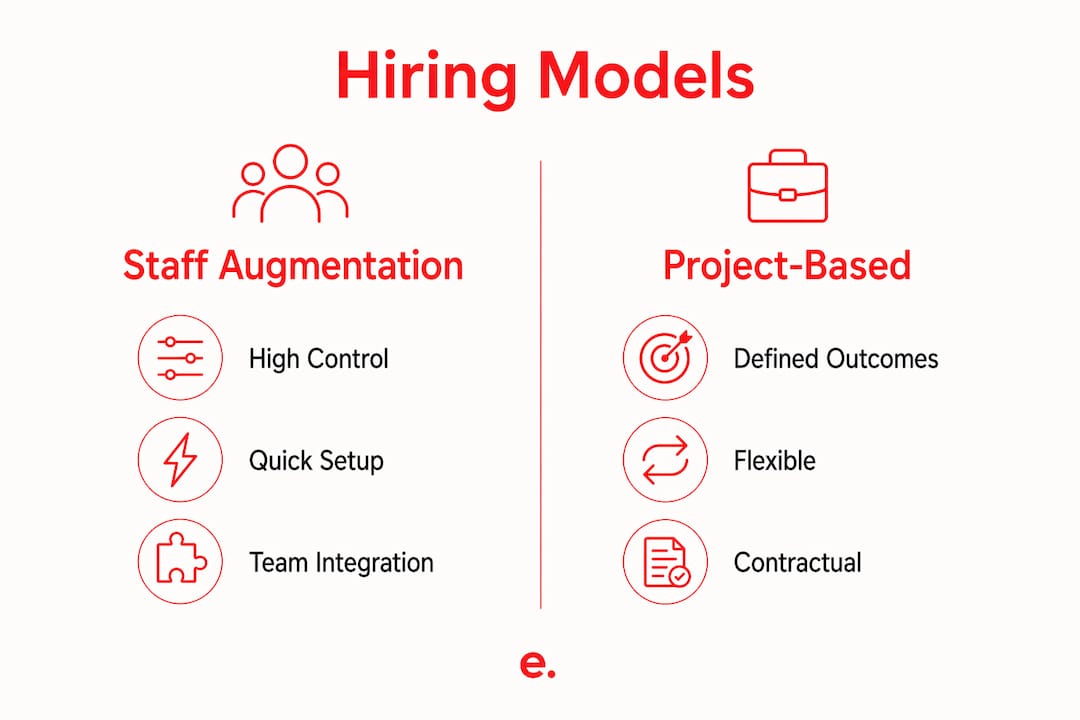
Staff augmentation places offshore professionals directly inside your existing team structure. A LATAM-based graphic designer joins your Slack, attends your design reviews, and works under your creative director. You fill a skill gap without adding a full local headcount.
Project-based delivery works when you need a defined output, such as a brand refresh or a campaign asset library, and do not need ongoing integration. A vendor manages the offshore team, and you receive deliverables. This is outsourcing adjacent and gives you less day-to-day control.
Distributed or cloud team models build entire offshore creative departments managed through collaboration tools like Figma, Notion, and Slack. Media companies that hire offshore digital marketers at scale often use this structure to run content operations across time zones.
Hybrid models combine augmentation for core roles with project-based vendors for overflow work. This gives startups flexibility without overcommitting to headcount.
What are the real cost savings from offshore creative hiring?
The cost difference between offshore and domestic creative talent is not marginal. LATAM graphic designers average around $6,600 annually compared to $50,000 to $82,000 for equivalent U.S. roles, representing savings of 88% to 92%. India offers comparable savings across digital marketing, video production, and content roles.
| Role | U.S. Annual Cost | Offshore Annual Cost (LATAM/India) | Estimated Savings |
|---|---|---|---|
| Graphic designer | $50,000–$82,000 | ~$6,600–$15,000 | 80%–92% |
| Digital marketing specialist | $55,000–$90,000 | ~$8,000–$18,000 | 78%–88% |
| Video editor | $48,000–$75,000 | ~$7,000–$14,000 | 78%–90% |
Remotee clients report up to 32% savings on total hiring costs when accounting for compliance, payroll management, and onboarding support through an EOR model. That figure is conservative compared to raw salary comparisons because it factors in the real overhead of managing offshore staff.
Onboarding offshore designers typically takes one to three weeks depending on brand complexity. That ramp-up period carries a real cost in manager time and delayed output, so it belongs in your savings calculation. A hire who takes four weeks to reach full productivity on a complex brand system costs more than the salary comparison suggests.
Pro Tip: Build a 30-day onboarding plan before your offshore hire starts. Include brand guidelines, file naming conventions, tool access, and a shadowing schedule with a senior team member. This cuts ramp-up time and reduces the hidden cost of repeated corrections.
What operational challenges come with offshore creative hiring?
Time zone gaps of 8 to 14 hours between U.S. teams and offshore hubs in India or Southeast Asia are the most cited operational friction point. A feedback request sent at 3 PM Eastern may not receive a response until the following morning. For iterative creative work like campaign design or video editing, this extends revision cycles from hours to days.
The deeper problem is that unclear workflows amplify time zone friction. Without documented brand guidelines, file management systems, and feedback cadence protocols, every revision request becomes a coordination event. Creative workflow gaps inflate management time beyond what the labor cost savings justify.
Effective strategies to manage these challenges include:
- Overlap windows: Schedule a 2-hour daily overlap between your core team and the offshore team for live feedback and priority setting.
- Async-first communication: Use Loom for video feedback, Figma comments for design reviews, and structured briefs in Notion or Asana to reduce back-and-forth messages.
- Documented brand systems: Maintain a living brand guide in a shared tool so offshore designers can make decisions independently without waiting for approval.
- Clear escalation paths: Define which decisions the offshore hire can make autonomously and which require sign-off, reducing coordination delays.
“The businesses that struggle most with offshore creative teams are not the ones with the biggest time zone gaps. They are the ones that never documented how their creative process actually works.” This observation holds true across industries. Offshore hiring exposes workflow gaps that were always there but previously hidden by proximity.
How does Employer of Record (EOR) simplify legal offshore hiring?
An Employer of Record is a third-party entity that legally employs your offshore creative hire, handling payroll, tax compliance, benefits, and local labor law requirements while you direct the employee’s daily work. The EOR model enables compliant offshore hiring in one to two weeks compared to three to six months required to set up a foreign legal entity.
For startups and growing businesses, this difference is significant. Setting up a legal entity in India or Colombia to hire two designers is not practical. An EOR removes that barrier entirely.
The legal protections you need to secure before work begins include:
- IP assignment clauses: All creative work produced by the offshore hire must be explicitly assigned to your company in the employment contract. Default IP ownership rules vary by country.
- Confidentiality agreements: NDAs covering brand assets, campaign strategies, client data, and proprietary processes protect your business interests.
- Non-solicitation terms: Prevent offshore hires from taking client relationships or team contacts if they leave.
- Offboarding protocols: Define how access is revoked and assets are returned when the engagement ends.
Contract hygiene is not a legal formality. It is the mechanism that makes offshore creative hiring safe for your business. Skipping or rushing these steps creates real exposure, particularly for brands with valuable visual identities or proprietary campaign data.
Pro Tip: Ask your EOR provider to confirm that IP assignment language in the employment contract is enforceable under the local jurisdiction’s law, not just your home country’s law. This is a common oversight that creates disputes during offboarding.
Remotee’s EOR service in India covers all of these compliance requirements, including payroll, tax filings, and contract management, so you can focus on creative output rather than legal administration.
What are best practices for onboarding and retaining offshore creative talent?
Dedicated offshore hires placed through vetted staffing partners outperform freelancers and agencies on brand knowledge retention and operational continuity. The difference is integration. A freelancer completes a task. A dedicated offshore hire learns your brand, your clients, and your standards over time.
Effective onboarding and retention practices include:
- Phased onboarding: Week one covers tool access, brand immersion, and shadowing. Week two involves supervised project work with structured feedback. Week three transitions to independent delivery with check-ins.
- Success metrics from day one: Define what good looks like before the hire starts. Revision rate per deliverable, turnaround time, and brand consistency scores give offshore creatives clear targets.
- Regular one-on-ones: Weekly 30-minute video calls between the offshore hire and their direct manager build rapport and surface blockers before they become delays.
- Cultural awareness: Creative feedback norms differ across cultures. Direct criticism that feels constructive in a U.S. context can feel dismissive in India or the Philippines. Frame feedback around the work, not the person.
- Career development signals: Offshore hires who see a path forward stay longer. Assign stretch projects, acknowledge strong work publicly, and include offshore team members in team-wide recognition.
The best offshore hiring practices treat the offshore hire as a full team member from day one. That means including them in planning meetings, giving them context on business goals, and soliciting their input on creative decisions. Hires who understand the “why” behind their work produce better output and stay longer.
Key takeaways
Offshore creative talent hiring delivers real cost savings, but workflow preparation and legal compliance determine whether those savings hold.
| Point | Details |
|---|---|
| Offshore staffing vs. outsourcing | Offshore staffing keeps management control with you; outsourcing delegates it to a vendor. |
| Cost savings are substantial | LATAM and India creative roles cost 80%–92% less than U.S. equivalents before overhead. |
| Time zones require workflow design | 8–14 hour gaps extend feedback cycles; async tools and overlap windows are non-negotiable. |
| EOR enables fast, compliant hiring | An Employer of Record gets offshore hires legally onboarded in 1–2 weeks without entity setup. |
| IP and contracts protect your assets | Explicit IP assignment and confidentiality clauses must be in place before any creative work begins. |
Why cost is only half the offshore hiring equation
I have watched businesses make the same mistake repeatedly. They run the salary comparison, see the 80% savings, and move fast. They hire a talented offshore designer or digital marketer, skip the workflow documentation, and then spend the next three months frustrated by revision cycles and miscommunication. The savings evaporate in management overhead.
The businesses that get offshore creative hiring right treat it as a systems problem, not just a cost problem. Before the hire starts, they have a brand guide, a file structure, a feedback protocol, and a clear escalation path. They have thought through the time zone overlap and built it into the team calendar. They have chosen an EOR provider so the legal side is handled without distraction.
I also think the EOR model is underused by startups specifically. Founders often assume it is only for large companies with complex HR needs. The reality is that EOR is most valuable at the early stage, when you do not have a legal team, do not have time to set up a foreign entity, and cannot afford a compliance mistake. Services like Remotee exist precisely for that scenario.
The other thing worth saying directly: offshore creative hires are not a lower tier of talent. India and LATAM produce world-class graphic designers, digital marketers, and creative strategists. The benefits of offshore marketing talent for startups go beyond cost. You get access to professionals who have worked across global brands, bring fresh creative perspectives, and often have stronger technical skills in specific tools than local candidates at the same price point. Treat them as integrated team members and they will perform like it.
— Rajkumar
Scale your creative team with Remotee’s EOR solutions
Remotee makes offshore creative talent hiring straightforward for startups and growing businesses. As a dedicated Employer of Record in India, Remotee handles payroll, compliance, contracts, and HR administration so you can focus entirely on building your creative team and delivering results.
Clients report up to 32% savings on total hiring costs compared to domestic alternatives, with offshore creative professionals onboarded in as little as one to two weeks. Whether you need a graphic designer, a digital marketing specialist, or a full creative team, Remotee presents only vetted, top-tier candidates matched to your requirements. Explore Remotee’s offshore hiring services to see how fast and cost-effectively you can scale your creative capabilities.
FAQ
What is offshore creative talent hiring?
Offshore creative talent hiring is the practice of sourcing graphic designers, digital marketers, video editors, and other creative professionals in other countries who work as direct members of your managed team. Unlike outsourcing, you retain full management control over their daily work and output.
How much can businesses save by hiring offshore creatives?
LATAM graphic designers average around $6,600 annually versus $50,000 to $82,000 in the U.S., representing savings of up to 92%. Actual net savings depend on onboarding costs, management overhead, and whether you use an EOR service.
What is an Employer of Record and why does it matter for offshore hiring?
An Employer of Record legally employs your offshore hire and manages payroll, tax compliance, and contracts on your behalf while you direct the work. EOR models enable compliant offshore onboarding in one to two weeks compared to three to six months for foreign entity setup.
What are the biggest operational challenges in offshore creative hiring?
Time zone gaps of 8 to 14 hours extend feedback cycles and increase coordination overhead, particularly for iterative creative work. The solution is documented workflows, async communication tools like Loom and Figma, and scheduled daily overlap windows.
What legal protections are needed before offshore creative work begins?
IP assignment clauses, confidentiality agreements, and non-solicitation terms must be in the employment contract before any creative work starts. These protections must be enforceable under the offshore hire’s local jurisdiction, not just your home country’s law.