What Is a Full-Time Offshore Employee? 2026 Guide
TL;DR:
- A full-time offshore employee works exclusively for your company and is legally employed through an Employer of Record.
- This model offers significant cost savings, faster hiring, and easier access to niche global skills, while requiring deliberate management and integration efforts.
A full-time offshore employee is a dedicated professional hired by your company to work exclusively from another country, functioning as a fully integrated member of your internal team rather than a contractor or freelancer. This offshore employment definition separates the model from traditional outsourcing: the worker reports directly to you, follows your processes, and represents your brand. Businesses use this model to access global talent pools, reduce labor costs significantly, and build teams that operate across time zones. Employer of Record (EOR) services like Remotee make this structure legally straightforward, even when hiring across borders.
What is a full-time offshore employee vs. a contractor or outsourced vendor?
The distinction matters more than most business owners realize. Outsourcing is tactical delegation to a vendor who manages their own staff and delivers an output. A full-time offshore employee, by contrast, is exclusively yours. They attend your standups, use your tools, follow your workflows, and build institutional knowledge inside your organization.
Contractors and freelancers sit in a middle ground. They may work for multiple clients simultaneously, set their own hours, and have no obligation to integrate with your culture. A full-time offshore employee works fixed hours, reports to your managers, and has a single employer: you.
The legal distinction carries real weight. Offshore workers acting as full employees who are misclassified as contractors create compliance liabilities, including back taxes and penalties. Direct reporting lines, fixed schedules, and indefinite core work all signal employee status under most jurisdictions.
| Model | Control | Exclusivity | Legal Employer |
|---|---|---|---|
| Full-time offshore employee | Full | Yes | You (via EOR) |
| Contractor | Partial | No | Self-employed |
| Outsourced vendor | None | No | Vendor company |
| Freelancer | Minimal | No | Self-employed |
Key differences that define the offshore employee model:
- Direct management. You set goals, conduct reviews, and direct daily work.
- Exclusive dedication. The employee works only for your company during contracted hours.
- Cultural integration. They participate in team meetings, company rituals, and internal communications.
- Legal employment. An EOR handles local payroll, taxes, and labor law compliance on your behalf.
What are the primary benefits of hiring full-time offshore employees?
Cost savings are the entry point, but they are not the whole story. Companies typically realize 40–70% cost savings by using offshore full-time employees, cutting spend on office space, local payroll taxes, and recruiting overhead. That range is wide because it depends on the destination country, role type, and local market conditions.
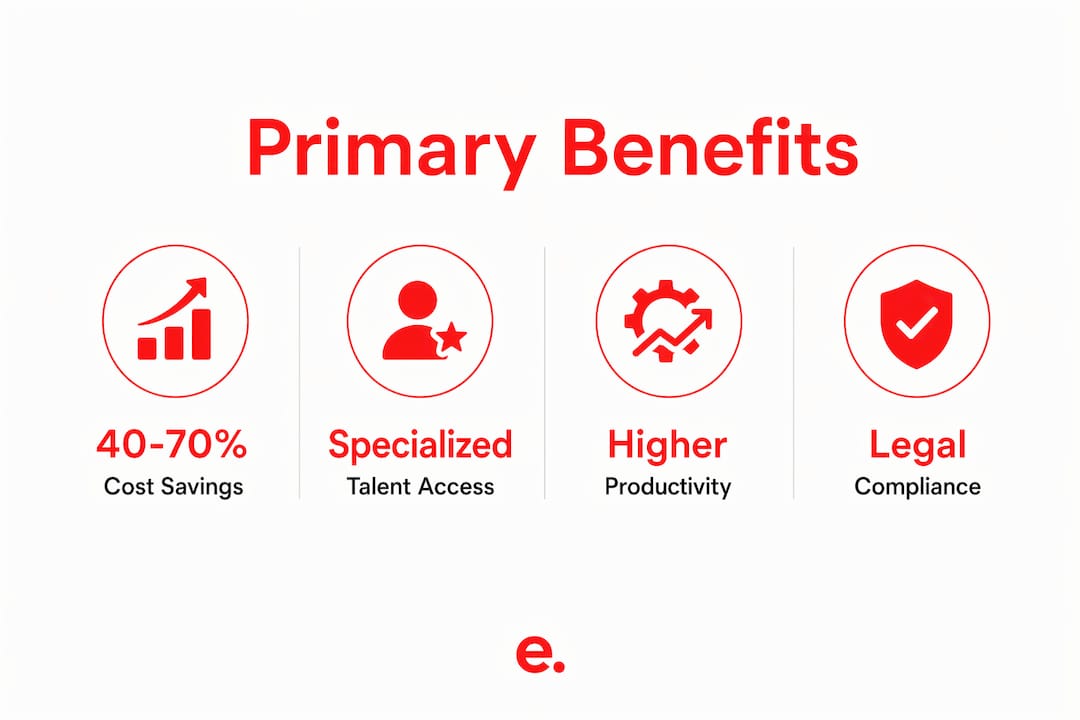
The talent access argument has grown stronger. Offshore staffing now includes highly skilled roles like AI specialists, data analysts, and full-stack engineers, well beyond the call center work that defined the model a decade ago. If you cannot find a qualified machine learning engineer locally, or cannot afford the local market rate, an offshore hire solves both problems at once.
Speed is another underrated advantage. Hiring offshore via EOR generally takes weeks, compared to the 90-plus day average for a local hiring cycle. That speed matters when you are scaling a product team or backfilling a critical role.
The operational benefits of dedicated offshore staffing compound over time:
- Follow-the-sun workflows. A team in India or the Philippines continues work while your US team sleeps, cutting time-to-market by up to 33%.
- Retention through integration. Offshore employees treated as core team members show retention rates comparable to domestic staff.
- Scalability without fixed overhead. You add headcount without leasing more office space or navigating local employment law directly.
- Access to niche skills. Specialized technical talent unavailable in your local market becomes reachable through global hiring.
Pro Tip: When calculating offshore cost savings, include the full loaded cost of a domestic hire: salary, benefits, payroll taxes, office space, and recruiting fees. The real savings gap is almost always larger than the salary comparison alone suggests.
How do you manage full-time offshore employees effectively?
The biggest management failure in offshore teams is treating offshore staff as overflow capacity rather than core contributors. Companies that treat offshore hires as extra capacity rather than core team members see high turnover. The fix is not complicated, but it requires deliberate effort from day one.

Mandated overlap hours
Mandated Overlap, typically 2–4 hours of synchronous work, is the single most effective structural tool for global team collaboration. It prevents the “black box” dynamic where offshore staff work in isolation and onshore managers lose visibility. Schedule this overlap at a time that does not consistently require one party to work at 5 a.m. or 11 p.m. Rotating the burden shows respect and prevents burnout.
Asynchronous communication protocols
Outside the overlap window, asynchronous tools like Loom, Notion, and Slack carry the load. The key is protocol, not just tool choice. Define response time expectations, document decisions in writing, and record video briefings for complex tasks. Offshore employees who receive clear async instructions produce work that matches or exceeds co-located output.
Onboarding and career development
Successful offshore integrations require as much investment in training and performance support as domestic employees receive. This means a structured onboarding program, regular one-on-ones, quarterly performance reviews, and a visible career path. Offshore employees who see no growth trajectory leave. Those who see a path forward stay and build expertise that compounds in value.
Common pitfalls to avoid:
- Skipping formal onboarding because the employee is “remote anyway”
- Excluding offshore staff from company all-hands or team events
- Assigning only low-complexity tasks that limit skill development
- Failing to document processes, leaving offshore employees dependent on real-time access to onshore colleagues
- Ignoring cultural differences in communication style and feedback norms
Technology plays a direct role in making these practices work. The role of technology in offshore staffing has expanded to include AI-assisted project management, automated payroll, and real-time collaboration platforms that reduce the friction of distance.
How do you legally hire and onboard full-time offshore employees?
The legal path to hiring a full-time offshore employee runs through one of three structures: setting up a local legal entity, using an Employer of Record, or hiring through a Professional Employer Organization. For most small and mid-sized businesses, the EOR model is the fastest and most cost-effective option.
Here is how the process works in practice:
- Define the role. Write a job description that specifies responsibilities, required skills, working hours, and reporting structure. Clarity here prevents misclassification risk later.
- Select an EOR partner. The EOR becomes the legal employer of record in the destination country. They handle local payroll, statutory benefits, tax filings, and labor law compliance. You retain full operational control.
- Source and screen candidates. Your EOR partner or your own recruitment process identifies candidates. Remotee, for example, presents only pre-vetted candidates from India, reducing screening time significantly.
- Complete EOR onboarding. The EOR issues a locally compliant employment contract, registers the employee with local authorities, and sets up payroll. This typically takes days, not months.
- Integrate into your team. Provide equipment, system access, and a structured onboarding program identical to what a domestic hire would receive.
- Establish compliance monitoring. Review the employment relationship periodically. Legal substance outweighs contract form: if the working relationship evolves to resemble full employment, the legal classification must reflect that.
Understanding how offshore payroll works for global teams is a prerequisite before you sign any EOR agreement. Payroll in India, for instance, involves Provident Fund contributions, Professional Tax, and TDS deductions. An EOR manages all of this, but you need to understand the cost structure to budget accurately.
Key Takeaways
A full-time offshore employee is a direct, exclusive hire who integrates into your team and is legally employed through an EOR, delivering cost savings, talent access, and operational continuity that contractors and outsourced vendors cannot match.
| Point | Details |
|---|---|
| Offshore employee vs. contractor | Full-time offshore employees work exclusively for you; contractors serve multiple clients and carry misclassification risk. |
| Cost savings range | Businesses typically save 40–70% on labor costs compared to equivalent domestic hires. |
| EOR speeds up hiring | Using an EOR cuts hiring timelines to weeks, versus the 90-plus day average for local recruitment. |
| Integration drives retention | Offshore employees treated as core team members with equal onboarding and career development stay longer. |
| Mandated Overlap prevents burnout | Scheduling 2–4 hours of daily synchronous work maintains collaboration without exhausting either team. |
Why the “offshore team” mindset shift matters more than the cost savings
The companies that get the most out of offshore employees are not the ones chasing the cheapest labor. They are the ones that made a genuine decision to build a global team. I have seen this play out repeatedly: a business hires an offshore developer to save money, treats them as a vendor, and wonders why the output feels disconnected and the turnover is high. Then another company hires the same profile, puts them through the same onboarding as a San Francisco hire, includes them in product decisions, and gets a team member who stays for years and grows into a senior role.
The cost savings are real and they matter. But they are a byproduct of doing the integration correctly, not a goal you pursue by cutting corners on the employment relationship. Long-term success depends on investing in offshore employee skills with the same rigor you apply to domestic staff. That means budget for training, time for mentorship, and genuine career conversations.
The other shift I would push for is letting go of the idea that offshore roles are inherently junior or support-oriented. Accessing niche global talent through offshore employees is now more valuable than cost arbitrage alone. The AI engineers, the data architects, the senior product designers: they exist in India, in the Philippines, in Eastern Europe, and they are often more accessible offshore than they are in a tight local market.
Build the team you actually need. Use the offshore model to reach the people you cannot find or afford locally. The cost savings will follow.
— Rajkumar
How Remotee makes offshore hiring straightforward for growing businesses
Hiring a full-time offshore employee involves compliance, payroll, local labor law, and onboarding coordination across time zones. Most business owners and HR teams do not have the bandwidth to manage all of that from scratch.
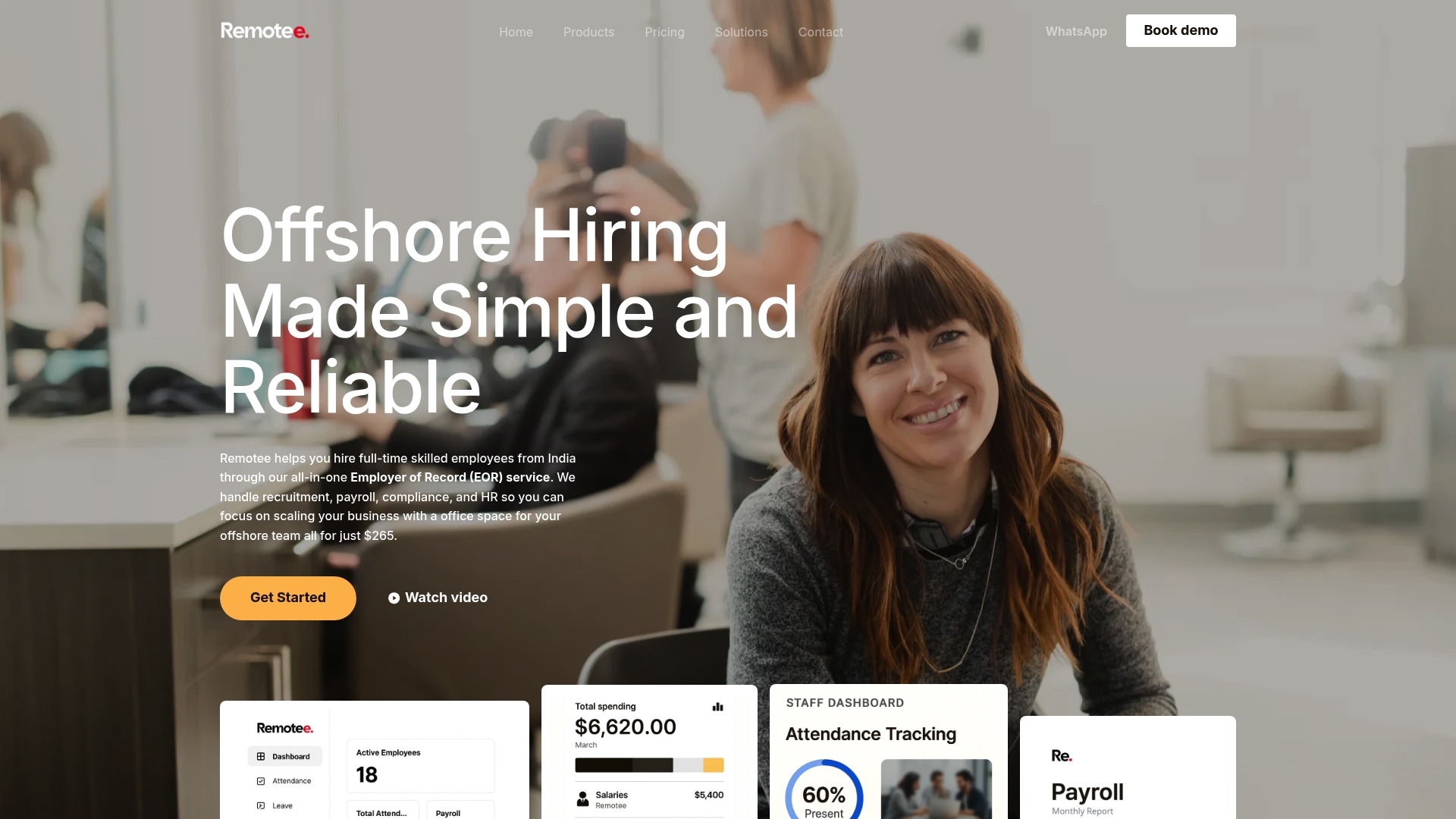
Remotee’s Employer of Record service in India handles every layer of that complexity. Remotee manages local payroll, statutory compliance, HR administration, and candidate vetting, so you get a fully integrated team member without building a legal entity in India. Clients report up to 32% savings on hiring costs. Remotee presents only pre-screened candidates, which means your team spends time on final selection rather than sorting through unqualified applications. For business owners and HR professionals ready to move from exploring offshore staffing solutions to actually building a global team, Remotee is a direct path to doing it correctly.
FAQ
What is the offshore employment definition in simple terms?
A full-time offshore employee is a worker hired by your company to work exclusively from another country, fully integrated into your team and legally employed through a local entity or EOR.
How does an EOR help with offshore hiring?
An Employer of Record acts as the legal employer in the destination country, managing payroll, taxes, and labor law compliance while you retain full operational control of the employee.
What are the biggest advantages of offshore teams?
The primary advantages of offshore teams include 40–70% labor cost savings, access to specialized skills unavailable locally, faster hiring timelines, and follow-the-sun operational coverage.
How do you avoid misclassifying offshore employees as contractors?
If an offshore worker reports directly to your managers, works fixed hours, and performs indefinite core work, they likely qualify as an employee under local law. Use an EOR to formalize the relationship correctly from the start.
How long does it take to hire a full-time offshore employee?
Using an EOR, the process typically takes weeks from role definition to onboarding, compared to the 90-plus day average for a standard local hiring cycle.