How Offshore Payroll Works for Global Teams in 2026
TL;DR:
- Offshore payroll involves managing employee compensation, taxes, and compliance across multiple countries using specialized providers with local expertise. It combines automated software with local legal support to ensure accurate salary calculations, tax filings, and statutory benefits, minimizing legal and operational risks. The choice between EOR and payroll outsourcing depends on whether businesses want a full legal employment solution or just pay processing support, with strategic payroll management being critical for successful offshore expansion.
Offshore payroll is the process of managing employee compensation, tax filings, and statutory compliance across multiple countries by using specialized providers that combine payroll software with local regulatory expertise. For business owners and HR professionals expanding into markets like India, the Philippines, or Eastern Europe, understanding how offshore payroll works is the difference between a compliant, scalable operation and a costly legal exposure. The offshore payroll process covers everything from gross-to-net salary calculations and currency settlements to multi-jurisdiction tax remittances and benefits administration, all without requiring you to set up a legal entity in every country where you hire.

How does the offshore payroll process work step-by-step?
The offshore payroll process follows a structured, sequenced workflow that runs across multiple time zones and regulatory environments simultaneously. Each stage must be completed in the correct order, or the entire cycle breaks down.
-
Employee data intake. Your payroll provider collects hours worked, salary changes, bonuses, new hires, and terminations from your HR systems or a shared portal. Accuracy at this stage determines everything downstream.
-
Gross-to-net calculation. The provider applies country-specific tax rates, social security contributions, pension deductions, and statutory benefits to compute each employee’s net pay. A developer in Bangalore and a contractor in Warsaw face entirely different deduction structures, and the system must handle both correctly.
-
Payroll funding and FX settlement. This is where most companies get surprised. Multi-country payroll cycles require gross payroll funding in local currency to clear before the pay date, often 10 or more days early due to FX and banking processing timelines. A UK pay date of the 28th means your provider needs a funding decision by the 18th to account for FX conversion and settlement lag.
-
Statutory filing and tax remittance. The provider submits payroll tax filings, social contribution reports, and statutory declarations to the relevant government bodies in each jurisdiction, on each country’s specific schedule.
-
Employee payment. Net salaries are disbursed directly to employee bank accounts in local currency. US ACH settles next-day, while SWIFT transfers to Mexico take one to three days with additional fees, so payment timing varies by country.
-
Reconciliation and reporting. Payroll data flows into your accounting system, general ledger, and HR platform. The provider produces payroll registers, cost reports, and audit trails for your finance team.
Pro Tip: Build a payroll calendar that maps every country’s funding deadline, not just the pay date. Missing a funding cut-off by one day can push salaries into the next banking cycle and trigger employee complaints and potential labor violations.
What compliance and tax challenges does offshore payroll address?
Compliance is the core reason companies outsource offshore payroll rather than managing it internally. The regulatory surface area across even three or four countries is enormous.
- Tax withholding variability. Each country sets its own income tax brackets, withholding schedules, and filing frequencies. India uses a TDS (Tax Deducted at Source) system with quarterly filings. Germany requires monthly Lohnsteuer remittances. Handling both manually without local expertise is a recipe for errors.
- Statutory benefits and contributions. Employers in most countries must contribute to government-mandated programs such as provident funds, health insurance, or unemployment insurance. These rates change regularly, and payroll compliance requires tracking every update in real time.
- Labor law adherence. Termination rules, notice periods, severance calculations, and leave entitlements differ sharply by jurisdiction. A payroll error tied to an incorrect severance calculation can trigger a labor tribunal claim.
- Data privacy and security. Payroll data is highly sensitive and subject to data sovereignty laws. Reputable providers implement role-based access controls, encryption, and compliance with GDPR, SOC 2, and ISO 27001 standards.
- Misclassification risk. Treating an employee as a contractor to avoid payroll obligations is one of the most common and expensive mistakes in offshore expansion. Providers with local legal expertise flag these risks before they become audits.
“Payroll errors in offshore teams lead to legal liability, audit risk, reputational damage, and employee attrition, making payroll the most risk-dense layer of global expansion.”
Offshore payroll compliance includes multifaceted management of statutory deductions, labor law adherence, tax remittances, benefit administration, and employment recordkeeping. Providers track regulatory changes and update their systems automatically, so you are not relying on a spreadsheet maintained by someone who last checked the local tax code six months ago.
How do offshore payroll providers integrate technology and human expertise?
The most effective offshore payroll services operate on a dual-layer model: automated payroll software handles calculations, data consolidation, and reporting, while local compliance specialists validate filings, interpret regulation changes, and manage jurisdiction-specific edge cases.
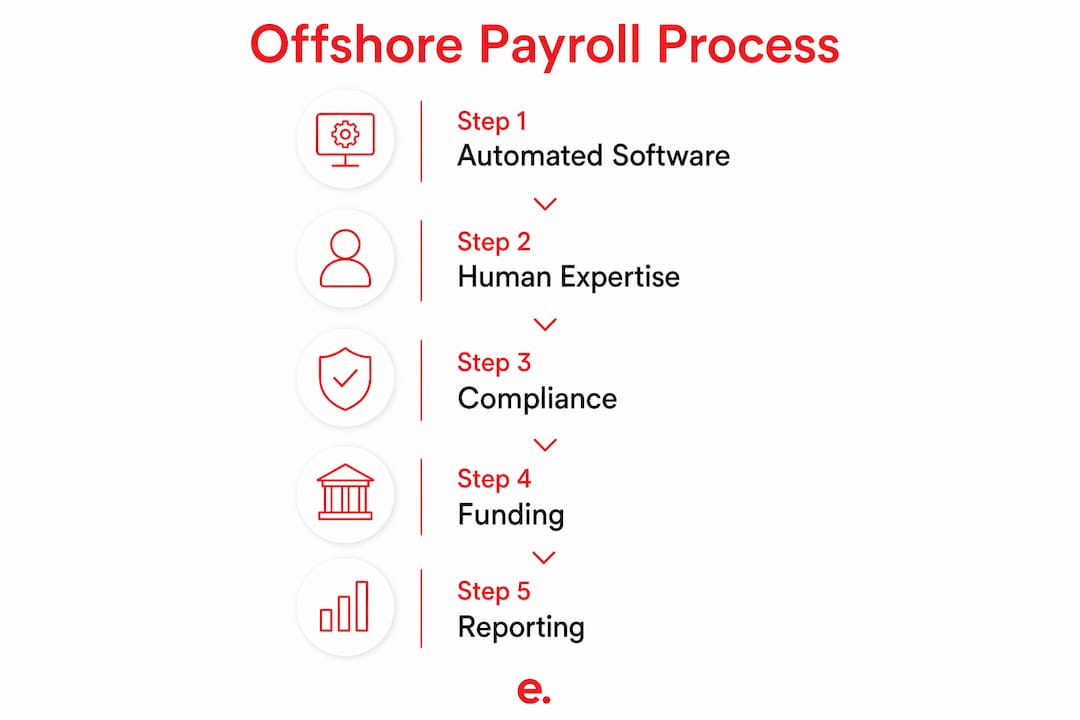
Relying on software alone creates a dangerous blind spot. Automated payroll systems risk non-compliance when dynamic regional labor laws and tax rates change faster than software update cycles. A local expert in India, for example, will catch a mid-year provident fund rate adjustment that a global platform might not incorporate until the next quarterly release.
| Layer | Function | Risk without it |
|---|---|---|
| Automated payroll software | Gross-to-net calculations, consolidated reporting, system integrations | Manual errors, slow processing, poor audit trails |
| Local compliance specialists | Jurisdiction-specific filings, regulation monitoring, edge-case resolution | Missed filings, incorrect deductions, legal penalties |
| FX and funding management | Currency conversion, settlement timing, banking fee optimization | Late payments, budget overruns, employee dissatisfaction |
Cloud-based payroll platforms like Workday, SAP SuccessFactors, and dedicated global payroll tools provide consolidated dashboards where HR teams can view payroll status across every country in one place. These platforms integrate with HRIS systems, accounting software like Xero or QuickBooks, and expense management tools to reduce manual data entry.
Pro Tip: When evaluating offshore payroll providers, ask specifically about their local partner network. A provider with in-country legal and accounting partners in your target markets will outperform a purely software-driven solution every time.
Cross-border payroll funding also introduces FX volatility as a budget risk. If your functional currency is USD and you are paying employees in Indian Rupees or Polish Zloty, a 3% currency move in the wrong direction can meaningfully inflate your monthly payroll cost. Experienced providers help you hedge or time funding decisions to minimize this exposure.
What are the differences between EOR and offshore payroll services?
This distinction matters more than most business owners realize, and confusing the two leads to compliance gaps.
Offshore payroll outsourcing means you hand off the mechanics of pay processing to a third party. You remain the legal employer in each country, which means you still carry the compliance obligations, the employment contracts, and the liability for labor law violations.
Employer of Record (EOR) is a fundamentally different model. An EOR serves as the legal employer, handling contracts, payroll, tax withholding, benefits, and compliance under local labor laws. You direct the work, but the EOR carries the legal employment relationship. This means you can hire in a new country without setting up a local entity, which typically takes three to six months and significant legal fees.
| Factor | EOR | Offshore payroll outsourcing |
|---|---|---|
| Legal employer | EOR provider | Your company |
| Entity setup required | No | Yes, in most cases |
| Compliance responsibility | EOR provider | Your company |
| Speed to hire | Days to weeks | Months |
| Best for | Market entry, lean teams | Established entities with existing local presence |
The role of payroll in offshore agency staff arrangements is also worth clarifying. Staffing agencies provide recruitment support and physical infrastructure such as office space and equipment. They do not carry legal employment obligations. EOR providers do. If you are using an offshore staffing agency, you still need a payroll and compliance solution layered on top.
For companies hiring in India specifically, the EOR model is particularly effective. India’s labor laws, including the Employees’ Provident Fund Act, the Payment of Gratuity Act, and state-specific professional tax rules, create a compliance matrix that is difficult to manage without local legal expertise. An EOR absorbs that complexity entirely.
Outsourcing payroll to a back-office partner converts variable payroll administration costs into fixed, predictable costs and frees your HR team to focus on recruitment and business growth rather than filing schedules and tax tables.
Key takeaways
Offshore payroll works by combining automated payroll software with local compliance expertise to manage multi-country salary calculations, tax filings, currency settlements, and statutory benefits, with EOR solutions offering the most complete compliance coverage for companies without local entities.
| Point | Details |
|---|---|
| Fund payroll early | Multi-country pay cycles require funding decisions 10 or more days before pay date due to FX and banking timelines. |
| Use the dual-layer model | Automated software plus local compliance specialists is the only reliable approach to multi-jurisdiction payroll. |
| EOR vs. payroll outsourcing | EOR carries legal employment and full compliance; payroll outsourcing handles pay mechanics only, leaving liability with you. |
| Compliance is a risk layer | Payroll errors in offshore teams trigger audits, penalties, and employee attrition, not just administrative inconvenience. |
| Data security is non-negotiable | Offshore payroll providers must meet GDPR, SOC 2, or ISO 27001 standards to protect sensitive employee data. |
Why I treat offshore payroll as a strategic function, not a back-office task
Most business owners I speak with treat payroll as the last thing they think about when expanding offshore. They focus on finding talent, setting up communication tools, and onboarding workflows. Payroll gets delegated to whoever handled it domestically, with the assumption that the process is basically the same across borders.
That assumption is wrong, and it is expensive when it fails.
I have seen companies get hit with backdated tax liabilities in India because their payroll provider missed a TDS filing deadline. I have seen offshore teams lose trust in their employer because salaries arrived three days late due to a missed FX funding cut-off. These are not edge cases. They are predictable failures that happen when payroll is treated as administrative rather than strategic.
The offshore payroll for remote teams that works best is the one where someone senior owns the payroll calendar, understands the funding timelines, and has a direct line to local compliance specialists. Not a ticket queue. A direct line.
My recommendation for any business owner considering offshore expansion: decide upfront whether you want to be the legal employer or not. If you do not have a local entity and do not want the compliance burden, use an EOR. If you already have an entity and just need pay processing support, offshore payroll outsourcing is sufficient. But do not confuse the two, and do not underestimate the complexity of either. The offshore staffing risk mitigation checklist is a good starting point for mapping your exposure before you commit to a model.
Payroll is where your offshore expansion either builds trust with your team or destroys it. Get it right from day one.
— Rajkumar
How Remotee simplifies offshore payroll and compliance for India hiring
If you are expanding your team into India and want to skip the entity setup, the compliance research, and the payroll complexity, Remotee’s Employer of Record service handles all of it. Remotee acts as the legal employer for your India-based staff, managing payroll, statutory contributions, tax filings, and HR administration under Indian labor law.

Clients working with Remotee report up to 32% savings on hiring costs compared to traditional recruitment and entity-based models. You get access to top-tier talent in India without the overhead of local legal infrastructure. Remotee’s payroll and compliance services cover everything from TDS filings and provident fund contributions to gratuity calculations and professional tax, so your HR team can focus on growth rather than regulatory paperwork.
FAQ
What is offshore payroll?
Offshore payroll is the outsourcing of employee compensation, tax filings, and statutory compliance management to specialized providers operating across multiple countries. It combines payroll software with local regulatory expertise to handle gross-to-net calculations, currency settlements, and government remittances.
How does offshore payroll handle taxes in different countries?
Offshore payroll providers apply country-specific tax rates, withholding schedules, and filing frequencies for each jurisdiction. Local compliance specialists monitor regulatory changes and submit statutory filings on the correct schedule to avoid penalties.
What is the difference between EOR and offshore payroll outsourcing?
An EOR is the legal employer of record and carries full compliance responsibility, while offshore payroll outsourcing handles pay processing only and leaves legal employment obligations with your company. EOR is the better choice when you lack a local entity in the target country.
How far in advance does offshore payroll need to be funded?
Multi-country payroll cycles typically require funding decisions 10 or more days before the pay date to account for FX conversion and cross-border banking settlement timelines. Missing this window can delay employee salaries and trigger labor compliance issues.
Is offshore payroll data secure?
Reputable offshore payroll providers protect employee data through role-based access controls, encryption, and compliance with international standards including GDPR, SOC 2, and ISO 27001. Data sovereignty laws in each country also govern how payroll information is stored and processed.