How Offshore Staffing Differs from Outsourcing in 2026
TL;DR:
- Offshore staffing involves directly managing dedicated remote employees working exclusively for your company, unlike outsourcing where a vendor controls the team and process. It provides greater flexibility, transparency, and knowledge retention but requires strong internal management capabilities. The decision depends on project scope stability, management capacity, and long-term organizational goals.
Offshore staffing is defined as hiring dedicated remote employees who work exclusively for your business, integrate into your team, and report directly to your managers. This is fundamentally different from outsourcing, where you hand a project or business function to an external vendor who controls the team, the process, and the output. Understanding how offshore staffing differs from outsourcing is not a semantic exercise. It determines who owns your intellectual property, how fast you can pivot, and whether your institutional knowledge stays inside your company or walks out the door when a contract ends. Both models have real advantages and real costs. The right choice depends on your project scope, internal management capacity, and long-term growth goals.
How offshore staffing differs from outsourcing in management and control
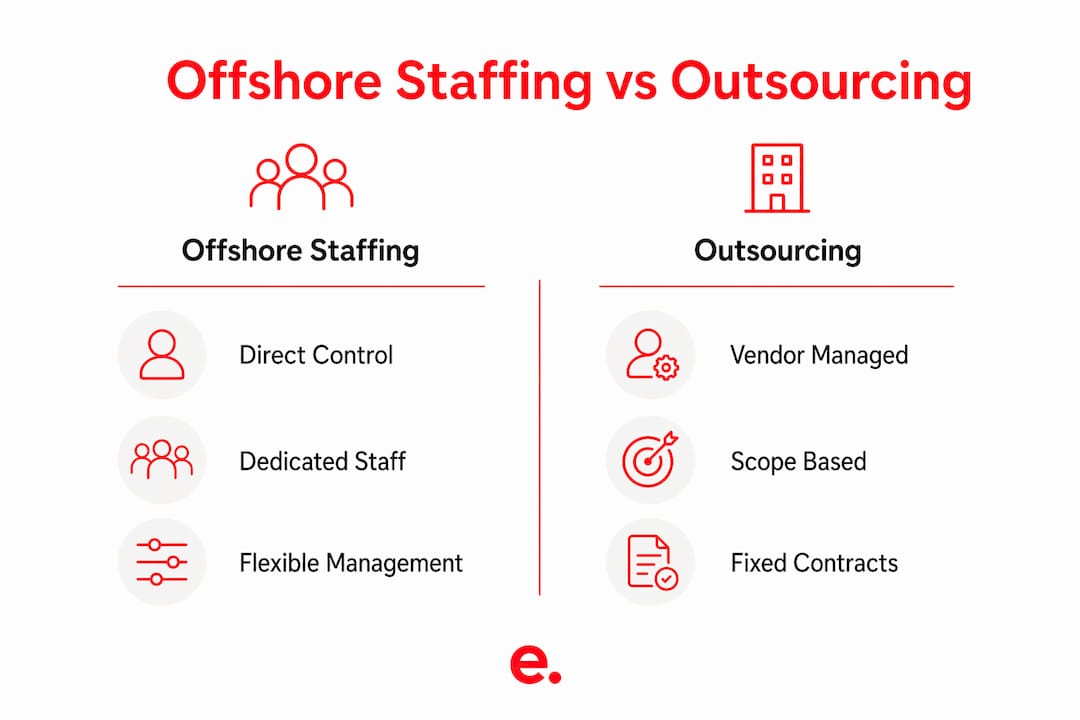
The single sharpest difference between offshore staffing and outsourcing is who manages the people doing the work. Staff augmentation places contributors under your managers, using your tools, your processes, and your communication channels. Your offshore staff member joins your Slack workspace, attends your sprint planning calls, and reports to your team lead. That is the offshore staffing model.

Outsourcing works in reverse. You hand a scope of work to a vendor, and their project managers control how the team executes it. You receive deliverables and status updates, but you have limited visibility into daily decisions, team composition, or how problems get solved. This is not a flaw in outsourcing. It is the design. The vendor absorbs execution risk in exchange for control.
The practical implications are significant. Offshore staffing gives you the flexibility to reprioritize work mid-sprint, redirect effort, and hold individuals accountable. Outsourcing gives you a fixed output with less management burden on your side. The tradeoff is responsiveness versus simplicity.
| Factor | Offshore staffing | Outsourcing |
|---|---|---|
| Who manages daily work | Your internal managers | Vendor’s project managers |
| Reporting structure | Direct to your team | To vendor, then to you |
| Tool and process ownership | Client’s tools and workflows | Vendor’s tools and workflows |
| Flexibility to reprioritize | High | Low to moderate |
| Client visibility into execution | Full | Limited |
Pro Tip: If your product roadmap changes frequently, offshore staffing is the better fit. Outsourcing contracts are built around fixed scopes, and changing direction mid-project almost always triggers change orders.
What are the cost structures of offshore staffing vs outsourcing?
The differences between staffing and outsourcing become most visible when you examine how money actually flows. Offshore staffing typically bills at a monthly or hourly rate per dedicated employee, with the cost broken into salary and a service or management fee. Outsourcing charges bundled fees with less transparency, making it harder to understand what you are paying for labor versus overhead versus vendor margin.
This distinction matters for budgeting. With offshore staffing, you can see exactly what each team member costs and scale up or down by adding or removing headcount. With outsourcing, you often pay a fixed project price or milestone-based fee, which sounds predictable until scope changes enter the picture.
Hidden costs exist in both models, but they appear in different places:
- Offshore staffing: Internal management overhead, onboarding time, and the cost of integrating remote employees into your workflows before they reach full productivity.
- Outsourcing: Discovery fees charged before work begins, scope creep that can add 20 to 40% to the original statement of work cost, and exit costs when the contract ends and institutional knowledge leaves with the vendor’s team.
- Both models: Communication overhead, time zone coordination, and the cost of misaligned expectations if the engagement is not set up correctly.
Remotee clients report up to 32% savings on hiring costs compared to equivalent onshore hires, which reflects the salary arbitrage available through offshore staffing in India. That figure is achievable because the cost structure is transparent. You pay for the employee and the service layer, not a bundled vendor margin.
Pro Tip: When comparing bids from outsourcing vendors, always ask for a breakdown of labor costs versus management fees. If a vendor refuses to separate those figures, that opacity will follow you throughout the engagement.
How do integration and team culture affect productivity?
Offshore staffing and outsourcing produce very different team dynamics, and those dynamics compound over time. Staff augmentation staff integrate culturally and operationally with your team, which improves knowledge retention and long-term productivity. An offshore developer who has worked inside your codebase for 18 months understands your architecture decisions, your technical debt, and your product priorities. That knowledge is yours.
Outsourcing teams operate under vendor culture with limited integration, and they hand off knowledge at contract end, increasing maintenance risks. When the contract closes, the vendor’s team moves to the next client. Your documentation may be thorough, but the tacit knowledge, the “why we built it this way” understanding, is gone.
The offshore staffing benefits for culture and knowledge retention are most visible in three areas:
- Code and IP ownership: Offshore staff produce work that belongs entirely to your company from day one, with no ambiguity about who owns what.
- Long-term maintenance: Employees who built a system are far better positioned to maintain and extend it than a new vendor team reading documentation.
- Team cohesion: Offshore staff who attend your team meetings, celebrate your product launches, and understand your company values behave like employees, not contractors.
Pro Tip: To accelerate cultural integration, assign each offshore staff member a dedicated internal buddy for the first 90 days. This single practice reduces ramp time and dramatically improves retention.
Which scenarios are best suited for offshore staffing vs outsourcing?
The most useful framework for choosing between these models is scope stability. Staff augmentation suits evolving, long-term work where the client retains knowledge. Outsourcing fits bounded, non-core projects where delivery risk can be transferred to a vendor.
Use this checklist to guide your decision:
- Is the project scope well-defined and unlikely to change? If yes, outsourcing is viable. If no, offshore staffing gives you the control to adapt.
- Do you have internal managers who can direct and evaluate remote workers? Strong internal management capability is a prerequisite for successful staff augmentation. If that capacity does not exist, outsourcing may be the safer starting point.
- Is this work core to your product or business? Core functions, such as product development, customer data management, or proprietary processes, belong under your direct control. Non-core functions, such as one-time data migration or a fixed marketing campaign, are reasonable outsourcing candidates.
- Do you need the team to scale up or down over time? Offshore staffing scales by headcount. Outsourcing scales by contract renegotiation, which is slower and more expensive.
- How important is knowledge retention? If the work will need ongoing support, updates, or iteration, offshore staffing protects that knowledge inside your organization.
Offshore staffing is also faster to activate than most businesses expect. Staff augmentation ramps talent in 1 to 2 weeks, while outsourcing typically requires 2 to 6 weeks of discovery before any output is produced. For businesses with urgent hiring timelines, understanding offshore hiring timelines is a practical advantage that outsourcing simply cannot match.
What are the key risks and how can you mitigate them?
Both models carry risks, but the failure modes are different. Knowing where each model breaks down is as important as knowing where it performs well.
Offshore staffing risks and mitigations:
- Management overhead: Offshore staff require active direction. Without a capable internal manager, productivity suffers. Assign clear ownership before the first hire.
- Onboarding time: Full productivity takes weeks, not days. Build this into your project timeline and budget for it explicitly.
- Communication gaps: Time zone differences and cultural nuances can slow decisions. Establish overlapping working hours and clear escalation paths from day one.
Outsourcing risks and mitigations:
- Vendor lock-in: When a vendor controls your codebase, your data, or your processes, switching costs are high. Negotiate source code ownership and data portability into every contract before signing.
- Scope creep: Outsourcing’s failure mode often involves expensive change orders and loss of institutional knowledge. Define acceptance criteria in writing before work begins, and require sign-off on any scope changes before they are executed.
- Knowledge loss at contract end: Require comprehensive documentation as a contract deliverable, not an afterthought. Build in a knowledge transfer period of at least two weeks before the engagement closes.
A practical risk mitigation checklist for offshore staffing covers contractual protections, IP clauses, and onboarding protocols that apply regardless of which model you choose. Reviewing common vendor mistakes to avoid before signing any agreement saves significant cost and friction downstream.
Key takeaways
Offshore staffing gives you direct control over dedicated remote employees, while outsourcing transfers execution ownership to a vendor. The right model depends on scope stability, internal management capacity, and whether the work is core to your business.
| Point | Details |
|---|---|
| Control defines the difference | Offshore staff report to you; outsourced teams report to the vendor’s project managers. |
| Cost transparency favors staffing | Offshore staffing separates salary and service fees; outsourcing bundles costs with less visibility. |
| Scope stability drives the choice | Use offshore staffing for evolving, long-term work; use outsourcing for fixed, non-core projects. |
| Knowledge retention is at stake | Offshore staff keep institutional knowledge inside your company; outsourcing teams take it when they leave. |
| Management capacity is a prerequisite | Successful offshore staffing requires internal managers who can direct and evaluate remote workers. |
Why the control question matters more than the cost question
I have spoken with dozens of business owners who chose outsourcing because the upfront price looked lower. Almost all of them eventually regretted it, not because the vendor did poor work, but because they underestimated how much they needed to stay close to the work.
The uncomfortable truth about outsourcing is that you are not buying a cheaper version of employment. You are buying a fundamentally different relationship with the work itself. When a product evolves, when priorities shift, when a customer complaint reveals a deeper architectural problem, you need people who are inside your organization and accountable to you. A vendor’s project manager has different incentives. Their job is to deliver the contracted scope, not to care about your product the way your team does.
Offshore staffing is not the right answer for every situation. If you genuinely have a bounded, well-specified project and no internal capacity to manage remote workers, outsourcing is the rational choice. But I have seen too many companies treat outsourcing as a shortcut around building real management capability. That shortcut is expensive. The 20 to 40% scope creep cost that appears in fixed-bid contracts is not bad luck. It is the predictable result of trying to specify complex, evolving work in advance.
The hybrid model, where you outsource a defined initial build and then transition to offshore staffing for ongoing development, is underused and worth considering. It lets you move fast at the start without sacrificing long-term control. The key is writing the transition plan into the original outsourcing contract, including source code handover, documentation standards, and a knowledge transfer timeline.
— Rajkumar
Build your dedicated offshore team with Remotee
Remotee’s Employer of Record service in India gives you the direct control of offshore staffing without the compliance complexity of hiring abroad independently. Remotee manages payroll, HR, and local labor law compliance, so your team can focus on managing the work, not the paperwork. Clients report up to 32% savings on hiring costs compared to equivalent onshore hires. Remotee presents only top-tier candidates, and the entire engagement is structured so your offshore staff integrate directly into your team from day one. If you are ready to explore offshore hiring with full transparency and control, Remotee is built for exactly that.
FAQ
What is the main difference between offshore staffing and outsourcing?
Offshore staffing means hiring dedicated remote employees who work exclusively for your business under your direct management. Outsourcing means delegating a project or function to an external vendor who controls the team and delivers the output.
Which model is better for long-term product development?
Offshore staffing is better for long-term, evolving product work because your team retains institutional knowledge and you maintain direct control over priorities and execution.
Does outsourcing cost less than offshore staffing?
Not necessarily. Outsourcing often appears cheaper upfront but can add 20 to 40% to original costs through scope creep and change orders. Offshore staffing has more transparent, predictable cost structures.
Can a business use both offshore staffing and outsourcing?
Yes. A hybrid approach, where you outsource a fixed initial build and then transition to offshore staffing for ongoing work, is a practical strategy that balances speed with long-term control.
How quickly can offshore staff be onboarded compared to outsourcing?
Offshore staffing typically ramps new talent in 1 to 2 weeks. Outsourcing engagements usually require 2 to 6 weeks of discovery before productive output begins.