7 Signs Your Startup Needs Offshore Talent in 2026

TL;DR:
- Offshore talent can lower costs and fill skill gaps that delay product launches for startups. Proper planning, clear task definitions, and compliance management are crucial to success. Investors view lean offshore teams with local leadership as a smart resource for early-stage growth.
Offshore talent is defined as full-time or contract workers hired outside your home country to fill roles your local market cannot staff affordably or quickly enough. The signs a startup needs offshore talent are specific and measurable: a local hiring burn rate that threatens your runway, skill gaps that delay product launches, and repetitive operational tasks that consume senior team capacity. Cost savings of 40%–70% versus US hires make offshore staffing one of the most direct levers a founder can pull. Recognizing these signals early is the difference between extending your runway and running out of it.
1. What are the top signs your startup needs offshore talent?
Your local hiring costs are eating your runway. When a single mid-level US engineer costs $120,000–$180,000 annually and a comparable offshore developer costs $30,000–$55,000, the math forces a decision. That gap is not a discount. It is the difference between hiring one person locally and hiring three offshore.

Pro Tip: Track your monthly burn attributed to salaries separately from infrastructure costs. If salaries exceed 60% of burn, offshore staffing is worth modeling immediately.
You are turning down work or delaying launches. A product roadmap that slips by weeks because you cannot staff a sprint is a direct revenue signal. Offshore teams can be deployed in days to weeks, not months, which closes that gap faster than any local recruiting cycle.
Your administrative and operational tasks are consuming senior talent. When your CTO is reviewing invoices or your lead engineer is handling customer support tickets, you have a staffing misalignment. Roles like bookkeeping, customer experience, and sales development are well-suited for offshore execution and do not require local presence.
You need coverage across time zones. A startup serving customers in multiple regions needs support that does not stop at 5 PM Eastern. Offshore teams in India or Latin America provide natural time zone coverage without paying overtime or shift premiums.
Your tasks are well-defined and repeatable. Offshore teams perform best on discrete, clearly scoped work: MVPs, integrations, data processing, and scripted sales outreach. If you can write a clear spec, you can offshore it.
2. Which roles are best suited for offshore staffing?
Not every role belongs offshore, and the distinction matters to your investors as much as your operations. Investors expect founding engineers, the CTO, and closing-tier sales to remain local. Those roles carry architectural credibility and direct investor trust. Moving them offshore sends a negative signal at any funding stage.
The roles that work well offshore fall into a clear pattern: they are scriptable, process-driven, or technically defined.
Offshore-friendly roles:
- Sales Development Representatives (SDRs) running outbound sequences
- Bookkeeping and accounts payable
- Customer experience and tier-1 support
- Mid-level software engineers on defined feature work
- QA engineers and test automation
- Data entry and operations coordinators
- Content production and basic design work
Keep these roles local:
- Founders and co-founders
- CTO and VP Engineering
- Senior engineers making architectural decisions
- Account executives handling enterprise closes
- Investor relations and board-facing roles
| Role type | Offshore | Local |
|---|---|---|
| SDR / outbound sales | Yes | No |
| Bookkeeping | Yes | No |
| Mid-level engineering | Yes | No |
| CTO / VP Engineering | No | Yes |
| Closing-tier sales | No | Yes |
| Customer experience | Yes | No |
Top-tier investors now view lean, offshore-heavy teams as smart capital allocation when leadership stays local. Negative signals appear only at Series B and beyond, when internal infrastructure is expected to be more mature. At seed and pre-seed, a hybrid model is not just acceptable. It is often the recommended approach.
3. How to successfully integrate offshore talent into your startup team
The onboarding gap is the single highest-leverage investment in offshore success. Most friction does not come from a lack of talent. It comes from founders who never adapted their internal processes for asynchronous collaboration. A developer in Bangalore cannot read your mind about code review standards if those standards live only in your head.
Start with documentation. Every repeatable process needs a written spec before you hand it to an offshore team member. This includes code review checklists, communication cadence expectations, and escalation paths.
Pro Tip: Run a one-week documentation sprint before your first offshore hire starts. Write down every process you currently explain verbally. That library becomes your onboarding foundation.
Adapt your workflows for async-first collaboration. Daily standups work across time zones if you record them and post summaries in Slack or Notion. Tools like Loom, Linear, and Confluence reduce the need for real-time alignment without sacrificing visibility.
Treat your offshore partner as an extension of your HR and legal framework. Successful startups handle compliance by routing offshore hires through an Employer of Record, which eliminates permanent establishment risk and keeps payroll clean. Trying to manage foreign employment law directly is a common and expensive mistake.
You can read more about managing HR for offshore teams to understand what compliance actually requires at each stage of growth.
4. What are the risks of offshore staffing, and how do you mitigate them?
Offshore staffing carries real risks, and the founders who fail with it almost always made the same mistakes: they hired without vetting, defined tasks poorly, and ignored legal exposure. Poorly managed offshore teams fail because of unclear communication and task definitions, not because of a talent shortage.
The most common risks and their direct fixes:
- Communication barriers. Fix this with async-first documentation and weekly video syncs. Never rely on chat alone for complex tasks.
- Quality control gaps. Fix this with test-driven development standards, defined acceptance criteria, and regular code or output reviews.
- IP security exposure. Fix this with signed NDAs, clear IP assignment clauses in contracts, and restricted access to production systems.
- Time zone friction. Fix this by choosing offshore locations with partial overlap to your working hours, or by setting a defined async handoff window.
- Legal and compliance risk. Fix this by routing hires through a vetted Employer of Record rather than direct contracting. Offshore partners handling compliance reduce permanent establishment risk significantly.
| Risk | Mitigation |
|---|---|
| Communication breakdown | Async documentation, weekly syncs |
| IP theft | NDAs, IP assignment clauses |
| Quality issues | Defined specs, test-driven processes |
| Legal exposure | Employer of Record for compliance |
| Time zone friction | Partial overlap or async handoff windows |
Founders also underestimate the cost of unwinding a bad in-house hire versus ending an offshore contract. Offshore contracts are structurally easier to exit, which makes them lower-risk for early-stage startups testing new functions. Avoiding common vendor mistakes from the start saves both money and time.
Key takeaways
Startups that recognize the right signals early and act on them with a clear offshore hiring strategy consistently extend their runway and ship faster than those that wait.
| Point | Details |
|---|---|
| Cost gap is decisive | Offshore engineers cost $30,000–$55,000 annually versus $120,000–$180,000 locally. |
| Role selection matters | Keep founders, CTO, and closing sales local. Offshore SDRs, bookkeeping, and mid-level engineering. |
| Onboarding drives success | Adapting documentation and async workflows before day one determines offshore team performance. |
| Compliance needs structure | Route offshore hires through an Employer of Record to avoid permanent establishment risk. |
| Investors accept hybrid models | Lean offshore teams with local leadership are viewed as smart capital allocation at seed stage. |
What I have learned from watching startups get offshore hiring right and wrong
I have seen founders treat offshore hiring as a cost-cutting shortcut, and I have seen others treat it as a genuine growth strategy. The outcomes are completely different.
The founders who succeed do one thing the others skip: they define the work before they hire. They write the spec, document the process, and set the acceptance criteria. Then they hire. The founders who fail do it in reverse. They hire first, then scramble to explain what they actually need. That scramble is where offshore relationships break down.
The investor concern about offshore teams is real but often overstated. What investors actually care about is whether the people making architectural and strategic decisions are reachable, accountable, and credible. If your CTO is in San Francisco and your QA team is in Hyderabad, no serious investor at seed stage will penalize you for that. What they will penalize you for is a founding team that is invisible or a product that ships slowly because you refused to staff up.
The other thing I would push back on is the idea that offshore hiring is only for cost savings. The best use case I have seen is speed. A startup that can spin up a three-person engineering pod in two weeks instead of three months has a real competitive advantage. That speed compounds over time.
If you are evaluating offshore staffing cost and benefits, do not just model the salary delta. Model the time-to-hire, the ramp time, and the cost of the work that did not get done while you were recruiting locally.
— Rajkumar
How Remotee helps startups hire offshore talent fast
Remotee is built specifically for startups that need to hire offshore talent without getting buried in compliance, payroll, and HR administration.
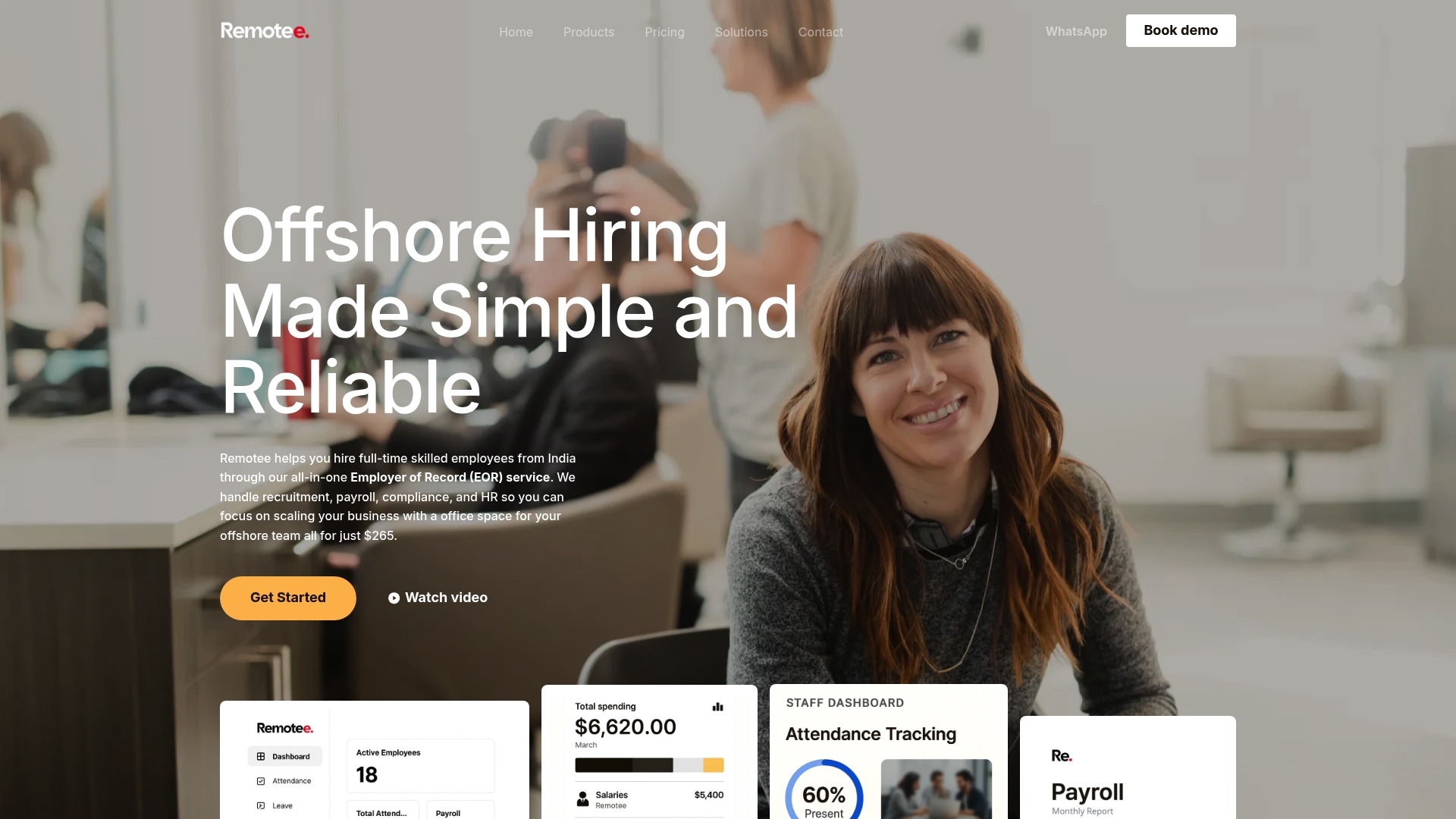
Remotee’s Employer of Record service in India handles every legal and operational detail of hiring full-time employees offshore. That includes payroll, local labor law compliance, and HR management. Clients report up to 32% savings on hiring costs. Remotee presents only vetted, top-tier candidates, so you are not sorting through unqualified applications. For startups that need to move fast and stay lean, Remotee removes the friction between deciding to hire offshore and actually doing it. Explore Remotee’s full offshore hiring solutions to see how quickly you can get your first hire in place.
FAQ
What are the clearest signs a startup needs offshore talent?
The clearest signs are a local hiring burn rate that threatens runway, product launches delayed by staffing gaps, and repetitive operational tasks consuming senior team capacity. If local salaries are pushing your monthly burn past sustainable levels, offshore staffing is the direct fix.
Which offshore roles give startups the best return?
SDRs, bookkeeping, customer experience, mid-level engineers, and QA roles deliver the strongest return because they are process-driven and well-defined. Offshore teams excel on discrete, scoped work rather than open-ended research or strategy.
Do investors penalize startups for using offshore teams?
No. Top-tier investors view lean, offshore-heavy teams as smart capital allocation when leadership and senior roles remain local. Concerns arise only at Series B and beyond if internal infrastructure has not matured.
How do you avoid the biggest offshore hiring mistakes?
Define every task clearly before hiring, route employees through an Employer of Record for compliance, and adapt your internal workflows for async collaboration. Friction in offshore teams almost always traces back to founders who did not adapt their processes, not to a lack of talent.
What is an Employer of Record, and why does it matter for offshore hiring?
An Employer of Record is a company that legally employs workers on your behalf in another country, handling payroll, taxes, and local labor law compliance. It eliminates the permanent establishment risk that comes with directly contracting foreign workers.