Why India Is the Top Offshore Staffing Destination

TL;DR:
- India is the top offshore staffing destination due to its vast STEM talent pool, cost savings of up to 60%, and a growing innovation ecosystem. Companies benefit from faster hiring, 24/7 workflow cycles, and strategic partnerships with Indian teams that lead to higher quality and lower attrition. Using an Employer of Record simplifies compliance and maximizes the long-term value of offshore teams in India.
India is the world’s leading offshore staffing destination because no other country combines a talent pool of millions of STEM graduates, labor cost savings of 40% to 60%, and a rapidly maturing innovation ecosystem under one roof. The term “offshore staffing” refers to hiring full-time or contract employees in another country to perform work for your organization. In India’s case, that definition has expanded well beyond back-office support. Today, India powers product development, AI research, and cybersecurity operations for Fortune 500 companies and fast-growing startups alike. Understanding why India is the top offshore staffing destination requires looking past the cost line and into the structural advantages that no competitor has yet replicated.
Why India is the top offshore staffing destination for skilled talent
India’s talent advantage is not accidental. The country produces millions of STEM graduates annually, with a growing concentration in specialized technical disciplines like artificial intelligence, machine learning, and digital engineering. That output creates a self-reinforcing cycle: more graduates attract more global investment, which funds better training programs, which produces even more capable professionals.

What makes this talent pool genuinely different from other offshore markets is the shift from generalist roles to deep domain expertise. Indian offshore teams no longer just execute tasks handed down from headquarters. They own product roadmaps, lead architecture decisions, and manage end-to-end technology platforms. This transition is visible in the numbers: over 1,800 Global Capability Centers now operate in India, employing more than 1.9 million professionals focused on innovation rather than maintenance.
The academic and industry ecosystem accelerates this further. Indian Institutes of Technology, the Indian Institutes of Management, and a dense network of engineering colleges feed talent directly into partnerships with companies like Google, Microsoft, and Infosys. Startups in Bengaluru, Hyderabad, and Pune compete for the same graduates, raising the bar on skills and compensation expectations simultaneously.
- AI and machine learning: India ranks among the top three countries globally for AI talent concentration, with major labs from Amazon, IBM, and SAP operating research centers in the country.
- Cybersecurity: Demand for Indian cybersecurity professionals has grown sharply, with firms like Wipro and HCL Technologies building dedicated security practices that serve global clients.
- Digital engineering: Full-stack development, cloud architecture, and DevOps expertise are now standard offerings from Indian offshore teams, not premium add-ons.
Pro Tip: When evaluating Indian offshore talent, ask candidates about their involvement in product ownership or architecture decisions, not just execution. Teams with that experience integrate faster and require less oversight from your side.
How India’s cost structure compares to other offshore regions
Cost is still the most cited reason companies explore offshore staffing, and India’s numbers hold up under scrutiny. The average salary for a software developer in India ranges from $25,000 to $35,000 annually. Eastern European developers typically earn between $35,000 and $60,000 for comparable roles. Latin American developers sit in a similar range to Eastern Europe, with proximity to US time zones as their primary differentiator.
The table below compares key offshore staffing regions across the factors that matter most to business leaders.
| Region | Avg. developer salary (USD/year) | English proficiency | Time zone overlap with US | Talent pool depth |
|---|---|---|---|---|
| India | $25,000–$35,000 | High | Partial (follow-the-sun) | Very large |
| Eastern Europe | $35,000–$60,000 | High | Moderate | Medium |
| Latin America | $35,000–$55,000 | Moderate | Strong | Medium |
| Southeast Asia | $20,000–$30,000 | Moderate | Partial | Growing |
India’s cost advantage is real, but the more important number is total cost of engagement. When you factor in compliance management, payroll processing, benefits administration, and recruitment overhead, the savings reach 40% to 60% compared to equivalent onshore hiring. Remotee clients specifically report up to 32% savings on hiring costs when using an Employer of Record model, which eliminates the need to establish a local legal entity.
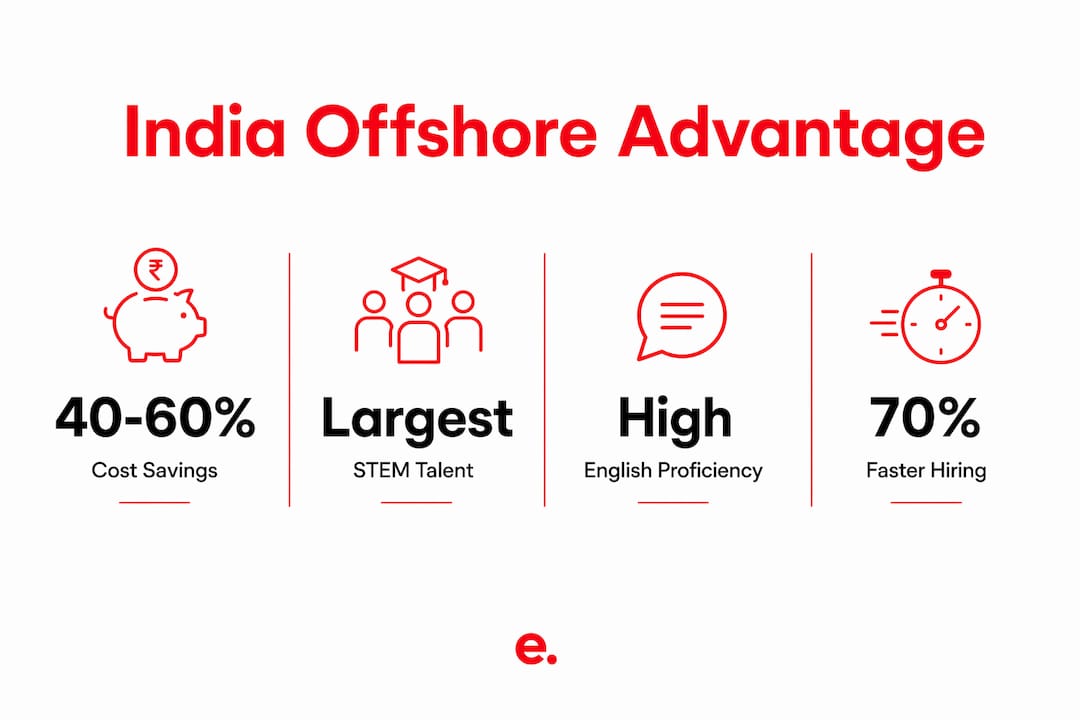
English proficiency is another structural advantage India holds over Southeast Asia and parts of Latin America. India ranks consistently high on global English proficiency indexes, which means communication friction in global teams is lower. For business leaders who have managed offshore teams in multiple regions, this difference shows up immediately in meeting quality, written documentation, and the speed of feedback loops.
Pro Tip: Run a cost-benefit analysis before committing to any offshore region. Include compliance costs, not just salaries. India’s regulatory environment, when managed through an EOR, often produces better total economics than regions with nominally similar labor costs.
What operational advantages make India a strategic offshore partner?
Cost savings get companies to the table. Operational advantages keep them there. India’s offshore staffing ecosystem delivers three capabilities that directly affect business performance: faster hiring, continuous workflows, and policy-backed infrastructure.
Offshore staffing agencies in India can reduce hiring cycles by up to 70%, compressing what typically takes one to three months onshore into days or weeks. That speed comes from pre-vetted talent pools, established recruitment pipelines, and a labor market large enough to produce multiple qualified candidates for almost any technical role. For companies scaling quickly or replacing critical talent, this is a material operational advantage.
The follow-the-sun model is a second structural benefit. Indian teams operating in IST (UTC+5:30) overlap with US morning hours and European afternoon hours, enabling 24/7 project development cycles that compress time-to-market. A product bug reported at 6 PM in New York can be diagnosed, fixed, and tested before the New York team arrives the next morning. That kind of workflow acceleration is not theoretical. It is standard practice for companies like Atlassian, Adobe, and Cisco that run significant engineering operations in India.
India’s policy environment reinforces these operational advantages. States like Karnataka, Telangana, Tamil Nadu, and Maharashtra have introduced dedicated GCC incentive policies covering tax benefits, land allocation, and skill-building programs. The national government’s Digital India initiative has expanded broadband infrastructure into tier-two cities like Coimbatore, Indore, and Nagpur, creating new talent markets beyond the traditional metros.
Here is a practical sequence for capturing these operational benefits:
- Define the role architecture first. Decide whether you need a dedicated team, a virtual captive center, or individual contributors before approaching any staffing partner. The model determines the cost structure and management overhead.
- Prioritize pre-vetted talent pools. Work with partners who maintain active pipelines rather than sourcing from scratch. This is where the 70% hiring cycle reduction actually materializes.
- Build overlap hours into the contract. Specify a minimum number of daily overlap hours with your home time zone. Four hours of overlap eliminates most async communication delays.
- Leverage tier-two city talent. Cities like Pune, Coimbatore, and Jaipur offer strong technical talent at 15% to 20% lower cost than Bengaluru or Mumbai, with lower attrition rates.
How business leaders can maximize value from Indian offshore teams
The companies that extract the most value from offshore hiring in India treat their Indian teams as strategic partners, not execution resources. That distinction changes everything from how you structure onboarding to how you measure performance.
Choosing the right staffing model is the first decision. A dedicated team model gives you a fixed group of professionals who work exclusively on your projects, building institutional knowledge over time. A virtual captive center goes further, giving you operational control and brand identity within India without the legal complexity of setting up a subsidiary. Both models outperform staff augmentation for long-term engagements where continuity matters.
Cultural and communication dynamics deserve deliberate attention. Indian professionals generally prefer structured feedback, clear role definitions, and visible career progression. Teams that receive regular performance reviews, defined promotion criteria, and opportunities to lead projects show significantly lower attrition than those managed purely on task delivery. This is not a cultural stereotype. It is a management practice that works across geographies but is particularly impactful in India’s competitive talent market.
- Build leadership pipelines early. Identify high-potential team members within the first six months and give them ownership of a module, a process, or a client relationship. Teams with internal leadership paths retain talent longer and require less management from the home office.
- Integrate Indian teams into product planning. Including offshore team leads in sprint planning, roadmap reviews, and architecture discussions produces better outcomes than handing down specifications. It also signals that the team’s judgment is valued.
- Address vendor selection rigorously. Not all offshore staffing providers in India operate at the same standard. Evaluate partners on their compliance track record, talent retention rates, and the depth of their pre-vetted candidate pools. A weak vendor relationship undermines every other advantage India offers.
- Use an Employer of Record for compliance. Navigating India’s labor laws, provident fund requirements, and tax regulations independently is complex. An EOR like Remotee handles these obligations, reducing legal risk and administrative burden while you focus on team performance.
The scalability benefits of Indian offshore teams are particularly relevant for growth-stage companies. You can add five engineers in three weeks or reduce a team by two without the severance complexity that applies in most Western markets. That flexibility is a genuine competitive advantage when product roadmaps shift quickly.
Key takeaways
India leads offshore staffing because it combines the world’s largest STEM talent pool with 40% to 60% cost savings and an innovation ecosystem that now rivals any global technology hub.
| Point | Details |
|---|---|
| Cost savings are quantifiable | Indian offshore staffing delivers 40%–60% labor cost savings versus equivalent onshore roles. |
| Talent depth is unmatched | Over 1,800 GCCs employ 1.9 million+ professionals in India, focused on innovation. |
| Hiring speed is a real advantage | Offshore agencies in India reduce hiring cycles by up to 70% versus onshore timelines. |
| Operational models compress timelines | Follow-the-sun workflows enable 24/7 development cycles that accelerate time-to-market. |
| Strategic partnership beats task delegation | Companies that integrate Indian teams into planning and leadership pipelines see lower attrition and higher output quality. |
India’s offshore evolution: what most leaders still underestimate
I have spent years watching companies approach India as a cost-cutting exercise and leave it as a capability-building one. The shift is real, and it is accelerating. What most business leaders still underestimate is how quickly India’s offshore staffing ecosystem has moved from headcount-led growth to capability-led value creation.
The companies winning with Indian offshore teams in 2026 are not the ones who negotiated the lowest hourly rate. They are the ones who gave their Indian teams genuine ownership, invested in skill deepening, and treated the relationship as a long-term strategic asset. I have seen a mid-sized SaaS company in Austin hand over its entire data engineering function to a Bengaluru team within 18 months, not because it was cheap, but because the team became genuinely better at it than anyone they could hire locally.
Tier-two cities are the next frontier that most leaders are ignoring. Indore, Coimbatore, and Nagpur are producing strong technical talent at lower cost and with meaningfully lower attrition than the major metros. The infrastructure is there. The talent is there. The companies that move into these markets now will have a staffing advantage that takes competitors years to replicate.
My honest advice: stop evaluating India purely on a cost-per-hour basis. Evaluate it on what your team in India can own, build, and lead. That is where the real return on offshore staffing lives.
— Rajkumar
How Remotee helps you hire in India without the complexity

Remotee’s Employer of Record service in India removes the legal, compliance, and payroll complexity that stops many companies from acting on India’s offshore advantages. You identify the talent. Remotee handles employment contracts, provident fund contributions, tax filings, and HR administration, so your team is legally employed and fully compliant from day one. Clients report up to 32% savings on hiring costs compared to traditional recruitment models. If you are ready to hire technology talent in India without setting up a local entity, Remotee gives you a direct path to India’s best professionals with none of the administrative overhead.
FAQ
Why is India the top offshore staffing destination?
India combines the world’s largest STEM talent pool, labor cost savings of 40% to 60%, high English proficiency, and a mature innovation ecosystem with over 1,800 Global Capability Centers. No other offshore region matches this combination of scale, skill depth, and cost efficiency.
How much can companies save with offshore staffing in India?
Companies typically save between 40% and 60% on labor costs by hiring in India versus equivalent onshore roles. Remotee clients using an Employer of Record model report up to 32% savings on total hiring costs, including compliance and HR administration.
What roles are best suited for Indian offshore teams?
Software development, AI and machine learning, cybersecurity, data engineering, and digital product management are the strongest categories. Indian offshore teams increasingly own product roadmaps and architecture decisions, not just execution tasks.
How fast can you hire offshore staff in India?
Offshore staffing agencies in India reduce hiring cycles by up to 70%, filling specialized technical roles in days or weeks rather than the one to three months typical of onshore hiring. Pre-vetted talent pools are the primary driver of this speed.
What is an Employer of Record and why does it matter for hiring in India?
An Employer of Record is a third-party organization that legally employs workers on your behalf, managing payroll, tax compliance, and HR obligations under local law. For companies hiring in India, an EOR eliminates the need to establish a local legal entity while keeping the team fully compliant with Indian labor regulations.