What Is a Managed Offshore Workforce? A 2026 Guide
TL;DR:
- A managed offshore workforce allows your business to control daily work while an EOR handles legal employment, payroll, and compliance nationally. This model provides fast, cost-effective access to global talent without establishing local entities, ensuring legal conformity and scalable growth. Effective governance, communication, and technology use are essential to maximize success with offshore teams.
A managed offshore workforce is a model where your business controls the day-to-day work of remote international employees while a third-party provider, typically an Employer of Record (EOR), handles all legal employment, payroll, taxation, and compliance in the worker’s home country. This structure gives you the talent access of global hiring without the legal complexity of setting up foreign entities. Providers like Remotee have made this model particularly accessible for companies targeting India’s deep talent pool, where clients report savings of up to 32% on hiring costs. Understanding how this model works is the first step toward building a global team that actually performs.
What is a managed offshore workforce and how does it work?
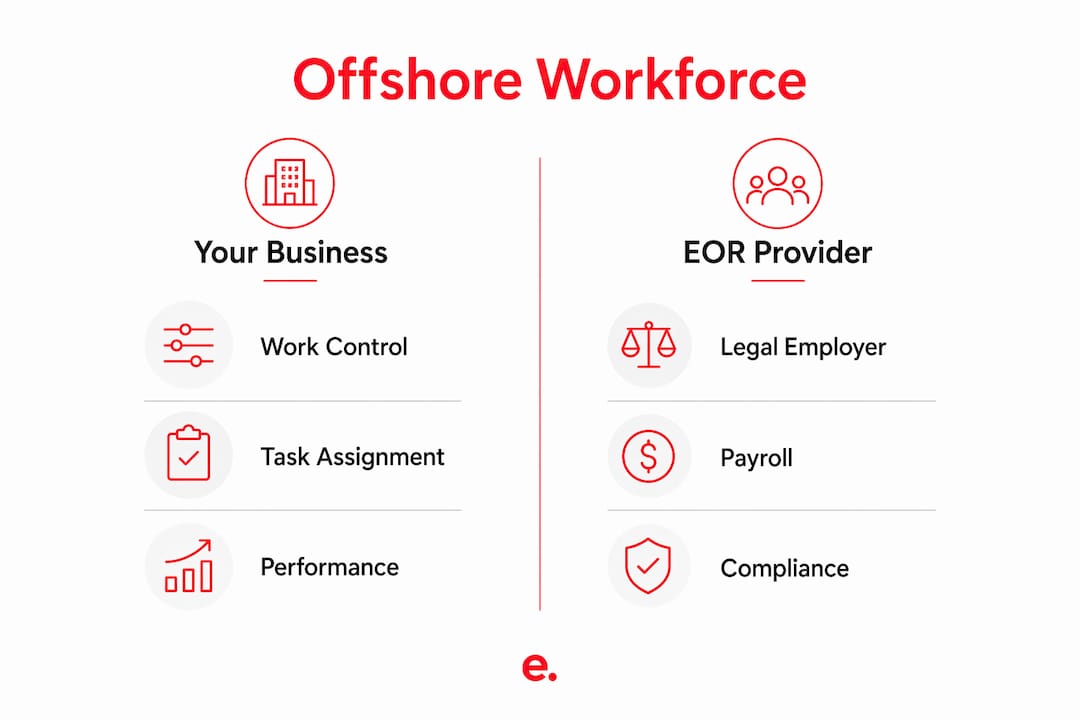
A managed offshore workforce means end-to-end management of employees overseas, covering hiring, payroll, compliance, and performance, while the client retains full control over work priorities and deliverables. The operational split is precise: you direct the work, and your EOR partner owns the legal employment relationship. This separation is what makes the model both practical and legally sound.

The EOR becomes the official employer on paper in the offshore location. It signs employment contracts, runs payroll, withholds taxes, administers statutory benefits, and keeps the business compliant with local labor law. You never need to register a legal entity in India, the Philippines, or wherever your team is based. The EOR handles legal employment while you manage the actual work output, meeting cadences, and performance standards.
Here is how the responsibilities divide in practice:
| Responsibility | Your business | EOR provider |
|---|---|---|
| Assigning tasks and deliverables | ✓ | |
| Performance reviews and feedback | ✓ | |
| Employment contracts and onboarding | ✓ | |
| Payroll processing and tax filing | ✓ | |
| Statutory benefits and local compliance | ✓ | |
| Termination procedures under local law | ✓ |
Technology sits at the center of this model. Workforce planning and governance tools cover HR, compliance reporting, and performance tracking at scale. Platforms like Slack, Jira, and Notion keep distributed teams aligned on deliverables, while the EOR’s HR systems handle the administrative back end invisibly.
Pro Tip: Set up a shared project management workspace from day one. When your offshore team uses the same tools as your local team, the geographic distance stops feeling like an operational gap.
What are the key benefits of offshore teams in this model?
The EOR-backed managed workforce reduces friction in international hiring by separating legal employment from operational control. That separation unlocks several concrete advantages that traditional hiring or project outsourcing cannot match.
- Cost efficiency without quality compromise. Hiring through an EOR in India costs significantly less than equivalent roles in the US, UK, or Australia. Remotee clients report up to 32% savings on hiring costs, and that figure does not account for the overhead eliminated by outsourcing payroll and compliance administration.
- Speed to hire. Without needing to establish a local legal entity, you can onboard a qualified engineer, accountant, or designer in India within days rather than months. EOR providers onboard quickly without entity setup, making this model ideal for testing new markets or scaling fast.
- Compliance without a legal team. Employment law in India, for example, covers provident fund contributions, gratuity, professional tax, and state-specific regulations. An EOR absorbs all of that complexity so your team never has to.
- Direct employee relationships, not vendor relationships. Your offshore staff attend your standups, use your tools, and follow your processes. This is fundamentally different from outsourcing a project to a vendor who delivers outputs on their own schedule.
- Scalability without structural overhead. You can grow from two offshore employees to twenty without adding HR headcount or legal infrastructure on your end.
The benefits of dedicated offshore staffing are most visible for businesses in growth phases: technology startups scaling engineering capacity, professional services firms building back-office support, and e-commerce brands expanding customer operations across time zones.
How does a managed offshore workforce compare to other staffing models?
Three models dominate global staffing conversations: managed offshore workforce via EOR, traditional outsourcing, and Professional Employer Organization (PEO) arrangements. They sound similar but operate very differently.
Offshore staffing differs from outsourcing in one critical way: your staff report directly to you and follow your processes, rather than a vendor managing deliverables independently. In traditional outsourcing, you buy an outcome. In a managed offshore workforce, you manage people who happen to be overseas. That distinction matters enormously for quality control, institutional knowledge, and team culture.
The EOR versus PEO distinction is equally important. An EOR differs from a PEO in that the EOR holds full legal employer status where no local entity exists. A PEO co-employs workers alongside your existing registered entity in that country. If you have no Indian company registration, a PEO cannot help you. An EOR can.
| Model | Who employs the worker? | Do you need a local entity? | Who controls the work? |
|---|---|---|---|
| Managed offshore (EOR) | EOR provider | No | Your business |
| Traditional outsourcing | Vendor | No | Vendor |
| PEO | Shared with your entity | Yes | Your business |
| Direct local hire | Your entity | Yes | Your business |
The right model depends on your situation. If you want direct employees overseas without entity setup, EOR is the answer. If you want to hand off a project entirely, outsourcing works. If you already have a registered entity abroad, a PEO or direct hire becomes viable. Most fast-growing businesses without existing international entities find the EOR model the most practical path, and reviewing your offshore staffing contract options before committing helps you choose the right structure from the start.
What are best practices for managing offshore teams effectively?
Offshore workforce management is a leadership discipline spanning HR, operations, technology, and strategy. Getting the operational setup right from the beginning prevents the most common failures: communication breakdowns, governance gaps, and cultural disconnects.
- Establish a communication rhythm before work begins. Define which meetings are synchronous and which are async. A daily standup, a weekly team review, and a monthly performance check cover most needs. Document these norms in writing so offshore employees know exactly what is expected.
- Build a governance cadence for continuity. Governance practices anticipate multi-stakeholder handover and continuity challenges across offshore contracts. Schedule regular reviews of deliverables, team health, and compliance status. This prevents oversight loss when team members or vendor contacts change.
- Use technology for visibility, not surveillance. Tools like Linear for engineering, Asana for project management, and Loom for async video updates give you genuine performance visibility without micromanagement. The goal is shared context, not monitoring.
- Invest in onboarding as seriously as you would for local hires. Offshore employees who receive structured onboarding, including company values, team introductions, and clear role expectations, perform measurably better and stay longer. Review offshore staff retention strategies to build this into your process from day one.
- Address compliance proactively, not reactively. Work with your EOR to understand local statutory requirements, notice periods, and termination rules before you need them. Surprises in employment law are expensive. The offshore staffing risk mitigation checklist for 2026 is a practical starting point.
Pro Tip: Assign a dedicated internal point of contact for your offshore team. One person who owns the relationship, answers questions quickly, and advocates internally makes a measurable difference in offshore team engagement and output quality.
Avoiding vendor selection mistakes is equally critical. Many businesses underinvest in evaluating their EOR or staffing partner, then discover compliance gaps or poor candidate quality months later. Understanding common offshore vendor mistakes before you sign a contract saves significant time and cost.
Key takeaways
A managed offshore workforce gives businesses direct control over international employees while an EOR provider owns all legal, payroll, and compliance obligations in the worker’s home country.
| Point | Details |
|---|---|
| Core model definition | Your business manages work output; the EOR manages legal employment and compliance. |
| EOR advantage | No local entity required, allowing fast, compliant offshore hiring in markets like India. |
| Versus outsourcing | Offshore staff follow your processes directly, unlike vendors who own their own delivery. |
| Cost impact | Clients using EOR models in India report up to 32% savings on total hiring costs. |
| Governance is non-negotiable | Regular cadence reviews prevent continuity failures and compliance gaps across offshore teams. |
Why governance separates successful offshore teams from struggling ones
I have seen businesses treat a managed offshore workforce as a set-and-forget arrangement. They hire through an EOR, hand off a job description, and expect results. That approach works for about three months. Then the cracks appear: misaligned priorities, communication delays, and a team that feels disconnected from the company’s actual direction.
The businesses that get the most from this model treat their offshore employees exactly like their local ones, with the same onboarding investment, the same performance feedback loops, and the same cultural inclusion. The EOR handles the legal complexity so you can focus entirely on that relationship quality. When you use that freed-up attention well, the results are genuinely impressive.
The compliance piece also deserves more respect than most decision-makers give it. India’s employment regulations are detailed and change regularly. Provident fund rules, gratuity calculations, and state-level professional tax requirements are not things you want to learn through a compliance violation. Partnering with an EOR that specializes in Indian employment law, rather than a generalist global platform, gives you a material advantage here. The role of technology in offshore staffing is also accelerating fast. EOR platforms now offer real-time compliance dashboards, automated payroll reconciliation, and integrated performance tracking. Businesses that use these tools well gain visibility that was simply not available five years ago.
The model works. But it works because of deliberate governance, not despite the absence of it.
— Rajkumar
How Remotee makes building your offshore team straightforward
Remotee’s EOR services in India are built specifically for businesses that want direct offshore employees without the administrative burden of local entity setup. Remotee manages employment contracts, payroll, statutory compliance, and HR administration end to end, so your team can focus entirely on the work.
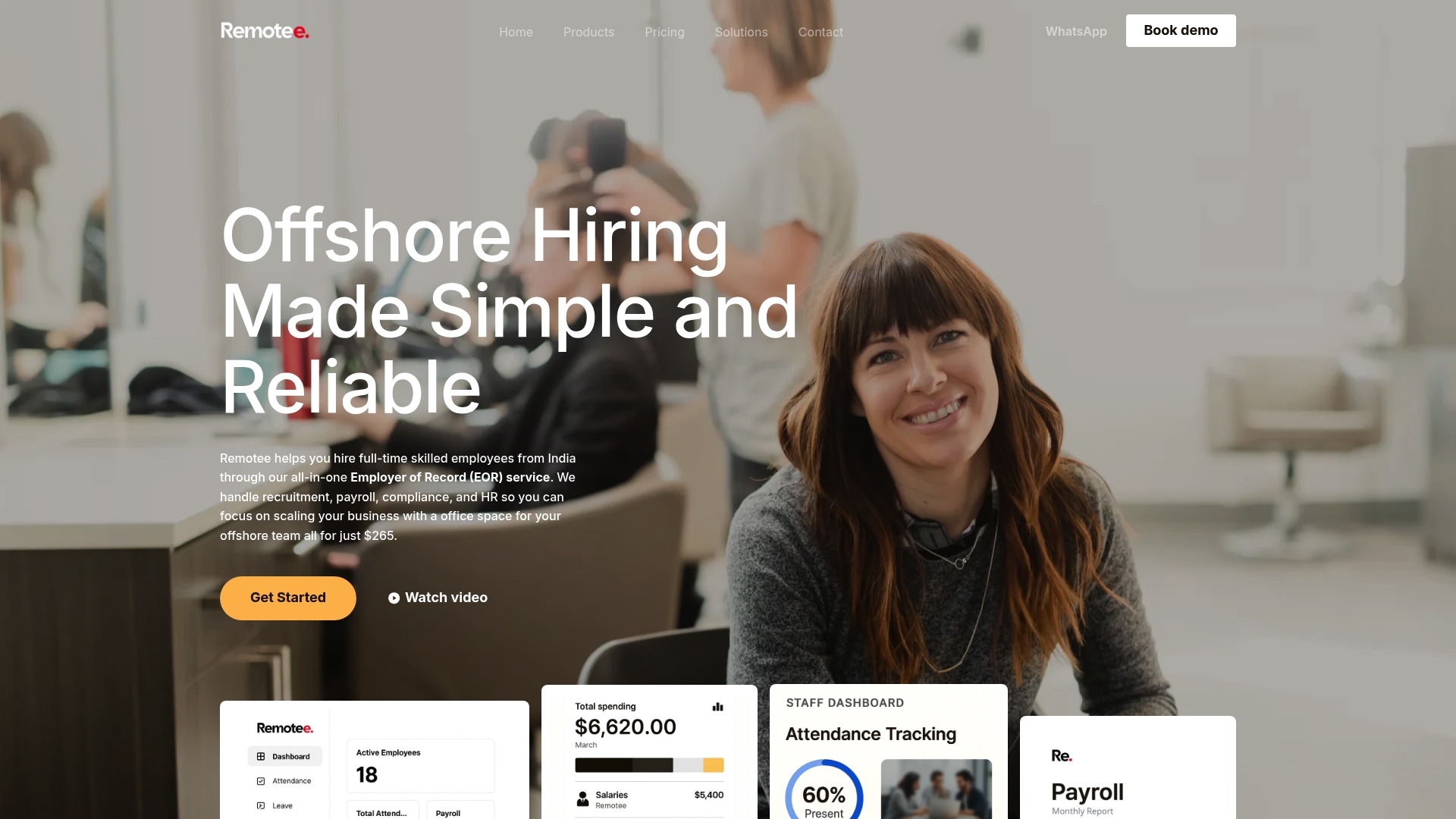
Clients consistently report up to 32% savings on hiring costs, and Remotee’s candidate vetting process means only qualified, thoroughly screened professionals reach your interview stage. Whether you are hiring your first offshore employee or scaling a team of twenty, Remotee’s offshore hiring solutions give you the compliance confidence and talent quality to build with certainty. If you are ready to explore what a managed offshore workforce looks like for your specific business, Remotee is the right starting point.
FAQ
What is a managed offshore workforce in simple terms?
A managed offshore workforce is a model where your business directs the daily work of employees based overseas, while a third-party EOR provider handles all legal employment, payroll, and compliance in that country. You get direct employees without needing a foreign legal entity.
How is an EOR different from a staffing agency?
An EOR becomes the legal employer of your offshore staff and manages all compliance obligations, while a staffing agency typically recruits candidates and places them under your own employment. The EOR model is specifically designed for cross-border hiring where no local entity exists.
What does an offshore team actually cost compared to local hiring?
Costs vary by role and location, but businesses using EOR models in India commonly report savings of up to 32% compared to equivalent local hires, factoring in salary, benefits, and eliminated administrative overhead.
Can I manage offshore employees the same way I manage local staff?
Yes. Offshore staff attend meetings, use your tools, and follow your standard operating procedures directly. The EOR handles the back-end employment administration, leaving your management relationship with the employee unchanged.
What is the biggest risk in managing an offshore workforce?
Governance gaps are the most common failure point. Without a structured communication cadence and clear performance expectations, offshore teams lose alignment quickly. Pairing strong internal governance with a reliable EOR partner addresses both the operational and compliance risks simultaneously.