Benefits of Dedicated Offshore Staffing for Business Leaders
TL;DR:
- Dedicated offshore staffing offers significant cost savings by reducing labor expenses by up to 78% compared to onshore hires. It grants access to specialized global talent, enables 24/7 operations through the follow-the-sun model, and allows fast team scaling within about 30 days. Proper management, compliance, and integration are crucial for offshore success, which services like Remotee simplify through Employer of Record solutions.
Scaling a business while keeping costs under control is one of the hardest balancing acts in modern operations. Hiring locally is expensive, slow, and increasingly competitive. The benefits of dedicated offshore staffing offer a real alternative: not a workaround, but a deliberate strategic model that gives you access to skilled professionals at a fraction of the cost, with the flexibility to grow or adjust as your business demands. This article breaks down the specific, measurable advantages that make dedicated offshore teams worth serious consideration for any business leader thinking about the next phase of growth.
Table of Contents
- Key takeaways
- 1. The core benefits of dedicated offshore staffing start with cost
- 2. Access to global talent and specialized skills
- 3. Round-the-clock operations through the follow-the-sun model
- 4. Scalability and flexibility that traditional hiring cannot match
- 5. Reduced management overhead compared to project outsourcing
- 6. Compliance and legal simplicity through employer of record services
- My take on what actually makes offshore staffing work
- How Remotee helps you capture these advantages faster
- FAQ
Key takeaways
| Point | Details |
|---|---|
| Significant cost reduction | Offshore staffing cuts labor costs by 60–78% compared to US, UK, or Australian local hires. |
| Access to specialized talent | Offshore teams open up niche technical and multilingual skills that are scarce or unavailable locally. |
| 24/7 operational coverage | The follow-the-sun model turns time zone differences into a productivity advantage without night shift premiums. |
| Fast, flexible scaling | A pre-defined offshore team of 3–8 members can be hired in roughly 30 days, far faster than traditional recruitment. |
| Governance is non-negotiable | Offshore success requires active legal, HR, and compliance management, not a passive vendor relationship. |
1. The core benefits of dedicated offshore staffing start with cost
The financial case for offshore staffing is not subtle. Businesses reduce labor costs by 60–78% compared to hiring locally in the US, UK, Canada, or Australia. For a single mid-level engineering role, that can translate to annual savings exceeding $25,000. Scale that across a team and the numbers become significant fast.
The savings go beyond base salaries. When you hire offshore through a dedicated model, you typically eliminate:
- Office space and equipment costs
- Employer-side payroll taxes and benefits overhead
- Recruitment agency fees and internal HR time
- Severance and turnover replacement costs
A 10-member offshore engineering team can save over $1 million annually compared to an equivalent onshore team. Offshore engineers typically cost 30–45% of their US counterparts on a fully loaded basis. That is not a rounding error. That is a budget reallocation that can fund product development, marketing, or market expansion.
Pro Tip: When calculating your offshore savings, always use fully loaded cost comparisons. Include benefits, office overhead, and recruitment costs on the local side to get an honest number.

2. Access to global talent and specialized skills
Local hiring markets have ceilings. If you are based in a mid-sized city and need a machine learning engineer, a multilingual customer success specialist, or a senior DevOps architect, you are competing with every other company in your region for a thin pool of candidates. Offshore staffing removes that ceiling entirely.
Dedicated offshore teams give you access to professionals across multiple countries with deep specialization in areas including:
- Full-stack and backend software development
- Data science and AI model training
- Finance, accounting, and compliance
- Technical support and customer operations
- Digital marketing and content production
Beyond the skills themselves, offshore professionals often bring exposure to diverse workflows and international clients. That adaptability is genuinely useful when your business operates across markets or needs teams that can shift priorities quickly.
Pro Tip: When evaluating offshore talent, ask candidates to describe a project where they worked across multiple time zones or with cross-cultural teams. Their answer tells you more about real-world readiness than any technical test.
The offshore staffing advantages here are structural, not incidental. You are not settling for second-tier talent because local options are expensive. You are accessing a broader, often deeper talent pool that local hiring simply cannot reach.
3. Round-the-clock operations through the follow-the-sun model
Most business leaders think of time zone differences as a problem to manage. The follow-the-sun model reframes them as a productivity asset. When your offshore team in India or Southeast Asia ends their day, your onshore team is just starting theirs. Work moves continuously without anyone pulling a night shift.
Here is how the operational math works in practice:
| Metric | Traditional single-location team | Follow-the-sun offshore model |
|---|---|---|
| Daily productive hours | 8 hours | Up to 24 hours |
| Night shift premiums | Significant cost | Eliminated |
| Customer response time | Next business day | Same calendar day |
| Software release frequency | Standard sprint cycles | Up to 30% improvement |
| Operational cost reduction | Baseline | 30–50% lower |
The follow-the-sun model also reduces burnout. Instead of asking onshore staff to cover late hours during a product launch or a service incident, your offshore team handles it during their regular working day. Customer satisfaction improves because response times drop by up to 40%, and your onshore team works sustainable hours.
For professional services firms managing client SLAs, this model is particularly powerful. You can commit to faster turnaround times without increasing headcount costs or burning out your existing team.
4. Scalability and flexibility that traditional hiring cannot match
One of the most underrated offshore workforce benefits is the speed at which you can build or resize a team. A dedicated offshore team of 3 to 8 members can be hired in approximately 30 days when role requirements are clearly defined. Without that preparation, the same process typically takes 60 to 90 days. That difference matters when you are responding to a new contract, a product launch, or a sudden spike in demand.
The engagement model you choose also shapes how much flexibility you get:
- Staff augmentation places individual offshore professionals directly under your management structure. You get maximum control over day-to-day work and direct integration with your existing team. Best for filling specific skill gaps or adding capacity to an existing project.
- Dedicated offshore pods are self-contained teams with their own internal coordination. They reduce your management overhead because the team operates with more autonomy. Best for longer engagements where you need a team to own a function or product area.
- Project-based outsourcing hands off a defined deliverable to an external vendor. You get the output but lose visibility into who is doing the work and how. This model carries the highest risk of subcontracting chains and quality inconsistency.
For most business leaders evaluating outsourcing options, the dedicated pod model hits the right balance. You maintain strategic oversight without managing every task, and the team builds institutional knowledge over time rather than starting from scratch with each engagement.
Pro Tip: Always include a replacement SLA clause in your offshore vendor contract. If a key team member leaves, you need a defined timeline for their replacement to protect continuity.
5. Reduced management overhead compared to project outsourcing
Project outsourcing sounds appealing because it appears to remove management burden entirely. In practice, it often creates more work. You spend time writing detailed briefs, reviewing deliverables against unclear expectations, and managing revision cycles with a vendor who has limited context about your business.
Dedicated staffing solutions work differently. Your offshore team learns your systems, your standards, and your priorities over time. The onboarding investment pays forward because you are not re-explaining context every few weeks to a rotating cast of contractors.
The efficiency in offshore staffing comes from continuity. A dedicated team that has worked with you for six months understands your codebase, your client communication style, and your internal approval processes. That knowledge compounds. A project outsourcing vendor starts from zero every time.
There is also the subcontracting risk to consider. Subcontracting chains can hide who is actually working on your project, creating quality and confidentiality risks that are difficult to detect until something goes wrong. Dedicated models give you direct relationships with the people doing the work, which is a structural advantage that project outsourcing rarely provides.
6. Compliance and legal simplicity through employer of record services
Hiring employees in another country is not as simple as signing a contract and wiring a salary. Each country has its own labor laws, tax obligations, and employment regulations. Getting this wrong exposes you to financial penalties and reputational risk.
Offshore staffing governance requires active management across legal, tax, HR, and operations. Local labor laws change frequently, and what was compliant last year may not be this year. This is where employer of record services remove a significant operational burden.
An EOR acts as the legal employer of your offshore staff in their home country. The EOR handles payroll, benefits, tax filings, and compliance with local employment law. You direct the work. The EOR manages the legal and administrative relationship. This structure lets you hire in markets like India without setting up a local entity, which can take months and cost tens of thousands of dollars.
For business leaders who want the benefits of remote teams without building an in-country HR and legal function, the EOR model is the most practical path to compliant, scalable offshore hiring.
My take on what actually makes offshore staffing work
I have seen companies treat offshore staffing as a cost-cutting exercise and wonder why their results are mediocre. I have also seen companies build offshore teams that outperform their onshore counterparts. The difference is almost never about talent. It is about how the engagement is set up and maintained.
The first 90 days are where most offshore engagements succeed or fail. If you do not invest in a documented integration period with clear communication norms, defined escalation paths, and deliberate context-sharing, you will spend the next year doing repeated context resets. That kills productivity faster than any time zone gap.
My other strong opinion: do not treat compliance as someone else’s problem. IP protection in 2026 requires more than an NDA. You need segmented code repositories, audit-ready access trails, and explicit no-subcontracting clauses in every vendor contract. These are not bureaucratic details. They are the controls that determine whether you actually own what your offshore team builds.
The companies that get the most from offshore staffing are the ones that treat their offshore team as a real part of the organization. Regular video calls, shared tools, inclusion in team retrospectives, and genuine career development conversations. When offshore staff feel like they belong to the company, attrition drops and output quality rises. That is not a soft observation. It is the most consistent pattern I have seen across successful offshore engagements.
— Rajkumar
How Remotee helps you capture these advantages faster
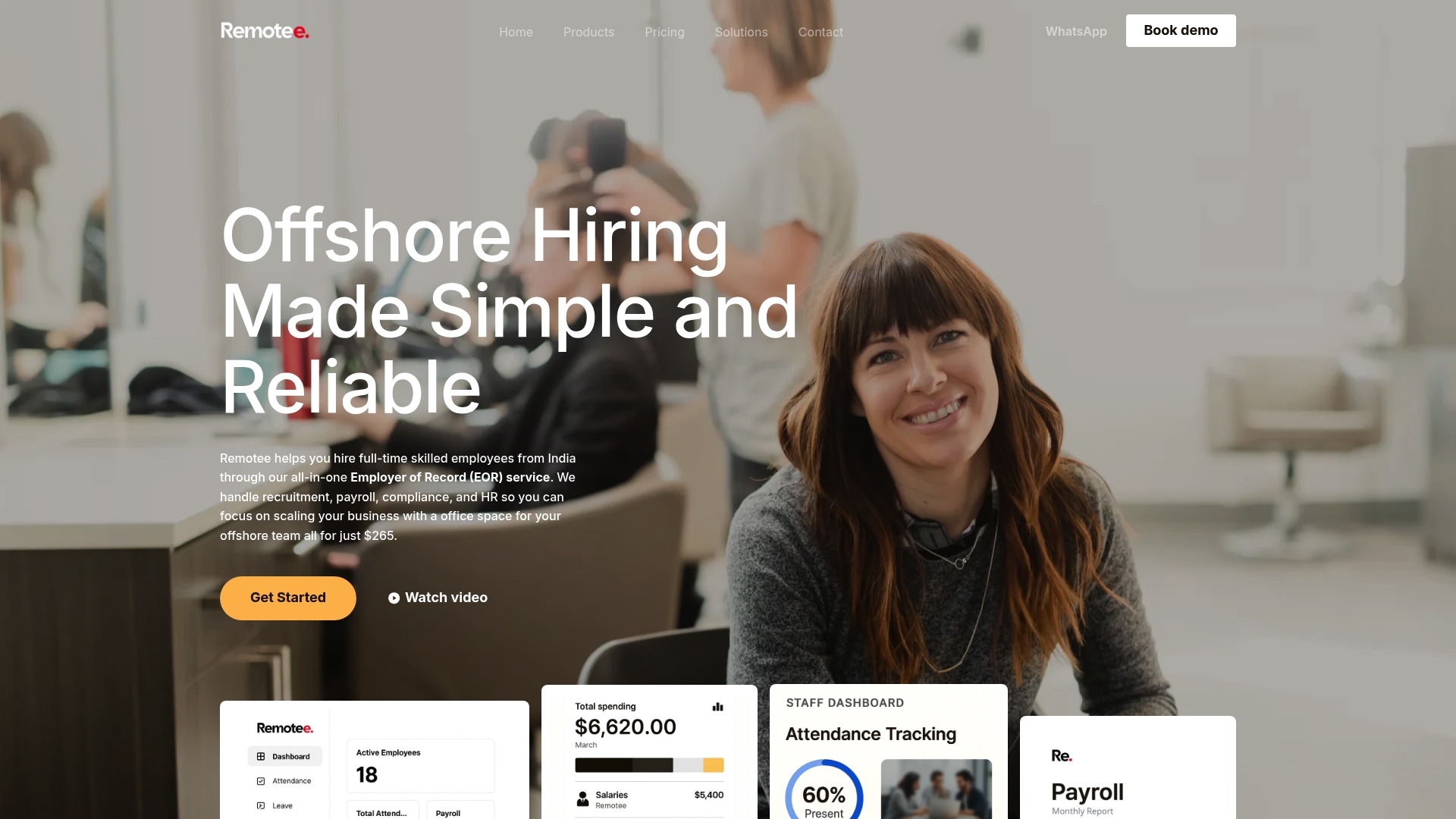
Remotee was built specifically for business leaders who want the benefits of dedicated offshore staffing without the administrative complexity of building an offshore operation from scratch. As an Employer of Record service focused on India, Remotee manages payroll, compliance, HR, and onboarding so you can focus on directing the work rather than managing the legal infrastructure around it.
Clients working with Remotee report up to 32% savings on hiring costs, and the platform is designed to get dedicated teams in place within 30 days. Every candidate presented has been vetted against your specific requirements. You are not sorting through applications. You are choosing from a shortlist of professionals who are genuinely qualified for the role.
If you are evaluating outsourcing options and want a model that gives you direct relationships with your offshore staff, full compliance coverage, and a team that grows with your business, Remotee is worth a close look.
FAQ
How much can businesses save with dedicated offshore staffing?
Businesses typically reduce labor costs by 60–78% compared to local hiring in the US, UK, Canada, or Australia, with annual savings per role commonly exceeding $25,000.
How does the follow-the-sun model work for offshore teams?
The follow-the-sun model staggers work across time zones so that when one team ends their day, another begins, enabling up to 24 hours of continuous productivity without night shift premiums or burnout.
What is the difference between staff augmentation and a dedicated offshore pod?
Staff augmentation places individual offshore professionals under your direct management, while a dedicated pod is a self-contained team that operates with more autonomy and lower day-to-day management overhead.
How long does it take to hire a dedicated offshore team?
With clearly defined role requirements, a team of 3 to 8 members can typically be hired in approximately 30 days, compared to 60 to 90 days without that preparation.
What is an employer of record and why does it matter for offshore hiring?
An employer of record is a third-party organization that acts as the legal employer of your offshore staff in their home country, handling payroll, tax, and compliance so you can hire internationally without setting up a local legal entity.