Expand Agency Capacity with Offshore Talent in 2026

TL;DR:
- Expanding agency capacity through offshore talent is most effective when utilizing compliant staffing models like EOR services. Proper workflow integration, regular compliance audits, and precise control of legal and operational risks are essential for sustainable offshore staffing success. Agencies that proactively manage these factors realize significant capacity gains and maintain legal and regulatory compliance.
Expanding agency capacity through offshore talent acquisition is the most direct path to scaling operations without the overhead of local hiring. Agencies that treat offshore staffing as a strategic model rather than a cost-cutting shortcut consistently outperform those that don’t. This guide covers the staffing models available in 2026, the compliance obligations you cannot ignore under FLSA and international tax law, and the integration practices that determine whether your offshore team actually delivers capacity gains. References from Foley & Lardner, Greenback Tax Services, and Insight Global ground every recommendation in current expert analysis.
What are the best offshore staffing models to expand agency capacity?
Four primary models exist for agencies looking to add international workforce solutions: direct offshore hiring, contractor arrangements, Employer of Record (EOR), and Professional Employer Organization (PEO). Each carries a different risk profile, cost structure, and time-to-hire. Choosing the wrong one doesn’t just slow you down. It can expose your agency to misclassification penalties or tax liabilities that wipe out any savings.

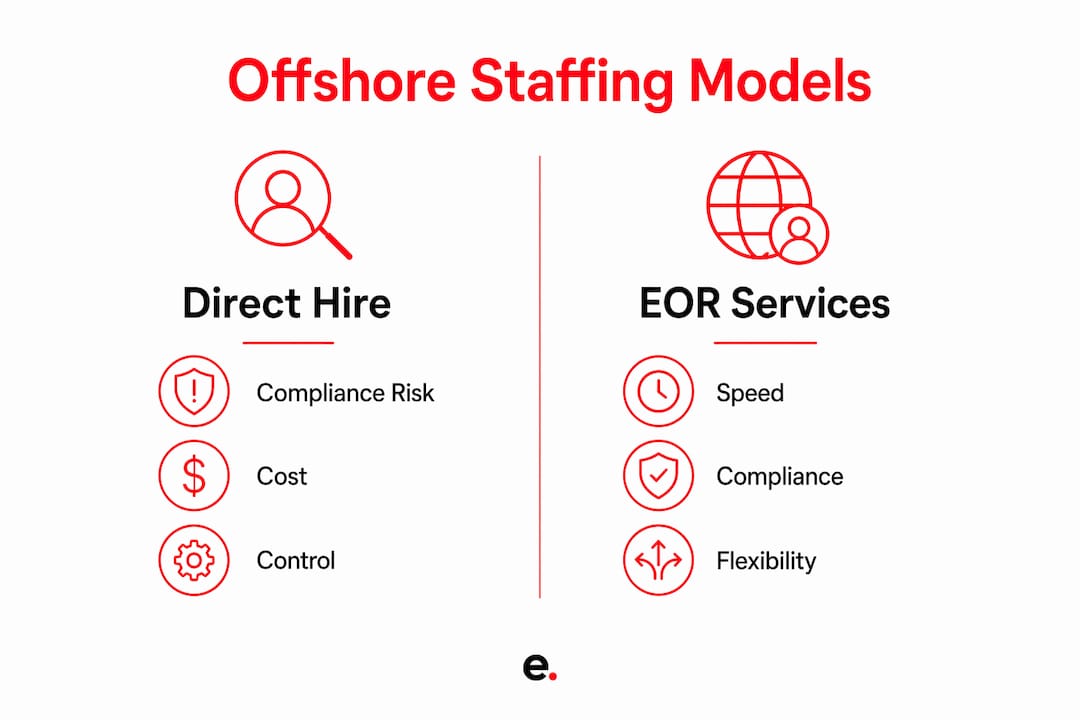
Direct offshore hiring means your agency establishes a legal entity in the target country and employs workers directly. This gives you maximum control but requires months of setup, local legal counsel, and ongoing HR infrastructure. It works for agencies committing to a large, permanent offshore presence. For most growing agencies, it’s overkill at the start.
Contractor arrangements are faster to set up but carry real risk. Misclassifying a full-time worker as an independent contractor is one of the most common and costly mistakes in offshore staffing. Tax authorities in India, the Philippines, and across the EU apply strict tests for worker classification, and getting it wrong triggers back taxes and penalties.
EOR services allow fast, compliant hiring abroad while your agency retains day-to-day control over work performance. The EOR becomes the legal employer, handling local contracts, payroll, and statutory compliance. This is the model that balances speed, compliance, and operational control for most mid-size agencies.
| Model | Compliance risk | Cost | Control | Time to hire |
|---|---|---|---|---|
| Direct hire (local entity) | Low (if managed well) | High setup cost | Full | 3 to 6 months |
| Contractor arrangement | High (misclassification) | Low | Moderate | 1 to 4 weeks |
| Employer of Record (EOR) | Low | Moderate | Operational | 1 to 3 weeks |
| PEO | Low to moderate | Moderate to high | Shared | 2 to 6 weeks |
Pro Tip: Choose EOR over setting up a local entity when you need to hire fewer than 20 people in a new country. The break-even point for a local entity rarely justifies the legal and administrative cost below that headcount threshold.
How to ensure compliance when hiring offshore talent
Compliance is where agencies most often underestimate the complexity of offshore staffing. The risks are not theoretical. Foley & Lardner’s 2026 guidance identifies off-the-clock work and incorrect exempt versus non-exempt classifications as the leading sources of wage-and-hour liability in remote workforces. Most violations come from operational gaps, not bad intent.
The core compliance obligations agencies must address include:
- FLSA wage and hour rules. Even when workers are offshore, U.S.-based agencies managing remote employees must enforce accurate timekeeping, prohibit off-the-clock work, and correctly classify exempt and non-exempt roles. Failure to do so creates overtime underpayment exposure.
- Employee location tracking. Tracking actual work locations daily is required to comply with differing wage-and-hour rules across jurisdictions. An employee working from a different state or country than their contract specifies creates a separate compliance obligation.
- Tax obligations for U.S. employees abroad. U.S. employees working abroad still owe Social Security and Medicare taxes unless covered by a totalization agreement. The Foreign Earned Income Exclusion (FEIE) does not eliminate FICA obligations. Greenback Tax Services notes that totalization agreements with over 30 countries provide exceptions, but each must be verified individually.
- Multi-state and multi-jurisdiction audits. Agencies with distributed remote teams need periodic audits across every jurisdiction where employees work. Foley & Lardner advise maintaining robust work-location records as the primary defense against compliance surprises.
- GDPR vendor risk management. When personal data crosses borders, Vision Compliance recommends documented breach-notification timelines and Transfer Impact Assessments as part of any offshore vendor relationship. This applies to agencies handling EU client data through offshore teams.
Pro Tip: Schedule a compliance audit every six months, not annually. Offshore team compositions change faster than annual review cycles can catch, and a single misclassified worker can trigger a broader audit of your entire workforce.
Staying compliant during business expansion requires treating compliance as an operational function, not a legal checkbox. Build location tracking, timekeeping verification, and classification reviews into your standard HR workflow from day one.
How can agencies integrate offshore teams to realize real capacity gains?
Headcount alone does not equal capacity. Insight Global’s research is direct on this point: capacity increases only when offshore teams are fully integrated into workflows with good communication and access to the right tools. Agencies that treat offshore hires as a separate tier consistently see lower productivity than those that integrate them as full team members.
The integration gap shows up in predictable places. Offshore team members who lack access to project management platforms, client communication channels, or internal knowledge bases spend a disproportionate amount of time waiting for information. That waiting time is invisible on a headcount report but visible in missed deadlines and rework.
Effective integration requires four specific practices. First, map your existing workflows before adding offshore capacity. Identify where handoffs happen, which tasks are time-sensitive, and which roles require real-time collaboration versus asynchronous execution. Second, assign timezone coverage deliberately. A team in India working IST can cover a full U.S. business day with a morning overlap window, but only if the handoff process is designed around that schedule rather than assumed to work by default.
Third, give offshore team members the same tool access as onshore staff. This means Slack, Asana, Jira, Google Workspace, or whatever your agency runs on. Partial access creates partial contribution. Fourth, establish a weekly cadence that includes offshore leads in planning conversations, not just execution updates. Agencies that include offshore team members in sprint planning or client strategy calls report significantly faster ramp-up times and lower attrition. The role of technology in offshore staffing is central to making this integration work at scale.
Cultural alignment takes longer than tool access. Build in explicit onboarding time for communication norms, feedback expectations, and escalation paths. Agencies that skip this step find that offshore teams default to over-delivering on narrow task definitions rather than flagging problems early, which is the opposite of what you need for genuine capacity expansion.
What steps should you take to mitigate risks when expanding offshore?
Risk mitigation in offshore staffing is not a one-time due diligence exercise. It is an ongoing operational discipline. The most common failure points are misclassification, IP assignment gaps, and over-reliance on EOR indemnification.
“EOR protection is more limited than many assume, and contract details matter.” — Quentin Dupard
Quentin Dupard’s analysis makes clear that misclassification, IP assignment failures, and certain tax positions fall outside standard EOR indemnification. Your agency must enforce its own IP assignment clauses and tax compliance processes. Do not assume the EOR contract covers these by default.
The practical risk mitigation checklist for agencies expanding offshore includes:
- Vendor risk assessments. Treat GDPR vendor risk assessment as a core operational activity. Document breach-notification timelines, data transfer safeguards, and SLAs before any offshore vendor handles personal data.
- IP assignment clauses. Every offshore worker agreement must include explicit IP assignment language. This is especially critical for creative agencies, software development shops, and any firm producing client deliverables.
- Contract review for EOR carve-outs. Read the indemnification section of your EOR agreement carefully. Understand what the EOR covers and what it explicitly excludes. Then build internal processes to cover the gaps.
- Misclassification audits. Review contractor classifications annually against the legal tests applied in each jurisdiction. A worker who qualified as a contractor two years ago may now meet the threshold for employee status under updated local law.
Pro Tip: Maintain a daily log of where each offshore team member actually works. This single record protects you in wage-and-hour audits, tax inquiries, and GDPR investigations. It takes minutes to maintain and hours to reconstruct after the fact.
The offshore staffing risk mitigation checklist for 2026 covers these areas in detail and is worth reviewing before you sign any new offshore staffing agreement.
Key takeaways
Agencies that expand capacity through offshore talent succeed when they combine the right staffing model, disciplined compliance, and genuine workflow integration.
| Point | Details |
|---|---|
| Choose EOR for speed and compliance | EOR services reduce time-to-hire to one to three weeks while keeping compliance liability managed. |
| Track work locations daily | Daily location records are your primary defense in wage-and-hour and multi-jurisdiction tax audits. |
| Integrate offshore teams fully | Capacity gains only materialize when offshore staff have full tool access and are included in planning cycles. |
| Read EOR contracts carefully | IP assignment and misclassification risks often fall outside standard EOR indemnification clauses. |
| Audit compliance every six months | Offshore team compositions change fast; annual reviews miss classification and location drift. |
What I’ve learned about scaling agencies offshore the hard way
I’ve watched agency owners make the same mistake repeatedly. They hire offshore talent, celebrate the headcount addition, and then wonder six months later why capacity hasn’t actually improved. The answer is almost always integration, not talent quality.
The offshore professionals I’ve seen perform best are not the ones with the most impressive credentials. They are the ones who were brought into the team’s actual workflows from week one. They had access to the same tools, attended the same planning calls, and were held to the same performance standards as onshore staff. That is not a soft cultural preference. It is a structural requirement for capacity expansion to work.
On compliance, my honest view is that most agency owners underestimate how jurisdiction-specific the obligations are. A worker logging in from a different city than their contract specifies is not a minor administrative detail. It is a separate wage-and-hour obligation. Foley & Lardner’s 2026 guidance on this point is not alarmist. It reflects what tax and labor authorities are actually auditing.
The agencies that scale well offshore treat EOR services as a starting point, not a complete solution. They use the EOR to get compliant fast, then build their own internal compliance processes around the gaps the EOR doesn’t cover. IP assignment, tax position verification, and location tracking are yours to own. The EOR handles payroll and local employment law. Everything else requires your attention.
The benefits of dedicated offshore staffing are real and substantial. But they only materialize for agencies that do the operational work to earn them.
— Rajkumar
How Remotee helps agencies scale with offshore talent
Remotee’s Employer of Record service in India gives agency owners a direct path to compliant, fast offshore hiring without building local legal infrastructure. Remotee manages payroll, HR, and statutory compliance so your team focuses on client delivery rather than regulatory paperwork. Clients report up to 32% savings on hiring costs compared to equivalent onshore roles. If you are ready to hire offshore talent in India with full compliance support, Remotee presents only pre-vetted candidates matched to your agency’s specific requirements. Explore offshore hiring options or review cost-per-hire benchmarks to build your business case before your next hiring decision.
FAQ
What is the fastest way to expand agency capacity with offshore talent?
Using an Employer of Record (EOR) service is the fastest compliant path, typically reducing time-to-hire to one to three weeks. The EOR handles local contracts, payroll, and statutory compliance while your agency retains operational control.
Do U.S. agencies owe taxes on offshore employees?
U.S. employees working abroad still owe Social Security and Medicare taxes unless a totalization agreement applies. Greenback Tax Services confirms the FEIE does not eliminate FICA obligations, so agencies must verify each country’s agreement status individually.
What does an EOR not cover?
EOR indemnification typically excludes misclassification decisions, IP assignment failures, and certain tax positions. Quentin Dupard’s analysis shows agencies must enforce their own IP assignment clauses and tax compliance processes beyond what the EOR contract provides.
How do you integrate offshore teams effectively?
Offshore teams need full access to your agency’s project management and communication tools, inclusion in planning cycles, and explicit handoff processes designed around timezone coverage. Insight Global’s research confirms that productivity gains depend on skill alignment and stable workflow integration.
How often should agencies audit offshore compliance?
Every six months is the recommended interval. Foley & Lardner advise periodic multi-state wage audits and robust work-location records, and offshore team compositions change fast enough that annual reviews consistently miss classification and location drift.