Offshore Developer Onboarding Best Practices for 2026

TL;DR:
- Effective offshore developer onboarding combines pre-boarding, structured milestones, and asynchronous communication to accelerate productivity within 90 days. Implementing a dual-buddy model, clear communication norms, and ownership of async rituals fosters social integration and retention, reducing early turnover costs. Regular feedback and phased evaluations ensure onboarding systems remain effective and supportive.
Offshore developer onboarding best practices are the structured set of actions that take a new remote engineer from signed offer to full productivity without losing weeks to confusion, access delays, or cultural friction. A structured 90-day onboarding program enables offshore developers to reach productivity 50% faster than ad hoc approaches. Poor onboarding costs companies over $120,000 to replace a single senior engineer. For tech executives and HR professionals at startups and SMEs, getting this process right is not optional. Tools like GitHub, Slack, and Loom are table stakes. The real differentiator is a repeatable system that covers preparation, communication, mentorship, and phased ownership transfer across the first 90 days.
1. What are offshore developer onboarding best practices?
Offshore developer onboarding, also called remote engineering integration, is the process of preparing, welcoming, and ramping up a developer who works from a different country or time zone. The goal is full contribution, not just access to a laptop and a Slack channel. Formal onboarding frameworks increase productivity by 62% among new engineering hires. That number reflects the gap between teams that treat onboarding as a checklist and those that treat it as a product. The sections below cover each layer of that product, from pre-boarding through the 90-day milestone review.

2. What foundational steps prepare your offshore developer before Day 1?
Pre-boarding is the work your team does before the developer’s first login. Access provisioning and security compliance must be complete by Day 2 or 3 to prevent work blockage in the first week. A 3–5 day access lag is the most common and most avoidable failure in offshore software development onboarding. Fix it by treating access tickets as a launch dependency, not an afterthought.
The pre-boarding checklist covers five areas:
- Access provisioning: Open tickets for GitHub, Jira, VPN, and any internal tools before the start date. Automated provisioning tools cut this to under an hour.
- Hardware and software: Ship a pre-configured machine at least one week before Day 1. Include IDE settings, SSH keys, and VPN credentials already installed.
- Documentation: Prepare a dev environment setup guide, architecture overview, and a glossary of internal project names. A Confluence page works well for this.
- Buddy assignment: Assign a peer, not a manager, to handle initial questions. A peer buddy for at least 2 hours daily in the first week reviewing PRs produces the highest ROI for a smooth ramp-up.
- Compliance agreements: Security, IP, and data handling agreements must be signed by Day 3 at the latest.
Pro Tip: Send a short Loom video walking through the codebase architecture before Day 1. Developers who watch it arrive with context, not questions about folder structure.
3. How should you structure the first 7 days to establish momentum?
The first week sets the tone for the entire onboarding process for developers. The goal is one merged pull request by Friday. If that does not happen, the system failed, not the developer.
Structure the week in this order:
- Day 1, welcome call: Schedule a 30-minute video call with the team lead. Introduce the developer to at least three teammates by name and role.
- Day 1–2, environment setup: The developer clones the repo, runs the test suite locally, and confirms the dev environment works. Any blockers get escalated immediately.
- Day 2–3, starter task: Assign a small, well-scoped task. A bug fix or a documentation update works better than a feature ticket. The task should be completable in one day.
- Day 3–4, first PR: The developer opens a pull request. The buddy reviews it within two hours. Feedback uses explicit tags (more on this in the next section).
- Day 4–5, pair programming: Schedule one 60-minute pair session with a senior engineer. This is the fastest way to transfer unwritten knowledge about code style and system design.
- Day 5, async norms: Walk through the team’s communication tools. Show how Slack channels are organized, how Loom is used for async updates, and where decisions get documented.
Pro Tip: Assign the starter task before Day 1 so the developer can read the ticket during setup. Arriving with a task already in mind cuts the “what do I work on?” delay entirely.
4. What are effective communication practices during ongoing onboarding?
Communication architecture is the part of remote developer onboarding that most teams get wrong. The fix is not more meetings. It is a clear split between synchronous and asynchronous work.
- Daily overlap window: Establish a 2–4 hour window where the offshore developer and the core team are online at the same time. This window handles blockers, code reviews, and quick decisions. Structured async updates reduce blocker resolution time from 18 hours to 3 hours. That is a direct productivity gain.
- Async by default: 70–80% of communication flow should be asynchronous. Tools like Loom for video updates, Confluence for documentation, and written PR reviews carry the bulk of daily communication. This prevents the manager bottleneck failure mode where nothing moves unless one person is online.
- Public channels over DMs: Move from private direct messages to public Slack channels by Week 2. Public channel engagement by Week 2 signals a psychologically safe and integrated team environment. It also means knowledge stops living in inboxes.
- PR comment tagging: Use explicit tags in code review comments.
[nit]means optional style preference.[suggestion]means a recommended improvement.[required]means the PR cannot merge without this change. This system removes cultural ambiguity and makes feedback unambiguous for developers working across time zones.
5. How to build team belonging and developer ownership
Social integration is the part of offshore team integration that gets cut when schedules get tight. That is a mistake. Buffer has used a dual-buddy model since 2012, pairing each new hire with both a technical mentor and a culture buddy. The technical mentor handles code reviews and architecture questions. The culture buddy handles everything else: team norms, unwritten rules, and social context.
Belonging practices that work in practice:
- Schedule virtual coffee chats with two or three teammates in the first two weeks. Keep them to 20 minutes and make them optional but encouraged.
- Give the developer ownership of one async ritual within the first 30 days. Managing the standup bot, preparing demo content, or owning a section of the team wiki all work. Ownership of async rituals within 30 days transitions developers from ticket takers to feature owners.
- Ask the developer to flag one thing they would improve about the onboarding process itself. This signals that their opinion matters and surfaces real gaps in your system.
- Track velocity and engagement metrics weekly. A developer who is not commenting in public channels or whose PR frequency drops is showing early warning signs.
“Onboarding is a core engineering product. Failure to produce a mergeable PR early indicates a system failure, not an individual performance problem.” Branch8
For startups focused on offshore staff retention, belonging is not a soft metric. It is a direct predictor of whether a developer stays past the six-month mark.
6. How do 30-60-90 day milestones maximize productivity and retention?
The 30-60-90 day framework is the industry standard for structuring offshore software development onboarding. Each phase has distinct goals and measurable deliverables.
| Phase | Goal | Key Deliverable |
|---|---|---|
| Day 1–30 | Environment, codebase, first contributions | 3+ merged PRs, completed onboarding checklist |
| Day 31–60 | Independent task ownership | Solo feature delivery, active PR reviews of peers |
| Day 61–90 | Team integration and process ownership | Owns a service area or async ritual, contributes to retrospectives |
Weekly 1:1 meetings focused on onboarding experience improve retention with a small time investment. Sixty minutes total across four weeks produces measurable returns in faster productivity and reduced churn. That is 15 minutes per week. The conversation should cover three questions: What is going well? What is blocked? What does the developer need that they do not have?
Poor onboarding accounts for roughly 20% of new hire turnover within the first 45 days. The 30-60-90 framework directly addresses this by giving both the developer and the manager clear expectations at each stage. A structured 90-day program requires 40–60 hours of manager time in the first month. That investment is small compared to the $120,000+ cost of replacing a senior engineer who left because onboarding failed them.
Adjust the plan after each phase. Run a short retrospective at Day 30 and Day 60. Ask what the developer needed that was missing. Update the onboarding docs before the next hire starts.
Key Takeaways
Effective offshore developer onboarding requires pre-boarding preparation, structured milestones, async communication, and dual mentorship to reach full productivity within 90 days.
| Point | Details |
|---|---|
| Pre-board before Day 1 | Provision all access and ship hardware at least one week early to avoid productivity delays. |
| Use the dual-buddy model | Assign a technical mentor and a culture buddy to support both ramp-up and social integration. |
| Default to async communication | Keep 70–80% of communication asynchronous using Loom, Confluence, and written PR reviews. |
| Apply the 30-60-90 framework | Set clear deliverables at each phase to track progress and catch retention risks early. |
| Give ownership early | Assign async ritual ownership within 30 days to shift developers from task execution to outcome ownership. |
What I’ve learned about onboarding offshore developers in startups
The biggest mistake I see startups make is treating onboarding as a one-time event. They send a welcome email, share a Notion doc, and assume the developer will figure it out. Three weeks later, the developer is still waiting on access to a staging environment and has never spoken to anyone outside their immediate squad.
Onboarding is a product. It has users, failure modes, and a feedback loop. If a developer cannot merge a PR in the first week, that is a bug in your system. Fix the system, not the person.
The second mistake is ticket-only work in the first 30 days. Giving an offshore developer nothing but Jira tickets to close signals that you see them as a resource, not a team member. The developers who stay and grow are the ones who got real ownership early, even if it was just managing the standup bot or owning a section of the docs.
Early code contributions are the clearest signal that onboarding is working. A developer who has merged three PRs by Day 14 is integrated. A developer who has not touched the codebase by Day 14 is at risk. Watch that metric closely.
Cultural inclusion is not a bonus feature. It is the difference between a developer who flags a production issue at 11pm because they care about the team and one who logs off at exactly 5pm and never looks back. Virtual coffee chats, public channel participation, and a culture buddy are not soft perks. They are retention infrastructure.
— Rajkumar
How Remotee helps you get offshore onboarding right
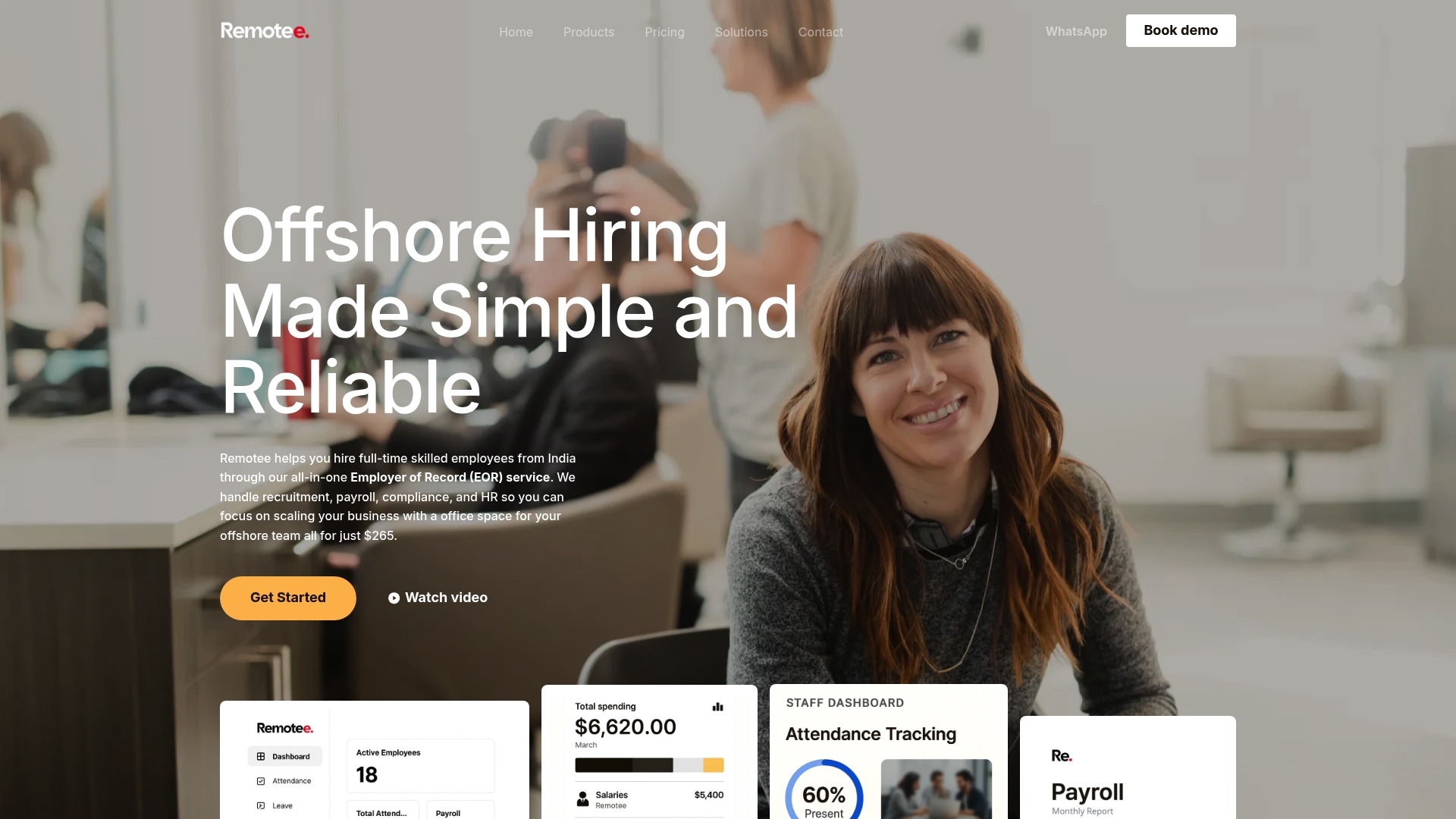
Remotee’s Employer of Record service in India handles compliance, payroll, and HR so your team can focus on building a great onboarding experience instead of navigating local labor law. Remotee manages the legal and administrative layer that slows down offshore hiring, from contracts to tax compliance. Clients report up to 32% savings on hiring costs. Remotee also connects you with pre-vetted senior engineers who are ready to contribute from Day 1. If you want offshore team integration that actually works, Remotee gives you the infrastructure to make it happen. Explore how offshore hiring with Remotee fits your growth plan.
FAQ
What is the standard timeline for offshore developer onboarding?
The industry standard is a structured 90-day program. A well-run 90-day onboarding enables offshore developers to reach full productivity 50% faster than unstructured approaches.
How do you reduce communication delays with offshore developers?
Establish a 2–4 hour daily synchronous overlap window and default to async tools like Loom and Confluence for everything else. This combination reduces blocker resolution time from 18 hours to 3 hours.
What is the dual-buddy model for remote developer onboarding?
The dual-buddy model assigns each new developer both a technical mentor for code and architecture questions and a culture buddy for team norms and social integration. Buffer has used this model successfully since 2012.
How do you measure whether offshore onboarding is working?
Track merged PRs in the first two weeks, public channel engagement by Week 2, and developer velocity across the 30-60-90 day phases. A developer with no merged PRs by Day 14 is a signal to investigate the onboarding system.
Why does poor onboarding lead to early turnover?
Poor onboarding accounts for roughly 20% of new hire turnover within the first 45 days. Developers who lack access, context, or social connection disengage quickly, and replacing a senior engineer costs over $120,000.