Why Offshore Hiring Timelines Matter for Tech Teams
TL;DR:
- Offshore hiring timelines encompass sourcing, notice periods, onboarding, and ramp-up, often exceeding six months. Delays in internal documentation and approvals significantly increase costs and reduce candidate conversion rates. Using faster models like EOR or pre-planned internal processes can dramatically shorten onboarding and improve your ROI.
Most business leaders assume offshore hiring is faster and cheaper than domestic recruitment. That assumption is often wrong, and the gap between expectation and reality is where budgets quietly disappear. Understanding why offshore hiring timelines matter is not just an HR concern. It directly shapes delivery capacity, cash flow, and whether your product ships on time. The actual timeline from first job posting to full productivity includes sourcing, notice periods, onboarding, and a ramp-up phase that together can stretch well past six months if left unmanaged.
Table of Contents
- Key takeaways
- Why offshore hiring timelines matter more than you think
- The operational and financial cost of timeline delays
- Comparing offshore models on timeline and fit
- Strategies to compress and control offshore timelines
- My take on timeline discipline as a competitive advantage
- How Remotee removes the timeline friction for you
- FAQ
Key takeaways
| Point | Details |
|---|---|
| Timelines span much longer than sourcing | Senior tech roles average 95 days to offer acceptance, with full productivity often taking 5 to 7 months. |
| Vacancy costs compound daily | Every day a critical role sits open can cost $500 to $1,500 in lost output, making speed a financial priority. |
| EOR beats entity setup for speed | EOR onboarding takes 5 to 10 business days compared to 3 to 6 months for entity setup in a new country. |
| Internal delays are the hidden bottleneck | Document readiness and approval cycles inside your own organization often extend timelines more than your offshore provider does. |
| Time-to-first-billable hour is the real metric | Start date alone does not reflect productivity. Measuring when a hire begins contributing billings captures actual value delivery. |
Why offshore hiring timelines matter more than you think
The phrase “offshore recruitment timelines” tends to trigger conversations about sourcing speed. How fast can you get candidates? How quickly can you screen? But the sourcing phase is only one part of a much longer chain.
Senior software engineering roles average 95 days from job posting to offer acceptance, with total ramp-up to productive contribution extending across 5 to 7 months. That is before you account for the offshore-specific variables: notice periods in India often run 60 to 90 days, and EOR onboarding takes 5 to 10 business days in the best cases, while setting up a legal entity abroad can take 3 to 6 months or longer.
Here is what typically gets missed in timeline planning:
- Sourcing phase: Job posting, screening, technical assessments, and offer negotiations. This alone averages over three months for senior roles.
- Notice period: Candidates in India frequently serve 60 to 90 day notice periods, adding time after an offer is accepted.
- EOR or entity onboarding: Legal and payroll setup takes 5 to 10 business days with EOR, but visa or work permit complications add 2 to 12 additional weeks.
- Ramp-up period: Even after a hire’s first day, full productivity arrives only at the 4 to 6 week mark at earliest, and often much later for senior contributors.
- Project readiness: Development environment setup, access provisioning, and team context sharing add further days before a developer can write a single line of production code.
Pro Tip: Map your “time before developer login” separately from onboarding paperwork. If your internal IT and DevOps teams are not prepped before a hire’s first day, you lose a week or more of productive capacity even after a fast EOR onboarding.
The operational and financial cost of timeline delays
The importance of offshore hiring becomes concrete when you attach numbers to delays. Vacancy cost is calculated as average daily value of the role multiplied by the number of days the seat sits empty. For a senior engineer driving client-facing delivery, that number accumulates fast.

Over a 95-day sourcing period alone, vacancy costs can reach $47,500 to $142,500. And that is only to offer acceptance. The cost does not stop when someone joins. Workforce planning data shows teams reach only 50% productivity by month three and full productivity between months six and nine for senior roles. For a single senior engineering hire, total vacancy costs including the ramp period can reach €120,000 to €250,000.
| Timeline phase | Typical duration | Cost implication |
|---|---|---|
| Sourcing to offer | 60 to 95 days | $47,500 to $142,500 in vacancy costs |
| Notice period | 30 to 90 days | Extended vacancy, delivery risk |
| EOR onboarding | 5 to 10 business days | Minimal if documentation is ready |
| Ramp to 50% productivity | 8 to 12 weeks post-start | Half capacity billing or output |
| Full productivity | Month 6 to 9 | True break-even on hiring investment |
Beyond the financial model, timeline friction damages candidate conversion. Scheduling delays cause approximately 42% of candidate withdrawals in general recruitment processes. In offshore hiring, the stakes are higher because top candidates often hold multiple offers simultaneously. A slow interview cycle or delayed offer does not just cost you time. It costs you the candidate entirely, resetting the entire clock.
Pro Tip: Compress your interview stages to a maximum of three rounds, and commit to dispositions within 3 to 5 business days per stage. This single discipline reduces candidate drop-off significantly and maintains your negotiating position.
The metric most leaders overlook in offshore work is time-to-first-billable hour. A start date feels like a milestone, but a hire who cannot bill or ship for six weeks after joining is not yet contributing to your business. Time-to-first-billable hour is the only metric that actually captures when your hiring investment starts paying off.
Comparing offshore models on timeline and fit
Not all offshore hiring models carry the same timeline profile. Understanding the tradeoffs is central to offshore hiring best practices for any tech startup or agency.
Employer of Record (EOR) is the fastest path to a compliant hire. With documentation prepared, onboarding clears in 5 to 10 business days. You get payroll, compliance, and HR managed without building local infrastructure. The tradeoff is scalability. EOR suits first hires and test markets, but high headcount at scale becomes expensive relative to owning an entity.
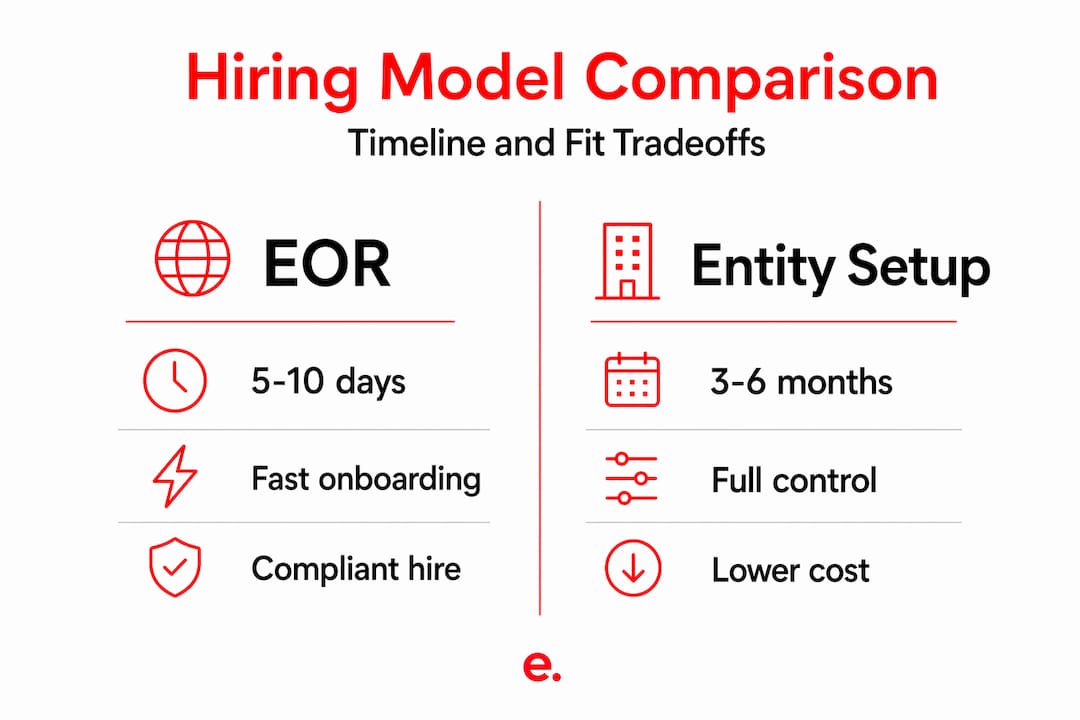
Entity setup gives you full operational control and lower per-head costs at volume. The cost: a 3 to 6 month setup window before your first hire can legally start. For near-term delivery needs, that lead time is simply not usable.
Nearshore models (Latin America, Eastern Europe) occupy an interesting middle ground on timeline. Nearshore ramp-up runs 2 to 4 weeks from contract to first billable hour, largely because timezone overlap enables real-time collaboration. Offshore teams with a 9 to 12 hour time difference rely on asynchronous handoffs, which add days to every cycle.
Key considerations when choosing your model:
- EOR for speed: Best when you need a hire in under 30 days and compliance setup is your bottleneck.
- Entity setup for scale: Only viable if you are planning 6 to 12 months ahead with confirmed headcount projections.
- Nearshore for timezone-sensitive work: If your delivery model requires daily standups and real-time code review, timezone overlap cuts handoff delays substantially.
- India offshore via EOR: Combining India’s deep tech talent pool with EOR management gives you cost efficiency and speed. Remotee’s EOR model in India specifically addresses this balance.
A practical approach for growing teams is to use EOR as a bridge strategy: hire fast now through EOR, then transition to an entity once headcount justifies the setup investment.
Strategies to compress and control offshore timelines
Timelines for global recruitment improve most dramatically when you fix your own internal processes, not just your vendor’s. Internal delays from document readiness, finance sign-offs, and HR gatekeeping consistently cause more onboarding delay than offshore provider processing times.
Here is a practical sequence for getting offshore hiring right from the start:
- Front-load documentation. Collect all compliance and contract documents before a candidate even reaches the final interview stage. Do not let paperwork become a post-offer bottleneck.
- Run internal approvals in parallel. Finance approvals, headcount sign-offs, and IT provisioning requests should start when the first shortlist is presented, not after offer acceptance.
- Use pre-vetted talent pipelines. Partners who maintain active candidate pools cut sourcing time significantly. Waiting for a pipeline to be built after a role is opened costs weeks.
- Set milestone-based expectations. Replace vague “they’ll be productive soon” timelines with specific milestones: first pull request by day 10, first standalone feature by day 30, fully independent by day 60.
- Prepare the team before day one. Assign a technical buddy, set up development environments, and write a 30-day integration plan. Meaningful ramp-up requires pre-start operational readiness, not just completed paperwork.
Pro Tip: Use your offshore staffing partner’s risk mitigation checklist before any new hire process begins. Pre-identifying your internal bottlenecks before you post a role can cut two to three weeks off your actual time-to-start.
Aligning hiring milestones with engineering sprint cycles and billing periods also matters. If a new hire’s onboarding overlaps with your team’s sprint planning, you can integrate them into live work faster instead of keeping them in isolation during a shadow period.
My take on timeline discipline as a competitive advantage
I have seen a pattern repeat itself across tech startups and agencies that scale with offshore teams. The companies that struggle are not failing because of bad candidates or bad offshore partners. They are failing because leadership treats hiring as complete at the offer acceptance stage.
In my experience, onboarding is a strategic integration step. The first four weeks of a hire’s tenure determine whether they become a net contributor in month two or month five. When you have not prepared the team, configured access, or assigned meaningful work before day one, you are paying full salary for someone who is essentially waiting. That waiting has a cost, and it compounds.
The contrarian view I hold is that “speed” in offshore hiring without synchronized workflows actually degrades outcomes. I have watched leaders rush sourcing to hit a headcount target, then watch a hire sit idle for three weeks because IT provisioning was not ready. The hire’s enthusiasm drops, team integration suffers, and you end up with a longer effective ramp despite a fast sourcing cycle.
What I have found actually works is treating your offshore hiring timeline as an operational cadence document, not an HR task list. Map every phase to a delivery milestone. Ask: what does this person need to be billing or shipping by week six, and work backward from that date to figure out when sourcing needs to start. When you align offshore hiring milestones with engineering delivery rhythms, your ROI on offshore talent becomes measurable and predictable.
— Rajkumar
How Remotee removes the timeline friction for you

If the timeline complexity described here feels familiar, you are not alone. Most tech startups and agencies hit these exact friction points the first time they scale offshore. Remotee was built to remove that friction.
With Remotee’s EOR service in India, onboarding moves in 5 to 10 business days with full compliance, payroll, and HR covered from day one. You skip the entity setup timeline entirely. Remotee’s pre-vetted talent pipeline means shortlists arrive fast, and the screening process is already structured to surface candidates who can hit their 30-day milestones. Clients consistently report up to 32% savings on hiring costs compared to domestic equivalents. Whether you are making your first offshore hire or scaling a team of twenty, Remotee’s offshore solutions are built to compress your time-to-first-billable hour, not just your time-to-hire.
FAQ
What is the average offshore hiring timeline for a senior tech role?
From posting to offer acceptance, senior software engineering roles average 95 days, with full productivity extending to 5 to 7 months when you include notice periods, onboarding, and ramp-up.
How fast is EOR onboarding compared to setting up an entity?
EOR onboarding typically completes in 5 to 10 business days, while establishing a legal entity in a new country takes 3 to 6 months. EOR is the clear choice when speed is a priority.
What causes the most delays in offshore hiring timelines?
Internal documentation delays and approval bottlenecks inside your own company are the leading causes of extended timelines, often exceeding the processing times of the offshore provider itself.
Why does time-to-first-billable hour matter more than start date?
Start date only marks when a hire joins payroll. Time-to-first-billable hour captures when they begin generating actual output, which is the true indicator of when your hiring investment breaks even.
How do scheduling delays affect offshore candidate conversion?
Slow interview cycles and delayed offers contribute to 42% of candidate withdrawals in general recruitment. In offshore markets where top candidates hold multiple offers, timeline speed is directly tied to offer acceptance rates.