Offshore Staff Retention Strategies That Actually Work
TL;DR:
- Retaining offshore talent requires strategic management of coaching, communication, and career visibility beyond just offering fair pay.
- Implementing structured coaching, timely transition communications, and clear knowledge mapping significantly reduces turnover and enhances long-term stability.
Hiring offshore talent is only half the battle. The real challenge, one that costs tech companies and startups millions in lost productivity, is keeping that talent. Offshore staff retention strategies often get reduced to “pay them more” or “host a team event,” but the research tells a different story. Retention is shaped by coaching quality, communication timing, staffing model structure, and whether your people see a real career path ahead of them. This article breaks down seven proven approaches, grounded in 2026 research, that give you a practical framework for how offshore staff retention works in practice.
Table of Contents
- Key Takeaways
- 1. Pay What the Market Demands, Not What You Can Get Away With
- 2. Build a Coaching Program, Not Just a Feedback Process
- 3. Time Your Transition Communications Like Your Retention Depends on It
- 4. Map Your Knowledge Holders Before They Walk Out
- 5. Choose the Right Staffing Model for Long-Term Stability
- 6. Create Career Visibility, Not Just Career Development
- 7. Use Employee Engagement Techniques That Match Your Culture
- My Take on What Most Companies Get Wrong
- How Remotee Helps You Build a Retention-Ready Offshore Team
- FAQ
Key Takeaways
| Point | Details |
|---|---|
| Fair pay is the baseline | Compensation aligned with local market rates reduces attrition and builds trust before anything else. |
| Coaching cuts turnover significantly | Structured coaching reduced offshore team turnover by over 40% in documented cases. |
| Communication timing is critical | Announcing project transitions by month 18 keeps transition losses under 8%; waiting causes 15 to 22% attrition spikes. |
| Staffing model choice matters | Vendor-managed teams consistently show lower attrition than seat-by-seat augmentation models with less oversight. |
| Knowledge transfer prevents quiet exits | Mapping knowledge holders and building mentorship pipelines protects against tribal knowledge loss as workforces age. |
1. Pay What the Market Demands, Not What You Can Get Away With
The first of any serious offshore staff retention strategies has to address compensation honestly. There is a persistent myth in offshore hiring that cost savings automatically come from paying less. They do not. They come from labor market differences, not from underpaying skilled professionals relative to their local peers.
When your offshore engineers discover that peers at competing firms earn 15 to 20% more for similar work, they leave. And they leave fast. This is especially true in markets like India, where tech talent has extensive options and word spreads quickly about compensation practices.
What actually works:
- Benchmark salaries against local market data at least once per year, not just at hire
- Include performance bonuses tied to measurable outcomes, not subjective manager reviews
- Offer benefits that matter locally, such as health coverage for family members, rather than copying a US-centric benefits package
- Practice pay transparency by explaining how compensation decisions are made
Pro Tip: Run a compensation audit every 12 months. If your offshore team’s pay has fallen below the 50th percentile for their local market, you are already losing people who haven’t resigned yet.
Pay transparency does something beyond just preventing exits. It builds trust. When your team understands how raises and promotions are decided, they stop filling the uncertainty with worst-case assumptions.

2. Build a Coaching Program, Not Just a Feedback Process
There is a meaningful difference between occasional performance reviews and a structured coaching system. The data makes this distinction very clear. Structured 1:1 coaching reduced offshore team turnover by more than 40% and improved quality assurance scores by 58%.
That is not a marginal gain. That is the difference between a stable team and a revolving door.
Effective coaching for offshore teams includes:
- Weekly or biweekly 1:1s with a dedicated focus on career development, not just task status
- Goal-setting that connects individual growth to company outcomes so people see a reason to stay
- Access to learning budgets for certifications, courses, or conferences relevant to their specialty
- Regular feedback cycles that go both ways, where team members can rate their managers too
Research on software engineer retention shows that psychological safety and career clarity outperform generic perks in driving long-term loyalty. Offshore engineers are not staying for the free snacks. They are staying because their manager creates an environment where it is safe to ask questions, admit mistakes, and grow.
Pro Tip: Treat your coaching program as an operating system, not a one-time initiative. Embed it into sprint cadences, onboarding, and performance cycles so it becomes a non-negotiable part of how your team functions, not something that disappears when managers get busy.
3. Time Your Transition Communications Like Your Retention Depends on It
This section addresses one of the most overlooked levers in offshore workforce management: when you tell people things.
Attrition risk peaks in months 4 through 9 of an offshore engagement, but it spikes again sharply during project transitions. The research is specific: announcing handover plans by month 18 of a long-term engagement reduces transition-related attrition to under 8%. Late announcements push that number to 15 to 22%.
Why such a dramatic difference? Because your offshore staff are making career decisions continuously. When they sense a transition coming but have no official information, they start interviewing. Clarity keeps them from making that call.
Here is what early, transparent communication looks like in practice:
- Share the transition timeline openly at month 18, even if details are still being finalized
- Communicate role continuity plans for each team member individually, not just as a group announcement
- Clarify how tenure, benefits, and compensation are handled during and after the handover
- Assign a governance lead who is the single point of contact for transition questions
“Clarity on what comes next is not just a courtesy. It is a retention mechanism. The moment your offshore team perceives a vacuum of information, they fill it by looking elsewhere.”
Effective communication during transitions also means defining who makes which decisions and when. Governance confusion during handovers creates friction that accelerates departures, particularly among your strongest performers who have the most options.
4. Map Your Knowledge Holders Before They Walk Out
Here is a retention risk most tech leaders underestimate until it is too late: nearly 50% of the offshore workforce is over age 45. That demographic shift means a significant portion of your offshore team carries tribal knowledge that is not written down anywhere.
When those team members exit, whether through retirement, career change, or simply finding a better offer, they take years of context with them. The impact is not just operational. It drives up recruiting costs and extends the time it takes for replacement hires to become productive.
| Approach | What it addresses | Effort level |
|---|---|---|
| Knowledge holder registry | Maps who owns critical undocumented expertise | Medium |
| Mentorship pipelines | Pairs experienced staff with successors before exits happen | Medium to High |
| Sprint documentation allocation | Builds knowledge capture into regular capacity | Low |
| Successor planning | Identifies backup owners for all critical knowledge areas | High |
Allocating roughly 10% of sprint capacity for documentation starting at month 6 of an engagement eliminates approximately 80% of handover friction down the line. That is a concrete, measurable return on a modest investment of structured time.
Pro Tip: Do not wait for a departure announcement to start building your knowledge registry. Create a living document now that maps which team members own which undocumented processes, and update it quarterly.
5. Choose the Right Staffing Model for Long-Term Stability
How offshore staff retention works is deeply tied to the model under which those staff are hired and managed. Not all offshore staffing structures create equal retention outcomes. This is one of the best practices for staff retention that often gets skipped in early-stage hiring decisions.
Vendor-managed offshore teams typically report annual attrition below 15%, compared to the 18 to 22% benchmark seen in less structured models. The reason is accountability. When a vendor manages the team, there are built-in processes for replacing staff, managing morale, and handling HR issues that seat-by-seat augmentation simply does not provide.
Key considerations when choosing your model:
- Staff augmentation gives you direct control but places the full retention burden on your internal team, which is a significant management overhead
- Vendor-managed teams include accountability structures and HR support, but require trust in your vendor’s processes
- Employer of Record (EOR) models like those offered by Remotee handle compliance, payroll, and benefits in-country while giving you direct access to your team
For onboarding speed, the offshore hiring advantage is significant. Offshore recruiting and onboarding typically costs $2,000 to $5,000, compared to $15,000 to $35,000 for in-house equivalents. Faster, less expensive onboarding means lower early-attrition costs and a shorter time to productivity for new hires.
Pair your model choice with a structured onboarding process that builds connection from day one. The first 90 days matter more than most leaders acknowledge. A team member who feels seen, informed, and integrated in the first three months is far less likely to leave at month six.
6. Create Career Visibility, Not Just Career Development
There is a difference between offering professional development and giving someone a clear line of sight to where their career is going. Offshore teams, particularly in tech, do not just want training budgets. They want to know what success looks like for them inside your organization.
What talent retention offshore actually requires is a visible ladder or lattice, not just a vague promise of growth. This means documenting promotion criteria clearly, showing team members what skills and outputs qualify them for advancement, and having those conversations explicitly rather than leaving people to guess.
You can also look at the offshore staffing risk mitigation checklist from Remotee for a structured way to think about career visibility as part of your broader retention planning.
Retention strategies for remote teams often fail here because managers assume the team understands the growth path. They rarely do. A quarterly career conversation, distinct from performance review, specifically addressing where the team member wants to be in two years and what you can offer toward that goal, is one of the highest-leverage retention investments you can make.
7. Use Employee Engagement Techniques That Match Your Culture
Generic employee engagement techniques often miss the mark for offshore teams because they are designed around co-located, culturally homogeneous workplaces. A ping-pong table and a Friday happy hour do not translate well across time zones.
Effective engagement for offshore teams in tech tends to center on three things: inclusion in decision-making, recognition that is specific and timely, and social connection that does not feel forced.
Including offshore team members in product discussions, architecture reviews, or business planning calls, rather than limiting them to execution, makes them feel like genuine contributors. Specific recognition matters more than generic praise. “You caught that database bottleneck before it hit production and saved us two days of downtime” lands differently than “great work this week.”
You can also reference the dedicated offshore staffing benefits research to understand how team structure itself shapes how engaged people feel. Dedicated teams, where members stay together over time, outperform project-by-project staffing on every engagement metric including retention.
My Take on What Most Companies Get Wrong
I’ve seen hundreds of offshore engagements play out, and the pattern that frustrates me most is this: companies spend enormous energy on sourcing and hiring, then treat retention as something that happens automatically if nothing goes wrong.
It doesn’t work that way. Retention is active management, not the absence of bad management.
The thing I’ve found that most leaders miss is the timing piece. They know communication matters, but they wait until the transition is fully planned before they say anything. By then, early announcement timing has already passed, and you’re watching your best people update their LinkedIn profiles while you’re still finalizing the handover roadmap.
The other thing I’ve observed is that managers confuse activity with engagement. Running a town hall or sending a pulse survey is not the same as creating psychological safety. Your offshore engineers know the difference between a manager who genuinely cares about their growth and one who is going through the motions. Participative leadership is not a style exercise. It is what separates a 5% annual attrition rate from a 20% one.
Build the systems. Be consistent with them. And treat your offshore team like the long-term strategic asset they are, not a cost line you’re optimizing.
— Rajkumar
How Remotee Helps You Build a Retention-Ready Offshore Team
Retention does not start at month six. It starts with how you hire, onboard, and structure your offshore team from day one.
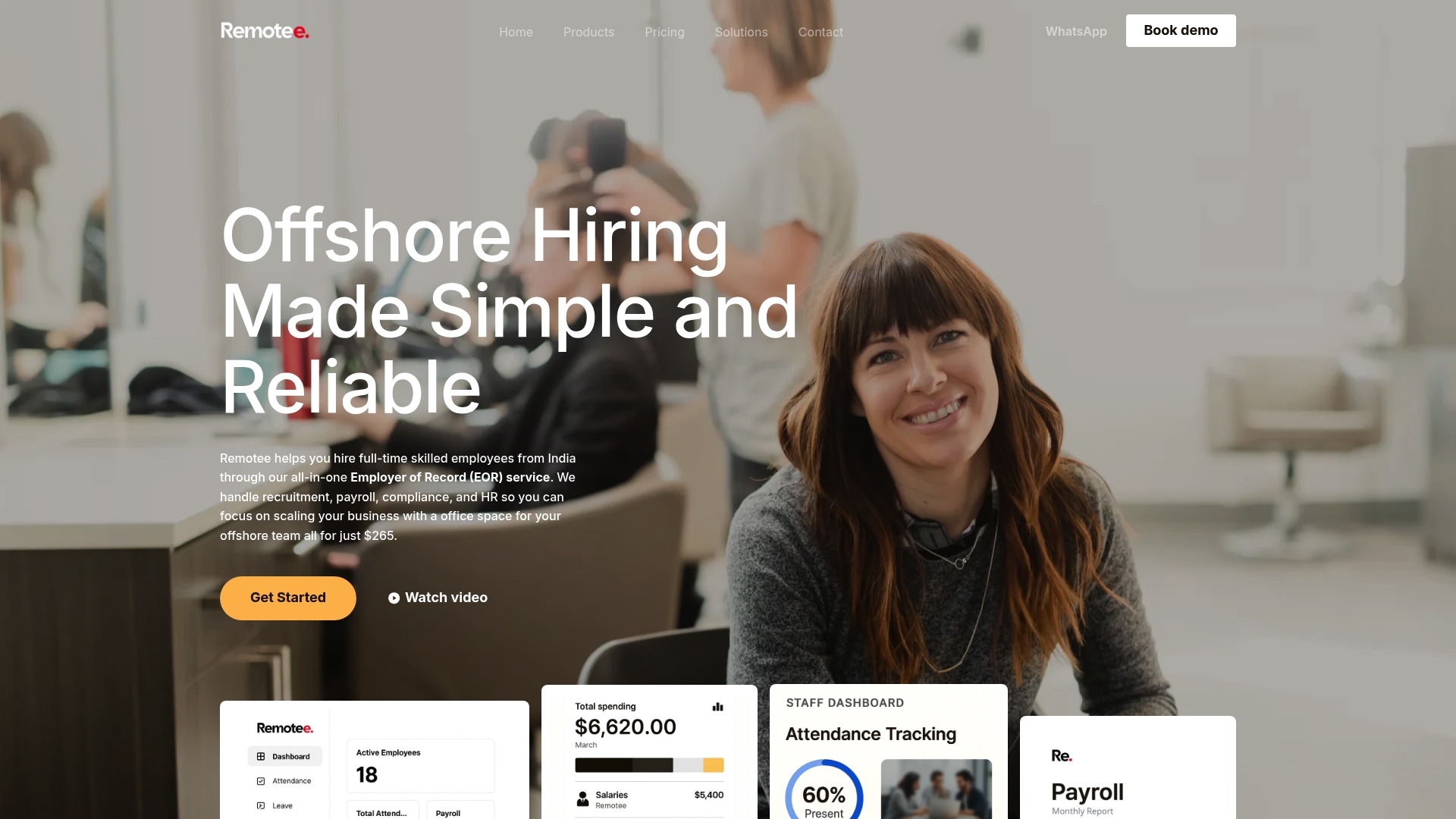
Remotee’s Employer of Record service in India handles the compliance, payroll, and HR infrastructure that most companies struggle to get right when hiring offshore. That means your team members receive locally compliant benefits, on-time payroll, and clear HR support from their first day. These are the foundation-level factors that prevent early attrition before your retention programs even kick in.
Clients working with Remotee report up to 32% savings on hiring costs, and they get there without compromising on talent quality or team stability. If you want to explore how offshore hiring with Remotee can support a retention-first approach from the ground up, the team is ready to walk you through it.
FAQ
What is talent retention offshore and why does it matter?
Talent retention offshore refers to the strategies and practices companies use to keep skilled offshore employees engaged and employed long-term. It matters because offshore attrition carries significant recruiting, onboarding, and productivity costs that offset the cost savings that drove offshore hiring in the first place.
How does structured coaching reduce offshore turnover?
Structured coaching reduces turnover by more than 40% in offshore teams by giving employees consistent career development, feedback, and a sense of direction. It addresses the management quality gap that is the leading cause of preventable attrition in offshore engagements.
When should you communicate project transitions to offshore staff?
Announce handover plans by month 18 of a long-term engagement. Early transition communication keeps attrition losses under 8%, while late or unclear communication drives losses to 15 to 22%.
Which offshore staffing model supports better retention?
Vendor-managed models and EOR structures typically outperform seat-by-seat staff augmentation for retention because they include built-in HR accountability, replacement processes, and locally compliant employment structures that reduce friction for team members.
How do you retain offshore employees without increasing costs significantly?
Focus on the non-monetary drivers: career visibility, coaching quality, timely communication, and psychological safety. These retention strategies for remote teams have a higher return than generic perks and require management investment rather than budget expansion.