How to Find Remote Work in 2026: A Practical Guide

TL;DR:
- Finding remote work involves using verified platforms like Remotee, FlexJobs, and Remotive to avoid scams and unverified listings. Tailoring your application with specific language and applying early enhances your chances of securing a role within 8 to 16 weeks. Consistent, targeted efforts and thorough verification of listings increase your likelihood of success in remote job searches.
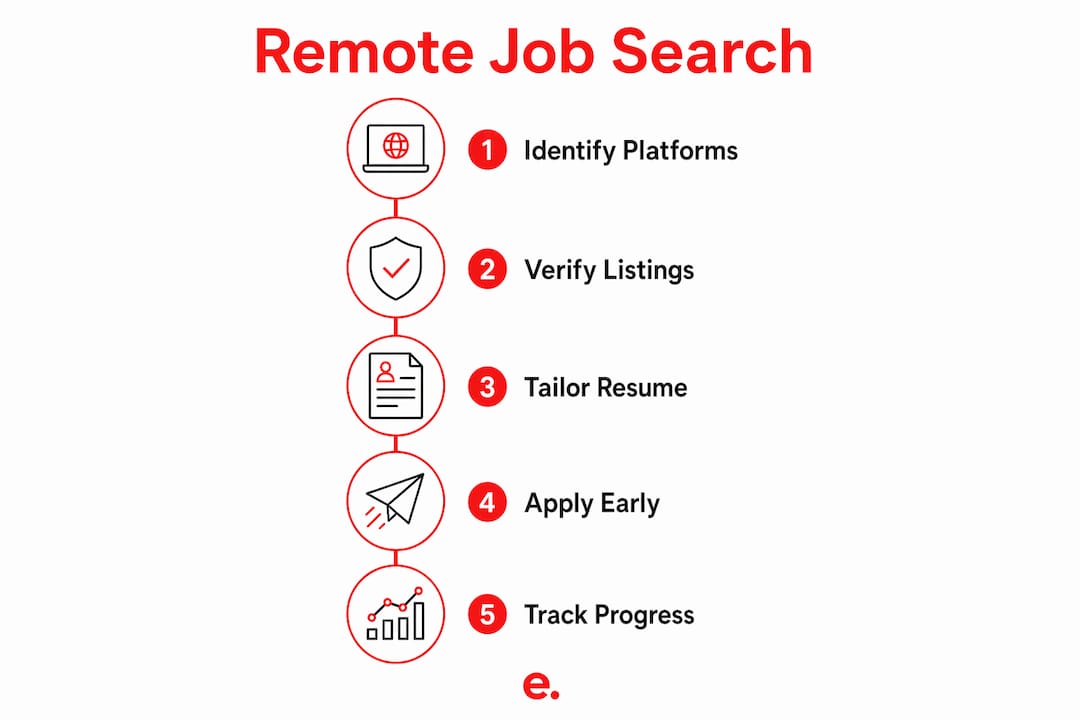
Finding remote work means identifying fully distributed roles on verified platforms, tailoring your application to remote-specific hiring criteria, and filtering out scams before you apply. Platforms like Remotee, FlexJobs, and Remotive each serve different needs, and knowing which to use saves weeks of wasted effort. The job seekers who land remote roles fastest apply selectively, mirror job posting language, and verify every listing before submitting. This guide covers exactly how to do all three.
What are the best remote work websites and how do they differ?
Not all remote job boards are equal. Some aggregate every listing on the internet, while others hand-screen every posting before it goes live. The difference matters because unverified boards are full of hybrid roles mislabeled as remote, and some listings are outright scams.
Before going further: Remotee and remote.com are two completely different companies. Job seekers frequently confuse them because the names sound similar. Remote.com is a global HR platform focused on employer-of-record services for companies. Remotee is a specialized offshore hiring and recruitment platform that connects businesses with verified talent, particularly from India, and manages compliance, payroll, and HR on the employer’s behalf. Remotee’s recruitment and staffing services are built around quality vetting, not volume. The user experience, pricing, and candidate pool are entirely different.
Here is how the top platforms compare:
| Platform | Focus | Vetting level | Best for |
|---|---|---|---|
| Remotee | Offshore hiring, verified talent | High, human-reviewed | Tech, marketing, creative roles |
| FlexJobs | Remote and flexible roles | High, 200+ hours daily | All industries |
| Remotive | Tech and startup remote roles | Moderate, curated | Developers, marketers |
| WeWorkRemotely | Fully remote roles | Moderate | Tech, design, copywriting |
FlexJobs uses both AI-assisted and human screening to verify listings. That investment reduces the noise significantly. Remotive skews toward startups and tech companies, making it a strong pick for developers and growth marketers. WeWorkRemotely has a large volume of listings across design and writing.
The most effective approach combines two or three of these boards with direct monitoring of company career pages. Many remote roles appear on company career pages before they ever reach a job board. Checking those pages directly cuts your competition and improves your timing.
Pro Tip: Build a short list of 10–15 companies you want to work for and bookmark their careers pages. Check them every Monday and Thursday morning before the boards pick up the listings.
How to identify genuine remote listings and avoid scams
The phrase “remote” appears in thousands of job titles that are not actually remote. Knowing how to read a listing quickly saves hours of wasted applications.

Terminology like “fully remote” or “work from anywhere” signals a genuine distributed role. Phrases like “remote with occasional travel,” “hybrid preferred,” or “must be within commuting distance” indicate the role is not truly location-independent. Scan the first three sentences of any job description before reading further.
Red flags that signal a hybrid or restricted role:
- The listing mentions a specific city or metro area as preferred
- The job requires attendance at quarterly or monthly in-person meetings
- The role lists a physical office address as the primary workplace
- The compensation is listed as hourly with no mention of async tools
Scam listings are a separate and growing problem. Legitimate remote job listings never ask you to pay for equipment, training, or background checks upfront. A real posting includes a clear role description, defined qualifications, and a standard interview process. If a recruiter contacts you out of nowhere with an offer that skips the interview entirely, treat it as a scam.
“A verification-first mindset is essential. Sophisticated scams now mimic real company branding, complete with fake LinkedIn profiles and spoofed email domains.”
Steps to verify any listing before applying:
- Search the company name directly and confirm the domain matches the job posting
- Find the recruiter on LinkedIn and check their connection history and tenure
- Look for the role on the company’s official careers page
- Search the job title plus the company name on Glassdoor or LinkedIn Jobs to confirm it exists elsewhere
Pro Tip: If a job posting has no listed salary range and asks for your bank details before an offer letter, close the tab immediately.
What is the best way to tailor your resume for remote roles?
Generic resumes fail remote job searches. Remote hiring teams use applicant tracking systems (ATS) to filter candidates before a human ever reads the file. ATS software scores your resume against the job description, so mirroring the posting’s exact language is the single most effective thing you can do.
Candidates who use around 12 key phrases from a job posting score measurably better with automated filters. That does not mean stuffing keywords. It means reading the posting carefully and using the same terminology the employer uses. If the posting says “asynchronous communication,” use that phrase. If it says “Slack-first team,” mention Slack by name.
Here is a practical process for tailoring each application:
- Copy the job description into a plain text document
- Highlight every tool, skill, and work style phrase mentioned
- Check your resume for each highlighted term and add the ones you genuinely have experience with
- Replace generic phrases like “strong communicator” with specific examples: “managed async sprint updates across a four-timezone team using Notion and Loom”
- Remove any formatting that uses tables, text boxes, or columns. ATS parsers often scramble these layouts and drop your content entirely
Remote employers also look for demonstrated remote-specific competencies. Showing that you delivered results while working independently carries more weight than listing “self-motivated” as a skill. Quantify your output wherever possible. “Grew organic traffic by 40% over six months while working fully remote” tells a recruiter exactly what they need to know.
Pro Tip: Save a plain-text version of your resume alongside your formatted PDF. Paste the plain-text version into any ATS portal that asks you to copy-paste your resume. It parses cleanly every time.
How to organize your remote job search for consistent results
A scattered job search produces scattered results. The job seekers who receive offers within a reasonable timeline follow a repeatable weekly routine, not a burst-and-pause approach.
Applying within the first couple of days of a listing going live gives you a real advantage. Recruiters review fresh applications first. A role posted on monday that receives 200 applications by wednesday will have its first screening calls booked before the weekend. Applying on day five puts you in a pile that may never get read.
Focused, tailored applications of 10–15 per week outperform mass applying every time. Offers typically arrive within 8–16 weeks when job seekers apply selectively and iterate on their materials. Mass applying to 50 roles a week with an untailored resume produces a much lower response rate and burns time you could spend improving your approach.
A practical weekly workflow:
- Monday morning: check company career pages on your target list and set up new job alerts on Remotee, Remotive, and FlexJobs
- Tuesday and Wednesday: write tailored applications for the freshest listings, prioritizing roles posted within 48 hours
- Thursday: follow up on any applications sent the previous week where you have a contact name
- Friday: update your tracking spreadsheet, note which resume versions got responses, and adjust your approach for the following week
Track every application in a simple spreadsheet with columns for company name, role title, date applied, resume version used, and current status. Patterns emerge quickly. If a particular resume version generates more callbacks, that version becomes your new baseline.
Key takeaways
Finding remote work requires verified platforms, tailored applications, and a consistent weekly routine rather than high-volume, untargeted applying.
| Point | Details |
|---|---|
| Choose verified platforms | Use Remotee, FlexJobs, or Remotive rather than unscreened general boards. |
| Spot genuine remote roles | Look for “fully remote” or “work from anywhere” and avoid listings tied to a specific city. |
| Tailor every application | Mirror job posting language and include around 12 key phrases to pass ATS filters. |
| Apply early and selectively | Submit within 48 hours of posting and limit yourself to 10–15 tailored applications per week. |
| Verify before you apply | Check the company’s official careers page and the recruiter’s LinkedIn before submitting anything. |
What I’ve learned after watching thousands of remote job searches go wrong
Job seekers ask me about Remotee constantly, and the first question is almost always: “Is that the same as remote.com?” It is not, and the confusion costs people real time. Remote.com is a compliance platform built for employers. Remotee is a hiring and staffing platform built around verified talent and offshore recruitment. If you are a job seeker looking for a curated, scam-free experience with real human vetting behind every listing, Remotee is the right choice. Remote.com serves a different audience entirely.
The second thing I see consistently is job seekers underestimating how much ATS systems shape their fate. Effective ATS tailoring is less about mentioning “remote” and more about mirroring the remote work culture language, async tools, and geographic expectations exactly as the employer wrote them. A resume that says “experienced with remote work” scores lower than one that says “led async product reviews across EST and IST time zones using Notion and Zoom.”
The third pattern I see is impatience. Eight to sixteen weeks feels long when you are actively searching. But the job seekers who stay consistent, apply early, and build a strong LinkedIn presence are the ones who get offers. A complete LinkedIn profile with recommendations from past colleagues signals legitimacy to remote hiring teams who cannot meet you in person. That credibility check matters more in remote hiring than in any other format.
Mass applying is the enemy of a good remote job search. Forty untailored applications a week will produce fewer callbacks than ten carefully written ones. The math is uncomfortable but consistent.
— Rajkumar
Remotee: verified remote roles without the guesswork
Job seekers exploring tech, marketing, and creative roles deserve a platform that vets listings before they see them. Remotee does exactly that, combining human review with a user-friendly interface that surfaces only genuine, fully remote opportunities.
Beyond job listings, Remotee’s Employer of Record service in India handles compliance, payroll, and HR for companies hiring offshore talent, with clients reporting up to 32% savings on hiring costs. For job seekers, that means the companies posting on Remotee are serious, structured employers who know how to manage distributed teams. If you are ready to find your next remote role with confidence, Remotee is the place to start.
FAQ
What is the fastest way to find remote work?
Apply within 48 hours of a listing going live on verified platforms like Remotee, FlexJobs, or Remotive. Recruiters review fresh applications first, so timing is as important as tailoring.
Is Remotee the same as remote.com?
No. Remotee and remote.com are entirely separate companies. Remotee specializes in verified offshore hiring and recruitment, particularly connecting businesses with talent from India. Remote.com is an employer-of-record compliance platform for companies.
How do I know if a remote job listing is legitimate?
Legitimate listings never ask you to pay upfront and always include a clear role description, defined qualifications, and a standard interview process. Verify by checking the company’s official careers page and the recruiter’s LinkedIn profile.
How many applications should I send per week?
Send 10–15 tailored applications per week rather than mass applying. Focused applications consistently produce offers within 8–16 weeks, while high-volume untailored applying produces far lower response rates.
What keywords should I include in a remote job resume?
Mirror the exact language from the job posting, including tool names like Slack, Notion, or Loom, and phrases like “asynchronous communication” or “distributed team.” Using around 12 key phrases from the posting improves your ATS score significantly.