How to Terminate Offshore Employees Compliantly in 2026
TL;DR:
- Terminating offshore employees lawfully requires following local labor laws through the Employer of Record (EOR) in each country.
- A compliant process depends on pre-termination documentation, jurisdiction alignment, protected status checks, and an approved cost projection.
- The EOR manages procedural steps like notices, consultations, severance calculation, and final payments, while internal teams coordinate documentation and approvals.
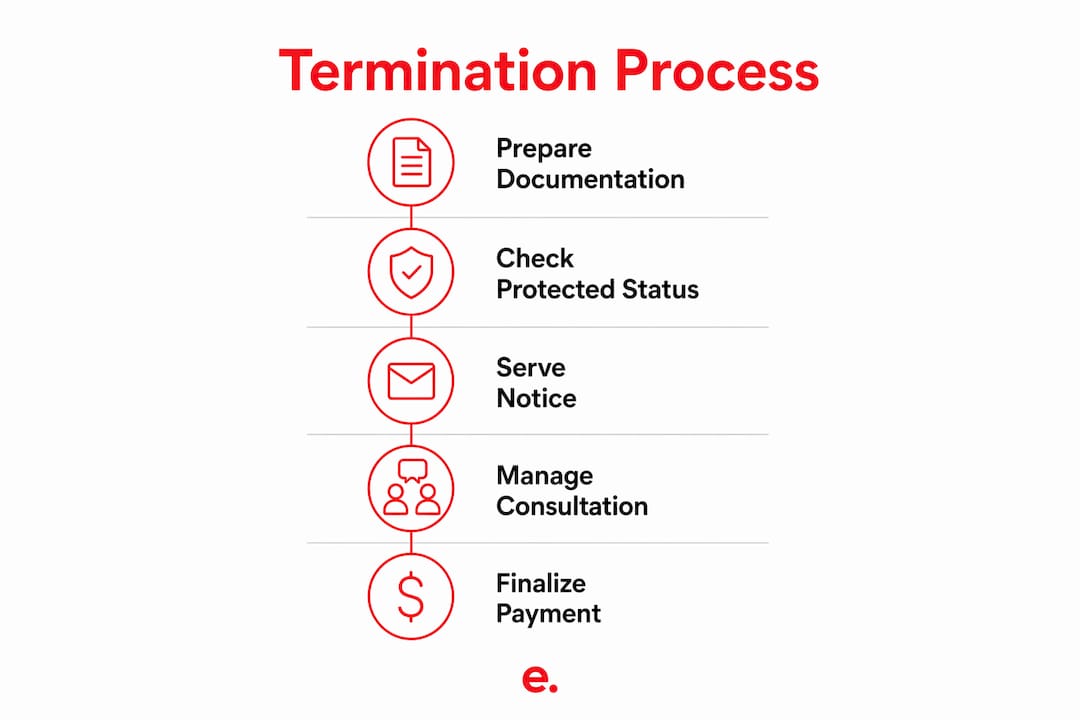
Terminating an offshore employee compliantly means following the Employer of Record’s (EOR) local labor law processes in the employee’s country, not the at-will employment rules common in the United States. The EOR is the legal employer of record in that jurisdiction, and every dismissal must flow through its country-specific termination framework. Skipping procedural steps, applying US instincts to global contracts, or issuing informal severance promises can trigger wrongful dismissal claims, labor court proceedings, and significant financial penalties. This guide walks HR managers and business owners through the prerequisites, step-by-step EOR process, jurisdiction-specific rules, and internal coordination practices needed for a legally sound offshore employee dismissal.
What prerequisites does compliant offshore termination require?
Compliant offshore termination starts well before any notice is served. Global termination compliance relies on four control inputs: a documented performance file, a finance-approved cost projection, a country-specific procedural map, and a single EOR point of contact who owns the process end to end. Missing any one of these inputs before issuing notice risks long delays and legal fees that often exceed the original severance cost.

The documented performance file is not optional. It must contain written warnings, performance improvement plans, attendance records, or business restructuring evidence, depending on the grounds for dismissal. Without this file, the EOR cannot confirm lawful grounds for termination, and the dismissal is legally vulnerable from day one.
Protected status checks are equally non-negotiable. Employees on parental leave, medical leave, or union-protected status in many countries cannot be dismissed without additional procedural steps or regulatory approval. Your EOR’s local legal team must verify protected status before any communication reaches the employee.
Jurisdiction alignment is a step many companies overlook. Misclassifying the jurisdiction of an offshore employee’s contract relative to their actual country of residence is one of the most common causes of failed dismissals at labor courts. Confirm that the contract jurisdiction matches the employee’s physical work location before the process begins.
Pro Tip: Never make informal severance promises to the employee before the EOR has reviewed and approved the cost projection. Unofficial commitments create binding obligations in many jurisdictions and can override the statutory calculation entirely.
- Assemble the documented performance or restructuring file.
- Confirm the employee’s country of residence and contract jurisdiction match.
- Run a protected status check through the EOR’s local legal team.
- Get a finance-approved cost projection covering notice pay, statutory severance, and any accrued benefits.
- Assign a single internal owner to coordinate all communication with the EOR.
How does the EOR manage the offshore termination process step by step?
The EOR is the legal employer responsible for executing every procedural step. Issuing notices and conducting statutory procedures are the EOR’s legal obligations, not yours. Your role is to provide the grounds, the documentation, and the approvals. The EOR translates those inputs into a compliant termination sequence under local law.
The typical sequence looks like this:
- Termination plan delivery. The EOR presents a written plan covering notice period, consultation requirements, severance calculation, and final pay timeline before any action is taken.
- Employee notice period. The EOR issues the formal notice letter in the local language, in the format required by local law.
- Works council or union consultation. Where required, the EOR manages this process. In Germany, works council consultation takes one week. A dismissal issued before that consultation period ends is legally void.
- Severance calculation and approval. The EOR calculates statutory severance based on tenure, contract type, and local law. Finance must approve the final figure before the EOR proceeds.
- Final pay processing. The EOR closes payroll, processes accrued leave, and issues the final settlement within the statutory deadline.
- Closing documentation. The EOR prepares the signed termination letter, qualified reference letter where required, and any statutory certificates.
Pro Tip: Request the full closing documentation packet from the EOR on the last working day. Documentation disputes are often raised by tax authorities or labor inspectors up to 12 months after termination, and missing records at that point are extremely difficult to reconstruct.
| Country | Works Council Required | Notice Period | Final Pay Deadline |
|---|---|---|---|
| Germany | Yes (1-week consultation) | 4 weeks minimum | Per statutory schedule |
| Vietnam | No | 3–45 days by contract type | 14 working days |
| India | No | Per contract or statute | 2 working days |
| Australia | No | 1–5 weeks by tenure | Per Fair Work Act |
What country-specific legal risks can derail offshore employee dismissal?
Jurisdiction-specific rules are where most offshore terminations go wrong. Each country has its own notice periods, payment deadlines, and procedural fairness requirements. Treating them as interchangeable is the fastest route to a labor court claim.
Vietnam’s Labour Code 2019 sets notice periods based on contract type, ranging from 3 to 45 days, and requires final settlement within 14 working days of the termination date. That 14-day window is not a guideline. Payroll must be closed and funds transferred before the deadline or the employer faces statutory penalties.
India’s Code on Wages, 2019 is even stricter. Wages payable on termination must be paid within 2 working days of dismissal. Withholding final wages because the employee has not returned company assets is not permitted under Indian law. This 48-hour rule applies regardless of the circumstances of the termination.
Australia presents a different kind of risk. The Fair Work Act applies in cases where the employment relationship has sufficient connection to Australia. In a May 2026 case, the Fair Work Commission ordered compensation after an employer terminated a worker by text message without warning or an opportunity to respond. The commercial reason for termination was not in dispute. The procedural failure alone triggered the payout.
“Lack of procedural fairness before dismissal can trigger compensation in Australia despite valid commercial reasons for termination.” — Fair Work Commission, May 2026
Common pitfalls that lead to failed terminations include dismissing before mandatory consultations are complete, withholding wages to recover assets, ignoring protected status, and serving notice in the wrong format or language. Each of these mistakes resets the clock and adds cost. The offshore staffing risk mitigation checklist from Remotee covers these jurisdiction-specific triggers in detail.
How should internal teams coordinate during an offshore layoff?
Internal coordination failures are as costly as legal missteps. When HR, finance, and the EOR are not aligned, mid-process changes create surcharges, delays, and sometimes void the termination entirely.
HR’s responsibilities during offshore employee separation are specific:
- Maintain the complete performance or restructuring file and make it available to the EOR on request.
- Prepare the employee communication plan in coordination with the EOR, not independently.
- Confirm the employee’s last working day aligns with the notice period the EOR has calculated.
- Avoid any direct communication with the employee about severance amounts before the EOR has finalized the statutory figure.
Finance must be briefed early. Coordinating HR, finance, and legal teams with a single EOR contact owning the termination process helps avoid costly missteps and delays. Finance needs to approve the cost projection, confirm cash flow for the final pay run, and understand the payroll closure timeline. Surprises at the payment stage are the most common cause of statutory deadline breaches.
The single point of contact rule matters more than most companies realize. When multiple people on your team communicate directly with the EOR at different stages, conflicting instructions create confusion and legal exposure. One person owns the process. Everyone else routes through that person.
Maintain an audit trail throughout. Every instruction to the EOR, every approval, and every document exchange should be logged. A robust audit trail and complete documentation packet at exit are your primary defense against wage claims and labor inspections that can arrive up to a year after the termination date. The HR role in offshore hiring extends through the full employment lifecycle, including offboarding, and that accountability should be built into your internal process from day one.
Key takeaways
Compliant offshore termination requires the EOR to execute every legal step under local law, with HR and finance providing documentation, approvals, and a single coordinated point of contact.
| Point | Details |
|---|---|
| EOR owns legal execution | The EOR issues notices, manages consultations, and processes final pay under local law. |
| Four inputs before notice | Prepare a performance file, cost projection, procedural map, and single EOR contact first. |
| Jurisdiction alignment is critical | Confirm the employee’s country of residence matches the contract jurisdiction before proceeding. |
| Country rules vary sharply | India requires final pay within 2 days; Vietnam within 14 working days; Germany requires works council consultation. |
| Audit trail protects you | Complete documentation at exit defends against labor and tax claims up to 12 months later. |
What i’ve learned after watching offshore terminations go wrong
The most expensive mistake I see HR teams make is treating offshore termination as an administrative task rather than a legal employment action. They assume the EOR will handle everything automatically once they send the instruction. That is not how it works. The EOR needs your documentation, your approvals, and your cooperation at every stage. Without those inputs, the process stalls.
The second mistake is the US at-will instinct. I have seen business owners instruct their EOR to terminate an employee immediately, with no notice, because that is how they would handle it domestically. Most compliance failures arise from exactly this pattern. The EOR cannot legally comply with that instruction. It will propose a compliant path instead, and if the business owner pushes back, the resulting delay costs more than the original notice period would have.
The third thing I have learned is that timing discipline matters enormously. Mid-process changes, like adjusting the termination date after notice has been served, or changing the severance offer after the EOR has communicated it, create legal complications that are hard to unwind. Commit to the plan the EOR presents. If you need to change it, do so before notice is issued, not after.
Working with a reliable EOR partner who has genuine in-country legal expertise is the single most effective way to reduce termination risk. Generic platforms that manage terminations from a central compliance team without local counsel are a liability. The offshore payroll and final settlement process is jurisdiction-specific at every step, and that specificity requires real local knowledge.
— Rajkumar
How Remotee handles compliant offshore terminations end to end
Offshore terminations carry real legal and financial risk when managed without in-country expertise. Remotee’s Employer of Record service in India manages every step of the termination process, from lawful grounds verification and notice period calculation to final pay execution and statutory documentation. HR managers and business owners get a single point of contact who owns the process, coordinates with local legal counsel, and keeps the timeline on track.

Remotee’s compliance-first approach means your offshore employee dismissal follows the correct local procedures without exposing your business to wrongful dismissal claims or wage penalty risk. If you are managing offshore staff and need a trusted EOR partner who understands the full employment lifecycle, explore Remotee’s offshore hiring solutions to see how compliant offboarding fits into a broader workforce strategy.
FAQ
What is an employer of record in offshore termination?
An Employer of Record (EOR) is the legal employer in the offshore worker’s country and is responsible for executing termination under local labor law. The EOR issues notices, manages statutory consultations, calculates severance, and processes final pay on your behalf.
How long does offshore employee termination take?
Timelines vary by country. Vietnam requires final settlement within 14 working days, India within 2 working days, and Germany requires a minimum one-week works council consultation before dismissal is valid.
Can i terminate an offshore employee immediately without notice?
No. Immediate termination without notice violates local labor law in most jurisdictions and exposes the business to wrongful dismissal claims and financial penalties. The EOR must follow the statutory notice period for the employee’s country.
What documentation is required for offshore employee dismissal?
A compliant termination requires a documented performance or restructuring file, a finance-approved cost projection, a signed termination letter, and a final pay settlement record. Missing documentation can be challenged by labor inspectors up to 12 months after the termination date.
What happens if procedural steps are skipped?
Skipping required steps, such as works council consultation in Germany or procedural fairness in Australia, can void the dismissal entirely or trigger mandatory compensation payouts. The Fair Work Commission ordered a payout in May 2026 after an employer terminated a worker by text without warning.