What Is Cost-Per-Hire Offshore? 2026 Guide

Most companies assume offshore hiring is simply cheaper. You post a job, hire someone in India or the Philippines, and watch your payroll costs drop. The reality of what is cost-per-hire offshore is considerably more layered. Understanding offshore cost-per-hire means accounting for EOR fees, statutory contributions, compliance overhead, and a productivity ramp-up that can stretch three to six months. This guide breaks down every component, shows you how to calculate offshore hiring expenses accurately, and gives you the frameworks to make smarter budget decisions before you commit to a hiring strategy.
Table of Contents
Key takeaways
| Point | Details |
|---|---|
| Cost-per-hire is a formula | Divide total internal and external recruiting costs by the number of hires to get your baseline metric. |
| Offshore adds unique cost layers | EOR fees, statutory employer contributions, and compliance costs must be factored into any offshore recruitment cost analysis. |
| Savings range from 40 to 70% | Offshore knowledge workers typically cost 40 to 70% less than U.S. equivalents, but only after all fees are included. |
| Hidden costs are real | Tools, onboarding, and a 3 to 6 month productivity adjustment period can add 15 to 20% to your effective offshore rate. |
| ROI requires a full-cost view | Comparing base salaries alone distorts your offshore hiring cost picture. Use a total-cost model before deciding. |
What is cost-per-hire offshore, and how is it calculated?
Cost-per-hire is the total amount your organization spends to fill one position, expressed as a single dollar figure. The SHRM/ANSI standard formula divides the sum of all internal and external recruiting costs by the total number of hires in a given period.
The formula:
Cost-Per-Hire = (Total Internal Costs + Total External Costs) ÷ Total Hires
Breaking down what goes into each bucket is where most HR teams lose precision.
Internal recruiting costs
These are the expenses your organization absorbs directly, regardless of whether a hire is made:
-
Recruiter and HR team salaries (prorated to time spent on recruiting)
-
Applicant tracking system (ATS) subscription fees
-
Hiring manager time spent on interviews and evaluations
-
Internal referral bonuses paid to employees
External recruiting costs
These are vendor and third-party expenses tied to sourcing and screening:
-
Agency fees of 15 to 25% of first-year salary for contingency placements, up to 40% for executive search
-
Job board postings ranging from $50 to $500 per listing
-
Background checks and skills assessments
-
Candidate travel and relocation support
For a practical example: if your team spends $12,000 on recruiter time, $3,000 on job boards, and $5,000 on an agency fee to fill four roles, your cost-per-hire is $5,000. That figure is your baseline. The U.S. average cost-per-hire sits around $4,700, though executive roles frequently exceed $15,000.
What cost-per-hire does not include: onboarding costs, training, equipment provisioning, or the productivity loss during ramp-up. Those belong in a separate total-cost-of-hire or time-to-productivity model, which becomes especially critical when you move offshore.
Offshore hiring costs: what you actually pay in 2026
When you hire offshore, the cost structure shifts significantly. Base salary is still the largest line item, but it sits alongside several fees that domestic hiring rarely requires. Understanding offshore cost-per-hire means building a complete picture of every recurring and one-time expense.

Salary benchmarks by role
Offshore salary ranges vary widely depending on role and region. Here are 2026 benchmarks for common positions:
| Role | Offshore annual cost | U.S. equivalent |
|---|---|---|
| Administrative / operations | $10,000 to $25,000 | $45,000 to $65,000 |
| Customer support | $12,000 to $28,000 | $40,000 to $55,000 |
| Mid-level software developer | $35,000 to $70,000 | $95,000 to $140,000 |
| Senior software engineer | $45,000 to $90,000 | $130,000 to $180,000 |
EOR and compliance fees
If you hire through an Employer of Record rather than setting up a local entity, you pay a monthly service fee per employee. EOR fees range from $199 to $1,200 per month, with the median landing between $400 and $700. That fee covers payroll processing, local compliance, HR administration, and benefits management. It does not cover the employee’s gross salary or statutory employer contributions.
Statutory contributions are the part most companies underestimate. In the U.S., employer payroll taxes run about 7.65%. In France, they reach 40 to 45%. India sits in a moderate range, but provident fund contributions, gratuity provisions, and professional tax add up. Always request a full statutory cost breakdown from your EOR provider before you finalize a budget.
Hidden costs that inflate your effective rate
Hidden expenses add 15 to 20% to your base offshore rate when you account for:
-
Software licenses and collaboration tools (Slack, Jira, Zoom, security VPNs)
-
Onboarding materials and manager time spent on knowledge transfer
-
Communication overhead and time-zone coordination
-
Productivity adjustments during the first 90 days
Pro Tip: Build a simple offshore cost model in a spreadsheet before you sign any contract. List salary, EOR fee, statutory contributions, and a 15% buffer for tools and onboarding. That number is your true monthly cost-per-offshore-hire.
Offshore vs. onshore cost-per-hire: real comparisons
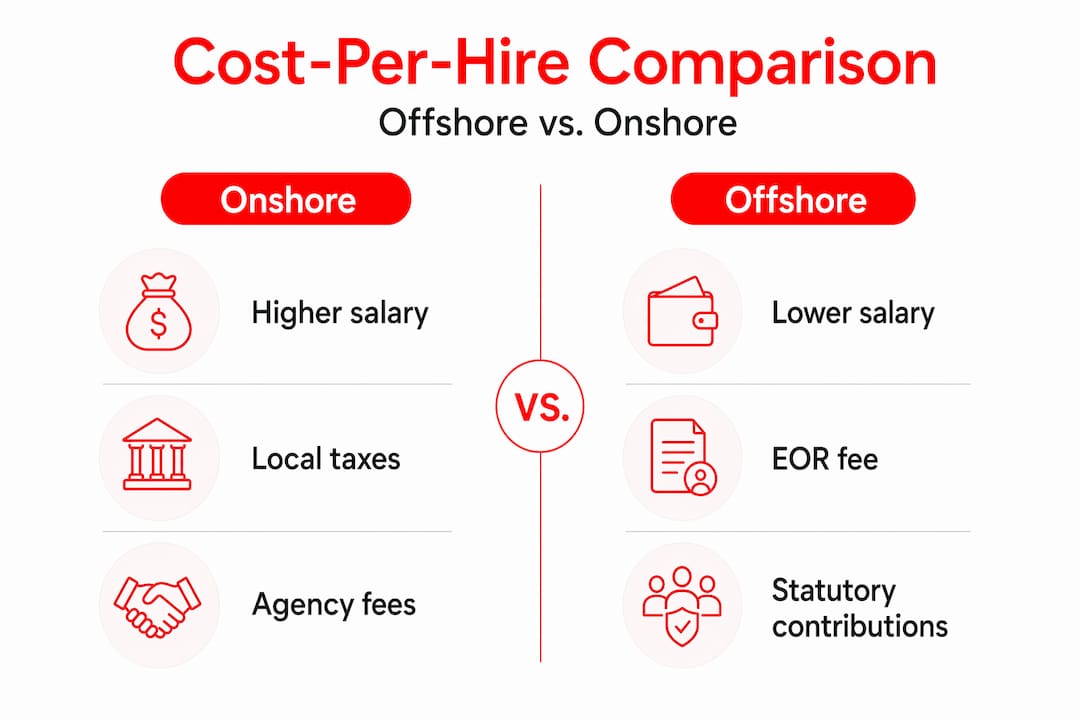
The numbers tell a compelling story, but only when you look at them correctly. Businesses hiring offshore knowledge workers save 40 to 70% compared to domestic costs when all-in fees are included. Here is what that looks like in practice.
| Role | U.S. total annual cost | Offshore total annual cost | Savings |
|---|---|---|---|
| Mid-level developer | $120,000 | $52,000 | ~57% |
| Customer support rep | $52,000 | $18,000 | ~65% |
| Operations analyst | $70,000 | $28,000 | ~60% |
Offshore costs above include salary, EOR fees at $550/month, statutory contributions, and a 15% overhead buffer.
The savings are real. But the comparison breaks down if you ignore a few critical factors:
-
Ramp-up time. A 3 to 6 month productivity adjustment is typical for offshore hires. During that period, your effective cost-per-unit-of-output is higher than the salary figures suggest.
-
Recruitment quality. A lower cost-per-hire means nothing if turnover is high. Factor in replacement costs, which can run 50 to 200% of annual salary.
-
Process maturity. Companies with clear documentation, async workflows, and structured onboarding see better offshore ROI than those that rely on informal, in-person knowledge transfer.
The ROI formula for offshore hiring is straightforward: take your onshore cost, subtract your offshore cost and hidden expenses, then divide by the onshore cost. Multiply by 100 for a percentage. A mid-level developer example yields roughly 50 to 57% ROI on a fully loaded basis. That is a strong case for offshore hiring, but it requires accurate inputs on both sides of the equation.
How to calculate and optimize your offshore cost-per-hire
Applying the SHRM formula to offshore hiring requires a few adjustments. Here is a step-by-step process for getting an accurate number.
-
List all internal recruiting costs. Include HR team hours spent sourcing, screening, and coordinating interviews. Assign a dollar value based on loaded hourly rates.
-
List all external recruiting costs. Add agency fees, job board costs, background checks, and any skills testing platforms you use for offshore candidates.
-
Add EOR setup and monthly fees. Include the onboarding fee (often $500 to $1,000 one-time) plus the first month of service.
-
Add statutory employer contributions. Get this figure directly from your EOR provider for the specific country. Do not estimate.
-
Add a tools and onboarding buffer. Use 15% of the first-month fully loaded cost as your baseline estimate.
-
Divide by number of hires. Apply the standard formula.
Common pitfalls to avoid in your offshore recruitment cost analysis:
-
Comparing offshore base salary directly to U.S. total compensation. Always compare total loaded costs.
-
Ignoring the EOR fee when calculating monthly burn. It is a fixed cost that does not disappear after onboarding.
-
Forgetting that agency markups on offshore placements still run 15 to 30% of first-year salary in many markets.
Pro Tip: Negotiate EOR fees annually, not just at contract signing. Once you have three or more employees on a single EOR platform, you have real leverage to reduce the per-employee monthly rate by 10 to 20%.
Cost-effective offshore hiring strategies also include building internal referral pipelines in your offshore market, which reduces external agency dependency over time. Companies that build direct talent relationships consistently report lower cost-per-hire figures in year two and beyond.
My honest take on offshore cost-per-hire
I have reviewed offshore hiring budgets for companies ranging from 10-person startups to mid-market firms scaling aggressively. The single most common mistake I see is treating cost-per-hire as the primary success metric for offshore decisions.
Cost-per-hire tells you what you spent to get someone through the door. It tells you nothing about whether that person will be productive in month four, whether your onboarding process is actually transferring knowledge, or whether the role was scoped correctly for a distributed team. I have seen companies celebrate a $3,200 offshore cost-per-hire and then spend $40,000 in manager time over six months trying to make the hire work.
What most companies miss is the budget line for ramp-up. If you hire a developer offshore and expect full productivity in week three, you are setting up both the employee and the manager to fail. The 3 to 6 month productivity curve is not a flaw in offshore hiring. It is a feature of any complex role, amplified by time zone and cultural distance. Budget for it explicitly.
My other observation: the companies that get the best long-term value from offshore hiring are not the ones chasing the lowest cost-per-hire. They are the ones that invest in process documentation, async communication standards, and structured check-ins during the first 90 days. The metric that actually predicts offshore hiring success is time-to-full-productivity, not cost-per-hire. Track both.
— Rajkumar
How Remotee simplifies your offshore hiring costs

Once you understand the full picture of offshore cost-per-hire, the next challenge is managing all those moving parts without building a compliance team from scratch. Remotee’s EOR service handles payroll, statutory contributions, HR administration, and local compliance for companies hiring full-time employees from India. There are no hidden fees and no guesswork on statutory costs. Clients report up to 32% savings on hiring costs compared to managing offshore hiring independently. If you are serious about building an offshore team without the administrative burden, Remotee gives you a clear cost structure and access to pre-vetted talent from day one.
FAQ
What does cost-per-hire mean in offshore hiring?
Cost-per-hire offshore is the total recruiting spend divided by the number of offshore hires made, including internal HR costs, agency fees, EOR setup fees, and statutory contributions. It gives you a single figure to benchmark and optimize your offshore recruitment budget.
How much does it cost to hire an offshore employee in 2026?
Total offshore hiring costs depend on role and region, but a fully loaded mid-level developer in India or the Philippines typically costs $45,000 to $75,000 annually, including salary, EOR fees of $400 to $700 per month, statutory contributions, and overhead.
What are the biggest hidden costs in offshore hiring?
The most commonly overlooked expenses are collaboration tools, onboarding time, statutory employer contributions, and the productivity adjustment period. These hidden costs add 15 to 20% to your effective offshore rate.
How do I calculate offshore cost-per-hire accurately?
Add all internal recruiting costs, external agency and job board fees, EOR setup and monthly fees, statutory contributions, and a 15% tools and onboarding buffer. Divide the total by the number of offshore hires made in the same period.
Is offshore hiring always cheaper than domestic hiring?
Offshore hiring typically delivers 40 to 70% savings on total compensation costs, but only when all fees are included and the ramp-up period is properly budgeted. Comparing base salaries alone overstates the savings.