How Global Companies Manage Offshore Benefits
TL;DR:
- Effective global benefits management combines centralized policy control with local execution to ensure compliance and cost efficiency. The Employer of Record model offers fast setup and reduces legal risks for small offshore teams, while integrated platforms improve visibility and employee engagement across countries. Monitoring market benchmarks annually and offering flexible benefits help balance costs and talent retention in diverse regions.
Global benefits administration is defined as the practice of designing, delivering, and governing employee benefits across multiple countries through a unified policy framework with localized execution. How global companies manage offshore benefits determines whether their international teams stay compliant, engaged, and cost-efficient. Employee benefits represent 20% or more of total payroll costs, making this one of the largest controllable expenses in any global HR budget. The standard industry term for this discipline is “global benefits management,” and it sits at the intersection of labor law, tax compliance, and workforce strategy. Getting it right requires more than copying a domestic benefits package and applying it abroad.
How global companies manage offshore benefits: the core framework
The foundation of effective offshore employee benefits management is centralized governance with local execution. This means a global HR team sets the policy guardrails, budget parameters, and compliance standards, while local HR leads or in-country partners handle the actual delivery. Without this split, companies either impose a one-size-fits-all package that misses local legal requirements, or they let each country operate independently and lose all cost control.

The components of a global benefits program fall into two clear categories. Statutory benefits are non-negotiable. Health insurance, pension contributions, paid vacation, parental leave, and sick leave vary significantly by country, and missing any of them creates immediate legal exposure. Supplemental benefits, such as life insurance, wellness allowances, or meal subsidies, are discretionary but often critical for talent retention in competitive markets like India, the Philippines, or Poland.
The main challenges HR teams face in managing global benefit programs include:
- Compliance complexity: Labor laws, tax codes, and mandatory benefit thresholds differ by jurisdiction and change frequently.
- Currency and budget risk: Exchange rate fluctuations affect the real cost of benefits denominated in local currencies.
- Fragmented administration: Multiple local brokers, providers, and spreadsheets create gaps in data and slow down reporting.
- Cultural misalignment: A generous 401(k) match means little to employees in countries where state pensions dominate retirement planning.
- Employee communication: Multilingual workforces need benefits information in their language and through accessible channels.
Each of these challenges compounds the others. A company managing teams in six countries through six separate brokers will struggle to get a single, accurate view of total benefits spend.
What employment model should you use for offshore benefits?
The employment model a company chooses directly determines how it administers benefits, how fast it can onboard employees, and how much compliance risk it carries. Three models dominate global hiring: the Employer of Record, the local subsidiary, and staff leasing arrangements.
Setting up a local subsidiary typically takes 3–6 months and costs $15,000 to $50,000 or more depending on the country. That investment buys full control over employment terms, benefits design, and payroll. It makes sense for companies with large, permanent headcounts in a single market. For a team of five engineers in Bangalore, the overhead is rarely justified.
An Employer of Record handles statutory employment, payroll, tax withholding, and basic benefits compliantly without requiring the company to establish a legal entity. The EOR becomes the legal employer on paper, while the client company directs the work. Setup is measured in days, not months. The trade-off is limited customization. EOR standard packages cover statutory minimums, and adding supplemental benefits through a global broker adds 4–6 weeks to the onboarding timeline.
| Model | Setup time | Upfront cost | Benefits control | Compliance risk |
|---|---|---|---|---|
| Employer of Record | Days to weeks | Low | Limited to standard packages | Managed by EOR |
| Local subsidiary | 3–6 months | $15,000–$50,000+ | Full | Managed internally |
| Staff leasing | Weeks | Medium | Moderate | Shared |
Pro Tip: If your offshore headcount is under 20 employees in a single country, an EOR almost always delivers better cost and compliance outcomes than a local entity. Reserve the subsidiary model for markets where you plan to hire at scale.
Compliance failures in worker classification can lead to back-payments, penalties, and severe legal consequences. Misclassifying a full-time employee as a contractor to avoid benefits obligations is the most common and costly mistake global companies make. The EOR model eliminates this risk by design.
What best practices make offshore benefits administration work?
Effective global benefits administration runs on three pillars: a unified platform, continuous compliance monitoring, and local market benchmarking.
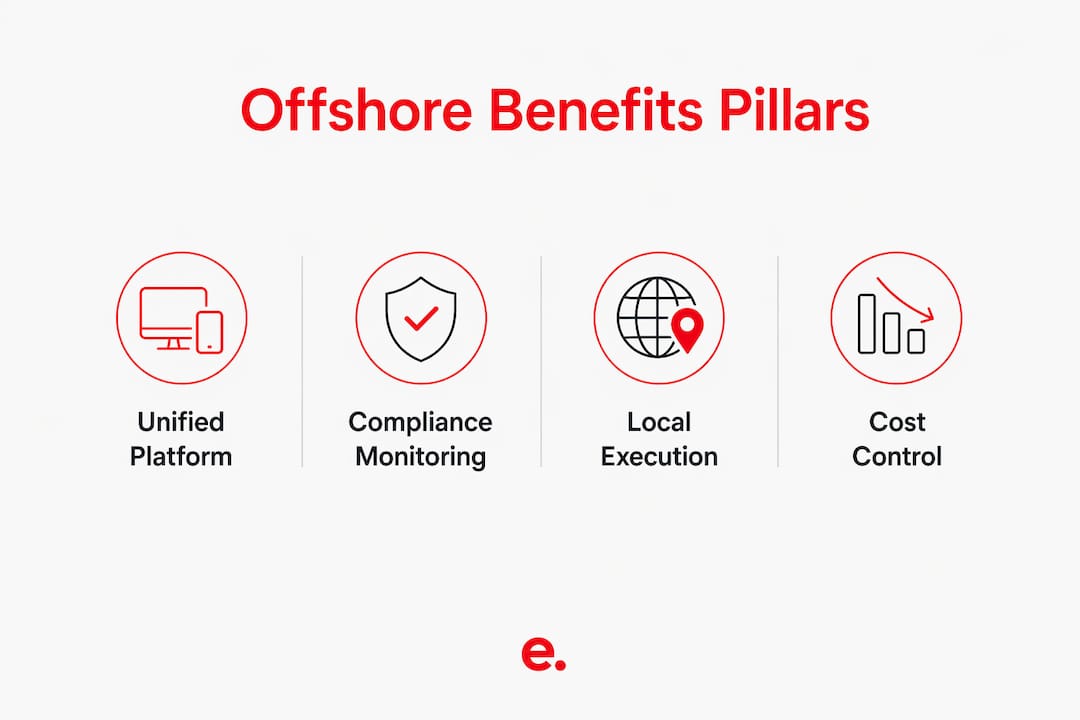
Fragmented spreadsheets and manual local processes undermine global benefits management. When each country office tracks benefits in its own system, the global HR team cannot see total spend, identify gaps, or respond to audits quickly. Moving to a centralized platform gives leadership real-time visibility across all locations. It also reduces manual errors that create compliance exposure.
Pro Tip: Before selecting a benefits platform, audit how many separate systems your team currently uses to track benefits across countries. If the number is more than two, you are almost certainly overpaying and underreporting.
Integrated benefits platforms also improve employee communication, multilingual access, and employer branding across locations. An employee in Chennai and an employee in Warsaw should both be able to see their benefits summary, submit claims, and access support in their own language. This is not a luxury. It directly affects engagement and retention.
The best practices that consistently deliver results in offshore benefits administration include:
- Benchmark against local markets annually. Benefits that were competitive two years ago may now fall below market rate, especially in fast-moving talent markets.
- Run compliance audits at least once per year. Regulatory changes in countries like India, Brazil, and Germany happen frequently and without much advance notice.
- Automate enrollment and renewal cycles. Manual renewal processes create gaps where employees fall off coverage, which creates both legal and HR problems.
- Centralize vendor contracts. Negotiating benefits renewals globally rather than country by country typically produces better pricing and more consistent terms.
How can companies balance cost control with competitive offshore benefits?
Cost control and competitiveness are not opposites in offshore benefits management. The companies that do this well use data, not instinct, to make decisions.
Global benchmark data tells you what the market actually pays for a given benefit in a specific country. Without it, HR teams either overspend to feel safe or underspend and lose talent. Market intelligence from sources like local HR associations, government labor statistics, and global benefits consultancies gives you the reference points to negotiate from a position of knowledge.
Flexible benefit models are the most effective tool for balancing cost and relevance across diverse markets. Rather than offering a fixed package, companies allocate a benefits budget per employee and let workers choose from a menu of options suited to their local context. A software engineer in Hyderabad might prioritize health coverage for family members. A designer in Warsaw might value additional vacation days. Both get value from the same budget envelope.
The steps to build a cost-controlled, competitive offshore benefits program are:
- Audit current spend by country. You cannot manage what you cannot measure. Pull total benefits cost per employee per location before making any changes.
- Identify statutory minimums for each jurisdiction. These are non-negotiable floors. Build your program up from there.
- Benchmark supplemental benefits against local market data. Determine where you are above, at, or below market for each benefit category.
- Consolidate vendors where possible. A single global broker or benefits platform typically offers better rates than multiple local providers.
- Build in annual review cycles. Benefits costs and market rates shift. A program that is not reviewed annually will drift out of alignment with both the budget and the market.
Avoiding a one-size-fits-all approach is not just good HR practice. It is a cost management strategy. Paying for benefits that employees do not value wastes budget that could fund benefits they actually want.
Key Takeaways
Global companies that manage offshore benefits well combine centralized policy control with local delivery, use EOR models for speed and compliance, and rely on integrated platforms to eliminate fragmented administration.
| Point | Details |
|---|---|
| Benefits cost 20%+ of payroll | Treat offshore benefits as a major cost center, not an administrative afterthought. |
| EOR beats local entity for small teams | For fewer than 20 employees per country, an EOR delivers faster setup and lower compliance risk. |
| Centralized platforms reduce errors | Moving off spreadsheets to a unified system improves visibility, reporting, and compliance. |
| Flexible benefits outperform fixed packages | Letting employees choose from a local menu increases satisfaction without increasing total spend. |
| Annual benchmarking is non-negotiable | Benefits that were competitive two years ago may now fall below market in fast-moving talent markets. |
What I have learned about offshore benefits after years in global HR
The biggest mistake I see global companies make is treating offshore benefits as a compliance checkbox rather than a talent strategy. They meet the statutory minimums, declare victory, and wonder why attrition in their offshore teams runs higher than at headquarters.
The companies that get this right think about benefits the way they think about compensation. They benchmark, they adjust, and they listen to what employees in each market actually want. A team in India does not have the same priorities as a team in Germany. Recognizing that is not complicated. Acting on it consistently is where most organizations fall short.
I have also seen the damage that fragmented administration causes. When benefits data lives in six different spreadsheets across six countries, nobody has an accurate picture of total spend or compliance status. The first time an audit or a legal dispute surfaces, the scramble to reconstruct records is expensive and embarrassing. A centralized approach to multi-country operations is not just operationally cleaner. It is a risk management decision.
The EOR model changed the calculus for smaller global teams. Before EOR services became widely available, a company hiring 10 engineers in Bangalore had to choose between setting up a local entity or misclassifying workers as contractors. Neither option was good. Now, an EOR handles the legal employment, payroll, and statutory benefits from day one, and the company can focus on the work rather than the paperwork. The offshore payroll integration that comes with a good EOR removes one of the most error-prone parts of international HR.
My honest advice: do not wait for a compliance failure to take offshore benefits seriously. The cost of getting it right upfront is a fraction of the cost of fixing it after a penalty or a talent exodus.
— Rajkumar
How Remotee helps global companies with offshore benefits
Managing offshore benefits across jurisdictions is complex, but the right partner removes most of that complexity from your plate.
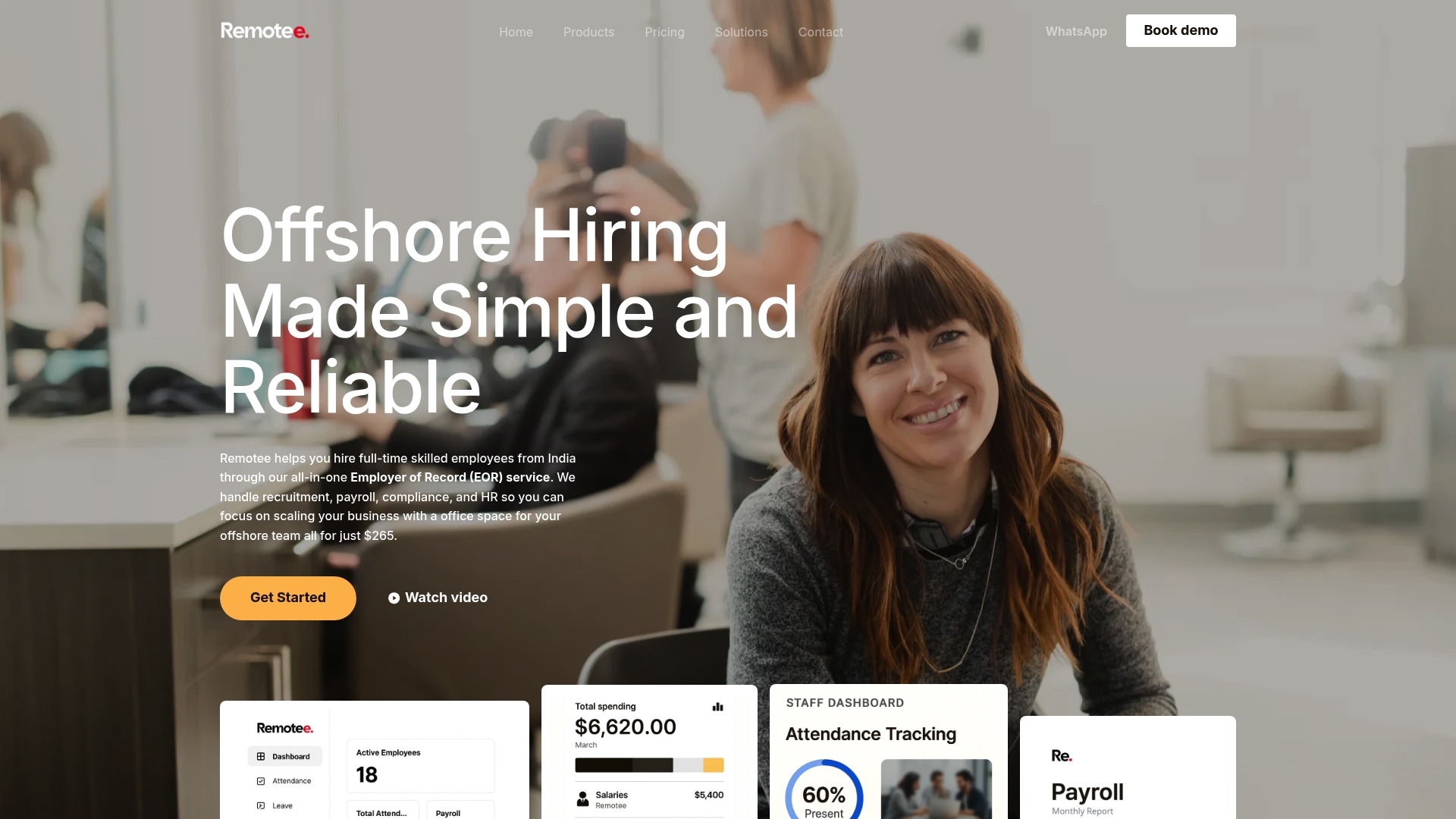
Remotee’s Employer of Record service in India handles statutory employment, payroll, tax withholding, and benefits administration so your team can focus on building the business. Clients report up to 32% savings on hiring costs compared to traditional recruitment and entity setup. Remotee presents only vetted, top-tier candidates and manages every compliance requirement from day one. For HR leaders who need compliant, fast, and cost-effective offshore hiring, Remotee’s full-service solutions cover the entire employment lifecycle, including benefits, payroll, and HR administration.
FAQ
What does offshore employee benefits management include?
Offshore employee benefits management covers statutory benefits required by local law, such as health insurance, pensions, and paid leave, plus any supplemental benefits the employer chooses to offer. It also includes compliance monitoring, vendor management, and employee communication across all offshore locations.
How long does it take to set up benefits for offshore employees?
Setup time depends on the employment model. An Employer of Record can establish compliant benefits in days, while a local subsidiary typically takes 3–6 months and costs $15,000 to $50,000 or more. Adding supplemental benefits through a global broker extends timelines by an additional 4–6 weeks.
What is the biggest compliance risk in offshore benefits?
Misclassifying full-time employees as independent contractors to avoid benefits obligations is the most common and costly compliance failure. It can result in back-payments, penalties, and legal action under local labor law.
Why do global companies use an Employer of Record for offshore benefits?
An EOR handles statutory employment, payroll, tax withholding, and benefits compliantly without requiring the company to set up a local legal entity. This reduces both setup time and ongoing compliance risk, making it the preferred model for companies with smaller offshore headcounts.
How can HR teams control the cost of global benefit programs?
HR teams control costs by auditing current spend per country, benchmarking against local market data, consolidating vendors, and offering flexible benefit models that let employees choose options relevant to their local context. Annual reviews keep programs aligned with both the budget and the market.