Manage India Employment Compliance: 2026 HR Guide
TL;DR:
- India’s new Labour Codes have replaced 29 legacy laws, creating a unified framework for employment obligations. HR teams must manage dual compliance with both old and new laws across different states, requiring a structured approach to mapping, monitoring, and documentation. Implementing a three-phase, 90-day audit process and utilizing compliance technology helps ensure continuous adherence and reduces legal risks.
India employment compliance is defined as the full set of legal obligations an employer must meet under Indian labor law, covering wages, social security, workplace safety, and industrial relations. Effectively managing these obligations requires more than a checklist. Since november 21, 2025, India’s four consolidated Labour Codes replaced 29 legacy central laws, reshaping how HR managers and compliance officers approach every aspect of the employment relationship. The Ministry of Labour and Employment, the Employees’ Provident Fund Organisation (EPFO), and the Employees’ State Insurance Corporation (ESIC) each enforce distinct obligations. To manage India employment compliance at scale, you need a structured framework that combines regulatory mapping, continuous monitoring, and technology-enabled workflows.
What are the key Indian labour laws HR managers must comply with?
India’s four Labour Codes consolidate wages, industrial relations, social security, and occupational safety into a single legislative architecture. Each Code carries specific employer obligations that directly affect HR operations.
The Code on Wages sets the floor for minimum wages and mandates that at least 50% of total remuneration must be structured as basic pay. This directly affects provident fund contributions, gratuity calculations, and take-home pay structures. HR teams that ignore this threshold face both underpayment liability and inflated variable pay structures that courts have repeatedly struck down.
The Industrial Relations Code introduces fixed-term employment as a statutory category and revises the thresholds for standing orders and retrenchment notice. Employers with 300 or more workers now require government permission before layoffs, up from the prior 100-worker threshold. That shift affects workforce planning for mid-size companies expanding in India.
The Code on Social Security consolidates EPFO, ESIC, gratuity, and maternity benefit obligations. New registrations after june 2026 require filing Form I electronically on the Shram Suvidha Portal. Existing entities are deemed registered under prior laws, but any structural change to the business triggers fresh filing requirements.
The Occupational Safety, Health and Working Conditions Code standardizes working hours, rest intervals, and contractor management across industries. It also introduces a digital record-keeping mandate for factories and establishments above specified thresholds.
The dual compliance challenge
HR teams must maintain compliance with both old and new laws until full state-to-central harmonization completes. Most Indian states have not yet enacted their own rules under the new Codes, so the legacy state-level acts remain operative in parallel. This dual compliance burden is the single most underestimated risk in India employment law right now. A company operating in Maharashtra, Karnataka, and Tamil Nadu may face three different compliance calendars for the same statutory obligation.
Key obligations HR managers must track across all four Codes include:
- Minimum wage notifications updated by each state government, typically twice a year
- EPFO and ESIC contribution deadlines (15th of each month for EPFO, 21st for ESIC)
- Annual returns and registers under the Shram Suvidha Portal
- Contractor compliance verification under the Contract Labour (Regulation and Abolition) Act, still operative in most states
- Sexual harassment policy compliance under the POSH Act, 2013
How to build a structured compliance management framework in India
Effective compliance management requires mapping business activities to specific legal obligations, not just tracking laws in the abstract. A company that hires remote workers in Bengaluru faces different obligations than one running a factory in Pune. The framework must start with operations, not statutes.

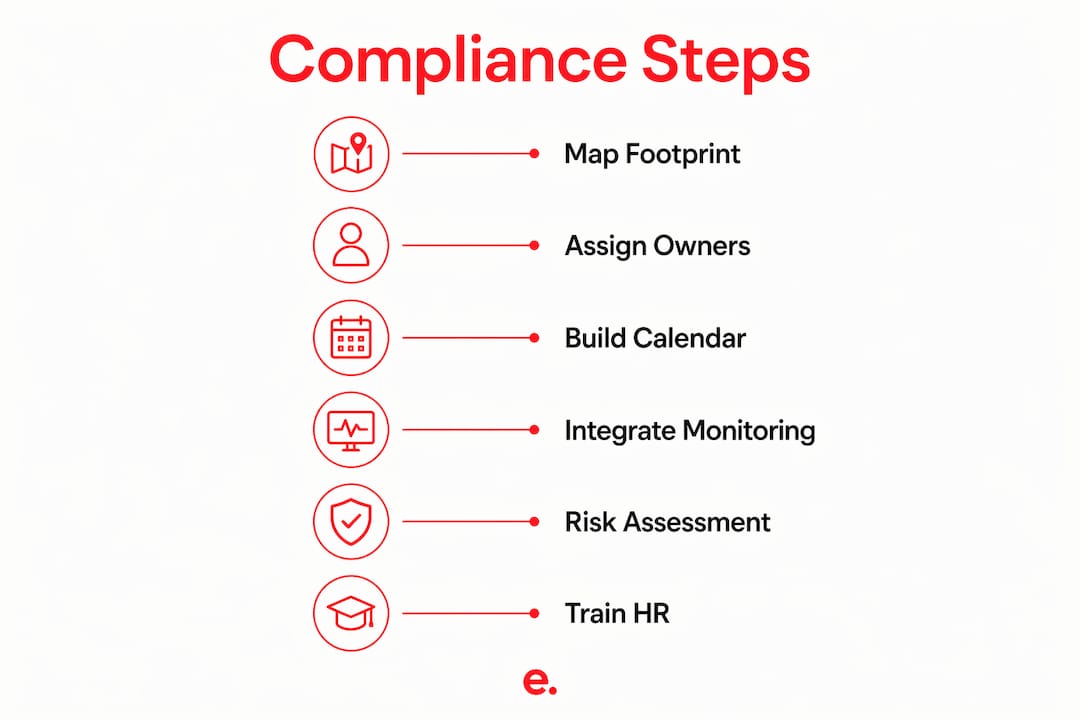
Step 1: Map your regulatory footprint. List every state where you employ people, the headcount at each location, and the industry classification. Each variable changes which laws apply. A 10-person tech office in Hyderabad triggers different obligations than a 10-person manufacturing unit in the same city.
Step 2: Assign compliance ownership. Every obligation needs a named owner with a deadline and an escalation path. Shared ownership is no ownership. Assign EPFO filings to one person, ESIC to another, and state-specific returns to a third. Document the assignment formally.
Step 3: Build a compliance calendar. Convert every obligation into a dated task with a buffer period before the statutory deadline. A 15th-of-the-month EPFO deadline should appear in your calendar as the 10th. That five-day buffer catches payroll errors before they become penalties.
Step 4: Integrate monitoring with workflows. Proactive regulatory monitoring and audit-ready documentation are critical to minimizing legal risk as the Labour Codes continue to evolve. Subscribe to Ministry of Labour and Employment circulars, state gazette notifications, and EPFO/ESIC advisory updates. Assign someone to review these weekly, not quarterly.
Step 5: Conduct a compliance risk assessment. Not all obligations carry equal risk. A missed EPFO payment triggers interest and damages. A late annual return typically draws a notice first. Prioritize high-penalty, high-frequency obligations and build redundancy into those processes.
Step 6: Train your HR team. Compliance as a continuous governance function requires people who understand why each obligation exists, not just how to file it. Quarterly training sessions on regulatory updates build the institutional knowledge that prevents gaps.
Pro Tip: Attach compliance evidence to each task at the moment of completion. Capturing a screenshot of a successful EPFO payment or saving a portal acknowledgment immediately prevents the last-minute scramble that derails most internal audits.
What technology tools can HR teams use for compliance management in India?
Indian businesses spend ₹1.5 lakh crore annually on compliance, and automation through ERP integrations measurably reduces errors and missed deadlines. That figure reflects the scale of the problem. Manual tracking through disconnected spreadsheets is the most common failure mode in India HR compliance.
A purpose-built compliance platform for the Indian regulatory environment should deliver:
- Real-time regulatory updates tied to the specific states and industries where you operate
- Automated alerts triggered by approaching deadlines, not just calendar reminders
- Obligation mapping that links each law to the specific HR process it governs
- Audit trails that record who completed each task, when, and with what supporting evidence
- ERP and payroll integration so wage data flows directly into statutory contribution calculations
The integration point between payroll and compliance is where most manual errors originate. When salary structures change mid-year and the compliance platform does not receive that update automatically, EPFO contributions fall short and the discrepancy compounds over months before anyone notices.
AI-assisted platforms now flag anomalies in contribution data, identify employees approaching ESIC eligibility thresholds, and generate draft responses to government notices. These capabilities reduce the time HR teams spend on compliance administration and redirect that time toward higher-value work.
Pro Tip: Before selecting any compliance platform, verify that it covers state-level notifications, not just central government updates. Most platforms handle central obligations well. State-level gaps are where penalties actually occur.
Remotee’s payroll and compliance service integrates statutory filings, contribution management, and regulatory updates into a single workflow, removing the manual handoffs that create errors.
What is the recommended 90-day process to achieve full compliance?
A structured 90-day compliance audit covers salary restructuring, digital registration, record digitization, and final auditing in three distinct phases. This timeline works because it sequences dependencies correctly. You cannot audit contribution accuracy before you have restructured salaries to meet the 50% basic pay rule.
Phase 1 (Days 1–30): Salary and payroll alignment
- Audit all existing employment contracts for salary structure compliance with the Code on Wages
- Restructure compensation to meet the 50% basic pay threshold where required
- Reconfigure payroll software to reflect the new structure
- Identify all applicable registrations across states and prepare documentation
- Conduct an initial gap assessment against all four Labour Codes
Phase 2 (Days 31–60): Registration and digitization
- Complete Form I filing on the Shram Suvidha Portal for any new or restructured entities
- Digitize all employee records, contracts, and prior compliance filings
- Organize records by state, establishment, and statutory category
- Verify contractor compliance documentation for all third-party vendors
- Set up your compliance calendar with named owners for every obligation
Phase 3 (Days 61–90): Audit and policy update
- Conduct a full internal compliance audit across all locations
- Verify EPFO and ESIC contribution accuracy against restructured payroll data
- Update HR policies to reflect new Code provisions on fixed-term employment and working hours
- Test your escalation workflows with a simulated compliance failure
- Document all findings and remediation steps for the audit trail
| Phase | Days | Primary Goal | Key Activities |
|---|---|---|---|
| Phase 1 | 1–30 | Payroll alignment | Salary restructuring, gap assessment, payroll reconfiguration |
| Phase 2 | 31–60 | Registration and records | Shram Suvidha filing, record digitization, compliance calendar setup |
| Phase 3 | 61–90 | Audit and policy | Internal audit, contribution verification, policy updates |
Pro Tip: Run Phase 3’s internal audit using the same checklist a government inspector would use. The Ministry of Labour and Employment publishes inspection checklists for major establishments. Using that exact format removes blind spots.
What are common compliance mistakes and how do you prevent them?
The most common compliance failure in Indian HR is disconnected spreadsheets used as the primary tracking system. Spreadsheets do not send alerts, do not integrate with payroll, and do not capture evidence. They record what someone intended to do, not what was actually done.
The second most common failure is treating the Labour Codes as a one-time implementation project. The Codes are live legislation. State governments issue notifications under them continuously. A compliance posture that was correct in january may be non-compliant by july without any action on your part.
Here are the compliance traps HR managers encounter most often, and how to close them:
- Outdated salary structures: Run a payroll audit every time a state revises its minimum wage notification. Set a calendar reminder for the revision dates in each state where you operate.
- Dual compliance gaps: Maintain a register of which state rules have been notified under the new Codes and which legacy acts still apply. Update it quarterly.
- Missing contractor documentation: Require principal employer compliance certificates from every contractor before each billing cycle, not annually.
- Ignored judicial updates: Subscribe to labor law newsletters from the Ministry of Labour and Employment and the Supreme Court’s labor law digest. Court rulings change enforcement practice faster than legislative amendments.
- No escalation path: Define what happens when a deadline is missed. A written escalation protocol prevents the “I thought you filed it” conversation that precedes most penalties.
- Evidence gaps: Capture compliance documentation at the moment each task is completed. Reconstructing evidence after a government notice arrives is expensive and often incomplete.
The underlying fix for all of these is the same. Compliance must function as a continuous governance process with technology, clear ownership, and regular review cycles built in.
Key Takeaways
Managing India employment compliance requires a continuous, technology-supported governance framework that maps obligations to operations, assigns clear ownership, and captures evidence at the point of task completion.
| Point | Details |
|---|---|
| Four Labour Codes govern all employment | The Codes on Wages, Industrial Relations, Social Security, and Safety replace 29 legacy laws and set new HR obligations. |
| Dual compliance is currently mandatory | HR teams must follow both legacy state laws and new central Codes until state harmonization completes. |
| The 90-day audit framework works | Sequencing salary restructuring, digital registration, and internal auditing in three phases prevents gaps and errors. |
| Technology reduces compliance risk | Platforms with real-time regulatory updates, automated alerts, and ERP integration eliminate the manual errors that trigger penalties. |
| Evidence capture prevents audit failures | Attaching documentation to each compliance task at completion time is the single most effective audit-readiness practice. |
India’s compliance shift is bigger than most HR teams realize
The transition to the four Labour Codes is not a paperwork update. It is a structural change in how the Indian government monitors and enforces employment obligations. The Shram Suvidha Portal now gives inspectors real-time visibility into registration status, filing history, and contribution records. That visibility did not exist five years ago.
What I have seen repeatedly is HR teams treating the new Codes as a one-time migration task. They restructure salaries, file Form I, and consider the job done. Six months later, a state government issues a notification under the Occupational Safety Code that changes their inspection obligations, and nobody catches it because the monitoring process stopped after the initial implementation.
The HR managers who handle this well share one habit. They treat compliance as a live function, not a project. They have someone whose job includes reading government gazettes every week. They run quarterly internal audits, not annual ones. They use technology to flag anomalies in contribution data before those anomalies become penalties.
The other shift I find underappreciated is the contractor compliance obligation. The Contract Labour Act remains operative in most states, and the new Codes add principal employer liability for contractor non-compliance in several scenarios. Companies that offshore specific functions to Indian vendors without verifying those vendors’ compliance posture are accumulating liability they cannot see.
My honest advice: build your compliance framework around the assumption that a government inspector will arrive next month. If your documentation, your records, and your contribution history can survive that inspection today, you are in a genuinely strong position. If they cannot, the 90-day framework is where to start.
— Rajkumar
How Remotee supports India employment compliance for global companies
Global companies hiring in India face the full weight of the Labour Codes, EPFO, ESIC, and state-level obligations from day one. Remotee’s Employer of Record service in India handles every layer of that obligation, including Shram Suvidha registration, payroll structuring under the Code on Wages, statutory contribution filings, and audit-ready documentation management.

Clients report up to 32% savings on hiring costs when they use Remotee’s EOR model instead of establishing a local entity. Remotee presents only pre-vetted candidates and manages all compliance, payroll, and HR administration, so your team focuses on the work, not the filings. For companies that need a clear path through India’s regulatory complexity, Remotee removes the operational burden entirely.
FAQ
What are the four Labour Codes in India?
India consolidated 29 central labor laws into four Codes covering wages, industrial relations, social security, and occupational safety. These Codes have been operationalized at the central level since late 2025.
What is the Shram Suvidha Portal used for?
The Shram Suvidha Portal is the Indian government’s unified digital platform for employer registration, compliance filings, and inspection management. New registrations under the Social Security Code require electronic Form I submission through this portal.
What does dual compliance mean for HR managers in India?
Dual compliance means HR teams must follow both the new Labour Codes and the legacy state-level laws that remain operative until each state enacts its own rules under the new framework. This creates parallel compliance obligations that vary by state.
How long does a compliance audit take in India?
A structured compliance audit covering salary restructuring, digital registration, and internal review takes approximately 90 days when executed in three sequential phases. Rushing the sequence creates gaps, particularly between payroll reconfiguration and contribution verification.
What is the minimum basic pay requirement under the Code on Wages?
The Code on Wages requires that at least 50% of an employee’s total remuneration be structured as basic pay. This threshold directly affects provident fund contributions, gratuity calculations, and overall compensation design.