Offshore Developer Cost Savings Explained for Business Owners

TL;DR:
- Offshore developer cost savings typically reach 55–70% when full costs like management and overhead are included. Proper management and understanding regional rate differences are crucial to maximizing benefits and avoiding hidden expenses. Companies that plan for attrition and build effective oversight save more and sustain offshore advantages over time.
Offshore developer cost savings are defined as the reduction in total engineering labor and overhead costs achieved by hiring developers in lower-cost regions instead of domestic markets. The U.S. Bureau of Labor Statistics forecasts a 1.2 million developer shortfall by 2026, which pushes American companies toward global talent sourcing as both a cost and capacity strategy. Business owners who understand offshore software development savings at a structural level, not just at the hourly rate level, consistently extract more value from their offshore teams. This article covers headline savings, hidden costs, regional rate differences, and a practical method for calculating your true return.
What makes up the total cost of offshore developer savings?
Offshore developer cost savings explained simply: you pay less per hour, but the full picture includes several cost layers beyond the base rate. The all-in monthly cost for a senior offshore developer from India ranges from $4,500 to $7,500, compared to $15,000 to $22,000 for an equivalent U.S. hire. That gap represents 55–70% savings after accounting for management, tools, and overhead. Knowing where each dollar goes helps you budget accurately and avoid surprises.

Direct salary costs
Base salary is the largest single variable. Offshore development rates vary significantly by region: South Asia averages $15–$55 per hour, Southeast Asia $18–$55 per hour, and Eastern Europe $30–$70 per hour. North American and Western European engineers typically bill $80–$200 or more per hour. The gap is real, and it compounds across a full team.
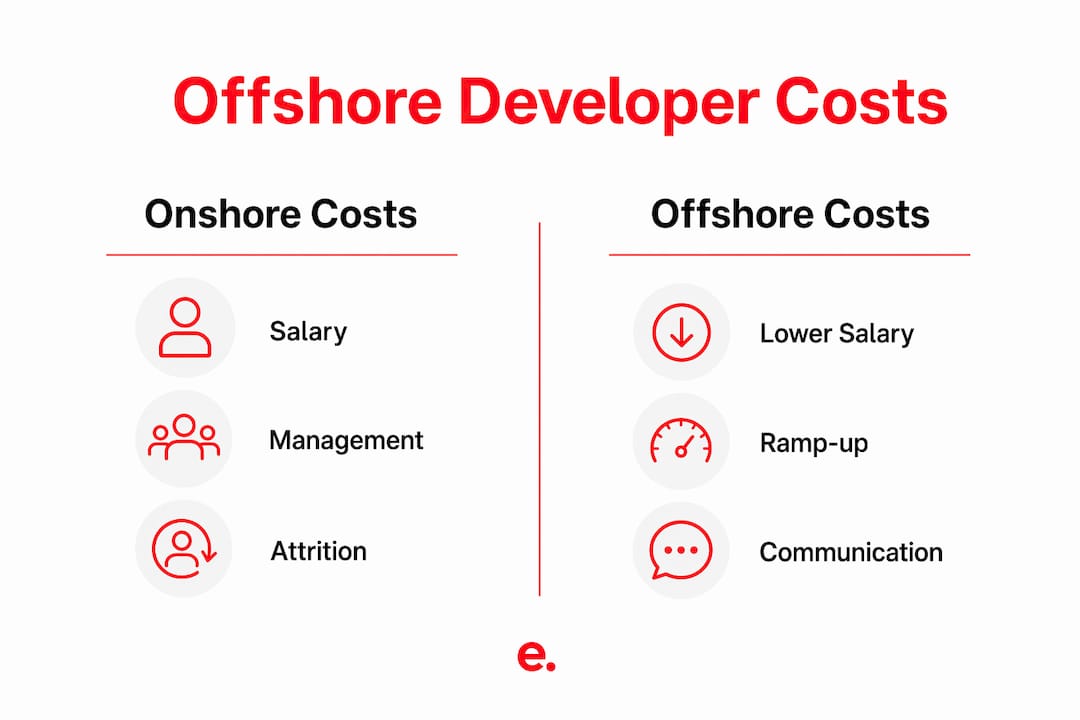
Hidden costs that reduce your savings
Several costs sit below the headline rate and eat into your margin if you ignore them.
- Onboarding and ramp-up: A new offshore developer operates at 40–60% productivity for the first 2–6 weeks. That reduced output equals roughly 1–2 months of full productivity lost per hire.
- Management overhead: Sprint planning, daily standups, and code reviews require 1–2 hours weekly plus 15–30 minutes daily per offshore developer. That adds up to 5–10% of a senior onshore manager’s working time per developer.
- Tooling costs: Communication platforms, project management software, security tools, and development environments all carry licensing fees. Budget $50–$150 per developer per month for a realistic tooling stack.
- Recruitment fees: Depending on your hiring model, placement fees or agency retainers add a one-time cost per hire.
Pro Tip: Build a simple spreadsheet that adds ramp-up productivity loss, monthly tooling, and management hours (valued at your manager’s hourly rate) to the base developer cost. Compare that total to your onshore equivalent. The real savings number will be lower than the headline rate gap, but still substantial.
| Cost category | Senior offshore developer (India) | Senior U.S. developer |
|---|---|---|
| Base monthly salary | $3,500–$5,500 | $12,000–$17,000 |
| Overhead and benefits | $500–$1,000 | $2,000–$4,000 |
| Management time cost | $300–$600 | $300–$600 |
| Tooling | $100–$150 | $100–$150 |
| Total all-in monthly | $4,500–$7,500 | $15,000–$22,000 |
How do offshore development rates vary by region and seniority?
Regional rate differences reflect cost of living, talent pool depth, and economic stability. Specialized skills like AI engineering raise rates regardless of location, so a senior AI engineer in India may cost more than a mid-level generalist in Eastern Europe. Understanding this prevents you from choosing a region based on geography alone.
Regional rate breakdown
- South Asia (India, Sri Lanka, Bangladesh): $15–$55 per hour. India offers the largest English-speaking developer pool globally, making it the most common choice for cost-effective offshore solutions.
- Southeast Asia (Philippines, Vietnam, Indonesia): $18–$55 per hour. Strong for web development and QA; growing rapidly in full-stack and mobile.
- Eastern Europe (Poland, Ukraine, Romania): $30–$70 per hour. Higher rates reflect stronger cultural alignment with Western teams and closer time zones to the U.S. East Coast.
- Latin America (Mexico, Colombia, Argentina): Typically 40–60% of onshore rates for nearshore arrangements, with better time-zone overlap for U.S. companies.
Seniority and its effect on team cost
Junior developers in South Asia cost $15–$25 per hour and suit well-defined, repetitive tasks with strong senior oversight. Mid-level engineers at $25–$40 per hour handle feature development with moderate supervision. Senior engineers at $40–$55 per hour can lead modules independently, which reduces your onshore management burden. A mixed team of one senior and two mid-level offshore developers often delivers more value than three junior developers at a lower blended rate.
Pro Tip: For greenfield projects, invest in at least one senior offshore engineer per team. The reduction in rework and code review cycles pays for the rate premium within the first quarter.
What are the hidden challenges and management costs in offshore development?
The biggest mistake business owners make is treating offshore hiring as a set-and-forget cost cut. Management overhead is mandatory, not optional, and must be planned into your budget from day one. Ignoring it leads to productivity loss that erodes the savings you expected.
Attrition and its real cost
Offshore markets carry meaningful turnover risk. Attrition rates in India and the Philippines run 20–30%, causing 4–8 weeks of productivity loss each time you replace a developer. Latin American markets show lower attrition at 10–15%, which partially offsets their higher hourly rates. High turnover is one of the most underestimated costs in offshore software development savings calculations.
Communication and coordination overhead
Asynchronous collaboration across time zones requires structure. Without it, decisions stall, bugs multiply, and sprint velocity drops. Structured communication rituals, including daily standups and weekly sprint reviews, are the minimum required to maintain output quality. Teams that skip these rituals consistently report higher rework rates and missed deadlines.
Key ongoing costs to track:
- Manager time for coordination (5–10% per developer)
- Overlap hours for real-time collaboration
- Rework from miscommunication or unclear requirements
- Replacement and re-onboarding when attrition hits
Pro Tip: Assign a dedicated offshore team lead who bridges your onshore product owner and the offshore developers. This single role reduces communication overhead by consolidating questions, decisions, and status updates into one channel.
How can you measure and maximize actual savings with offshore developers?
Calculating true offshore savings requires a structured approach, not a back-of-the-envelope hourly rate comparison. You can calculate offshore hiring savings accurately by building a total cost model that includes every variable. The result gives you a defensible number to present to stakeholders and a baseline to track over time.
Step-by-step savings calculation
- Establish your onshore baseline. Take the fully loaded annual cost of an equivalent domestic developer: salary, benefits, payroll taxes, office space, and equipment. For a senior U.S. engineer, this typically runs $180,000–$264,000 per year all-in.
- Calculate the offshore all-in cost. Add base salary, employer taxes in the offshore country, tooling, and your management overhead (valued at your manager’s hourly rate times hours spent).
- Add one-time ramp-up cost. Multiply the developer’s monthly cost by 1.5 to account for the reduced productivity window during onboarding.
- Factor in attrition risk. If your offshore market has 25% annual attrition, budget for one replacement cycle every four years per developer. Spread that ramp-up cost across the expected tenure.
- Calculate net savings. Subtract the offshore all-in annual cost from the onshore baseline. Divide by the onshore baseline to get your savings percentage.
Best practices to protect your savings
- Choose regions with talent pools that match your tech stack, not just the lowest hourly rate.
- Keep offshore teams at a size where one onshore manager can effectively oversee them. A ratio of one manager to five or six offshore developers is a practical ceiling.
- Evaluate vendors on attrition rates and retention programs, not just placement speed.
- Reassess your cost model every six months. Offshore rates in mature markets like India have risen steadily, and your savings percentage will shift over time.
- Use an offshore staffing model that gives you flexible headcount scaling. Offshore development speeds time-to-market by up to 33% when teams are structured to use time-zone differences for continuous delivery pipelines.
Key Takeaways
Offshore developer cost savings deliver 55–70% reduction in total engineering costs when you account for base salary, management overhead, tooling, and attrition risk in your full cost model.
| Point | Details |
|---|---|
| True savings range | All-in offshore costs run $4,500–$7,500 per month vs. $15,000–$22,000 for a U.S. equivalent. |
| Region shapes rate | South Asia offers the widest talent pool at $15–$55/hr; Eastern Europe costs more but reduces coordination overhead. |
| Hidden costs are real | Ramp-up, attrition, and management time can consume 15–25% of expected savings if unplanned. |
| Seniority mix matters | One senior offshore engineer per team reduces rework and lowers your onshore management burden. |
| Attrition is a budget item | Markets with 20–30% annual attrition require a replacement cost buffer built into your annual model. |
Why I think most businesses underestimate offshore savings and overspend anyway
Most business owners I have seen approach offshore hiring with one number in mind: the hourly rate. They compare $20 per hour in India to $120 per hour in the U.S. and declare a 83% saving before a single line of code is written. That number is wrong, and acting on it leads to budget overruns within the first quarter.
The real savings are still significant. A well-structured offshore team genuinely delivers 55–70% cost reduction. But that result requires deliberate management, not just a cheaper payroll line. The companies that sustain those savings treat offshore development as a dedicated staffing strategy, not a one-time cost cut.
The other mistake I see consistently is ignoring attrition. A 25% annual turnover rate means you are effectively re-onboarding a quarter of your team every year. Each replacement costs you 4–8 weeks of reduced productivity. That is not a rounding error. It is a structural cost that belongs in your model from day one.
Offshore development is worth it. The savings are real, the talent is deep, and the capacity gains are measurable. The businesses that fail with it are the ones that skip the math and skip the management structure. Build both, and the model works.
— Rajkumar
How Remotee helps you capture offshore savings without the overhead
Remotee specializes in Employer of Record services in India, handling compliance, payroll, and HR so you can hire full-time offshore developers without building a local legal entity. That removes one of the largest hidden costs in offshore hiring: the administrative burden of managing foreign employment law.

Clients working with Remotee report up to 32% savings on hiring costs compared to managing offshore recruitment independently. Remotee presents only vetted, top-tier candidates, which reduces the ramp-up risk and attrition exposure that erode savings over time. If you are evaluating offshore hiring options and want a partner that manages the complexity so you can focus on building product, Remotee is worth a direct conversation.
FAQ
What is the typical savings range for offshore developers?
Business owners save 55–70% on total engineering costs when hiring senior offshore developers from India compared to equivalent U.S. hires, after accounting for management, tooling, and overhead.
Which offshore region offers the best value for software development?
South Asia, particularly India, offers the best combination of talent pool depth, English proficiency, and cost, with senior engineers billing $40–$55 per hour versus $120–$200 per hour in the U.S.
What hidden costs reduce offshore developer savings?
Ramp-up productivity loss, management overhead (5–10% of a senior manager’s time per developer), attrition-driven replacement cycles, and tooling fees are the primary costs that reduce headline savings.
Is offshore development worth it for small businesses?
Offshore development is worth it for small businesses when the project scope is clear and at least one onshore manager can dedicate structured oversight time. Without that structure, communication overhead erodes the cost advantage.
How does attrition affect offshore software development savings?
Attrition rates of 20–30% in markets like India and the Philippines cause 4–8 weeks of productivity loss per replacement. Budget for at least one replacement cycle per developer over a four-year engagement to protect your savings model.