How Offshore Staffing Agencies Are Evaluated in 2026

TL;DR:
- Evaluating offshore staffing agencies involves a structured scorecard focused on expertise, vetting, compliance, pricing, communication, and flexibility. Conducting pilots with shortlisted agencies validates operational fit and reveals internal readiness, reducing long-term risks. Internal preparation and thorough vetting are critical for success, as speed or cost savings cannot compensate for poor organizational readiness.
Offshore staffing agency evaluation is the structured process of scoring potential vendors against defined criteria, including industry expertise, talent vetting rigor, compliance infrastructure, pricing transparency, and cultural fit, to identify the partner best aligned with your operational goals. How offshore staffing agencies are evaluated has evolved significantly by 2026, with leading organizations now using weighted scorecards that assign numerical weights to each criterion, removing gut-feel bias from a decision that carries real financial and legal consequences. The stakes are high: hidden turnover costs can reach 50 to 200% of annual salary, making a poor agency choice far more expensive than it first appears. This guide gives you the exact framework to assess any offshore agency objectively before you commit.
What are the essential criteria for evaluating offshore staffing agencies?
The most reliable method for evaluating offshore staffing agencies uses a weighted scorecard with five to seven core criteria, where industry expertise and talent quality each carry 20 to 25% of the total weight, and compliance and pricing transparency account for 5 to 15% each. This distribution reflects where the real risk lives. A technically capable agency that misclassifies workers or obscures fees creates downstream liability that no cost saving can offset.
The six criteria every scorecard should include are:
- Industry specialization: Does the agency have a documented track record in your sector? A software company evaluating an agency should look for case studies in product development, not generic back-office placements.
- Talent vetting depth: Does the agency use multi-stage screening that includes technical assessments, English proficiency testing at C1 or C2 standards, and background checks? Agencies that openly share their screening frameworks are demonstrably more reliable than those that describe their process in vague terms.
- Compliance infrastructure: Does the agency clearly disclose its legal framework, employment classification approach, IP protection clauses, and Employer of Record partner details? Vague compliance claims are a direct signal of hidden tax and regulatory exposure.
- Pricing transparency: Are rate cards published? Are onboarding, management, and replacement fees itemized separately? US-based senior developers average $80 to $150 per hour, while offshore equivalents run $30 to $40 per hour, but that gap narrows fast when hidden fees are factored in.
- Cultural fit and communication: Does the agency assess communication style, not just language proficiency? Timezone overlap, written communication clarity, and responsiveness during the sales process all predict post-placement performance.
- Contract flexibility: Can you start with a pilot? Are termination clauses reasonable? Does the contract include rate locks and scaling provisions?
Pro Tip: Build your scorecard before you contact any agency. Agencies that know you are comparing them on defined criteria will present more accurate information than those who sense an unstructured buyer.
| Criterion | Suggested weight |
|---|---|
| Industry expertise | 20 to 25% |
| Talent vetting quality | 20 to 25% |
| Compliance infrastructure | 10 to 15% |
| Pricing transparency | 10 to 15% |
| Communication and cultural fit | 15 to 20% |
| Contract flexibility | 10 to 15% |
How do agencies’ screening and replacement guarantee policies impact evaluation?
Screening depth is the single most predictive indicator of candidate quality, and it separates agencies that fill seats from agencies that deliver contributors. The offshore agency selection process at top-tier providers includes at minimum four stages before a candidate is ever presented to a client.
Here is what a rigorous screening process looks like in practice:
- Resume and portfolio review: Eliminates candidates who do not meet baseline technical or domain requirements. This stage should be documented and shareable with clients on request.
- Technical assessment: Role-specific tests, such as coding challenges for developers or tool-specific tasks for operations roles, validate claimed skills. Agencies that skip this step are relying on self-reported competence.
- English proficiency validation: C1 or C2 proficiency is the standard for client-facing or collaborative roles. Agencies should be able to show test scores or structured interview transcripts, not just assert that candidates “communicate well.”
- Soft skills and communication fit interview: Evaluates how a candidate handles ambiguity, receives feedback, and communicates under pressure. This stage directly predicts integration success with your internal team.
- Background and reference checks: Verifies employment history and flags any red flags before placement.
Replacement guarantee terms are equally telling. Replacement guarantees typically start at 14 days, with 30 days becoming the standard for specialized IT roles. A 14-day guarantee on a senior data engineer is inadequate. The time to source, screen, and onboard a replacement alone can exceed two weeks, meaning the guarantee offers no real protection. When you see a short guarantee on a specialized role, treat it as a signal that the agency lacks confidence in its own vetting.
Pro Tip: Ask the agency to walk you through a specific placement they got wrong and how they handled the replacement. Their answer tells you more about operational maturity than any guarantee clause.

The operational implication is direct: agencies with longer guarantees and transparent screening processes reduce your exposure to the most expensive offshore staffing failure mode, which is placing the wrong person and absorbing the cost of starting over.
What role do communication, account management, and contract flexibility play in agency evaluation?
These factors are consistently underweighted by buyers who focus exclusively on technical criteria, and they are consistently cited as the cause of failed engagements. Dedicated account management with named contacts, clear escalation paths, and regular check-ins is a structural feature of agencies that sustain client relationships beyond the first placement.
The communication evaluation should begin during the sales process itself. Track how quickly the agency responds to your initial inquiry, how clearly they answer compliance questions, and whether they proactively flag limitations in their service. An agency that is slow, evasive, or over-promising during the sales cycle will not improve after you sign.
Key contract elements to assess include:
- Pilot options: Can you engage for one to three months before committing to a long-term contract? Agencies confident in their delivery will offer this.
- Termination clauses: What is the notice period? Are there penalties for early exit? Reasonable terms signal a partner orientation rather than a lock-in strategy.
- Scaling provisions: Does the contract allow you to add headcount without renegotiating rates? This matters when you move from pilot to full deployment.
- Rate locks: Are rates fixed for the contract term? Agencies that reserve the right to adjust rates quarterly create budget unpredictability.
| Contract element | What to look for | Red flag |
|---|---|---|
| Pilot option | 1 to 3 months, low commitment | No pilot, minimum 6-month lock-in |
| Termination clause | 30-day notice, no penalty | 90-day notice with financial penalty |
| Rate lock | Fixed for 12 months | Quarterly rate adjustment rights |
| Scaling provision | Add headcount at same rate | Renegotiation required for each hire |
Treating the agency as an integrated partner embedded in your operational rhythm, rather than a transactional vendor, requires that your internal leadership provides clear roadmaps and accountability structures. The contract should reflect that mutual commitment. Agencies that resist flexible terms are signaling that the relationship is one-directional.
How to use a weighted scorecard and pilot projects to make the final agency selection
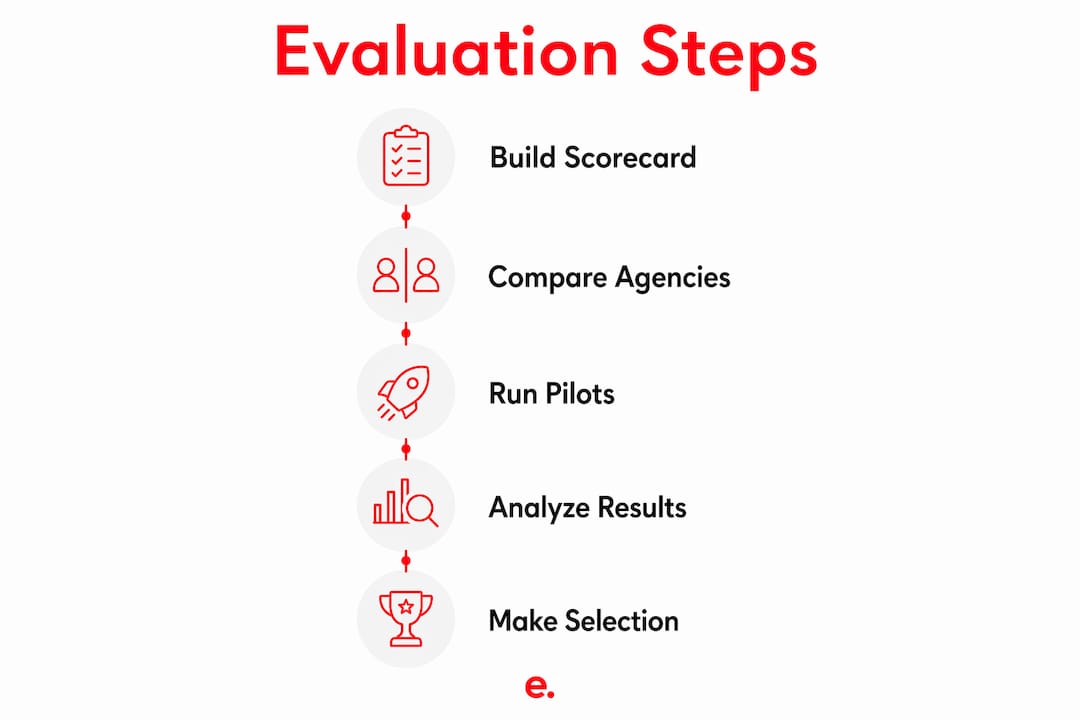
A weighted scorecard converts subjective impressions into a defensible, comparable score across multiple agencies. The process works in five steps.
- Define your criteria and weights. Use the six criteria from the evaluation framework above. Adjust weights based on your priorities. If compliance is your primary concern because you operate in a regulated industry, increase its weight to 25%.
- Score each agency on a 1 to 5 scale per criterion. Use evidence, not impression. A score of 5 for vetting depth requires the agency to have shared its actual screening rubric, not just described it verbally.
- Multiply each score by its weight and sum the totals. An agency scoring 4 on a 25% criterion contributes 1.0 to the total. An agency scoring 5 on a 10% criterion contributes only 0.5. This arithmetic prevents a single impressive dimension from distorting the overall picture.
- Review qualitative factors alongside the scores. Scorecard totals that are within five points of each other should be decided by qualitative factors: responsiveness, cultural alignment, and reference quality.
- Select the top two agencies for a pilot engagement. Never commit to a single agency based on scorecard alone.
Pro Tip: Run pilots with two agencies simultaneously on different but comparable scopes. The contrast in responsiveness, communication quality, and output clarity will be more instructive than any reference call.
A pilot project of one to three months with a small team validates what the scorecard predicts. Pilot success metrics should cover four dimensions: communication frequency and clarity, cultural integration with your existing team, technical output quality, and agency responsiveness when problems arise. The last metric is the most important. Every engagement encounters friction. How the agency responds to the first problem tells you everything about the next three years.
For businesses evaluating offshore staffing vendors for the first time, the pilot also surfaces internal gaps. You may discover that your onboarding documentation is insufficient, your project management tools are not set up for distributed teams, or your internal leads lack experience managing remote contributors. These are fixable problems, but they are better discovered in a pilot than after a 12-month contract is signed.
Key takeaways
Offshore staffing agencies are best evaluated through a weighted scorecard covering expertise, vetting depth, compliance, pricing, communication, and contract flexibility, validated by a structured pilot before long-term commitment.
| Point | Details |
|---|---|
| Use a weighted scorecard | Assign 20 to 25% weight to expertise and talent quality; adjust compliance weight for regulated industries. |
| Demand screening transparency | Agencies that share their evaluation rubrics produce more predictable candidate quality than those that do not. |
| Assess total cost, not rate | Hidden turnover and replacement costs can reach 50 to 200% of annual salary, making hourly rate a misleading metric. |
| Evaluate contract flexibility | Pilot options, reasonable termination clauses, and rate locks distinguish partners from vendors. |
| Run a pilot before scaling | A one to three month pilot with two agencies simultaneously reveals operational fit that no scorecard can predict. |
What I’ve learned from watching companies get this wrong
Most companies that struggle with offshore staffing did not fail at the evaluation stage. They failed at the preparation stage, and then blamed the agency. I have seen businesses run rigorous scorecards, select genuinely capable agencies, and still produce poor outcomes because they had no internal infrastructure to manage a distributed team. No clear roadmap. No dedicated internal lead. No onboarding documentation. The agency delivered competent people into a vacuum, and the engagement collapsed within 90 days.
The uncomfortable truth is that internal operational readiness determines offshore staffing success more than agency quality does. Before you evaluate a single agency, ask yourself whether your organization is actually ready to absorb offshore talent. If the answer is uncertain, fix that first.
The second pattern I see consistently is buyers who optimize for speed over vetting quality. They want someone placed in two weeks, and they choose the agency that promises the fastest turnaround. Speed and rigor are inversely correlated in staffing. An agency that can place a senior developer in five business days is almost certainly skipping stages. The offshore staffing risk mitigation checklist for 2026 is explicit on this point: prioritize vetting depth over time-to-fill, especially for roles that require domain expertise or client interaction.
Finally, treat compliance opacity as a disqualifying condition, not a yellow flag. Agencies that cannot clearly explain their employment classification approach, their EOR partner relationships, or their IP protection clauses are exposing you to liability that no cost saving justifies. Ask directly. If the answer is vague, move on.
— Rajkumar
Ready to move from evaluation to execution?
Once you have identified the right offshore staffing partner, the next challenge is managing compliance, payroll, and HR without building a local legal entity. That is exactly what Remotee solves.

Remotee’s Employer of Record service in India handles employment contracts, statutory compliance, payroll processing, and HR administration so your team can focus on the work itself. Clients report up to 32% savings on hiring costs compared to traditional recruitment models. Whether you are onboarding your first offshore hire or scaling a team of twenty, Remotee removes the operational complexity that typically slows down post-evaluation execution. Explore offshore hiring solutions designed specifically for business leaders who have already done the hard work of choosing the right partner.
FAQ
What criteria matter most when evaluating offshore staffing agencies?
Industry expertise and talent vetting quality carry the highest weight, typically 20 to 25% each in a structured scorecard. Compliance infrastructure and pricing transparency follow, with cultural fit and contract flexibility rounding out the framework.
How long should a replacement guarantee be for specialized roles?
Replacement guarantees for specialized IT roles should be at least 30 days. A 14-day guarantee is the industry floor for general roles but is insufficient for senior or domain-specific positions where sourcing alone can take two weeks.
What is the best way to compare multiple offshore staffing agencies objectively?
Build a weighted scorecard before contacting any agency, score each provider on defined criteria using evidence rather than impression, and run simultaneous pilot projects with your top two finalists to validate fit under real conditions.
How do hidden costs affect the true price of offshore staffing?
Hidden fees and turnover costs can amount to 50 to 200% of annual salary, meaning the advertised hourly rate is rarely the actual cost of engagement. Always request fully itemized pricing that includes onboarding, management, and replacement fees.
When should a business use a pilot project in the agency selection process?
A pilot of one to three months should precede any long-term contract, particularly for first-time offshore engagements. It validates communication quality, cultural integration, and agency responsiveness to problems before you commit to scale.