The Role of HR in Offshore Hiring: 2026 Guide
TL;DR:
- HR’s role in offshore hiring involves managing compliance, payroll, recruitment, and employee relations across foreign jurisdictions. Proper oversight, cultural alignment, and regular reviews are essential to mitigate risks such as misclassification, compliance gaps, and provider failures. Partnering with dedicated offshore HR providers and retaining local legal counsel helps ensure legal accountability and retention of company values.
The role of HR in offshore hiring is to manage recruitment, payroll, legal compliance, and employee relations across foreign jurisdictions. This is not a support function. It is the operational backbone that determines whether an offshore team delivers results or creates liability. HR professionals expanding into markets like India must coordinate tools like ADP for payroll, Slack for team communication, and Xero for financial reporting, while simultaneously navigating local labor laws, tax obligations, and cultural expectations. Get this right, and offshore hiring becomes a genuine competitive advantage.
What specific HR responsibilities are involved in offshore hiring?
Offshore HR teams cover payroll processing, compliance management, recruitment, benefits administration, HRIS management, and employee training. Each function carries distinct operational weight, and none can be treated as secondary.

Payroll and tax reporting are the most technically demanding. HR must calculate gross-to-net pay according to local tax codes, manage statutory deductions, and file reports with the relevant government bodies. In India, this means handling Provident Fund contributions, Professional Tax, and TDS (Tax Deducted at Source) correctly every pay cycle. Errors here trigger penalties that compound quickly.
Legal compliance management includes worker classification reviews, contract structuring, and benefits compliance. HR professionals must determine whether a worker is classified as an employee or a contractor under local law, not just under the company’s internal framework. Misclassification is one of the most common and costly errors in offshore hiring, and it rarely surfaces until an audit or dispute forces the issue.
Recruitment and candidate screening offshore require a structured process that mirrors the rigor applied to domestic hires. HR sets the job brief, coordinates with sourcing partners, manages interview pipelines, and owns the final offer process. Onboarding follows immediately, covering system access, compliance documentation, and cultural orientation.
Core HR responsibilities in offshore hiring include:
- Payroll processing and statutory tax filing in the host country
- Worker classification reviews to prevent misclassification exposure
- Recruitment coordination from job brief through offer acceptance
- Benefits administration including local statutory and supplemental benefits
- HRIS management using platforms like BambooHR or Workday for centralized records
- Employee training and development programs adapted to remote delivery
Pro Tip: Set up a dedicated offshore HR calendar that tracks local public holidays, statutory filing deadlines, and compliance review dates for each country where you hire. Missing a single filing window can trigger fines that exceed a month’s payroll costs.
How does offshore HR compare with traditional in-house HR models?
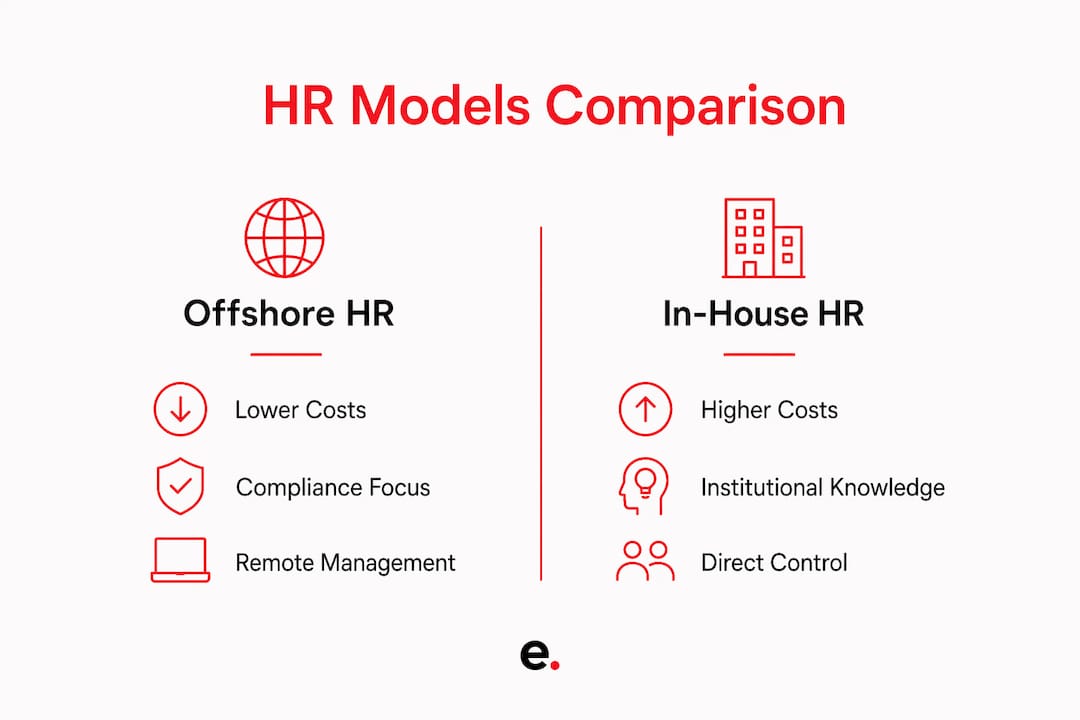
The core difference between offshore HR and traditional in-house HR is where legal and operational accountability sits. In a traditional model, the HR team owns every function directly. In an offshore model, especially one using an Employer of Record (EOR), accountability is distributed, and that distribution creates both opportunity and risk.
Offshore HR staffing can reduce HR costs by 40 to 70 percent compared to building equivalent in-house capacity. That figure reflects lower labor costs in offshore markets, reduced overhead, and the elimination of redundant administrative roles. The savings free up in-house HR leaders to focus on strategy, culture, and talent development rather than transactional processing.
The risk profile, however, is different. Traditional HR teams carry full institutional knowledge of the company’s legal exposure. Offshore HR providers, including EOR vendors, operate within a defined contractual scope. Most business leaders mistakenly believe an EOR handles all compliance liability. The client company retains responsibility for understanding and managing risks, even when an EOR is processing payroll and filing taxes on its behalf.
| Factor | Offshore HR model | Traditional in-house HR |
|---|---|---|
| Cost structure | 40–70% lower operational costs | Higher fixed overhead |
| Legal accountability | Shared with EOR or HR BPO provider | Fully internal |
| Scalability | Rapid, geography-flexible | Slower, constrained by headcount |
| Cultural integration | Requires deliberate investment | Naturally embedded |
| Compliance expertise | Localized to host country | Focused on domestic law |
Pro Tip: Before signing with any offshore HR provider or EOR, request a written scope-of-compliance document that specifies exactly which obligations they own and which remain with your company. Verbal assurances are not enforceable.
What are best practices for managing cultural alignment and compliance in offshore HR?
Cultural alignment is the most underestimated variable in offshore HR. Companies that treat it as a secondary concern after systems and payroll are set up consistently report higher attrition, lower productivity, and communication breakdowns within the first year. The fix is structural, not cosmetic.
Follow this sequence to build cultural alignment and compliance into your offshore HR model from day one:
-
Run a values-focused discovery process before selecting any provider. Assess cultural alignment by evaluating whether the provider’s onboarding process asks about your company values, team dynamics, and communication norms. Providers that jump straight to system access and pricing are signaling that culture is not their priority.
-
Conduct formal classification reviews every six months. HR leaders should perform a classification review on a biannual schedule to catch reclassification risks before they become legal events. Labor law in markets like India evolves, and what was compliant 18 months ago may not be today.
-
Assign dedicated account managers on both sides. Dedicated account managers act as single points of contact, centralizing communication and improving response times. This structure prevents the fragmented communication that causes offshore teams to feel disconnected from the parent company.
-
Retain local legal counsel independently of your EOR. Your EOR’s legal team works for your EOR. A separate local employment lawyer retained directly by your company provides independent cross-checks and protects your interests in any dispute with the provider.
-
Use technology to maintain cultural presence. Platforms like Loom for async video updates, Notion for shared documentation, and Slack for real-time communication keep offshore employees connected to company culture without requiring constant synchronous meetings. The role of technology in offshore staffing has expanded significantly, and HR leaders who ignore it are operating at a disadvantage.
Pro Tip: Schedule a quarterly “culture sync” call between your onshore leadership team and offshore HR leads. Use it to share company updates, recognize offshore team contributions, and surface any friction points before they become retention problems.
How can HR professionals mitigate risks when hiring offshore?
Risk in offshore hiring concentrates in three areas: worker misclassification, compliance gaps, and provider accountability failures. Each is preventable with the right protocols in place.
Misclassification is the highest-frequency risk. When a company hires offshore workers as independent contractors to avoid payroll obligations, but those workers function as full-time employees under local law, the company faces back taxes, penalties, and potential litigation. The EOR handles a defined scope of compliance, but HR teams must maintain secondary legal oversight and incident-response protocols. Outsourcing payroll does not outsource accountability.
Compliance gaps emerge when labor laws change and the offshore HR provider fails to update their processes in time. Effective HR offshoring requires clear communication, documented update processes on labor law changes, dedicated compliance officers, and legal partnerships. HR leaders should require their providers to deliver written compliance updates within 30 days of any relevant legislative change.
Provider accountability failures happen when service-level agreements (SLAs) are vague or unenforced. HR professionals should build the following safeguards into every offshore engagement:
- Documented incident-response plans that specify escalation paths, resolution timelines, and liability allocation for compliance failures
- Quarterly SLA reviews measuring provider performance against agreed metrics for payroll accuracy, response times, and compliance filing deadlines
- Independent legal counsel retained separately from the EOR to review contracts and provide unbiased compliance opinions
- Regular training sessions for offshore HR providers on your company’s internal policies, not just local labor law
- Offshore staffing risk frameworks such as the risk mitigation checklist that HR teams can use to audit vendor performance systematically
Traditional recruitment agencies rarely produce true cultural alignment for mid-senior offshore hiring. Dedicated recruitment partners who embed in the company culture perform measurably better on candidate quality and retention. This applies equally to offshore HR providers. Specialization and cultural investment are not optional features. They are selection criteria.
Key takeaways
HR’s role in offshore hiring succeeds when compliance accountability, cultural alignment, and provider oversight are treated as active management responsibilities, not delegated assumptions.
| Point | Details |
|---|---|
| HR owns compliance accountability | Even with an EOR, the client company retains legal responsibility for understanding and managing risks. |
| Classification reviews are non-negotiable | Conduct formal worker classification reviews every six months to prevent costly misclassification exposure. |
| Cultural fit drives provider selection | Prioritize offshore HR providers that assess company values in discovery, not just system access and pricing. |
| Independent legal counsel is a safeguard | Retain a local employment lawyer separately from your EOR to provide unbiased cross-checks. |
| Technology sustains cultural presence | Tools like Slack, Loom, and Notion keep offshore teams connected to company culture across time zones. |
What I’ve learned about offshore HR that most guides won’t tell you
Most articles on the role of HR in offshore hiring treat compliance as a checklist and culture as a bonus. After working closely with companies scaling offshore teams in India, I’ve found the opposite is true. Culture is the variable that determines whether your offshore team stays or leaves within 18 months. Compliance is the variable that determines whether you get sued.
The mistake I see most often is companies treating their EOR as a compliance firewall. They sign the contract, hand over payroll, and assume the risk has been transferred. It has not. The EOR processes your obligations. You still own them. I’ve seen companies receive tax notices in India for periods when their EOR was fully operational, because the EOR’s scope didn’t cover a specific filing category that nobody had thought to ask about. A local employment lawyer on retainer would have caught that in week one.
The second mistake is selecting offshore HR providers based on price. The major pitfall in offshore HR is focusing on cost over cultural fit. I’ve watched companies save 15 percent on provider fees and then spend three times that amount managing attrition, rework, and compliance remediation. The cheapest provider is almost never the most cost-effective one over a 24-month horizon.
What actually works is treating your offshore HR provider as an extension of your internal team, not a vendor. That means sharing your company’s values documentation, including them in relevant all-hands calls, and holding them to the same accountability standards you apply internally. The offshore staff retention strategies that produce results are the ones built on genuine integration, not transactional management.
— Rajkumar
How Remotee helps HR leaders hire offshore with confidence
HR professionals who want to expand into India without building a local legal entity need a partner that owns the operational complexity from day one.
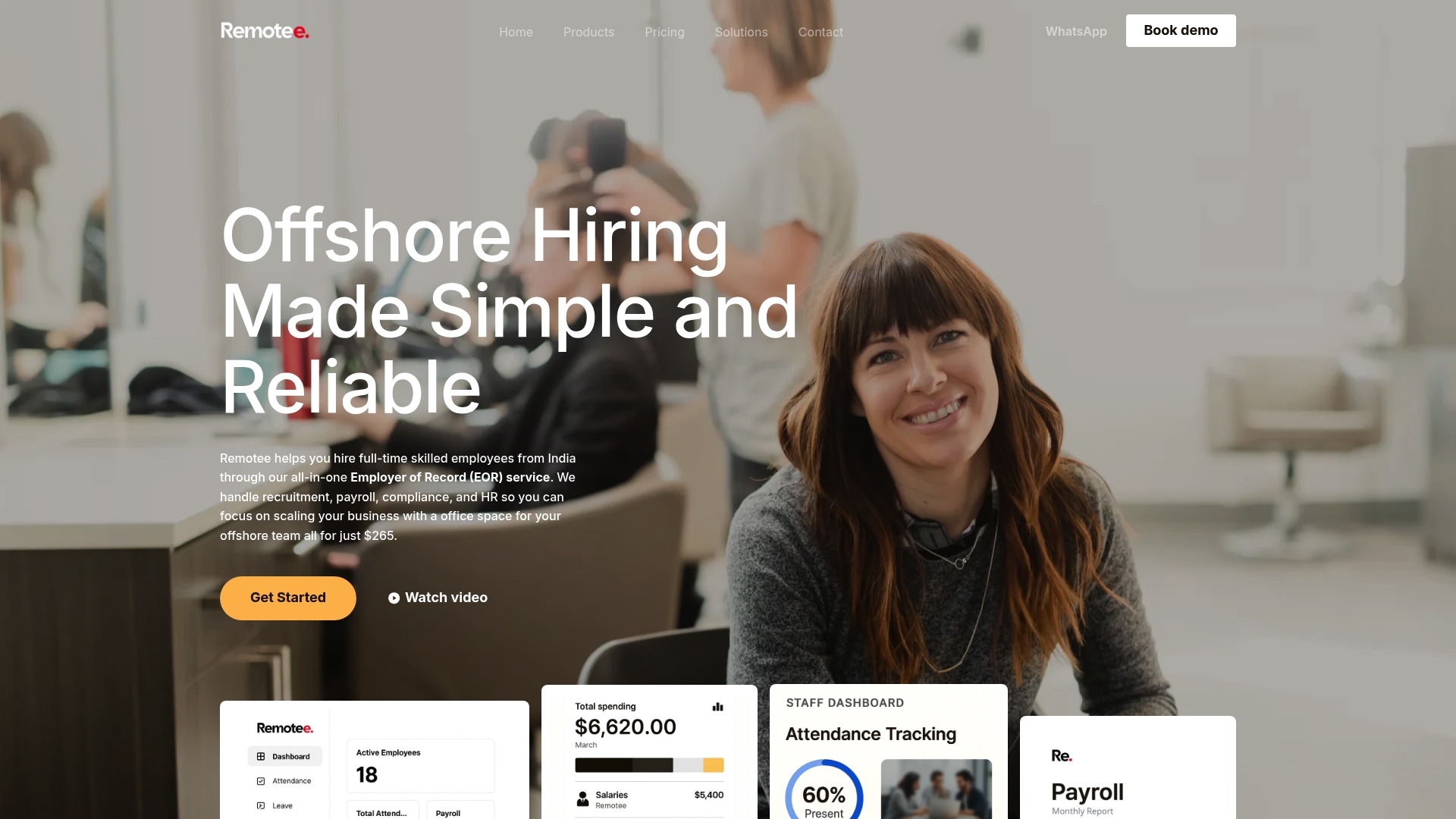
Remotee’s Employer of Record service in India covers payroll processing, statutory compliance, worker classification, and benefits administration under Indian labor law. Clients report up to 32 percent savings on hiring costs compared to traditional recruitment and entity-setup models. Remotee assigns dedicated account managers who act as single points of contact, integrates with payroll platforms, and supports the full offshore hiring process from sourcing through onboarding. For HR leaders who need compliance certainty and cultural alignment without the overhead, Remotee is built specifically for that outcome.
FAQ
What is the role of HR in offshore hiring?
HR manages recruitment, payroll, legal compliance, worker classification, benefits administration, and employee relations for offshore teams. These functions require localized expertise in the host country’s labor law and tax system.
What HR responsibilities shift when hiring offshore?
Payroll processing, statutory tax filing, worker classification reviews, and compliance monitoring all shift to require host-country expertise. HR must also manage cultural integration and provider accountability alongside these technical functions.
How does an Employer of Record differ from an HR BPO?
An EOR legally employs workers on behalf of the client company and owns payroll and statutory compliance within a defined scope. An HR BPO provides outsourced HR services but does not take on the legal employer role.
How often should HR conduct compliance reviews for offshore teams?
HR leaders should conduct formal classification and compliance reviews every six months to account for legislative changes in the host country and evolving worker relationships.
What is the biggest risk in offshore HR management?
Worker misclassification is the highest-frequency risk, followed by compliance gaps when labor laws change and provider accountability failures. Independent legal counsel and documented incident-response plans are the most effective safeguards against all three.