How Offshore Staffing Ensures Quality Control in 2026
TL;DR:
- Effective offshore quality control relies on structured, multi-layer frameworks that embed standards, enforced reviews, and automation from the start. The 6-layer QA process and blended-shore review model are the dominant structures, focusing on process rigor rather than talent quality alone. Built-in process controls and operational discipline significantly improve offshore outcomes, aligning them closely with onshore benchmarks.
Offshore staffing ensures quality control through structured, multi-layered processes that define standards, enforce reviews, and automate checkpoints before a single deliverable reaches the client. This is not a talent question. It is a process question. Organizations that treat quality assurance as a designed delivery layer rather than an afterthought consistently outperform those that rely on hiring alone. The 6-layer QA framework and the blended-shore review model are the two dominant structures shaping how offshore teams in 2026 maintain output that competes with onshore benchmarks. Understanding both is the starting point for any business leader evaluating offshore staffing for quality control.
How offshore staffing ensures quality control through structured frameworks
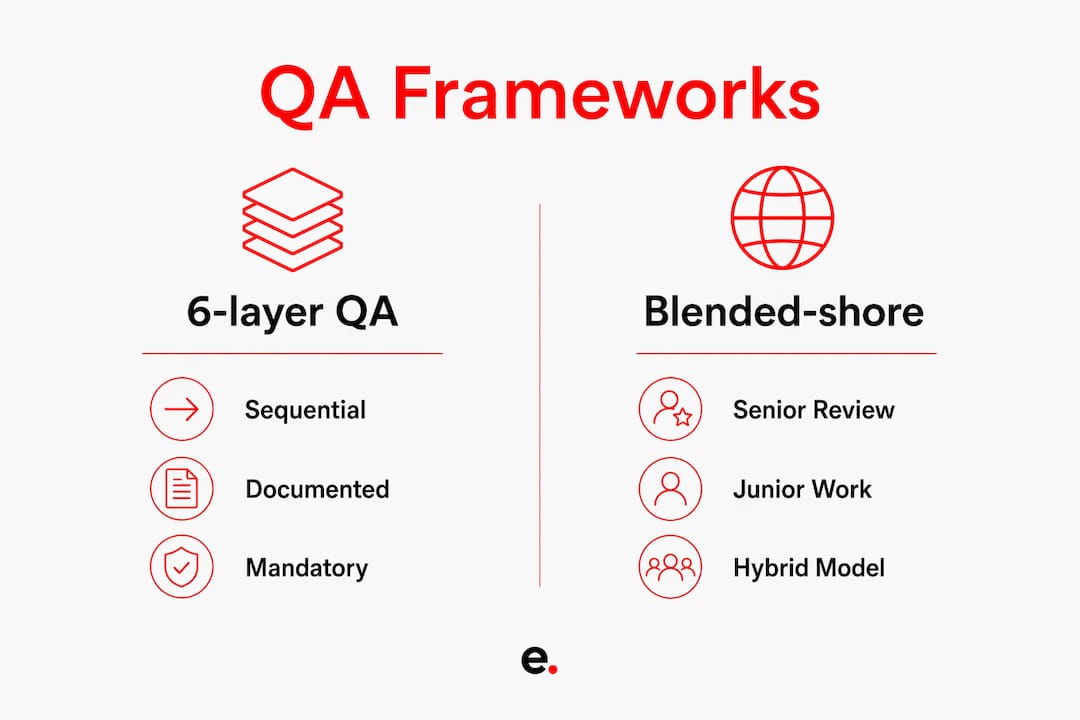
The most widely adopted structure for offshore quality assurance is the 6-layer QA process, which mandates documented coding standards, mandatory code reviews with criteria checklists, CI/CD gating on automated tests, style enforcement, production monitoring, and sprint retrospectives. Each layer is non-optional. Removing any one of them creates a gap that compounds over time into rework, defect accumulation, and delivery instability.

The second major model is the blended-shore review structure. In this model, offshore senior reviewers examine junior work first, then U.S.-based reviewers validate output against client standards, and a partner sign-off occurs before client delivery. Governance cadence runs every 90 days. This two-tier structure separates execution from validation, which is the core reason it reduces errors more reliably than single-layer review.
The table below compares both frameworks across the dimensions that matter most to business leaders:
| Dimension | 6-layer QA framework | Blended-shore review model |
|---|---|---|
| Review structure | Sequential automated and human layers | Offshore review plus client-side validation |
| Enforcement mechanism | CI/CD gates block merges on failure | Multi-tier sign-off before delivery |
| Error detection timing | Pre-merge, pre-deployment | Pre-client delivery |
| Governance cadence | Sprint retrospectives | Quarterly business reviews |
| Best suited for | Software development teams | Accounting, finance, professional services |
Pro Tip: Define your quality gates before the first task is assigned. Enforcing each QA layer from day one avoids entrenched defects that become exponentially more expensive to fix after delivery cycles begin.
The critical insight both frameworks share is that process rigor before work begins drives outcomes, not the caliber of talent alone. This distinction separates organizations that scale offshore successfully from those that cycle through vendors blaming “cultural fit.”
How technology and automation improve offshore quality assurance
Automation is the enforcement mechanism that makes quality frameworks repeatable at scale. Without it, review standards degrade under deadline pressure. With it, the process runs whether or not a manager is watching.
The core technology stack for offshore quality assurance in 2026 includes:
- CI/CD pipelines with automated quality gates: Tools like GitHub Actions integrate static analysis, style checks via Laravel Pint or CS Fixer, and unit test coverage thresholds. Automated quality gates block any pull request merge that fails these checks, making enforcement structural rather than behavioral.
- Security and dependency scanning: Automated dependency scanning flags vulnerabilities before code reaches staging. PHPStan and similar tools catch type errors and logic issues that human reviewers miss under time pressure.
- Production monitoring and alerting: Tools like Sentry or Bugsnag track live error rates and performance degradation, feeding alerts directly into development channels so issues surface within minutes rather than days.
- Review turnaround dashboards: Tracking 24-hour review turnaround during timezone overlap windows prevents backlogs that lead to rushed merges and inconsistent quality acceptance.
- Test coverage enforcement: Coverage thresholds configured in CI pipelines mean no code ships without meeting a defined minimum, removing the subjective judgment that erodes standards over time.
The role of technology in offshore staffing operations extends beyond code quality. Dashboards that track error rates by category, sprint velocity, and rework hours give business leaders the visibility they need to distinguish a training problem from a staffing problem before it becomes a delivery crisis.
Async workflows across time zones are where automation earns its value most clearly. When a developer in Bangalore finishes a feature at 6 PM local time, the CI pipeline runs, the quality gate either passes or blocks, and the U.S.-based reviewer sees a clean result waiting at 8 AM Eastern. No human coordination required. The process runs on its own.
What operational strategies sustain quality in offshore teams
Technology enforces standards. Operations sustain them. The two work together, but operational discipline is what keeps quality from eroding as teams grow and projects become more complex.
The most effective operational approach follows a structured sequence:
- Define roles and accountability before engagement begins. Every offshore team member needs a clear KPI set, a defined escalation matrix, and a named reviewer. Ambiguity in accountability is the leading cause of quality drift in offshore engagements.
- Split execution from validation. Treating offshore teams as execution engines supervised by local expert review layers frees domestic staff for client-facing work while maintaining quality control. This is the operational logic behind the blended-shore model.
- Establish a 90-day review cadence. Quarterly metrics reviews that segment errors by category reveal whether recurring issues stem from training gaps, staffing mismatches, or process failures. Quarter-over-quarter declining error rates are the target. Flat or rising rates require a specific corrective response, not a general performance conversation.
- Document SOPs for every repeatable task. Structured standard operating procedures reduce onboarding time and eliminate the variability that comes from undocumented tribal knowledge. New team members reach full productivity faster, and quality does not dip during transitions.
- Enforce communication protocols across time zones. Defined async update formats, response time expectations, and escalation triggers prevent the communication gaps that cause quality failures to go undetected until they become expensive.
- Invest in team stability. Attrition directly degrades quality in offshore engagements. Dedicated offshore teams with defined career paths and technical leadership maintain standards better than rotating freelance arrangements. Stability is a quality input, not just an HR concern.
For business leaders building offshore teams, the offshore staff retention strategies that reduce attrition are directly connected to the quality outcomes they measure. A team that stays together builds shared context, and shared context reduces errors.
How offshore quality control compares to onshore models
The most persistent misconception about offshore staffing is that quality is inherently lower because talent is lower. The data does not support this. Dedicated offshore teams with technical leadership, shared standards, and calibrated collaboration converge to near-onshore defect rates over time. The variable is not geography. It is process maturity.
| Quality dimension | Well-run offshore team | Offshore team without process | Onshore team |
|---|---|---|---|
| Defect rate | Near-onshore after ramp-up | High and inconsistent | Baseline |
| Rework hours | Declining quarter-over-quarter | Persistent and growing | Low |
| Review enforcement | Mandatory, multi-tier | Optional or absent | Varies by team |
| Stability impact | High with dedicated model | Low with staff augmentation | High |
The organizations that report poor offshore quality almost always share one characteristic: they skipped proactive controls. Firms that treat reviews as optional or fail to document multi-tier sign-off processes accumulate error debt that burns partner time without producing quality gains. This is a process failure, not a talent failure.
The benefits of dedicated offshore staffing over staff augmentation models are measurable in sprint velocity and defect rates. Dedicated Offshore Development Centers with stable teams and technical leadership outperform rotating contractor pools on every quality metric that matters to a business leader. Avoiding common offshore vendor mistakes starts with choosing the right engagement model before signing a contract.
Pro Tip: Before selecting an offshore staffing model, ask vendors for quarter-over-quarter defect rate data from existing engagements. Any vendor that cannot produce this data does not have a quality control process worth trusting.
Key takeaways
Offshore staffing ensures quality control when review layers, automation gates, and operational cadence are built into the engagement structure before work begins, not added reactively after quality problems surface.
| Point | Details |
|---|---|
| Process drives quality, not talent | Upfront-defined standards and mandatory review layers determine output quality more than hiring decisions alone. |
| Automation enforces consistency | CI/CD pipelines with quality gates block non-compliant code from merging, removing human variability from enforcement. |
| Blended-shore model reduces errors | Splitting offshore execution from client-side validation creates multi-tier accountability that catches errors before delivery. |
| Quarterly reviews target root causes | Segmenting errors by category every 90 days identifies training or staffing issues before they become systemic. |
| Team stability is a quality input | Dedicated offshore teams with career paths and technical leadership maintain standards better than rotating staff augmentation. |
Why I think most offshore quality failures are self-inflicted
After working closely with business leaders who have built and rebuilt offshore teams, the pattern I see most often is not bad talent. It is a complete absence of pre-engagement process design. Companies hire offshore developers or accountants, hand them work, and then express surprise when quality is inconsistent. The process was never defined. The review was never mandatory. The gate was never built.
The blended-shore model changed how I think about this. Treating offshore teams as execution engines supervised by a local review layer is not a workaround. It is the correct architecture. It frees your domestic experts to do client-facing work while maintaining quality control over offshore output. That is not a compromise. It is a better division of labor than most purely onshore teams achieve.
The other thing I have observed is that business leaders underestimate the cost of skipping sprint retrospectives. When recurring errors are not converted into process changes, they repeat. Every sprint. The offshore risk mitigation checklist for 2026 puts retrospectives in the non-negotiable category, and I agree completely. Reactive fixes are expensive. Process improvements are cheap.
If you are evaluating offshore staffing for quality control, start with the question: what is our review architecture? If the answer is vague, the quality outcome will be too.
— Rajkumar
How Remotee helps you build offshore teams with quality built in

Remotee’s offshore hiring solutions are built around the same principles this article covers: structured vetting, defined onboarding processes, and compliance management that removes operational risk before it affects quality. As an Employer of Record in India, Remotee handles payroll, HR, and regulatory compliance so your team can focus on building and enforcing quality frameworks rather than managing administrative complexity. Clients report up to 32% savings on hiring costs while accessing a pool of pre-vetted talent ready to integrate into your existing review and monitoring workflows. If you are ready to build an offshore team with quality control embedded from day one, Remotee is the place to start.
FAQ
What is the 6-layer QA process in offshore staffing?
The 6-layer QA process is a structured framework covering coding standards, mandatory code reviews, automated testing, CI/CD gating, production monitoring, and sprint retrospectives. Each layer is non-optional and enforced before deliverables reach the client.
How do CI/CD pipelines support offshore quality assurance?
CI/CD pipelines with automated quality gates block pull request merges that fail static analysis, style checks, or test coverage thresholds. This makes quality enforcement structural rather than dependent on individual reviewer discipline.
Does offshore staffing produce lower quality than onshore?
Not when process controls are in place. Dedicated offshore teams with technical leadership and shared standards converge to near-onshore defect rates over time. The quality gap is a process gap, not a talent gap.
How often should offshore quality metrics be reviewed?
Quarterly reviews every 90 days are the standard cadence. Metrics should be segmented by error category so that training gaps and staffing mismatches can be identified and corrected with precision rather than addressed through generic performance management.
What is the blended-shore review model?
The blended-shore model splits offshore staffing into an execution layer managed offshore and a validation layer managed by local or client-side reviewers. Partner sign-off occurs before client delivery, creating multi-tier accountability that reduces errors and improves deliverable consistency.