Why Hire Indian Animators: The 2026 Business Guide

TL;DR:
- Indian animators deliver high-quality work at significantly lower costs, making India the top outsourcing destination in 2026. Their technical proficiency and creative evolution enable them to contribute to international projects beyond simple execution. Government incentives and a large talent pool support long-term, profitable collaborations with Indian animation studios.
Indian animators deliver world-class animation quality at a fraction of Western production costs, making India the top destination for animation outsourcing in 2026. The country’s AVGC (Animation, Visual Effects, Gaming, and Comics) sector is growing at 15–18% annually and projected to reach $2.2–3 billion by 2026. Over 100,000 trained AVGC professionals enter the market each year. That supply gives businesses and media companies access to a talent pool that is both deep and constantly refreshing. Add government incentives like 100% FDI on the automatic route, and the case for hiring Indian animators becomes hard to ignore.
Why hire Indian animators to cut production costs?
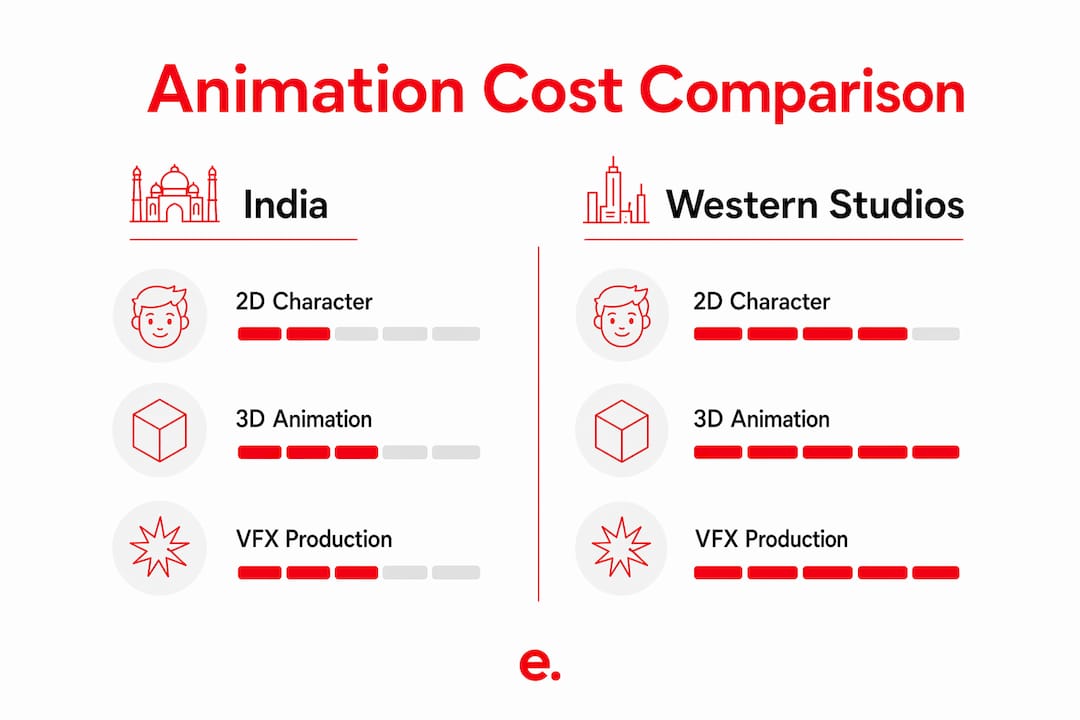
The cost difference between Indian and Western animation studios is not marginal. 2D character animation costs $500–$1,500 per minute in India, compared to $5,000–$20,000 per minute at Western studios. That gap represents up to 90% in savings for comparable quality output.
The table below shows typical per-minute cost ranges across animation styles:
| Animation Style | India (per minute) | Western Studios (per minute) |
|---|---|---|
| 2D character animation | $500–$1,500 | $5,000–$20,000 |
| 3D animation | $1,000–$5,000 | $10,000–$30,000 |
| Motion graphics | $300–$800 | $2,000–$8,000 |
| Whiteboard/explainer | $200–$600 | $1,500–$5,000 |
Fixed costs like studio overhead and software licensing amortize more favorably over longer projects in India. A 10-episode series benefits far more from Indian pricing than a single 60-second spot, because the per-episode overhead drops as the relationship matures.
Animation pricing depends heavily on style, scripting clarity, and revision scope. A vague brief leads to costly rework during production. Skipping pre-production stages like scripting and storyboarding is the single most common reason projects run over budget.
- Finalize your script before requesting quotes. Incomplete scripts inflate estimates.
- Define revision rounds upfront. Open-ended revisions are the fastest way to erode cost savings.
- Budget separately for audio, voiceover, and music. These are rarely included in base animation quotes.
- Request itemized quotes that separate pre-production, animation, and post-production costs.
Pro Tip: Ask studios to quote based on a completed script and locked style guide. You will get a more accurate price and avoid scope creep that eats into your savings.
What makes Indian animation talent uniquely capable?
India’s animation talent has moved well past the “cheap labor” label. Indian animators excel in industry-standard tools like Maya, Houdini, and Unreal Engine, which means their work integrates directly into Western production pipelines without conversion or rework. That technical fluency is not accidental. It reflects decades of training programs aligned with global studio requirements.
The more significant shift is creative. India’s animation talent pool has evolved from cost-driven to creativity-driven, with artists now actively contributing to storytelling, not just executing frames. Studios that once handled only service work now pitch original concepts, develop characters, and co-produce content for international markets.
“The most successful partnerships treat Indian animation studios as creative collaborators, not just service vendors. Collaborative storytelling yields better artistic outcomes and stronger client relationships.”
— Sean Mullen, as cited by Animation Xpress
The talent available spans the full production chain:
- Character animators trained in performance-driven techniques for film and streaming
- VFX compositors with credits on international productions
- Concept artists and storyboard artists who contribute at the development stage
- Technical directors who manage pipeline integration with Western software environments
- Creative supervisors who can lead projects end-to-end without constant client oversight
When you hire remote animators from India, you are not buying execution capacity alone. You are accessing creative professionals who can shape the work, not just complete it.
What government policies support hiring Indian animators?
India’s policy environment actively encourages foreign companies to hire and invest in its animation sector. Foreign animation productions can claim 30–40% federal cash rebates and benefit from 100% FDI approval on the automatic route. India’s costs are already 60–70% lower than Hollywood or London for equivalent technical output. The rebates push that advantage further.
The key policies that make India attractive for animation outsourcing are:
- 100% FDI automatic route. Foreign companies can establish wholly owned subsidiaries in India’s animation and VFX sector without prior government approval. Only standard post-allotment filings are required.
- Federal cash rebates. Productions that meet qualifying criteria can claim back 30–40% of eligible Indian expenditure through central government programs.
- State-level incentives. States like Maharashtra, Karnataka, and Telangana offer additional subsidies, studio space incentives, and talent development grants to attract foreign productions.
- AVGC talent pipeline investment. The Indian government funds specialized AVGC training programs at universities and technical institutes, ensuring a steady supply of production-ready graduates.
- Simplified entity setup. Establishing a wholly owned subsidiary in India requires minimal bureaucratic steps under the automatic FDI route, making it practical for studios of any size.
Pro Tip: If you plan to produce more than one project in India, explore setting up a local entity or using an Employer of Record service. Both options give you more control over talent and costs than project-by-project outsourcing.
For a broader look at India’s outsourcing policy environment, the same incentive framework applies across professional services, not just animation.
How to build a successful partnership with Indian animation studios
Choosing a partner studio with project-fit experience matters more than choosing the largest or cheapest option. A studio that specializes in 2D children’s content will not automatically excel at photorealistic 3D VFX. Match the studio’s portfolio to your specific content type before signing anything.
Time zone differences are an asset when managed correctly. Follow-the-sun workflows allow Western and Indian teams to hand off work at the end of each day, enabling nearly continuous production progress. A US-based creative director can review overnight renders every morning without waiting a full business day. That compression alone can cut production timelines significantly.
Practical steps for a strong partnership:
- Send a complete creative brief. Include style references, character sheets, color palettes, and tone guidelines before production starts.
- Define hand-off protocols. Specify what gets delivered at each stage, in what file format, and by what time in each team’s time zone.
- Set revision expectations in writing. Agree on the number of revision rounds per asset before work begins.
- Treat your Indian team as creative partners. Studios that receive creative latitude consistently produce better work than those given rigid execution-only briefs.
Avoiding common coordination failures is equally important. Review offshore staffing vendor mistakes before you finalize your engagement model. Many projects fail not because of talent gaps but because of unclear communication structures on the client side.
Pro Tip: Schedule a weekly video call that includes both creative leads and production managers. Async communication handles daily tasks well, but a live touchpoint prevents misalignments from compounding over weeks.
For guidance on storyboard artist recruitment specifically, Remotee’s offshore hiring guides cover the pre-production hiring process in detail.
You can also find relevant media and marketing services that complement animation production when building out a full content strategy for your brand.
Key Takeaways
Hiring Indian animators gives businesses access to world-class creative talent, significant cost savings, and a government-backed ecosystem that makes long-term outsourcing both practical and profitable.
| Point | Details |
|---|---|
| Cost savings are substantial | 2D animation costs $500–$1,500 per minute in India vs. $5,000–$20,000 in Western studios. |
| Talent is technically mature | Indian animators work in Maya, Houdini, and Unreal Engine, integrating directly into global pipelines. |
| Government incentives are real | Foreign productions qualify for 30–40% federal cash rebates and 100% FDI on the automatic route. |
| Studio fit beats studio size | Match the studio’s portfolio to your content type for better technical and creative results. |
| Time zones work in your favor | Follow-the-sun workflows compress timelines by enabling continuous daily production progress. |
India’s animation industry has grown up. Most clients haven’t caught up yet.
I have watched the conversation around Indian animation outsourcing stay stuck in the same place for years. Businesses ask about cost. They get a quote. They compare it to a Western studio. They hire based on price. Then they are surprised when the work feels generic or the relationship feels transactional.
The problem is not the talent. The problem is the brief. Indian animation studios at the mid-to-senior tier are not waiting for instructions. They are waiting for a creative conversation. The artists working in Mumbai, Pune, and Hyderabad have credits on streaming productions that your audience watches. They have opinions about character design, pacing, and visual tone. When you treat them like a rendering factory, you get factory output.
The studios that consistently deliver exceptional work share one trait. Their clients show up with a point of view, not just a script. They share references, explain the emotional intent of the project, and invite pushback. That kind of brief unlocks a different quality of collaboration.
The AVGC sector’s growth to $2.2–3 billion is not just a market size number. It signals that India has built an animation industry with its own creative identity. The best reason to hire Indian animators in 2026 is not the cost. It is that you can now find creative partners there who will make your project better, not just cheaper.
— Rajkumar
How Remotee makes hiring Indian animation talent straightforward
Remotee’s Employer of Record service in India removes the compliance and payroll complexity that stops many businesses from hiring Indian animators directly. Remotee handles contracts, local labor law compliance, payroll processing, and HR administration, so your team focuses on the creative work.
Clients working with Remotee report up to 32% savings on hiring costs compared to traditional recruitment models. Remotee presents only pre-vetted candidates, which means you spend less time screening and more time producing. For businesses ready to hire offshore creative talent at scale, Remotee provides the operational infrastructure to do it without legal risk or administrative drag. Contact Remotee to start building your Indian animation team today.
FAQ
How much does it cost to hire Indian animators?
2D animation in India costs $500–$1,500 per minute, compared to $5,000–$20,000 per minute at Western studios. Final costs depend on style, complexity, and revision scope.
What software do Indian animators use?
Indian animators work in industry-standard tools including Maya, Houdini, and Unreal Engine. This ensures direct compatibility with Western production pipelines.
Can foreign companies legally hire Indian animators directly?
Yes. India allows 100% FDI on the automatic route for animation and VFX, meaning foreign companies can establish wholly owned entities without prior government approval.
What is the best way to manage time zone differences with Indian teams?
Follow-the-sun workflows, where each team hands off completed work at the end of their day, allow nearly continuous production progress. Clear hand-off protocols and daily async updates keep both sides aligned.
How do I choose the right Indian animation studio?
Match the studio’s portfolio to your specific content type and style requirements. A studio’s experience with your genre matters more than its size or base pricing.