How Global Firms Vet Offshore Candidates in 2026

TL;DR:
- Global firms use multi-stage vetting to filter offshore candidates aggressively, with acceptance rates as low as 5 to 12 percent. AI voice screening accelerates the process by providing fast, calibrated assessments, helping shortlist candidates in 2 to 5 days. Effective offshore hiring relies on layered technical and communication evaluations, with regional adaptation through centers of excellence.
Offshore candidate vetting is the structured, multi-stage process global firms use to evaluate international applicants before making a hire. The best firms achieve acceptance rates of just 5–12%, which means their frameworks filter aggressively at every step. Firms like Outsourced SG and Offshore1st run four to five distinct screening layers, from resume review to live system design sessions, to ensure only genuinely qualified candidates reach offer stage. Tools like Talvin AI now automate the earliest layers, cutting shortlist time to as little as 2–5 business days. Understanding how global firms vet offshore candidates is the first step toward building a process that produces hires who contribute from week one, not month two.
What are the standard stages in vetting offshore candidates?
The most effective offshore vetting frameworks move from cheap, fast filters to expensive, high-signal assessments. This sequencing protects recruiter time and budget while progressively narrowing the candidate pool.
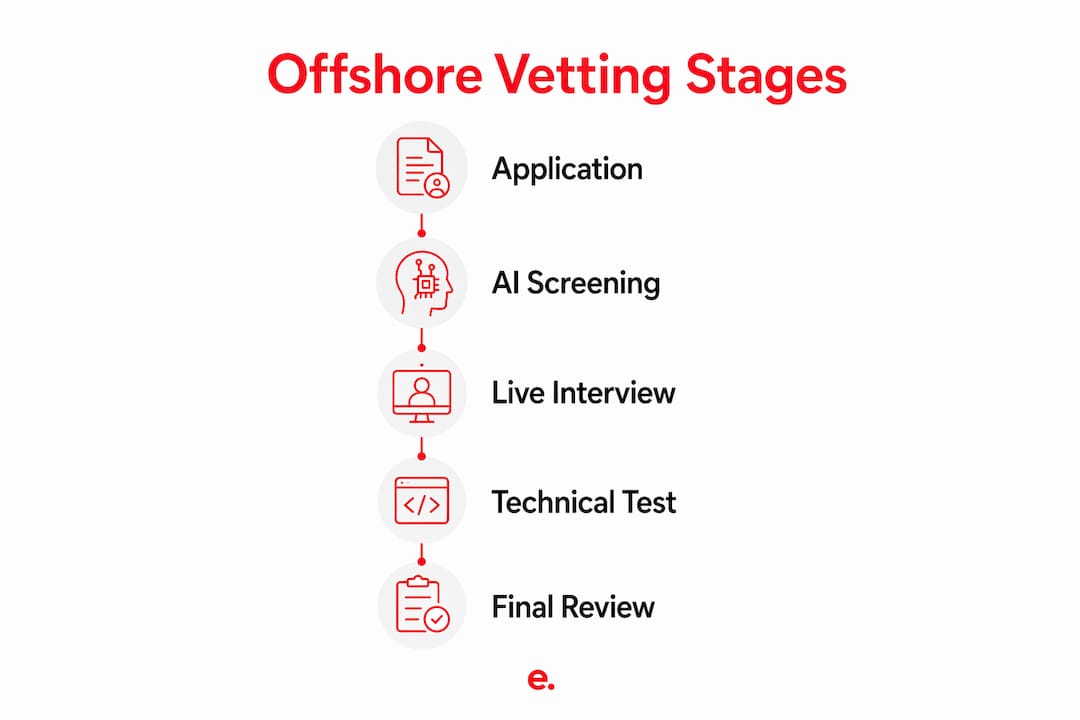
A four-stage funnel is the current standard among leading global firms:
-
Resume and portfolio screening. This stage eliminates candidates who lack the stated experience or credentials. Recruiters check for gaps, verify claimed certifications, and look for concrete project outcomes rather than vague role descriptions.
-
Timed technical challenge. Candidates complete a real-world task under time pressure. The goal is not perfection. It is to see how a candidate approaches an unfamiliar problem with limited guidance.
-
Live system design review. This is where vetting gets serious. A live, synchronous video session requires candidates to explain design decisions and adapt under direct questioning. Candidates who relied on AI-generated answers for the take-home challenge cannot hold up here.
-
Communication and cultural fit interview. Recruiters assess English fluency, async readiness, and how well the candidate explains complex ideas to a non-technical audience. This stage predicts day-to-day collaboration quality more than any technical test.
-
Reference and background checks. Offshore1st’s framework includes employment verification and open-source contribution reviews alongside direct contact with previous managers. This step catches credential inflation and validates the candidate’s professional history.
Pro Tip: Ask candidates to walk you through a past project failure during the communication interview. Candidates who can articulate what went wrong and what they changed reveal both self-awareness and async communication ability in a single answer.
How AI and advanced technologies speed up offshore screening

Automated AI voice interviews have become the standard first filter for high-volume offshore hiring. These platforms conduct two-way spoken conversations, not static questionnaires, and they run 24 hours a day across every time zone.
The practical impact is significant. Firms using AI screening tools can shortlist candidates in 2–5 days rather than the two to three weeks a traditional phone screen process requires. That speed matters when you are hiring across India, Vietnam, and Indonesia simultaneously.
Key advantages of AI voice screening for offshore evaluation include:
- Accent-calibrated assessment. Platforms like Talvin AI are calibrated for APAC accents including Sri Lanka, India, Malaysia, and Indonesia. Western-centric tools misread fluency and penalize candidates unfairly.
- Adaptive conversation flow. The AI adjusts follow-up questions based on candidate responses, producing a richer signal than pre-recorded video screens.
- ATS integration. Most enterprise-grade platforms push structured results directly into applicant tracking systems, removing manual data entry from the recruiter’s workflow.
- Consistent scoring. Every candidate answers a comparable set of prompts, which removes interviewer bias from the initial screening stage.
Pro Tip: Use AI voice interviews to screen for communication clarity and reasoning, not just vocabulary. A candidate who speaks simply but explains their logic step by step will outperform a fluent candidate who cannot structure an argument.
The role of AI in offshore hiring continues to expand beyond voice screening into written communication analysis and async task evaluation. Firms that adopt these tools early gain a measurable speed advantage in competitive talent markets.
How do global firms balance standardization and local adaptation?
Global firms that hire at scale face a structural tension. A single vetting standard applied everywhere misses regional legal requirements and cultural norms. But fully localized processes produce inconsistent quality and compliance gaps.
The solution most leading firms use is a Centers of Excellence model. A central CoE owns the core framework, the “global spine,” while regional teams adapt specific elements, the “ribs,” to fit local conditions.
| Element | Global spine (centralized) | Regional rib (localized) |
|---|---|---|
| Technical assessment rubric | Standardized scoring criteria | Adjusted for local skill benchmarks |
| Background check process | Mandatory employment verification | Adapted for local data privacy law |
| Communication evaluation | English fluency baseline | Tolerance for accent variation by market |
| Fraud risk protocols | Centralized flag criteria | Local document verification norms |
| Offer negotiation guidelines | Salary band governance | Market rate adjustments by country |
India and APAC markets illustrate why local adaptation matters. Credential fraud risk is higher in some markets, which means background check depth must increase. Negotiation norms differ significantly between Singapore and Vietnam. A recruiter applying a single script across both markets will either overpay or lose candidates at the offer stage.
Singapore compliance requirements add another layer of complexity for firms hiring in that market. Regulatory changes in 2026 affect how employment contracts are structured and what documentation offshore hires must provide before onboarding.
The CoE model also centralizes data governance. When all screening results flow into a single system, leadership can track acceptance rates, time-to-hire, and quality metrics across every region. That visibility is what allows firms to improve their offshore staffing risk management over time rather than repeating the same mistakes in each new market.
What criteria actually predict long-term offshore hire success?
Technical skill is the entry requirement, not the differentiator. The candidates who succeed long-term in offshore remote roles share a different set of traits that most vetting processes underweight.
Async communication readiness is the strongest predictor. High-performing offshore hires proactively document their thought processes and communicate blockers without being asked. This behavior cannot be faked in a live interview. Recruiters should ask candidates to describe how they handle a situation where they are stuck and cannot reach a colleague for eight hours.
“Async communication skills such as documented progress reports and written collaboration updates are stronger predictors of remote work success than technical ability alone for offshore candidates.” — Hirevire research
Other indicators worth evaluating:
- Code explainability under pressure. A candidate who wrote the code should be able to explain every design decision in plain language. If they cannot, the code was not theirs.
- Authenticity signals. Open-source contributions, published work, and social proof verification add confidence that a resume reflects real experience. Offshore1st’s framework treats these as a formal screening layer.
- Written communication quality. Review every email and message the candidate sends during the process. Clarity, structure, and response time reveal how they will behave once hired.
- Adaptability under ambiguity. Ask candidates to describe a project where requirements changed mid-delivery. How they handled that change predicts performance in distributed teams where context shifts without warning.
Cultural fit is not a one-time check. It is an ongoing assessment that starts at the first touchpoint and continues through onboarding. Firms that treat it as a single interview question miss the cumulative signal that builds across every interaction. The offshore developer vetting process at leading firms embeds cultural evaluation into every stage rather than isolating it at the end.
Key Takeaways
Effective offshore candidate vetting combines layered technical assessments with async communication screening to identify hires who perform from day one.
| Point | Details |
|---|---|
| Use a multi-stage funnel | Move from resume screens to live design sessions to filter progressively and protect recruiter time. |
| AI voice screening accelerates shortlisting | Platforms like Talvin AI cut shortlist time to 2–5 days while maintaining communication quality. |
| Centralize standards, localize execution | CoEs set the global framework; regional teams adapt for compliance, fraud risk, and market norms. |
| Async readiness outweighs technical skill | Candidates who document proactively and communicate blockers without prompting succeed long-term. |
| Background checks close the authenticity gap | Employment verification and open-source review catch credential inflation before an offer is made. |
What I have learned about offshore vetting that most guides miss
I have reviewed offshore vetting frameworks across dozens of global hiring engagements, and the pattern I see most often is this: firms invest heavily in technical assessment and almost nothing in async communication evaluation. They run a rigorous coding challenge, then ask two or three generic behavioral questions and call it a culture fit interview. That is not a culture fit interview. That is a formality.
The live system design session is the single most valuable stage in any offshore vetting process. Not because it tests architecture knowledge, but because it reveals whether a candidate can think out loud, accept pushback, and revise their position in real time. Those are the skills that determine whether a distributed team functions or fractures. Take-home challenges, no matter how well designed, cannot replicate that dynamic.
AI voice screening is genuinely useful, but only when the platform is calibrated for the market you are hiring in. I have seen firms apply Western-built tools to Indian and Southeast Asian candidate pools and then wonder why their shortlists feel thin. The tool was penalizing accent variation, not measuring communication quality. Talvin AI’s APAC calibration addresses this directly, and it matters more than most recruiters realize.
The future of offshore vetting is not more automation. It is smarter sequencing. The firms that will build the strongest offshore teams in the next three years are the ones that use AI to handle volume at the top of the funnel and reserve human judgment for the moments that actually predict performance: the live session, the async task, and the reference call with the previous manager.
— Rajkumar
How Remotee supports compliant, efficient offshore hiring
Global firms that want a proven vetting process without building one from scratch have a direct path forward with Remotee.
Remotee operates as an Employer of Record in India, managing compliance, payroll, and HR so your team focuses on the work, not the paperwork. Remotee presents only pre-vetted candidates, and clients report up to 32% savings on hiring costs compared to traditional recruitment. The vetting process covers technical assessment, communication evaluation, and background verification before any candidate reaches your desk. For global recruiters who need speed, quality, and legal compliance in a single solution, Remotee’s offshore hiring services are built for exactly that.
FAQ
What is the standard acceptance rate for offshore candidates at top firms?
Leading firms like Outsourced SG report a 5% acceptance rate, while Offshore1st reports 8–12%. These figures reflect multi-stage funnels that filter aggressively from resume screen through live interview.
How long does AI-powered offshore screening take?
AI voice interview platforms can shortlist candidates in 2–5 business days. That is significantly faster than traditional phone screen processes, which typically take two to three weeks at scale.
What is the most important skill to assess in offshore candidates?
Async communication readiness predicts long-term success better than technical skill alone. High performers proactively document progress and communicate blockers without being prompted.
How do global firms handle regional compliance differences in offshore vetting?
Most firms use a Centers of Excellence model. A central team sets the core vetting framework, while regional units adapt background check depth, documentation requirements, and offer terms to fit local labor law and market norms.
Why are live system design interviews better than take-home coding challenges?
Live sessions require candidates to explain and defend their decisions under direct questioning. This closes the gap created by AI-generated take-home submissions and reveals whether a candidate genuinely understands their own work.