The Role of Payroll in Creative Team Hiring
TL;DR:
- Payroll signals how much a creative employer values its staff and influences hiring, retention, and scaling. Addressing payroll errors early through integrated planning and cross-team collaboration enhances compliance, reduces costs, and builds trust, especially in global hiring. Flexible staffing models and payroll modernization improve agility and employee retention, making payroll a strategic tool rather than a back-office function.
Payroll is the single most direct signal a creative employer sends about how much it values its people. The role of payroll in creative team hiring extends far beyond processing checks. It shapes who accepts your offer, how long they stay, and whether your agency can scale without financial chaos. 93% of organizations now view payroll as core to their employer value proposition. That number tells you payroll is no longer a back-office function. It is a front-line hiring tool.
How does payroll integration shape the hiring process for creative teams?
Payroll problems in creative agencies rarely start in the payroll department. Errors often originate from poor recruitment role scoping, unclear job responsibilities, and missing handoffs between HR and finance. When a hiring manager writes a vague job description for a senior art director, the downstream effect is a payroll record with misclassified pay grades, wrong overtime rules, and missing benefits triggers.
The financial aspects of hiring creatives require HR and payroll teams to align before a role is posted, not after an offer is signed. Here is a practical four-step process to close that gap:
- Define compensation bands before posting the role. Set the salary floor, ceiling, and benefits package in writing. This prevents negotiation surprises that require payroll amendments on day one.
- Assign payroll data ownership during onboarding design. Decide who enters hours, who approves timesheets, and who reconciles pay runs. Ambiguity here is the top cause of payroll errors in creative project teams.
- Sync your ATS with your payroll platform. Tools like Greenhouse, Lever, or Workday can pass new hire data directly into payroll systems, cutting manual entry errors.
- Run a payroll simulation before the hire starts. Process the new role through your payroll system as a test run. Catch classification errors before they become compliance issues.
Pro Tip: Map every new creative role to a payroll category before the job goes live. A motion designer classified as a contractor when the work is full-time creates tax liability and erodes trust the moment the first paycheck arrives.
Payroll managers who own this process do more than cut checks. Strong payroll hires own compliance, systems integration, and cross-functional collaboration. That skill set is exactly what creative agencies need when they are scaling fast.

What payroll models best support fluctuating creative team demands?
Creative agencies do not run at a steady pace. A brand campaign launch, a product video sprint, or a rebrand project creates a six-week surge that does not justify a full-time hire. The payroll considerations for creative teams must account for this workload volatility.
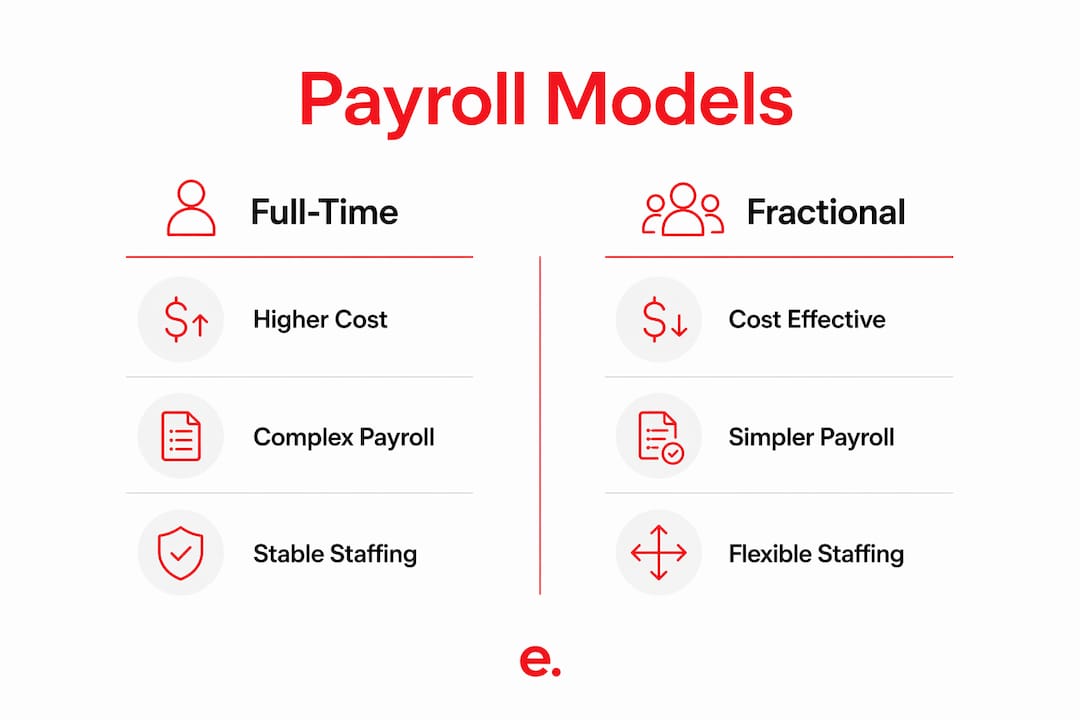
Full-time creative directors are the most expensive solution to a problem that is often temporary. A full-time Creative Director costs between $175,000 and $299,000 annually. That figure includes salary, benefits, payroll taxes, and onboarding overhead. Fractional creative directors, by contrast, run on retainers of $5,000–$15,000 per month and reduce total leadership costs by 40–65%.
| Staffing model | Estimated annual cost | Payroll complexity | Best for |
|---|---|---|---|
| Full-time Creative Director | $175K–$299K | High (benefits, taxes, equity) | Sustained, high-volume output |
| Fractional Creative Director | $60K–$180K | Medium (contract or EOR) | Campaign surges, brand pivots |
| Project-based freelancer | $15K–$60K per project | Low (1099 or platform-managed) | One-off deliverables |
| Offshore full-time hire | $40K–$90K (via EOR) | Low to medium (EOR-managed) | Ongoing creative production |
Creative agencies manage seasonal surges by using flexible freelancers and fractional roles to avoid permanent payroll overhead. This elastic staffing model also reduces burnout and turnover by preventing small teams from absorbing unsustainable workloads.
The payroll benefits of this approach are concrete:
- Fractional and freelance workers reduce employer payroll tax exposure significantly.
- Project-based billing converts fixed payroll costs into variable costs that track revenue.
- Offshore full-time hires through an Employer of Record (EOR) deliver full-time commitment at a fraction of domestic payroll cost.
- Elastic staffing gives finance teams predictable cost-per-project data rather than unpredictable overtime spikes.
For agencies exploring offshore creative talent hiring, the payroll model choice determines both cost structure and compliance exposure. Getting this decision right at the hiring stage prevents expensive reclassification later.
Why does payroll accuracy determine whether creative talent stays?
Payroll accuracy is the foundation of employee trust. 53% of employees say repeated payroll errors motivate them to leave. In creative industries, where top designers, copywriters, and strategists have multiple competing offers at any time, a single late or incorrect paycheck can accelerate a departure that was already in progress.
The importance of payroll in hiring goes beyond the first paycheck. Creative team compensation must include the full package:
- Base salary accuracy: Every pay run must match the offer letter exactly. Discrepancies, even small ones, signal disorganization.
- Benefits delivery: Health insurance, retirement contributions, and PTO accruals must activate on schedule. Delays here are the most common source of new-hire complaints.
- Bonus and commission clarity: For creative leads tied to campaign performance, bonus structures must be documented and paid on time.
- Transparent pay statements: Employees who can see exactly how their gross pay becomes net pay report higher trust in their employer.
76% of employees cite benefits and perks as the primary reason they stay with an employer. That statistic reframes creative team compensation entirely. Base salary gets candidates in the door. Benefits keep them at the desk.
Payroll modernization through AI-powered automation reduces errors and improves the employee experience by delivering real-time pay visibility. Platforms that give employees a self-service portal to check pay history, update tax withholdings, and view benefits balances remove the friction that turns minor payroll questions into HR escalations.
Pro Tip: Send a payroll confirmation message to every employee on pay day. A simple automated notification showing net pay and deductions reduces “where is my paycheck” inquiries by a measurable margin and reinforces that your payroll process is reliable.
60% of organizations link payroll modernization directly to improved employee engagement. For creative teams, where culture and trust are competitive differentiators, that connection is not optional.
How do payroll systems adapt to cross-border creative hiring?
Global creative hiring introduces payroll complexity that domestic-only teams never face. Tax treaties, local labor laws, mandatory benefits, and currency conversion all create compliance risk when a U.S. agency hires a motion designer in India or a UX writer in the Philippines.
EOR solutions enable global creative team payroll compliance without requiring the hiring company to set up a local legal entity. The EOR becomes the legal employer in the target country, handling local payroll, tax filings, statutory benefits, and labor law compliance on behalf of the agency.
The practical benefits for creative hiring managers are significant:
- No entity setup required. Hiring a full-time creative in India through an EOR takes weeks, not months. Setting up a local subsidiary takes six months or more.
- Compliant payroll from day one. The EOR calculates and remits local taxes, provident fund contributions, and statutory deductions automatically.
- Consistent employee experience. Offshore creative hires receive the same structured onboarding, benefits enrollment, and payroll communication as domestic staff.
- Reduced legal exposure. Misclassifying an offshore creative as a contractor when local law requires employment status is a common and costly error. EORs eliminate that risk.
For agencies expanding capacity with offshore talent, the EOR model converts a complex cross-border payroll challenge into a managed service. The agency focuses on creative output. The EOR handles everything else.
How payroll affects hiring processes in global contexts also includes currency risk management and benefits localization. A competitive salary in U.S. dollars must translate into a locally competitive package. EOR providers with in-country expertise handle this translation automatically, which means your offer letter lands correctly the first time.
Key takeaways
Payroll is a strategic hiring function in creative industries, and agencies that treat it as such retain more talent, reduce errors, and scale faster than those that do not.
| Point | Details |
|---|---|
| Payroll starts at recruitment | Role scoping errors in hiring directly cause downstream payroll errors and compliance gaps. |
| Flexible models cut costs | Fractional and offshore staffing reduces creative payroll costs by 40–65% versus full-time domestic hires. |
| Accuracy drives retention | 53% of employees leave after repeated payroll errors, making accuracy a direct retention lever. |
| Benefits outweigh base salary | 76% of creative employees stay for benefits and perks, not salary alone. |
| EOR removes global barriers | Employer of Record services handle cross-border payroll compliance without local entity setup. |
Payroll is the hiring lever most creative agencies underestimate
I have worked with creative agencies ranging from boutique design studios to mid-size integrated shops. The pattern I see repeated is the same: HR and finance treat payroll as a post-hire administrative task. Recruitment closes the deal, onboarding starts, and payroll catches up later. That sequence is backwards, and it costs agencies real money and real people.
The agencies that get this right build payroll considerations into the job design phase. They know the total cost of a hire before the first interview. They have a clear answer when a candidate asks about benefits, bonus timing, and pay frequency. That preparation signals organizational maturity. Candidates notice it.
The harder truth is that most payroll errors I have seen in creative teams trace back to a single moment: the hiring manager and the payroll team never talked. A creative director was hired at a rate that did not fit any existing pay grade. A freelance illustrator was onboarded with a contractor agreement that local law treated as employment. A senior copywriter’s equity grant was promised verbally but never entered into the system. Each of these is a payroll problem that started as a hiring problem.
My recommendation is to treat the payroll team as a hiring stakeholder, not a downstream recipient. Bring them into role design conversations. Let them flag classification risks before offers go out. That cross-functional habit is the single highest-return change most creative HR teams can make in 2026.
The future of payroll in creative hiring is real-time, transparent, and globally portable. AI-powered payroll platforms are already reducing error rates and giving employees self-service visibility into their compensation. Agencies that adopt these tools now will have a structural advantage in attracting and keeping the creative talent that defines their output.
— Rajkumar
How Remotee simplifies payroll for creative team hiring
Managing payroll for a growing creative team, especially one that spans borders, is one of the most time-consuming challenges HR professionals face. Remotee’s Employer of Record service in India removes that burden entirely. Remotee handles payroll processing, tax compliance, statutory benefits, and HR administration for your offshore creative hires, so your team focuses on output rather than paperwork.
Clients working with Remotee report up to 32% savings on hiring costs compared to domestic equivalents. For creative agencies hiring designers, video editors, or content strategists from India, that cost advantage compounds quickly. Remotee presents only pre-vetted candidates, which means your payroll and compliance setup starts with the right hire from day one. If you are ready to scale your creative team without the overhead, Remotee is built for exactly that.
FAQ
What is the role of payroll in creative team hiring?
Payroll defines the financial terms of employment and directly influences offer acceptance, onboarding trust, and long-term retention. It functions as both a compliance requirement and a strategic signal of how an organization values its creative staff.
How do payroll errors affect creative talent retention?
53% of employees say repeated payroll errors motivate them to leave their employer. In creative industries where talent has strong market alternatives, even a single significant error can accelerate departure.
What payroll model works best for agencies with variable workloads?
Fractional and project-based staffing models reduce payroll overhead by 40–65% compared to full-time hires, making them the most cost-effective option for agencies managing campaign surges or seasonal demand spikes.
How does an Employer of Record simplify cross-border payroll?
An EOR becomes the legal employer in the target country and manages local payroll, tax filings, and statutory benefits on behalf of the hiring agency. This eliminates the need to set up a local legal entity and reduces compliance risk significantly.
Why do benefits matter more than salary in creative compensation?
76% of employees cite benefits and perks as the primary reason they stay with an employer. For creative professionals evaluating multiple offers, a strong benefits package often outweighs a marginal salary difference.