How Offshore Hiring Reduces Agency Overhead in 2026
TL;DR:
- Offshore hiring enables agencies to cut costs by transferring payroll, benefits, office, and recruitment expenses to managed providers. Structured models paired with AI automation significantly reduce management overhead, attrition, and ramp-up times, leading to substantial long-term savings. Effective offshore strategies rely on disciplined management, clear SOPs, and leveraging technology to optimize operational efficiency and scalability.
Offshore hiring is the practice of employing skilled professionals in lower-cost regions to cut agency overhead without sacrificing output quality. For tech and creative agencies, this is not a staffing shortcut. It is a structural cost decision that touches payroll, benefits, office space, recruitment fees, and attrition. Agencies using managed offshore models report savings of 40 to 60% on total cost of ownership within six months. Understanding how offshore hiring reduces agency overhead requires looking beyond the hourly rate and examining every line item it eliminates.
How offshore hiring reduces agency overhead across cost categories
Offshore hiring removes overhead at multiple levels simultaneously, which is why its financial impact compounds faster than most agency leaders expect.

The most visible savings come from salary differentials. A senior developer in the United States costs $120,000 to $160,000 annually in base salary alone. An equivalent role filled offshore, particularly in India, runs $25,000 to $45,000. That gap funds two to three additional hires or flows directly to margin. But salary is only the beginning.
Agencies also eliminate or sharply reduce the following costs when they shift roles offshore:
- Payroll taxes and benefits: Employer-side payroll taxes, health insurance, 401(k) matching, and paid leave add 25 to 35% on top of base salary for US-based employees. Offshore roles under an Employer of Record model transfer these obligations to the provider.
- Office space and equipment: Remote offshore teams require no desk, no hardware provisioning, and no facilities overhead. For agencies in New York or San Francisco, this alone can represent $15,000 to $25,000 per employee per year.
- Recruitment fees: Traditional agency recruiting costs $20,000 to $40,000 per hire in placement fees. Managed offshore providers absorb sourcing, vetting, and onboarding into their service model.
- Attrition replacement: Average employee tenure at digital agencies is under two years, and each replacement costs $8,000 to $15,000 in lost productivity and rehiring. Managed offshore models reduce churn through dedicated team structures.
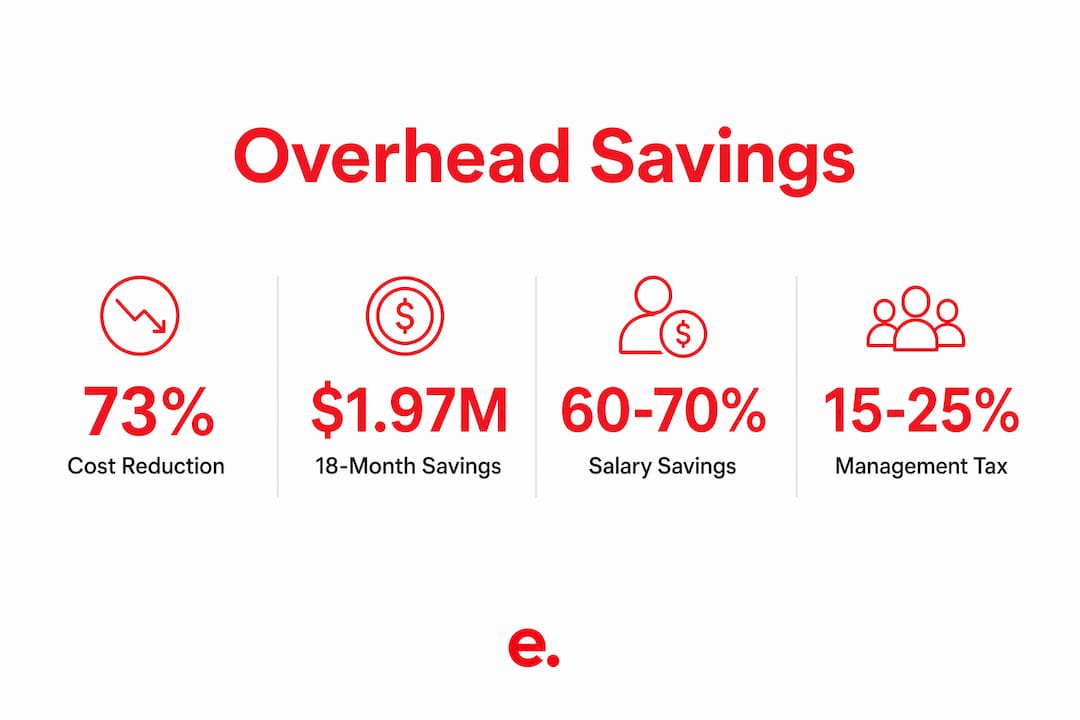
For a five-engineer team, these combined savings can reach $1,972,500 over 18 months, a 73% reduction compared to equivalent onshore staffing. That figure is not a projection. It reflects what agencies actually report when they account for the full cost stack.
Pro Tip: Before comparing offshore to onshore costs, build a total cost model that includes salary, taxes, benefits, office, equipment, recruiting fees, and average replacement costs. The hourly rate comparison alone understates the savings by 40% or more.
How do managed offshore teams differ from freelancers in reducing agency overhead?
The distinction between a freelancer and a managed offshore team is the difference between renting a tool and hiring a department. Both reduce costs with offshore teams on paper. Only one reduces overhead in practice.
Freelancer platforms like Upwork or Fiverr offer low hourly rates, but they introduce what practitioners call the “management tax.” Every deliverable requires briefing, review, revision cycles, and quality checks by your internal team. That coordination cost is invisible in the invoice but very real in your team’s calendar. Switching from freelancer platforms to structured staff augmentation can reduce total cost by 40 to 60% because it eliminates the management overhead and rework that freelancer models generate.
Managed offshore teams operate differently:
- A dedicated supervisor handles day-to-day quality assurance and performance accountability.
- Backup staffing is built into the model, so a sick day or resignation does not stall your sprint.
- Onboarding follows a defined process, reducing ramp-up time from weeks to days.
- The provider manages HR, payroll, and compliance, freeing your leadership from administrative drag.
“Managed offshore teams transfer HR, payroll, and compliance risks from agencies to providers, freeing internal leadership bandwidth.” — How To Reduce Agency Overhead Costs Without Compromising Quality
The practical implication is significant. When you hire through a managed model, you are paying for execution, not geography. The provider’s infrastructure absorbs the operational complexity that would otherwise land on your project managers, finance team, and HR staff. That is where the real overhead reduction happens.
What role does technology and automation play in optimizing offshore hiring overhead?
Combining offshore teams with AI-driven automation creates a compounding cost reduction that neither approach achieves alone. This is the 2026 best practice that separates agencies scaling efficiently from those still trading hours for dollars.
Here is how the combination works in practice:
- Automate recruiter admin tasks. AI tools integrated with applicant tracking systems handle resume screening, interview scheduling, and candidate communication. AI automation in staffing cuts admin time by 2.5 hours per recruiter daily.
- Reduce coordination overhead. Async communication tools like Loom, Notion, and Linear reduce the meeting load that offshore time zones would otherwise create. Offshore teams receive clear briefs and return completed work without synchronous bottlenecks.
- Invest in tooling with fast payback. A 50-person US staffing firm saved $72,000 per year with a $3,000 investment in automation tooling, with a 16-day payback period. The ROI on automation at this scale is not marginal. It is structural.
- Use AI for quality monitoring. Tools like Grammarly Business, Notion AI, and project management platforms with AI reporting layers allow onshore leads to monitor offshore output quality without manual review of every deliverable.
The agencies seeing the largest reductions in overhead are not choosing between offshore talent and technology. They are deploying both. Offshore teams handle execution-heavy tasks. AI handles administrative and coordination tasks. Onshore leadership handles strategy and client relationships. This hybrid agency structure accelerates delivery roadmaps while keeping fixed costs low. You can explore AI-powered recruitment tools to see how this integration works at the sourcing stage.
What challenges and hidden costs must agencies consider?
Offshore hiring does not eliminate overhead automatically. Agencies that treat it as a plug-and-play cost cut often discover new overhead categories they did not budget for.
The most common hidden cost is the management tax. A $25/hr offshore developer effectively costs $40/hr when you account for async coordination, reviewing, and error correction. This 15 to 25% management overhead is not a reason to avoid offshore hiring. It is a reason to structure it correctly from day one.
Other challenges agencies consistently encounter include:
- Onboarding and ramp-up time: Even experienced offshore hires need two to four weeks to learn your tools, processes, and client standards. Budget for this productivity gap explicitly.
- Cultural and communication gaps: Agencies working with offshore teams in India or Southeast Asia report that explicit documentation of expectations, tone, and deliverable standards reduces revision cycles by 30 to 50%.
- Compliance and legal exposure: Hiring offshore without an Employer of Record model exposes agencies to misclassification risk, local labor law violations, and tax liability. The total cost of offshore hiring must include compliance infrastructure, not just labor rates.
- Freelancer platform risks: Unmanaged freelancer arrangements lack accountability structures and often result in higher rework costs than anticipated.
Pro Tip: Calculate your true total cost of ownership before committing to any offshore model. Include base labor, management overhead at 20%, onboarding time, compliance tooling, and a realistic ramp-up delay of three to four weeks. This gives you an honest comparison against your current onshore cost.
How can agencies structure offshore hiring to maximize overhead reduction?
The structure of your offshore engagement determines whether you reduce overhead or simply shift it. Agencies that see the largest gains follow a deliberate sequencing model.
- Start with an EOR or managed service model. Setting up a local entity in India or the Philippines costs $10,000 to $20,000 upfront plus ongoing legal and compliance overhead. An EOR provider absorbs these costs and lets you scale from one hire to twenty without fixed infrastructure.
- Define clear SOPs before hiring. Standard operating procedures for every offshore role reduce onboarding time and management overhead. Document the deliverable format, review process, communication cadence, and quality benchmarks before the first hire starts.
- Assign onshore supervisors to offshore execution teams. A single onshore project lead managing three to five offshore specialists is the most cost-efficient ratio most agencies report. It preserves quality without recreating a full management layer.
- Reserve offshore roles for execution-heavy tasks. Development, design production, content writing, QA testing, and data analysis are the highest-value offshore roles for tech and creative agencies. Strategy, client management, and business development stay onshore.
| Model | Best for | Overhead impact |
|---|---|---|
| EOR managed service | Agencies hiring 1 to 20 offshore roles | Lowest fixed cost, fastest setup |
| Staff augmentation | Project-based capacity needs | Moderate savings, higher flexibility |
| Direct offshore entity | Agencies with 50+ offshore roles | High upfront cost, maximum long-term control |
| Freelancer platforms | One-off tasks only | Low rate, high management overhead |
Agencies that expand capacity with offshore talent through a managed model consistently report faster scaling timelines and lower per-head costs than those attempting direct entity setup. The key is matching the model to your current headcount and growth trajectory, not your aspirational one.
Key takeaways
Offshore hiring reduces agency overhead most effectively when agencies use managed models that transfer compliance, payroll, and HR costs to a provider while combining offshore execution with AI-driven automation.
| Point | Details |
|---|---|
| Salary and benefits savings | Offshore roles cost 60 to 70% less than US equivalents when total compensation is included. |
| Managed models beat freelancers | Structured offshore teams reduce management overhead and rework by 40 to 60% versus freelancer platforms. |
| Automation compounds savings | AI tools cut recruiter admin by 2.5 hours daily, multiplying the cost benefit of offshore hiring. |
| Hidden costs require planning | Management tax adds 15 to 25% to base offshore rates; budget for this from the start. |
| EOR models minimize fixed costs | Starting with an EOR avoids $10,000 to $20,000 in local entity setup fees and ongoing compliance burden. |
Why offshore hiring is a capability, not just a cost line
By Rajkumar
After working with dozens of tech and creative agencies on their offshore hiring decisions, the pattern I see most often is this: agencies treat offshore hiring as a one-time cost reduction move rather than a structural capability they build over time. That mindset is what causes most offshore engagements to underperform.
The agencies that genuinely reduce overhead through offshore hiring are not the ones chasing the lowest hourly rate. They are the ones that invest in the managed model, write clear SOPs, and treat their offshore team as a department with accountability structures. The savings follow from that discipline, not from the geography alone.
What surprises most agency leaders is how much of their overhead is not labor cost at all. It is the management drag, the compliance administration, the recruiting cycles, and the attrition replacement costs. Offshore hiring, done through a managed EOR model, attacks all of those simultaneously. That is why the cost-benefit analysis looks so compelling when you run the full numbers.
The other mistake I see is separating the offshore hiring decision from the technology investment. Agencies that pair offshore execution teams with AI-driven workflows for scheduling, QA, and communication see compounding returns. Neither lever is as powerful alone. Together, they change the unit economics of the agency entirely.
The agencies winning in 2026 are not the ones with the most local headcount. They are the ones that figured out how to pay for output, not overhead.
— Rajkumar
How Remotee helps agencies reduce overhead with offshore hiring

Remotee’s Employer of Record service in India gives tech and creative agencies a direct path to offshore hiring without the compliance complexity, payroll administration, or legal exposure that comes with direct employment. Remotee manages contracts, local labor law compliance, payroll processing, and HR operations so your leadership team focuses on client delivery, not administrative overhead. Clients report up to 32% savings on hiring costs, and Remotee’s vetting process means only top-tier candidates reach your team. If you are ready to reduce costs with offshore teams and build a scalable staffing model, explore Remotee’s offshore hiring solutions to see how agencies like yours are restructuring their cost base in 2026.
FAQ
What costs does offshore hiring actually eliminate for agencies?
Offshore hiring eliminates or sharply reduces recruitment fees, employer-side payroll taxes, benefits costs, office space, and attrition replacement costs. For a five-engineer team, total savings can reach $1,972,500 over 18 months compared to equivalent onshore staffing.
How much does the management tax affect offshore hiring savings?
The management tax adds 15 to 25% to base offshore rates due to coordination, review cycles, and error correction. A $25/hr offshore developer effectively costs $40/hr when this overhead is included, which is why managed service models outperform unmanaged freelancer arrangements.
Is an EOR model better than setting up a local offshore entity?
For agencies hiring fewer than 50 offshore roles, an EOR model is more cost-effective. Direct entity setup costs $10,000 to $20,000 upfront plus ongoing compliance overhead, while an EOR absorbs those costs and allows faster, more flexible scaling.
How does AI automation work alongside offshore teams to reduce overhead?
AI tools handle recruiter admin, scheduling, and quality monitoring, cutting admin time by 2.5 hours per recruiter daily. Combined with offshore execution teams, this creates a compounding overhead reduction that neither approach achieves independently.
What is the fastest way to start reducing agency overhead with offshore hiring?
Starting with a managed EOR service is the fastest path. It eliminates entity setup costs, transfers compliance and payroll obligations to the provider, and allows agencies to place their first offshore hire within weeks rather than months.