What Is Offshore Software Development: a 2026 Guide

TL;DR:
- Offshore software development involves hiring international teams to build and maintain software, offering access to global talent and flexible scaling beyond just cost savings. Choosing the appropriate engagement model and managing communication effectively are crucial for long-term success and overcoming inherent risks. Proper legal protections and integration strategies enhance offshore development outcomes, supported by services like Remotee that simplify offshore hiring processes.
Offshore software development gets reduced to a single idea more often than it should: cheap labor. That framing misses most of the story. What is offshore software development, really? It’s a model where you hire external teams in other countries to build, test, and maintain your software. But the strategic upside goes well beyond the hourly rate. Access to specialized talent pools that simply don’t exist in your local market, the ability to scale a team up or down without the overhead of full-time hiring, and a 24-hour development cycle are advantages that cost savings alone can’t capture. This guide covers all of it.
Table of Contents
- Key Takeaways
- What is offshore software development and how does it work
- Benefits of offshore software development beyond cost savings
- Offshore versus onshore software development
- Offshore engagement models and how to choose
- Risks and challenges worth knowing
- My take on what actually makes offshore development work
- How Remotee helps you hire offshore talent without the complexity
- FAQ
Key Takeaways
| Point | Details |
|---|---|
| More than cost savings | Offshore development gives you access to global talent, faster scaling, and specialized skills beyond what local markets offer. |
| Engagement model matters | Choosing between dedicated teams, staff augmentation, or BOT determines long-term control, cost, and knowledge retention. |
| Coordination is a design choice | Time zone lag causes delays only when management structures and decision authority are poorly defined. |
| Offshore vs. onshore trade-offs | Offshore suits well-defined projects with async workflows; onshore fits work needing constant real-time collaboration. |
| Match model to goal | Mismatching engagement type to project needs leads to churn, knowledge loss, and higher total cost. |
What is offshore software development and how does it work
At its core, offshore software development means outsourcing to teams in distant countries, typically with six or more hours of time zone difference. Those teams build features, fix bugs, write tests, and maintain production systems, functioning as an extension of your business rather than a separate vendor you hand off work to and forget about.

The day-to-day mechanics rely heavily on asynchronous collaboration. Your team in New York documents a feature spec at the end of the day. The offshore team in Bangalore picks it up in their morning, builds it, and pushes code before your team’s workday begins. Done well, this creates a rolling development cycle. Done poorly, it creates a chain of delays where every question takes 24 hours to answer.
Common offshore work scopes include:
- Full product development from architecture to deployment
- Dedicated QA and testing functions
- Ongoing maintenance and bug resolution
- Feature sprints within an existing product team
- Specialized work in areas like machine learning, DevOps, or mobile development
How offshore teams are typically structured:
Modern offshore engagements use Agile sprints, shared project management tools like Jira or Linear, and daily async standup updates to keep work moving. The three most common offshore engagement models are dedicated teams, staff augmentation, and Build-Operate-Transfer. Each fits a different stage and goal, which the later section on engagement models covers in detail.
Pro Tip: Before signing any offshore contract, document your decision-making process in writing. Who can approve a scope change? Who resolves a technical disagreement? Offshore teams that wait for approvals across time zones lose days on questions that should take minutes.
Benefits of offshore software development beyond cost savings
The cost argument is real. Offshore software development can reduce costs by 30 to 70% compared to equivalent onshore teams, depending on the country and engagement structure. Countries like India, Poland, and Vietnam offer highly skilled engineers at rates that reflect local salary markets, not San Francisco or London benchmarks. For a 10-person team, that difference can represent hundreds of thousands of dollars annually.
But cost is the floor, not the ceiling, of the offshore value proposition. Here is where the real advantages of offshore software development compound:
-
Access to specialized talent. Local hiring markets are finite. If your city doesn’t produce many machine learning engineers or your industry doesn’t attract mobile developers, you’re competing hard for a small pool. Offshore development opens the global market. Countries like India graduate over 1.5 million engineering students annually, which means you can find specialists in almost any stack or domain without inflating your salary budget.
-
Flexible scaling. You can grow an offshore team from two engineers to twelve within weeks. That kind of scaling would take six to nine months of recruiting locally. When your roadmap changes or a product launch compresses a deadline, offshore teams give you the capacity to respond. Flexible team extensions let you scale up quickly and reduce headcount without layoffs when a sprint cycle ends.
-
Faster time to market. With overlapping work hours across time zones, a well-managed offshore setup keeps development moving around the clock. A feature your onshore team scopes in the afternoon can be in testing by your next morning standup.
-
Strategic extension, not just outsourcing. The offshore teams that deliver the most value are treated like internal employees: included in planning sessions, given context on business goals, and built into your culture. Offshore teams as business extensions produce better output than teams operating in isolation with only a ticket queue for guidance.
-
Reduced operational overhead. Hiring locally means payroll, benefits, office space, equipment, and HR compliance. Offshore setups, especially through Employer of Record models, shift that burden to a third party and let you focus on building product.
Offshore versus onshore software development
Understanding the offshore versus onshore development comparison is less about finding a winner and more about knowing which model fits your specific situation. Both have clear strengths.
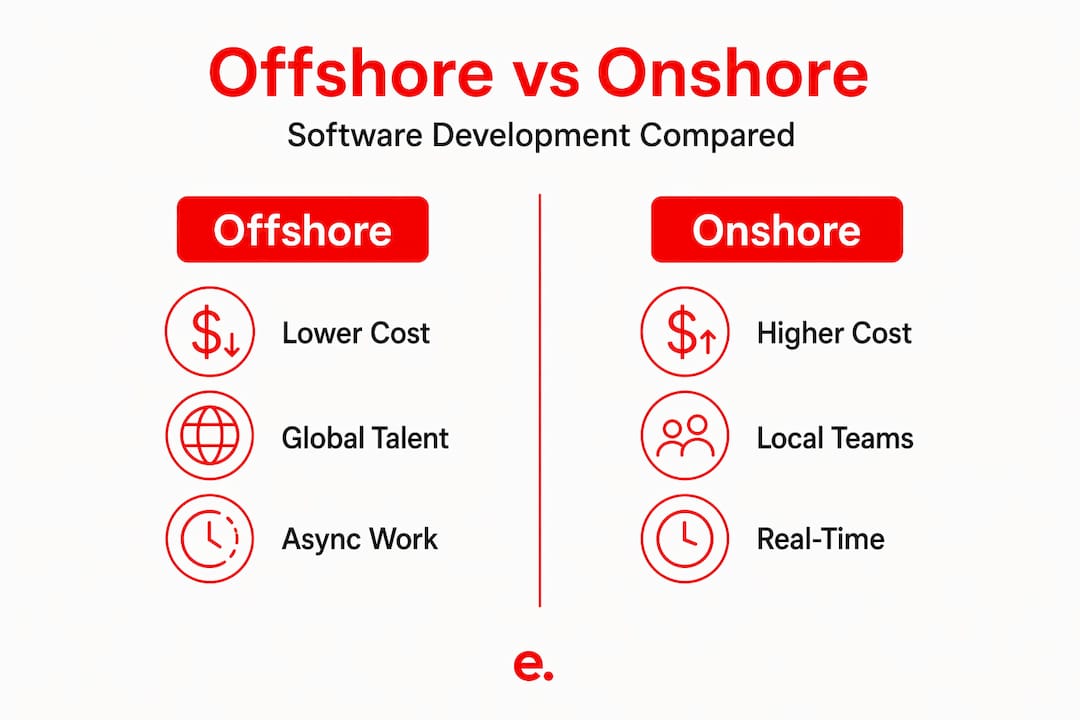
| Factor | Offshore | Onshore |
|---|---|---|
| Cost | 30 to 70% lower | Higher, reflects local salary markets |
| Talent pool | Global, larger, more specialized | Local, limited by geography |
| Time zone overlap | Limited, requires async workflows | Full overlap, real-time collaboration |
| Coordination overhead | Higher, requires documentation | Lower, easier ad hoc communication |
| Legal and compliance | More complex, requires due diligence | Simpler, familiar regulatory environment |
| Project suitability | Defined scopes, async-friendly work | Dynamic projects, frequent decisions |
Offshore works best for well-defined scopes where asynchronous workflows are practical. If your feature specs change three times a day based on live customer feedback, you’ll create coordination friction that erodes the cost benefit. Onshore makes more sense for early-stage product discovery where the team needs to be in constant dialogue.
The IP and compliance picture also differs. Offshore arrangements require you to think carefully about data security, contractual protections, and jurisdictional differences in intellectual property law. This isn’t a reason to avoid offshore development, but it is a reason to get proper legal frameworks in place before work begins.
Hybrid models are increasingly common. A core onshore team handles product strategy, design, and stakeholder communication. An offshore team handles engineering execution. You get the communication advantages of local leadership with the cost and scale benefits of an offshore engineering team.
Pro Tip: If you’re evaluating offshore for the first time, start with a contained project that has a clear deliverable and a defined timeline. It gives you a low-risk way to test the coordination model before committing to a full team.
Offshore engagement models and how to choose
Picking the wrong engagement model is one of the most expensive mistakes companies make in offshore software development. The three main structures each serve different goals:
Dedicated teams are a group of engineers, designers, and QA specialists who work exclusively on your product, typically for a sustained period. They become deeply familiar with your codebase, your standards, and your business context. This model works best when you’re building a long-term product and need consistent output. The trade-off is that you’re committing to ongoing costs even during slower development periods.
Staff augmentation places individual specialists inside your existing team. You hire a React developer or a DevOps engineer from an offshore pool, and they work directly under your management alongside your local team members. This model is fast to set up and scales down easily. The risk is knowledge loss: mismatched engagement types and high churn mean you rebuild context every time a developer rotates out.
Build-Operate-Transfer (BOT) is a longer-term strategy. The BOT model starts with an offshore partner building and managing a team on your behalf. Once the team is operational and mature, typically after one to three years, ownership transfers to you as a wholly owned entity. It gives you the expertise of a seasoned offshore partner during the build phase and full in-house control at the end.
How to choose the right model:
- Define your time horizon. If you need a feature shipped in eight weeks, staff augmentation is your option. If you’re building a two-year product, a dedicated team or BOT model pays off more.
- Assess how much management bandwidth you have. Staff augmentation requires you to manage individuals directly. Dedicated teams come with team leads who handle day-to-day management for you.
- Consider knowledge retention requirements. Projects with complex domain logic need consistent engineers who understand the system. Rotating augmented staff destroys that context over time.
- Think about long-term strategic ownership. If you want to build a captive development center without starting from scratch, BOT is the only model that gets you there.
Matching engagement type to long-term goals is not optional. It’s what separates offshore arrangements that compound value over time from ones that produce perpetual rework and high turnover.
Risks and challenges worth knowing
Offshore software development is not frictionless. The risks are real, but most of them are manageable with the right processes.
- Asynchronous delays. Time zone differences create feedback lag. A question asked at 3 PM EST might not be answered until the next morning. This compounds quickly on projects with unresolved dependencies. The solution is decision pre-authorization: define what each team member can approve without escalation so work doesn’t stall waiting for sign-off.
- Quality control variance. Offshore markets vary widely in engineering quality. A strong recruitment process with technical screening is non-negotiable. Don’t rely on a vendor’s word on candidate quality.
- IP and data security. Sharing proprietary code and customer data across jurisdictions creates legal exposure. Use NDAs, IP assignment clauses, and data processing agreements that are specific to the country you’re working in.
- Cultural and communication gaps. Different working cultures have different norms around raising problems or pushing back on decisions. Build explicit feedback channels into your process so issues surface early rather than quietly becoming bugs in production.
Management design determines whether time zone lag causes real delays or simply shifts when work happens. The geography is not the variable. How you structure escalation paths and decision authority is. Modern offshore success depends on clear objectives, well-documented workflows, and Agile delivery rhythms that create predictability without constant supervision.
Pro Tip: Create a decision log that both your local and offshore teams update daily. It takes 10 minutes and eliminates at least 80% of the “we didn’t know you decided that” conversations that derail offshore sprints.
My take on what actually makes offshore development work
I’ve watched companies go offshore for the wrong reasons and pay for it. The ones who treat it purely as a cost-cutting exercise usually get exactly what they paid for: low-cost engineers who produce low-context work because nobody invested in making them part of the team.
What I’ve found actually works is commitment to integration. The offshore teams that outperform expectations are the ones who get invited to product planning sessions, who understand why a feature matters, and who feel accountable to an outcome rather than just a ticket. That’s not about flying everyone to a retreat. It’s about communication design, how you write specs, how often you give feedback, and whether your offshore team lead has real authority or just passes messages up the chain.
The other thing most businesses underestimate is the cost of mismatched engagement models. A company using staff augmentation for a two-year platform build will spend more in re-onboarding and knowledge recovery than they saved on hourly rates. Long-term offshore success depends on dedicated team alignment with your culture and product goals, not just filling seats.
My advice: be honest about what you need before you select a model. Are you filling a short-term gap or building a long-term capability? The answer determines everything from contract structure to how you should manage the relationship.
— Rajkumar
How Remotee helps you hire offshore talent without the complexity
If this guide has convinced you that offshore software development is worth pursuing, the next question is execution. Building an offshore team from scratch means navigating local labor law, payroll compliance, HR administration, and talent sourcing in a market you may not know well.

Remotee handles all of that for you. As an Employer of Record service focused on India, one of the strongest offshore software development markets in the world, Remotee manages compliance, payroll, and HR so you can focus entirely on building product. Clients report up to 32% savings on hiring costs compared to traditional methods. Whether you’re scaling a dedicated team or exploring staff augmentation, Remotee presents only pre-vetted, top-tier candidates and removes the administrative friction that slows most offshore hiring down. You get the talent. They handle the rest.
FAQ
What is offshore software development in simple terms?
Offshore software development is the practice of hiring software engineers and development teams in other countries to build, test, or maintain your software. Teams typically operate in different time zones and collaborate asynchronously.
How much does offshore software development cost?
Costs vary by country and engagement model, but offshore development typically reduces labor costs by 30 to 70% compared to onshore equivalents. India, Vietnam, and Eastern European countries are common choices with competitive rates and strong engineering talent.
What is the difference between offshore and onshore development?
Onshore development uses teams in the same country, enabling real-time collaboration but at higher cost. Offshore uses teams abroad at lower cost but requires stronger documentation and async communication practices.
Which offshore engagement model is best for long-term projects?
Dedicated teams or the Build-Operate-Transfer model work best for long-term projects. Mismatching engagement types with project goals leads to higher churn and knowledge loss over time.
Is offshore software development secure for IP-sensitive projects?
Yes, with the right legal structure. Use NDAs, IP assignment agreements, and jurisdiction-specific data processing contracts before sharing any proprietary code or customer data with an offshore team.