How Offshore Teams Handle Client Accounts in 2026
TL;DR:
- Effective offshore client account management relies on structured communication, clear onboarding, and measurable performance standards. Incorporating a designated onshore liaison, defining response SLAs, and fostering cultural integration improve service quality and client trust. Proper planning and infrastructure ensure offshore teams deliver consistent results and scale successfully.
Offshore client account management is defined as the practice of assigning a distributed team, operating from a separate geography, full accountability for delivering client services under agreed performance standards. This is not a back-office arrangement. When done correctly, how offshore teams handle client accounts mirrors the quality and responsiveness of an onshore team, with structured communication windows, documented escalation paths, and measurable service-level agreements (SLAs) built in from day one. The frameworks that make this work in 2026 are specific, proven, and replicable. This article breaks them down for business leaders who need results, not theory.
How offshore teams handle client accounts through structured communication
The single biggest factor in offshore client account success is communication architecture. Building a communication architecture, not simply “communicating more,” means assigning specific channels to specific message types. Slack handles quick status updates. Email carries formal client correspondence. A ticketing system like Jira tracks task progress. Without this structure, messages fragment across platforms and context gets lost.

The daily overlap window is the backbone of real-time coordination. A 2–4 hour sync window between onshore and offshore staff resolves blockers in real time and prevents delays from compounding overnight. That window is not optional. It is the mechanism that keeps client work moving when time zones would otherwise create a full-day gap.
Outside that window, asynchronous communication carries the load. 70–80% of routine workflows run asynchronously in well-managed distributed teams. That means offshore staff document progress, flag issues, and hand off tasks without waiting for a live conversation. This ratio matters because it shows that synchronous time is reserved for decisions, not status updates.
Escalation protocols replace guesswork with documented rules. Clear escalation thresholds, such as “if blocked for more than 2 hours, escalate immediately,” convert vague “I’ll let you know if I’m stuck” behavior into predictable, traceable handoffs. Every team member knows exactly when and how to escalate, which eliminates the ambiguity that causes client issues to go unaddressed.
- Assign Slack for real-time status, email for client-facing communication, and a ticketing system for task tracking
- Set a fixed daily overlap window of 2–4 hours and protect it from schedule drift
- Define escalation triggers in writing before the team starts, not after the first crisis
- Schedule weekly video check-ins with cameras on to maintain relationship quality
Pro Tip: Write a one-page communication charter before your offshore team’s first day. It should name every channel, define what goes in each, and list escalation thresholds. Teams with a charter resolve blockers faster and generate fewer client complaints in the first 90 days.
How does onboarding and piloting client accounts offshore build competence?
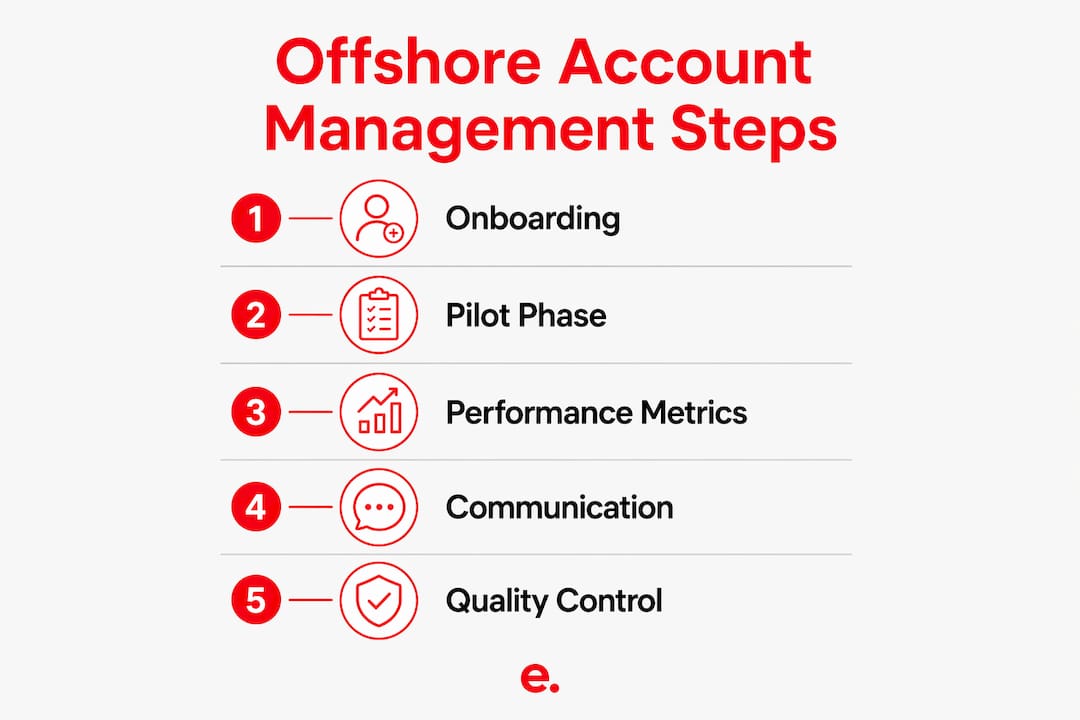
A phased onboarding model is the most reliable way to transfer client accounts offshore without disrupting service. The pilot timeline that consistently works runs as follows: two weeks of supervised live ticket resolution with daily feedback, followed by a gradual reduction in oversight, with full independence reached by week five. Skipping this phase is the most common mistake managers make.
Before the pilot starts, each client account needs three documents: an environment profile describing the client’s systems and preferences, a standard operating procedure (SOP) covering recurring tasks, and an escalation map showing who handles what when something goes wrong. These are not bureaucratic extras. They are the difference between an offshore team that performs reliably and one that generates constant rework.
Hardware and software setup takes approximately 14 business days. That timeline needs to be built into your project plan, not treated as an afterthought. Offshore staff who start without the right access or tools spend their first weeks improvising, which creates errors that erode client confidence early.
After a successful pilot, account expansion follows a controlled sequence. Add one new account at a time. Review performance data from the pilot before adding the next. This approach lets you catch process gaps before they scale.
- Create environment profiles, SOPs, and escalation maps for each client account before the pilot begins
- Run two weeks of supervised live ticket resolution with daily feedback sessions
- Reduce oversight progressively through weeks three and four as competence is demonstrated
- Confirm full independence by week five with a formal performance review
- Add new accounts one at a time, using pilot data to validate readiness
Pro Tip: Treat the pilot phase as a knowledge-capture exercise, not just a training period. Document every edge case the offshore team encounters. Those edge cases become the most valuable additions to your SOPs and prevent the same issues from recurring with future accounts.
What performance standards ensure offshore teams deliver consistent quality?
Consistent quality in offshore client account management requires measurable standards, not general expectations. The 2026 SLA benchmarks for offshore teams are specific: one business hour for urgent issues, four hours for instant message queries, and twelve hours for general email queries. These numbers give both the offshore team and the client a clear, shared understanding of what “responsive” means.
Defining “done” is equally critical. Measurable completion criteria for recurring tasks, such as “all transactions reconciled and all reconciling items identified and documented,” remove the ambiguity that causes offshore teams to submit incomplete work. When the definition of done is vague, quality becomes inconsistent. When it is specific, quality becomes repeatable.
| Performance Standard | Benchmark |
|---|---|
| Urgent issue response time | 1 business hour |
| Instant message response time | 4 hours |
| General query turnaround | 12 hours |
| Minimum client check-in frequency | Weekly video meeting |
| Task completion criteria | Documented, measurable per account |
The named onshore point of contact model is non-negotiable for client trust. Clients do not want to send queries into a faceless queue. A named liaison on the onshore side handles the client relationship while the offshore team handles execution. This division preserves the personal connection clients expect without limiting the offshore team’s operational role.
- Set SLAs in writing and share them with clients at account kickoff
- Build shared work queues so onshore managers can see task status without asking
- Review SLA adherence weekly, not monthly, to catch drift before it becomes a pattern
- Use the offshore staffing risk checklist to audit your quality controls quarterly
How do managers overcome misconceptions and cultural barriers with offshore teams?
The most damaging misconception in offshore client management is treating the offshore team as back-office support. Firms that involve offshore staff in strategic planning and give them ownership over outcomes consistently outperform firms that limit offshore roles to task execution. The difference is not the talent. It is the mandate.
Cultural integration requires deliberate effort. Weekly video meetings with cameras on build the kind of familiarity that voice-only calls cannot. When offshore team members see faces, they read context, pick up on tone, and feel like part of the team rather than a remote service provider. This matters more than most managers expect.
Treating offshore staff as equal stakeholders in client success, not as execution resources, is the single structural change that separates high-performing offshore teams from mediocre ones. When offshore team members understand the client’s business goals, they make better decisions independently, escalate the right issues, and take initiative in ways that pure task-executors never do.
Avoiding communication overload is as important as avoiding communication gaps. Adding more meetings, more check-ins, and more status requests does not fix coordination problems. It creates noise. The solution is a defined communication architecture where every message type has a home and every team member knows where to look. You can also review common offshore staffing mistakes to avoid the patterns that undermine team cohesion before it forms.
Security is a cultural and operational issue, not just a technical one. Virtual Desktop Infrastructure (VDI) allows offshore teams to access client data without that data leaving the host country’s servers. This protects compliance and builds client confidence. Offshore teams that work in secure, well-configured environments also tend to take data handling more seriously because the infrastructure signals that the organization takes it seriously.
Key Takeaways
Offshore teams deliver consistent client account management when communication, onboarding, performance standards, and cultural integration are all built into the operating model from the start.
| Point | Details |
|---|---|
| Communication architecture | Assign specific channels to message types and protect the daily 2–4 hour sync window. |
| Phased onboarding | Run a five-week pilot with daily feedback before granting full account independence. |
| Measurable SLAs | Set response times of 1 hour for urgent issues, 4 hours for IMs, and 12 hours for general queries. |
| Named onshore liaison | Keep a named onshore contact for client relationships while the offshore team handles execution. |
| Strategic inclusion | Involve offshore staff in planning and give them outcome ownership to maximize performance. |
What I’ve learned from managing offshore client account teams
The advice I give most often to business leaders setting up offshore client teams is this: write the communication charter before the team’s first day, not after the first complaint. Every team I have seen struggle with offshore coordination had one thing in common. They assumed the team would figure out communication norms organically. They never do.
Escalation protocols deserve the same attention. “I’ll let you know if I’m stuck” is not a protocol. It is a gap. Defining a rule like “blocked for more than 2 hours means escalate now” sounds rigid, but it produces something valuable: a paper trail that shows exactly where bottlenecks occur. That data improves your process every quarter.
On technology, the choice between email-and-download file sharing and a proper VDI setup is not a cost question. It is a compliance and trust question. Clients who later discover their data traveled across borders in an uncontrolled way do not stay clients. The upfront investment in secure infrastructure pays for itself in retained accounts.
The onshore liaison model is the piece most managers underestimate. Clients want a person, not a process. Keeping a named onshore contact for each account while the offshore team does the work gives clients the relationship they need and gives your offshore team the space to perform without being second-guessed on every task. That structure is what turns an offshore arrangement into a managed offshore workforce that actually scales.
— Rajkumar
How Remotee helps you build offshore teams that manage client accounts well
Running an offshore team that handles client accounts requires more than good processes. It requires a legal and HR foundation that lets you focus on performance, not paperwork.
Remotee operates as an Employer of Record in India, managing compliance, payroll, and HR so you do not have to. You hire the talent and direct the work. Remotee handles the legal entity, tax filings, and employment contracts. Clients report up to 32% savings on hiring costs compared to traditional recruitment models. If you are building or expanding an offshore team to handle client accounts, Remotee removes the administrative complexity that slows most companies down. The result is a team that is ready to perform from day one, with the legal backing to operate confidently in India.
FAQ
How do offshore teams handle urgent client issues?
Best-practice SLAs set a one-business-hour response time for urgent issues. Offshore teams meet this standard by maintaining a defined escalation protocol and a daily overlap window with onshore staff for real-time resolution.
What is the best way to communicate with offshore teams?
The most effective approach uses a communication architecture that assigns specific channels to specific message types, such as Slack for quick updates, email for client correspondence, and a ticketing system for task tracking. A daily 2–4 hour sync window handles real-time decisions.
How long does it take to transition a client account to an offshore team?
A structured pilot takes approximately five weeks: two weeks of supervised live ticket resolution with daily feedback, followed by a gradual reduction in oversight, with full independence confirmed by week five.
How do offshore teams maintain client trust?
The named onshore point of contact model is the most reliable method. A named liaison manages the client relationship while the offshore team handles execution, preventing queries from going unanswered and preserving the personal connection clients expect.
What SLAs should offshore teams follow for client account management?
The 2026 benchmarks are one business hour for urgent issues, four hours for instant message queries, and twelve hours for general email queries, with a minimum of one weekly video meeting per client account.