Offshore Team Integration Best Practices for Tech Leaders

TL;DR:
- Effective offshore team integration relies on a clear communication charter, structured onboarding, and fostering ownership to ensure sustained productivity. Regular rituals and cultural inclusion build trust, while proactive preparation and explicit norms prevent misunderstandings and delays. Prioritizing these best practices minimizes failure risks and enhances remote collaboration success.
Offshore team integration best practices are defined as the deliberate communication, onboarding, and ownership structures that allow distributed teams to perform at the same level as co-located ones. Most offshore engagements fail not because of talent gaps but because of weak operating models. High-performing offshore teams maintain a minimum of 4 hours of daily synchronous overlap and route 70–80% of their information flow through asynchronous channels. Getting these foundations right from day one separates teams that ship consistently from those that stall in endless clarification loops.
1. Offshore team integration best practices: design your communication architecture first
The single most common reason offshore teams break down is the absence of a communication charter. A charter defines which channels carry which types of messages, what the response SLAs are, and how escalations move up the chain. Without it, engineers default to ad hoc Slack pings, decisions get buried in threads, and offshore members are left guessing.
Async communication should handle 70–80% of daily information flow. That proportion is not arbitrary. It reflects the reality that time zone gaps make synchronous dependency a bottleneck. Replacing daily standups with written async updates in shared tools saves 30–60 minutes per person per day. That time compounds across a team of ten into hours of recovered productivity every week.
Reserve your synchronous overlap window, ideally 4 hours, for blockers, design reviews, and relationship building. These are the conversations that genuinely require real-time back-and-forth. Everything else belongs in a written record.
Pro Tip: Maintain a shared decision log that captures the context, options considered, and final rationale for every significant call. Decision logs prevent repeated questions, reduce disengagement, and give offshore members the context they need to exercise good judgment independently.
Your communication charter should specify:
- Primary channels by message type (Slack for quick questions, Notion or Confluence for specs, Loom for async demos)
- Response SLAs by urgency tier (critical: 2 hours; standard: next business day)
- Escalation paths when SLAs are missed
- A shared decision log updated after every significant call or design session
2. What does structured onboarding look like for offshore teams?
Structured onboarding is the fastest way to protect sprint velocity during the integration phase. Pre-provisioning all tools and access 4 weeks before a developer’s start date keeps velocity dips under 20% during the integration window. That number matters because unplanned velocity loss in the first month is the most common reason leaders lose confidence in offshore arrangements.

The offshore developer onboarding process should cover more than tool access. Offshore engineers need product context, decision frameworks, and team rituals before they can contribute meaningfully. A new hire who understands why the product exists makes better tradeoffs than one who only knows the ticket queue.
Assign every offshore hire an onboarding buddy from the core team. The buddy’s job is not to answer every question but to help the new member understand unwritten norms, communication preferences, and team culture. This accelerates assimilation far more than any written handbook.
A practical onboarding sequence looks like this:
- Week minus 4: provision all accounts, repos, and communication tools
- Week minus 2: share product roadmap, architecture overview, and team rituals doc
- Day 1: intro calls with product owner, QA lead, and onboarding buddy
- Week 1: shadow existing sprint ceremonies without contributing to tickets
- Week 2: take ownership of one small, well-scoped ticket with buddy support
- Week 3: join retrospectives and contribute to async decision logs
- Week 4: review onboarding milestone metrics and update the knowledge base
Pro Tip: Document every question a new offshore hire asks during their first 30 days. Each unanswered question is a gap in your knowledge base. Closing those gaps reduces the ramp time for every hire that follows.
Security setup belongs in onboarding, not after it. Least-privilege access and secret management must be configured before coding starts. Retrofitting security controls after a team is operational is expensive and disruptive.
3. What are the keys to building ownership and accountability?
Assigning task tickets is not the same as assigning ownership. Module and service ownership gives offshore developers a stake in the quality and maintainability of what they build. Engineers who own a service think about edge cases, documentation, and long-term behavior. Engineers who only own tickets think about closing the ticket.
The “throw-it-over-the-wall” pattern is the most destructive dynamic in offshore development. It treats offshore teams as an execution layer rather than a thinking layer. Embedding offshore developers into cross-functional sprint teams with shared product owners and QA processes eliminates this pattern. The offshore engineer attends the same planning session, hears the same product context, and ships to the same definition of done.
Share the product roadmap with offshore team members. When engineers understand where the product is going, they make better architectural decisions and flag risks earlier. Keeping roadmap information from offshore teams is a false security measure that costs more in misaligned work than it saves.
The benefits of genuine ownership are concrete:
- Fewer regression bugs because the owner understands the full context of the module
- Faster incident response because the owner knows the system’s failure modes
- Higher code review quality because the owner has a personal stake in the codebase
- Reduced knowledge silos because owners document what they know
Pro Tip: Use structured PR comment tags like nit], [suggestion], and [required] to reduce cultural ambiguity in code reviews. [Comment tagging conventions save significant resolution time and remove the guesswork about how seriously a reviewer’s feedback should be taken.
4. How cultural inclusion and consistent rituals enhance offshore integration
Treating offshore members as contractors rather than core team members is the fastest way to lose them. Offshore teams thrive when they receive the same career growth opportunities, recognition, and cultural inclusion as the onsite team. The distinction between “the team” and “the offshore team” is a signal that erodes motivation over time.
Consistent rituals are the infrastructure of trust in distributed teams. Retrospectives, demo days, and personal check-ins scheduled during overlap hours build the kind of familiarity that makes async communication work. Without these touchpoints, offshore members operate in a social vacuum, which increases churn and reduces the quality of judgment calls.
Inclusion is not a policy. It is a pattern of repeated behavior. Every time an offshore engineer is excluded from a planning meeting, a product demo, or a team celebration, the message is clear: you are a vendor, not a colleague. That message compounds over months into disengagement and departure.
Practical inclusion tactics that work:
- Rotate meeting times so offshore members are not always the ones joining at an inconvenient hour
- Include offshore engineers in sprint demos, not just sprint delivery
- Celebrate offshore team milestones in the same channels used for onsite wins
- Schedule quarterly virtual social events with no work agenda
- Budget for at least one annual in-person gathering per offshore team
Cultural misunderstandings rarely announce themselves. An offshore engineer who says “yes” to a deadline may mean “I heard you” rather than “I can do this.” Building a culture where clarification is expected and welcomed, not penalized, removes this ambiguity. You can explore how successful offshore teams have handled this in practice to see what consistent inclusion looks like at scale.
Key takeaways
Effective offshore team integration requires a communication charter, structured onboarding, genuine ownership, and consistent cultural inclusion to deliver sustained productivity gains.
| Point | Details |
|---|---|
| Communication charter first | Define channels, SLAs, and escalation paths before the team starts work. |
| Pre-provision access early | Set up all tools and accounts 4 weeks before start to keep velocity dips under 20%. |
| Assign module ownership | Give offshore developers ownership of services, not just tickets, to improve quality. |
| Embed in sprint teams | Place offshore engineers in cross-functional sprints to eliminate handoff friction. |
| Treat inclusion as a habit | Schedule rituals like retrospectives and demos during overlap hours to build trust. |
What I’ve learned about offshore integration that most guides won’t tell you
I’ve watched well-funded startups burn through offshore arrangements that should have worked. The talent was there. The tooling was there. What was missing, almost every time, was a communication charter written before the first line of code was committed.
The async-first principle sounds obvious until you try to enforce it. Engineers default to synchronous communication because it feels faster in the moment. The discipline of writing decisions down, recording a Loom instead of scheduling a call, and maintaining a decision log requires active management for the first 90 days. After that, it becomes habit.
The onboarding mistake I see most often is treating access provisioning as the whole job. Getting someone into GitHub and Slack is not onboarding. Onboarding is transferring enough context that the new hire can make a judgment call without asking. That takes deliberate effort and a willingness to document things your senior engineers consider obvious.
The hardest part of cross-cultural integration is not language. It is the invisible hierarchy of communication norms. Some cultures treat directness as disrespect. Others treat ambiguity as politeness. Neither is wrong, but both will cause friction if you do not name the norms explicitly. I have found that writing a one-page “how we communicate” document, covering directness, feedback style, and escalation expectations, eliminates most of the friction in the first month.
Patience is not optional. Integration is iterative. The teams I have seen succeed are the ones that ran retrospectives on the integration process itself, not just the product, and adjusted their operating model based on what they found.
— Rajkumar
How Remotee helps you build and integrate offshore teams
Building an offshore team is one decision. Integrating it well is an ongoing practice. Remotee’s Employer of Record services in India handle the compliance, payroll, and HR infrastructure so your leadership team can focus on the integration work that actually drives productivity.
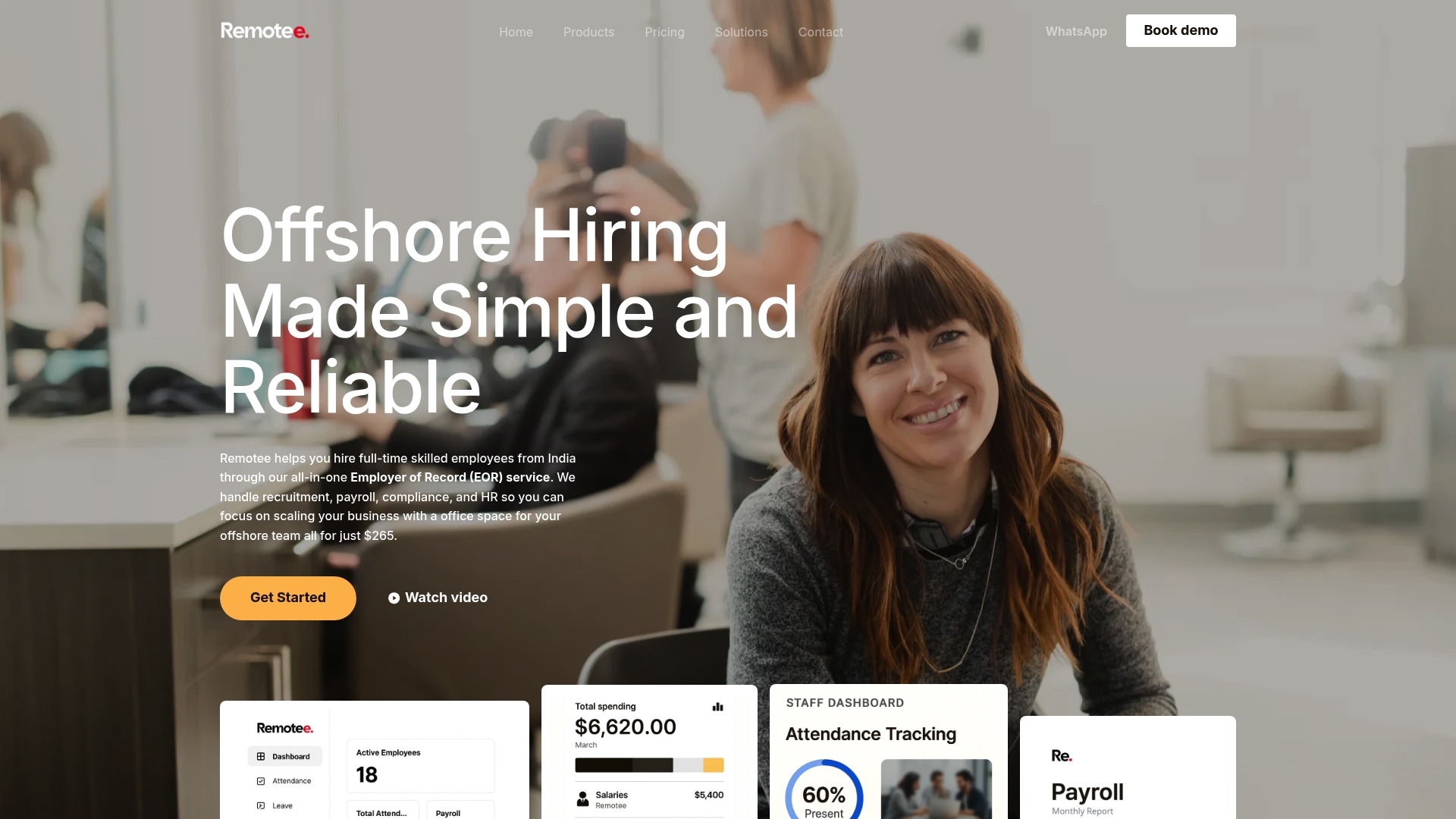
Remotee manages contracts, local labor law compliance, and onboarding logistics, which removes the administrative overhead that slows down integration in the first 90 days. Clients report up to 32% savings on hiring costs compared to traditional recruitment models. If you are building or expanding an offshore team and want the operational side handled correctly from day one, Remotee’s offshore hiring services are worth a close look.
FAQ
What is the most common reason offshore teams fail?
Offshore team failures are most often caused by weak communication frameworks, not talent shortages. The absence of a clear communication charter covering channels, SLAs, and escalation paths is the leading structural gap.
How much synchronous overlap do offshore teams need daily?
High-performing distributed teams maintain a minimum of 4 hours of daily synchronous overlap. This window covers blocker resolution, design reviews, and relationship-building conversations.
How early should you start onboarding an offshore developer?
Pre-provision all tools and access at least 4 weeks before the developer’s start date. This preparation keeps velocity dips under 20% during the integration phase.
How do you reduce ambiguity in offshore code reviews?
Use structured PR comment tags like [nit], [suggestion], and [required] to signal the weight of each piece of feedback. This convention removes cultural guesswork and accelerates review resolution.
What is the best way to build trust with an offshore team?
Schedule consistent shared rituals, including retrospectives, demo days, and personal check-ins, during overlap hours. Repeated, predictable inclusion in team ceremonies builds trust faster than any single gesture.