How to Stay Compliant Hiring Internationally in 2026
TL;DR:
- International hiring compliance requires meeting local employment, data privacy, and tax laws to avoid penalties. Building a clear governance framework and using locally drafted contracts help companies navigate regulatory risks effectively. Regular audits and combining technology with local expertise ensure continuous legal adherence in global workforce management.
International hiring compliance is the practice of meeting every employment law, data protection rule, and tax obligation that applies when you hire workers outside your home country. Get it wrong, and the consequences range from misclassification penalties worth thousands of dollars per violation to regulatory fines under GDPR and the EU AI Act. The pressure to stay compliant hiring internationally has never been higher: regulators across the US, EU, India, Brazil, and beyond are intensifying enforcement across payroll, immigration, and worker classification. This guide gives you a practical framework for building a compliant global hiring operation in 2026.
What are the primary global regulatory requirements for international hiring compliance?
Global hiring compliance covers five distinct legal domains. Each one carries its own enforcement risk, and none of them overlap cleanly across jurisdictions.
Employment law and worker classification is the most consequential domain. Every country defines the employment relationship differently. Brazil’s CLT labor code, India’s Code on Wages, and California’s AB5 each apply different tests to determine whether a worker is an employee or a contractor. Misclassification penalties include roughly 20% of wages plus 100% of FICA taxes, and California Labor Code 226.8 penalties range from $5,000 to $25,000 per violation. That exposure makes classification the first question to answer before any international hire.
Data privacy is the second critical domain. GDPR governs candidate data across the EU, but Brazil’s LGPD, India’s DPDP Act, China’s PIPL, and Quebec’s Law 25 each impose their own requirements on cross-border data transfers. You cannot apply a single consent form globally and expect it to hold up in every jurisdiction.
Pay transparency is expanding fast. Over 22 US states enforce salary-history bans as of mid-2026. That number means any remote role that could attract applicants from Colorado, New York, or California likely triggers a disclosure obligation, even if your company is headquartered elsewhere.
AI hiring regulations are now enforceable. The EU AI Act classifies automated candidate screening as a high-risk AI system, requiring conformity assessments and human oversight starting august 2026. Several US states have passed parallel laws requiring bias audits and candidate notification.
Immigration and right-to-work verification closes the list. Work authorization rules vary sharply by country, and failing to verify them before onboarding creates both legal exposure and potential criminal liability for the hiring entity.
Pro Tip: Build a jurisdiction matrix at the start of every international hiring project. List each target country, its worker classification test, data privacy law, pay transparency rule, and immigration requirement in one document. Update it quarterly.
How to build a compliant international hiring framework
Structure beats intention every time. A compliant framework assigns clear ownership across HR, legal, finance, and IT before the first job posting goes live.
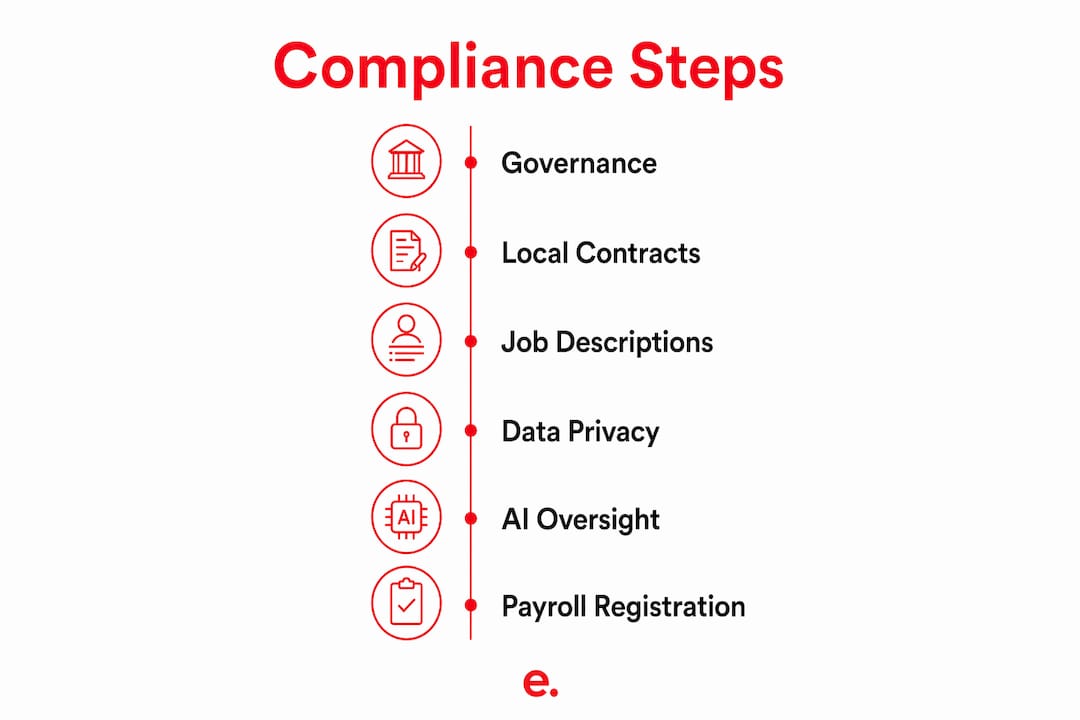
Step 1: Assign governance roles
Designate a global compliance lead in HR and pair them with in-country legal counsel for each target jurisdiction. Finance owns payroll tax registration. IT owns candidate data flows and vendor security reviews. Without named owners, compliance tasks fall through the gaps between departments.

Step 2: Use locally drafted employment contracts
Standardized global contracts are often legally unenforceable and risk nullifying key terms like non-compete clauses, probation periods, and termination notice. Draft country-specific templates with local counsel for every market where you hire. This is not optional in markets like Germany, France, or India, where statutory minimums override any contract term that falls short.
Step 3: Design compliant job descriptions and offer letters
Pay ranges must appear in job postings for roles that could attract applicants from pay-transparency jurisdictions. Offer letters must reflect local statutory benefits, not just your company’s standard package. A US-style offer letter sent to a hire in the Netherlands will miss mandatory holiday allowances, pension contributions, and notice period requirements.
Step 4: Implement data privacy safeguards
Geofence candidate data so that EU applicant records stay on EU-based servers. Conduct Data Protection Impact Assessments (DPIAs) before deploying any new recruiting tool that processes candidate data at scale. Run vendor due diligence on every ATS, background check provider, and video interview platform you use internationally.
Step 5: Enforce human oversight in AI screening
Automated hiring tools cannot make final adverse hiring decisions without a human decision step. Build a documented human-in-the-loop review into every AI-assisted screening workflow. Log every automated recommendation and the human decision that followed it.
Step 6: Register for payroll and tax obligations
Payroll compliance means withholding the correct income tax, social security, and statutory contributions in each country. Engage a payroll provider with proven multi-jurisdiction capability, or use an Employer of Record (EOR) service to handle registration and remittance. Learn more about how offshore payroll works before committing to a payroll structure.
| Compliance area | Key action | Primary risk if skipped |
|---|---|---|
| Worker classification | Apply local employment test before hire | Back taxes, penalties up to 20% of wages |
| Data privacy | Geofence data, conduct DPIAs | GDPR fines up to 4% of global revenue |
| Pay transparency | Include pay ranges in job postings | State-level fines and candidate lawsuits |
| AI hiring tools | Add human-in-the-loop review step | EU AI Act penalties, bias litigation |
| Payroll registration | Register in each jurisdiction before first paycheck | Tax authority penalties and interest |
Pro Tip: Never rely on a single global payroll provider’s self-certification for local compliance. Ask for jurisdiction-specific compliance documentation and audit reports before signing a contract.
What common pitfalls should you avoid when hiring internationally?
Most compliance failures are predictable. The same errors appear repeatedly across companies of every size.
- Misclassifying employees as contractors. Regulators look at the substance of the working relationship, not the label on the contract. Control over work hours, exclusivity, and integration into the company’s operations all point toward employment. The highest-stakes error in international hiring is misclassification, and it triggers back taxes, penalties, and reputational damage simultaneously.
- Ignoring pay transparency obligations. Posting a role without a salary range in a jurisdiction that requires one is a direct violation. The fine is only part of the problem. Candidates who notice the omission lose trust in the employer before the first interview.
- Skipping AI bias audits. Deploying an automated screening tool without a bias audit or candidate disclosure violates both the EU AI Act and several US state laws. Document every AI tool in your hiring stack and confirm it meets the transparency requirements of each jurisdiction where you use it.
- Overlooking right-to-work verification. Verifying work authorization after an offer is made, rather than before, creates legal exposure if the hire turns out to be ineligible. Build verification into the pre-offer stage.
- Triggering permanent establishment tax rules. A remote employee working in a foreign country can force tax registration in that country even if your company has no office there. This is one of the least-anticipated compliance risks in global hiring and one of the most expensive to unwind.
- Neglecting offboarding compliance. Terminating an international employee without following local notice periods, severance requirements, and documentation rules creates wrongful termination liability. Review compliant termination practices before any separation, not after.
Treating global hiring as a uniform process is the single most dangerous assumption an HR team can make. Regulatory divergence across the US, EU, and Asia-Pacific means that a policy that protects you in one market can expose you in another. Local adaptation is not a luxury. It is the baseline requirement for operating legally across borders.
How can technology support compliance in international hiring?
Compliance-first HR technology reduces manual error and creates the audit trails regulators expect to see.
The most practical tools fall into four categories. Contract management systems with country-specific templates and version control prevent the use of outdated or legally deficient agreements. Applicant tracking systems (ATS) with built-in pay range injection automatically insert the correct salary disclosure into job postings based on the applicant’s location. Candidate data platforms with geofencing enforce data residency requirements without relying on manual configuration by your IT team. Payroll platforms with multi-jurisdiction tax engines handle withholding, social contributions, and remittance across dozens of countries from a single interface.
Compliance-first recruiting tools can enforce pay range injections, geofence candidate data, preserve audit logs, and maintain human-in-the-loop workflows, turning regulatory requirements into built-in hiring features rather than manual checklists. That shift from reactive to proactive compliance is what separates companies that pass audits from those that fail them.
Employers must maintain meaningful human oversight in AI hiring tools to meet obligations under GDPR Article 22, the EU AI Act, and US AI laws. The technology handles volume and consistency. The human step handles judgment and accountability.
Pro Tip: Before deploying any new HR technology internationally, map its data flows against the privacy laws of every jurisdiction where you will use it. A tool that is compliant in the US may violate GDPR or India’s DPDP Act without modification.
How to audit and maintain compliance continuously in your global workforce
Compliance is not a one-time setup. Regulations change, your workforce grows, and enforcement priorities shift. Sustained compliance requires a structured review cycle.
- Run onboarding compliance checks. Verify that every new international hire has a locally compliant contract, correct payroll registration, and documented right-to-work verification before their first day. Gaps discovered after onboarding are harder and more expensive to fix.
- Schedule quarterly regulatory reviews. Assign a team member to monitor legislative changes in each jurisdiction where you employ people. Pay transparency laws, AI regulations, and data privacy rules are all evolving rapidly in 2026. Regulators globally are intensifying enforcement across immigration, payroll, data protection, and worker classification.
- Maintain complete documentation. Keep signed contracts, payroll records, right-to-work verification documents, DPIA reports, and AI audit logs for every international hire. Documentation is your primary defense in any regulatory investigation.
- Engage local legal and tax experts annually. In-house teams cannot track every jurisdictional change. Annual reviews with local counsel in each key market catch issues before they become violations. The role of compliance audits in global hiring is to surface these gaps systematically, not just reactively.
- Train hiring managers on compliance red flags. Managers who recognize misclassification risks, data privacy obligations, and pay transparency requirements make better decisions in the moment. Training reduces the gap between policy and practice.
- Review offboarding processes before every termination. Local notice periods, severance calculations, and required documentation vary widely. A compliant offboarding process protects you from wrongful termination claims and regulatory penalties.
Key Takeaways
Staying compliant when hiring internationally requires locally adapted contracts, documented human oversight in AI tools, and a continuous audit cycle across every jurisdiction where you employ people.
| Point | Details |
|---|---|
| Worker classification is the highest-stakes risk | Misclassification penalties include back taxes and fines up to 20% of wages per violation. |
| Local contracts are non-negotiable | Standardized global contracts are often unenforceable; use jurisdiction-specific templates for every market. |
| Pay transparency laws are expanding | Over 22 US states enforce salary-history bans; include pay ranges in all relevant job postings. |
| Human oversight in AI hiring is legally required | The EU AI Act and GDPR Article 22 both mandate a human decision step in automated screening. |
| Continuous audits prevent compounding violations | Quarterly regulatory reviews and complete documentation are your best defense against enforcement actions. |
What I have learned about compliance that most guides get wrong
Most compliance guides treat international hiring as a checklist problem. Build the right list, check every box, and you are protected. That framing is wrong, and it leads companies into a false sense of security.
The real challenge is that regulatory divergence across jurisdictions is accelerating, not stabilizing. What was compliant in a given market in 2024 may not be compliant today. The EU AI Act, India’s DPDP Act, and new US state pay transparency laws all came into force or expanded in the past 18 months. A static checklist cannot keep pace with that rate of change.
The companies that handle this well share one characteristic: they invest in compliance infrastructure before they need it. They hire local counsel before the first hire in a new market. They build human-in-the-loop workflows into their ATS before deploying AI screening. They register for payroll before the first paycheck, not after the first audit notice. That upfront investment looks expensive until you compare it to the cost of a misclassification penalty or a GDPR enforcement action.
The other thing I would push back on is the idea that technology alone solves this. Tools help enormously with consistency and audit trails. But technology cannot replace the judgment call of a local employment lawyer who knows how a specific labor court interprets a specific statute. The best global hiring operations combine compliance-first technology with genuine local expertise. Neither works as well without the other.
— Rajkumar
How Remotee supports compliant international hiring
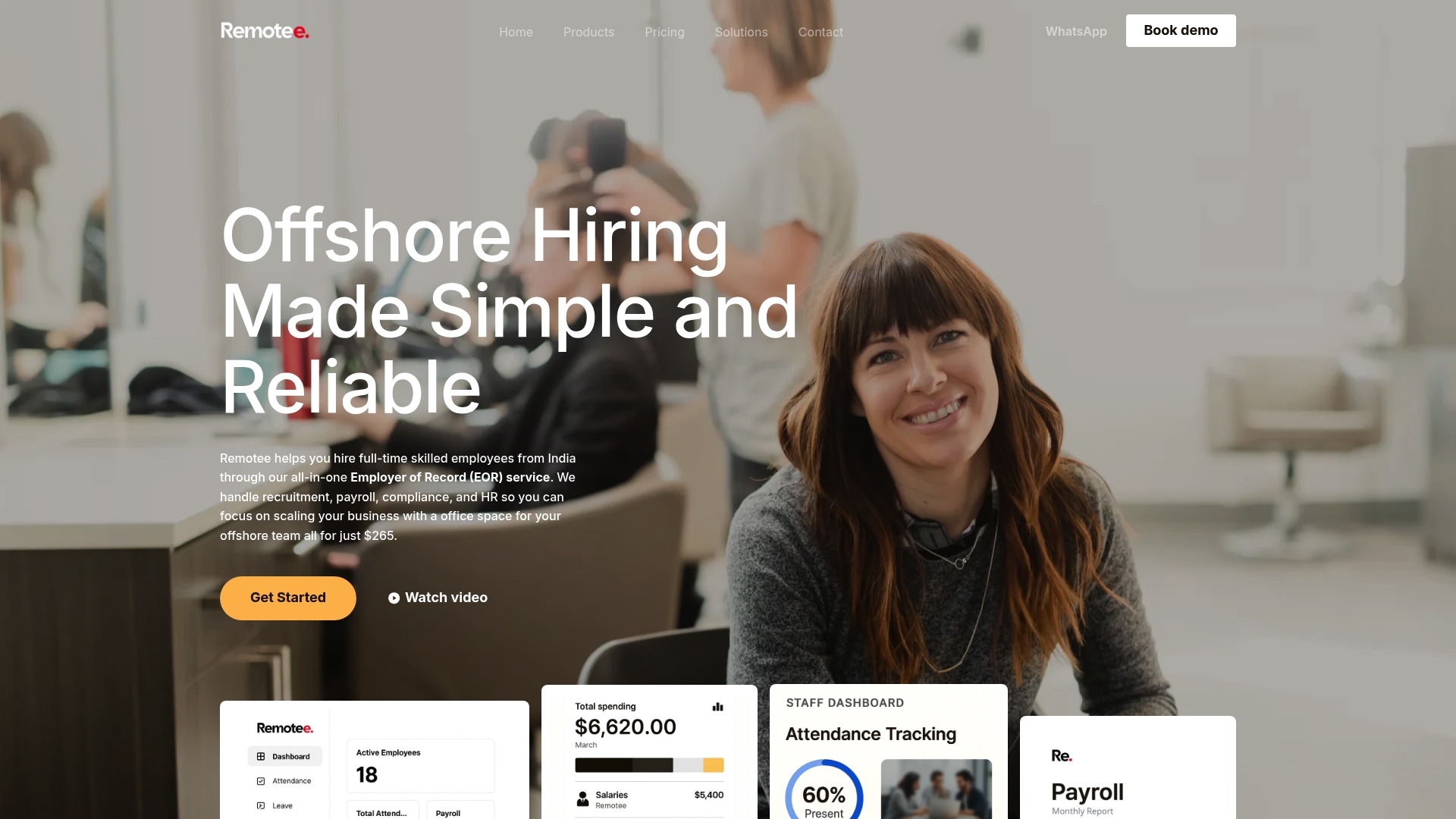
Remotee’s Employer of Record service handles the legal and administrative complexity of hiring full-time employees from India, including locally compliant employment contracts, payroll registration, tax withholding, and statutory benefits. Every hire goes through a compliance-first process that addresses worker classification, data privacy, and pay structure from day one. Remotee clients report up to 32% savings on hiring costs compared to building local entities independently. For HR teams and business owners who need to expand their offshore hiring operations without building a local legal entity, Remotee provides the infrastructure, the expertise, and the accountability to do it correctly.
FAQ
What is international hiring compliance?
International hiring compliance is the practice of meeting all employment laws, data privacy rules, tax obligations, and immigration requirements that apply when you hire workers in a foreign country. It covers worker classification, contracts, payroll, and candidate data handling.
What happens if you misclassify an international hire?
Misclassification penalties include back taxes, fines of roughly 20% of wages, and 100% of unpaid FICA taxes. California Labor Code 226.8 penalties alone range from $5,000 to $25,000 per violation.
Does the EU AI Act affect international hiring?
The EU AI Act classifies automated candidate screening as a high-risk AI system, requiring conformity assessments and documented human oversight starting august 2026. Any company using AI tools to screen candidates for EU-based roles must comply.
Can a remote employee trigger tax obligations in another country?
A remote employee working in a foreign jurisdiction can force a company to register for tax purposes in that country, even without a physical office. This permanent establishment risk applies in many countries and requires advance tax planning before hiring remotely abroad.
What is the fastest way to stay compliant when hiring internationally?
Using an Employer of Record (EOR) service is the fastest path to compliance. An EOR acts as the legal employer in the target country, handling contracts, payroll, tax registration, and statutory benefits, so your company avoids the cost and complexity of setting up a local entity.