What Is a Dedicated Offshore Team? A 2026 Guide

TL;DR:
- A dedicated offshore team consists of remote professionals working exclusively for one client, reporting directly and following the client’s workflows. It offers long-term continuity, cost savings, and the ability to build institutional knowledge, unlike project-based outsourcing. Success depends on well-documented processes, clear roles, and strong cultural and operational integration.
A dedicated offshore team is defined as a group of remote professionals working exclusively for one client as a long-term extension of their internal staff. Unlike freelancers or shared outsourcing pools, these professionals report directly to you, follow your workflows, and build institutional knowledge over time. The model sits at the intersection of full control and cost efficiency. Businesses exploring what is a dedicated offshore team often discover it delivers more than just cheaper labor. It delivers a second internal team, operating from another country, with the depth and continuity of a permanent hire.
What is a dedicated offshore team and how does it differ from outsourcing?
A dedicated offshore team consists of professionals in another country working exclusively for one client as a long-term extension of in-house staff. They report directly to the client and use the client’s internal processes and systems. This is the formal industry term: the “dedicated team model,” sometimes called the “offshore dedicated team” model in software and services contexts.
The distinction from traditional outsourcing matters. In a standard outsourcing arrangement, a vendor assigns resources across multiple clients, rotating staff based on project demand. In the dedicated model, your team members are allocated full-time or agreed part-time to your account only. They are not shared. That exclusivity is the defining feature.
Project-based outsourcing ends when the deliverable ships. A dedicated offshore team does not. It grows with your business, absorbs your culture, and retains the context that makes future work faster. That continuity is what separates this model from every other form of remote staffing.
How does a dedicated offshore team operate within a business?
The operational structure follows a clear division of responsibility. You own strategy and direction. The offshore team owns daily execution. The offshore partner, whether an Employer of Record or a staffing firm, handles HR, payroll, infrastructure, and legal compliance.

Day-to-day, the team integrates with your existing tools such as Slack, Jira, and ClickUp. They join your standups, follow your sprint cycles, and communicate through your channels. Siloed systems are the fastest way to break this model. When the offshore team operates inside your workflow rather than alongside it, ownership and visibility stay intact.
Here is how a typical operating rhythm looks in practice:
- Daily standups via video call to align on priorities and blockers
- Shared project boards in Jira or ClickUp for task tracking and accountability
- Weekly reviews with the client lead to assess output against KPIs
- Monthly retrospectives to refine processes and address friction points
- Quarterly planning sessions where the client sets strategic direction
Pro Tip: Treat your offshore team’s onboarding the same way you would a new internal hire. Assign a dedicated point of contact on your side, share your brand guidelines, and walk them through your decision-making logic. The first 30 days set the tone for the entire engagement.
For teams managing client accounts offshore, the integration depth directly predicts output quality. Shallow integration produces shallow results.
What are the benefits of a dedicated offshore team vs. other models?
Cost savings are real, but they are not immediate. Companies using dedicated offshore teams save approximately 18% in total expenditure over a two-year period compared to continuous staff augmentation. That advantage becomes visible after roughly nine months of operation. The savings come from reduced internal admin costs and standardized workflows, not just lower hourly rates.
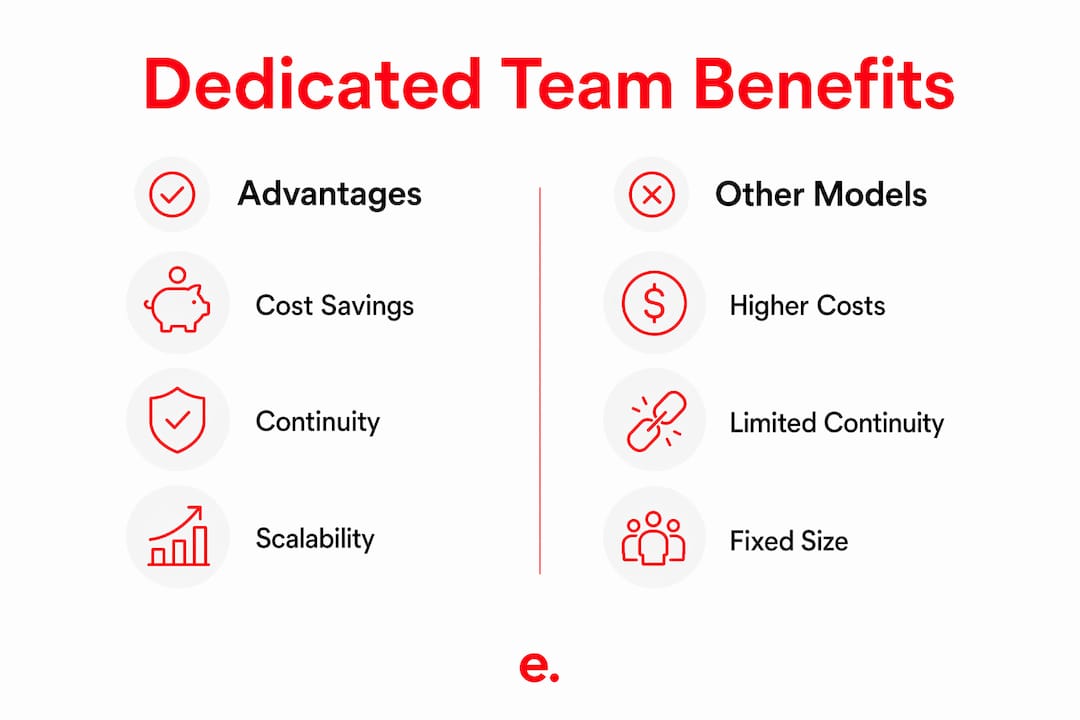
Beyond cost, the continuity advantage is significant. Dedicated teams document architectural decisions and embed product knowledge over time. That protects intellectual property and eliminates the ramp-up cost every time a new contractor joins. Staff augmentation models reset that knowledge clock with every rotation.
The benefits of dedicated offshore staffing extend into scalability as well. You can adjust team composition as project complexity changes, adding a QA engineer one quarter and a business analyst the next, without renegotiating a contract from scratch.
| Feature | Dedicated offshore team | Shared or project-based model |
|---|---|---|
| Resource exclusivity | Full-time, single client | Shared across clients |
| Knowledge retention | High, builds over time | Resets with each project |
| Cost trajectory | Improves after 9 months | Stays variable |
| Client control | Direct management | Vendor-mediated |
| Scalability | Flexible team composition | Scope-bound |
The control dimension also matters. You set the priorities. You define the standards. The offshore partner handles the administrative layer so you are not managing payroll or compliance in a foreign jurisdiction.
What are the common challenges in managing offshore teams effectively?
The most significant misconception about dedicated offshore teams is that they fix leadership or strategy problems. They do not. Offshore teams expose a lack of documented systems and fuzzy expectations faster than any internal audit. If your processes are unclear onshore, they will fail offshore.
Effective management depends on three non-negotiable foundations:
- Documented processes: Every repeatable task needs a written standard operating procedure before it moves offshore.
- Defined roles: Each team member must know exactly what they own and what decisions require client approval.
- Accountability measures: Weekly scorecards and KPIs replace micromanagement with measurable output tracking.
Micromanagement is the second most common failure mode. When clients over-supervise execution, they undermine the team’s ability to build ownership and speed. Clear systems create the conditions where the team can perform without constant oversight.
Cultural fit in offshore hiring is equally underestimated. Teams that integrate culturally and operationally outperform those that are treated as a geographic convenience. Invest in shared rituals, recognize wins publicly, and include offshore members in company-wide communications.
Pro Tip: Build a “decision rights” document early. List every recurring decision type and specify whether the offshore team resolves it independently, flags it for review, or escalates immediately. This single document eliminates most communication bottlenecks within the first 60 days.
How do businesses build and scale dedicated offshore teams?
Building a dedicated offshore team follows a sequence that most businesses skip at their own cost. The steps below reflect what actually works, not what sounds logical in theory.
- Audit your internal workflows first. Identify tasks that are repeatable, process-driven, and well-documented. These are offshore-ready. Complex judgment calls that require institutional context are not the right starting point.
- Define the role before recruiting. Write a detailed role profile that includes tools used, output expectations, communication cadence, and reporting structure. Vague job descriptions attract mismatched candidates.
- Vet candidates with a local mindset. Assess communication skills, cultural alignment, and technical competence equally. A technically strong candidate who cannot communicate clearly in your workflow will slow the team down.
- Start with a core team, then scale. A typical starting composition includes a project manager, two to three specialists, and a QA or review function. Team composition can be tailored to project complexity and scale as needs evolve.
- Use a phased onboarding plan. The first 30 days focus on tool access and process familiarization. Days 31–60 introduce live work with close review. By day 90, the team should operate with minimal supervision on defined tasks.
- Consider a hybrid model for flexibility. A hybrid staffing approach combines dedicated offshore team members for core long-term roles with staff augmentation for short-term spikes. This balances stability with adaptability.
For businesses hiring from India specifically, offshore developer onboarding practices have a direct impact on how quickly the team reaches full productivity. Structured onboarding cuts that timeline significantly.
Knowing how global firms vet offshore candidates also helps you avoid the most common hiring mistakes before they cost you months of rework.
What industries benefit most from dedicated offshore teams?
Industries that benefit most from dedicated offshore teams include technology and software development, marketing, customer support, and professional services. These sectors share a common trait: their work is ongoing, complex, and requires sustained collaboration rather than one-time delivery.
- Technology and software development: Dedicated teams of developers, QA engineers, and project managers handle long-term product builds, maintenance, and feature development.
- Marketing and creative operations: A dedicated offshore marketer or creative team manages content production, campaign execution, SEO, and paid media at scale. This is what the term “dedicated offshore marketer” refers to in practice.
- Customer support: Offshore support teams provide consistent coverage across time zones, reducing response times without expanding the onshore headcount.
- Professional services: Consulting, finance, and legal support functions benefit from teams that understand the client’s specific compliance environment and reporting standards.
Short-term or one-off projects are not the right fit for this model. The dedicated structure pays off when the work is continuous, the scope evolves, and knowledge accumulation creates compounding value. Successful offshore team case studies consistently show that the longest-running engagements produce the highest return on the initial setup investment.
For teams managing remote sales functions, the same principles apply: clear KPIs, defined ownership, and consistent communication cadence determine whether the offshore model succeeds or stalls.
Key Takeaways
A dedicated offshore team delivers lasting value only when the client owns strategy, the offshore team owns execution, and both sides operate inside the same documented systems.
| Point | Details |
|---|---|
| Exclusivity defines the model | Team members work for one client only, unlike shared or project-based outsourcing. |
| Cost savings take time | The 18% expenditure reduction becomes visible after approximately nine months of operation. |
| Documentation is non-negotiable | Undocumented processes fail offshore; clear SOPs and KPIs are the foundation of success. |
| Hybrid models add flexibility | Combining dedicated teams with staff augmentation covers both long-term stability and short-term demand spikes. |
| Industry fit matters | Technology, marketing, customer support, and professional services gain the most from this model. |
Why offshore teams reveal more about your leadership than your vendor
The part nobody tells you when you start building an offshore team is that the team will expose every gap in your internal clarity. I have seen businesses with genuinely talented offshore professionals produce mediocre results because the client side had no documented standards, no clear decision rights, and no consistent point of contact. The offshore team was not the problem. The leadership vacuum was.
What I have found is that the businesses that succeed with dedicated offshore teams are not the ones with the biggest budgets. They are the ones that treat documentation as a competitive asset. They write down how decisions get made. They define what “done” looks like before work starts. They give the offshore team real ownership over execution and resist the urge to micromanage every output.
The second thing I have learned is that cultural integration is not a soft metric. Teams that are included in company-wide communications, recognized for wins, and treated as colleagues rather than vendors perform at a measurably different level. Geography is irrelevant when the operating culture is shared.
If you are considering this model, start with your own house. Map your repeatable processes, write your standards, and define your communication cadence before you hire a single offshore team member. The offshore team will amplify whatever clarity or confusion already exists inside your organization.
— Rajkumar
How Remotee helps you build a dedicated offshore team
Building a dedicated offshore team requires more than finding the right talent. It requires managing employment contracts, payroll, and local compliance in a foreign jurisdiction, and that is where most businesses lose time and money.
Remotee’s Employer of Record service in India handles every layer of that complexity. Remotee manages compliance, payroll, and HR so you can focus on directing your team’s output rather than navigating Indian labor law. Clients report up to 32% savings on hiring costs compared to traditional recruitment approaches. Remotee presents only vetted, top-tier candidates aligned to your role requirements, and the offshore hiring process is built to get your team operational without the administrative overhead that typically slows expansion.
FAQ
What is a dedicated offshore team in simple terms?
A dedicated offshore team is a group of remote professionals in another country who work exclusively for your business as a long-term extension of your internal staff. They follow your workflows, use your tools, and report directly to you.
How is a dedicated offshore team different from staff augmentation?
Staff augmentation adds temporary contractors who rotate across clients and projects. A dedicated offshore team is exclusive to one client, builds institutional knowledge over time, and delivers cost savings that grow after approximately nine months of operation.
What roles are typically included in a dedicated offshore team?
Dedicated offshore teams commonly include developers, QA engineers, project managers, business analysts, and UX specialists, with team composition tailored to the client’s project complexity and scale.
What is a dedicated offshore marketer?
A dedicated offshore marketer is a remote marketing professional allocated exclusively to one client, managing functions such as content production, SEO, paid media, or campaign execution as part of a broader offshore team structure.
How long does it take to see results from a dedicated offshore team?
Cost advantages typically become visible after about nine months of operation. Productivity gains from knowledge retention and workflow integration appear earlier, often within the first 60–90 days of a structured onboarding process.