Offshore Development Model Explained for Business Leaders

TL;DR:
- An offshore development model defines collaboration, ownership, pricing, workflows, and risk sharing with international teams. Proper understanding of this framework helps leaders avoid costly mistakes and leverage significant cost savings, faster scaling, and access to niche skills. Successful offshore engagement relies on strategic model selection, strong governance, clear deployment planning, and treating offshore teams as integral members of the company.
An offshore development model is a structured framework that defines how your company collaborates with international software teams, covering ownership, pricing, workflows, delivery accountability, and risk distribution from day one. Business leaders who understand this framework before signing a contract avoid the most expensive mistakes in software outsourcing. Senior offshore developers in India cost $42,000–$68,000 annually versus $250,000–$380,000 in the US, a savings of $180,000–$310,000 per developer. That gap alone explains why the offshore development model explained correctly can reshape a company’s entire technology budget. Remotee helps business leaders access this advantage through compliant, fully managed offshore hiring in India.
What are the main offshore development models and how do they differ?
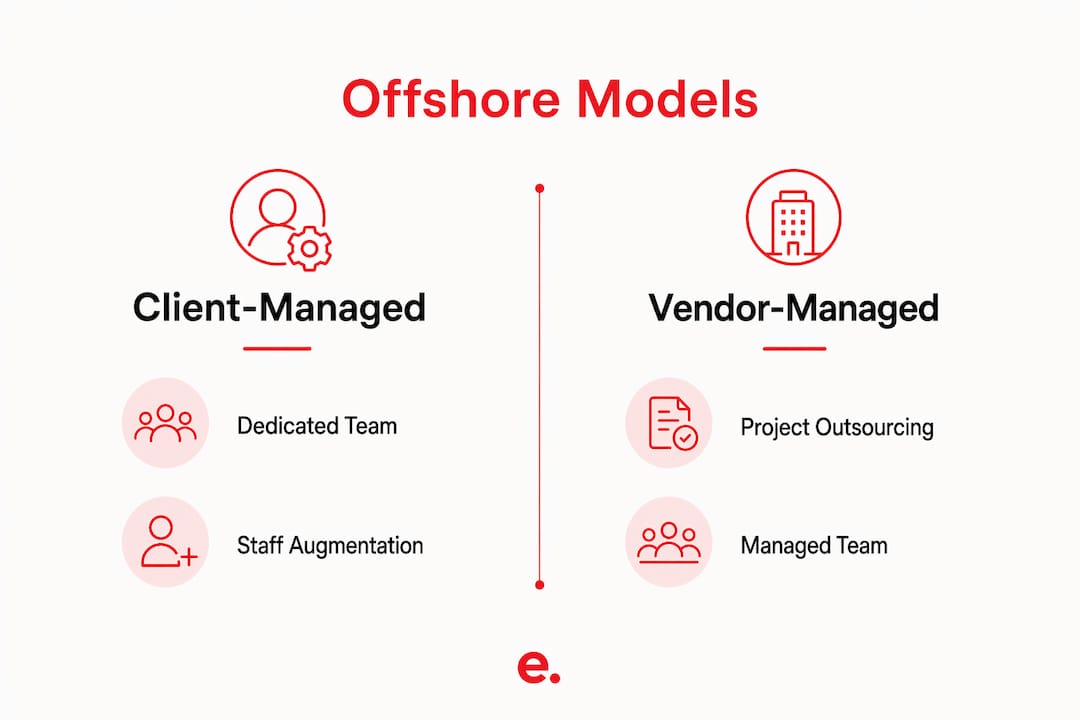
Key engagement models include Dedicated Team, Staff Augmentation, Project-Based Outsourcing, Managed Team, and Offshore Development Center (ODC). Each model distributes risk, billing, and management responsibility differently. Choosing the wrong one costs more than the hourly rate difference suggests.
Dedicated team
A dedicated team is a group of engineers hired exclusively for your projects, managed by you but employed through an offshore partner. You control the roadmap, sprint planning, and daily standups. This model suits long-term product development where you need deep integration with your internal staff.

Staff augmentation
Staff augmentation places individual offshore engineers inside your existing team structure. You direct their work directly, and they use your tools and follow your processes. This model works best when you have a defined internal team that needs specific skills added quickly.
Project-based outsourcing
Project-based outsourcing hands a defined scope to an offshore vendor, who owns delivery end to end. You specify requirements and accept the finished product. This model fits discrete, well-scoped projects where you prefer fixed pricing and minimal management overhead.
Managed team and ODC
A managed team sits between dedicated and project-based models. The vendor handles day-to-day management while you retain strategic direction. An Offshore Development Center (ODC) goes further, functioning as a captive offshore unit with its own infrastructure, culture, and leadership pipeline.
| Model | Ownership | Best for | Pricing |
|---|---|---|---|
| Dedicated team | Client | Long-term product work | Time and materials |
| Staff augmentation | Client | Skill gap filling | Hourly or monthly |
| Project-based | Vendor | Fixed-scope delivery | Fixed price |
| Managed team | Shared | Ongoing delivery with less oversight | Monthly retainer |
| ODC | Client | Large-scale, permanent offshore presence | Cost-plus |
Engagement model choice critically determines risk ownership, workflow management, and IP protection. High-performing organizations treat offshore teams as integrated extensions sharing tools and culture, not as external contractors.
Pro Tip: Before selecting a model, map your project’s control requirements. If your team runs two-week sprints and reviews code daily, a dedicated team or staff augmentation model will fit far better than project-based outsourcing.
What are the primary benefits and operational advantages of offshore development?
The offshore development model delivers four measurable advantages: cost reduction, faster scaling, extended productive hours, and access to niche technical talent. Each benefit compounds the others when you structure the engagement correctly.
Cost reduction that changes the math
Businesses achieve 40–70% total cost reduction when structuring offshore engagements correctly. That figure includes salary arbitrage, reduced benefits overhead, and lower real estate costs. For a team of five senior engineers, the annual savings can exceed $1 million compared to equivalent US-based hires.
Faster scaling without domestic hiring cycles
Offshore vendors add 3–10 engineers in 2–4 weeks, far quicker than the 90–120 day domestic hiring cycle. That speed matters when a product launch depends on hitting a specific sprint capacity. You can scale down with equal speed, avoiding the legal and financial costs of domestic layoffs.
Follow-the-sun productivity
Follow-the-sun development extends productive hours to 16–24 hours, accelerating delivery timelines by 33–50%. Offshore teams handle code reviews and QA while your domestic team is offline, enabling continuous sprints. This is not a theoretical benefit. Teams that implement it with clear handoff documentation consistently ship faster.
Access to niche technical skills
80% of executives increase offshore investment primarily to access niche technical skills in AI/ML, DevOps, and blockchain, not just to cut costs. That shift in motivation matters. It means offshore development has moved from a cost-cutting tactic to a capability-building strategy. You can access talent pools in India and Eastern Europe that simply do not exist at scale in most US cities.
Pro Tip: To capture follow-the-sun benefits, assign a dedicated overlap window of 2–3 hours daily where both teams are online. Use that window for sprint planning and blockers only. Keep async handoffs for execution work.
You can read more about how offshore staffing improves scalability for growing businesses in Remotee’s dedicated guide.
What challenges and limitations should leaders consider when adopting offshore development?
Offshore development carries real operational risks. Leaders who ignore them pay for it in rework, missed deadlines, and team friction. The good news is that every major challenge has a known mitigation.
Time zone gaps and async communication
Offshore teams typically operate 5–12 time zones away, relying primarily on asynchronous communication. That gap slows decision-making when teams lack clear escalation paths. Nearshore teams, operating within a 0–3 hour difference, allow real-time collaboration but cost 15–25% more. For agile projects with frequent scope changes, that premium may be worth paying.
Governance infrastructure is non-negotiable
Governance infrastructure, including documentation standards, asynchronous communication protocols, and quality gates, eliminates costly rework cycles. Teams that skip this step spend weeks fixing problems that clear processes would have prevented. Investing in governance pays off within the first month of engagement.
The practical minimum includes a shared project management tool (Jira or Linear), a documented definition of done for every ticket, weekly written status reports, and a named point of contact on both sides with authority to make decisions.
Projects that do not suit offshore models
Projects needing real-time collaboration or strict data residency are often unsuitable for offshore models. Healthcare platforms with HIPAA data residency requirements, financial systems under strict regulatory audit, and early-stage products where the spec changes daily all carry higher risk offshore. Total engagement cost depends on reducing rework, not just the hourly rate.
The underplanned deployment phase
The deployment and handover phase is consistently underplanned, causing friction at the most critical moment of a project. Knowledge transfer back to internal teams requires dedicated time, written documentation, and recorded walkthroughs. Budget at least four weeks for this phase on any engagement longer than six months.
Pro Tip: Build the handover plan before the project starts, not after. Define what documentation the offshore team must produce throughout the engagement, not just at the end. This single practice prevents the most common offshore project failure mode.
How to select and implement the right offshore development model for your business?
Selecting the right model requires matching your project profile to the engagement structure, not just finding the lowest hourly rate. Follow this process to make a defensible, data-backed decision.
-
Define your control requirements. Decide how much daily management involvement you want. If you want to direct engineers directly, choose dedicated team or staff augmentation. If you want to hand off delivery, choose project-based or managed team.
-
Assess your project scope stability. Fixed-scope projects with stable requirements suit project-based outsourcing. Evolving products with changing priorities need dedicated teams or staff augmentation where you can redirect work in real time.
-
Evaluate vendors on communication and methodology. Ask for sample sprint reports, documentation templates, and escalation procedures. A vendor who cannot show you these artifacts before signing has not built the governance infrastructure you need. Review Remotee’s guide on evaluating offshore staffing vendors for a full checklist.
-
Negotiate IP protection upfront. Every offshore contract must include a work-for-hire clause, an NDA covering all team members, and clear data handling protocols. Do not treat these as boilerplate. Have legal counsel review them specifically for the jurisdiction where your offshore team operates.
-
Integrate offshore teams into your culture. Include offshore engineers in team retrospectives, product demos, and company all-hands meetings. High-performing organizations treat offshore teams as integrated extensions sharing tools and culture. Teams that feel included deliver better work and stay longer.
-
Plan the handover before you start. Define documentation deliverables, knowledge transfer sessions, and transition timelines at the contract stage. This protects you if the engagement ends and prevents the costly friction that comes from an undocumented codebase.
For a deeper look at contract structures, Remotee’s offshore staffing contract guide covers engagement types, billing terms, and risk allocation in detail.
Key Takeaways
The offshore development model succeeds when you match the engagement structure to your project profile, invest in governance infrastructure, and treat offshore engineers as full members of your product team.
| Point | Details |
|---|---|
| Model selection drives outcomes | Choosing the wrong engagement model costs more than any hourly rate difference. |
| Cost savings are substantial | Correctly structured offshore engagements deliver 40–70% total cost reduction. |
| Governance prevents rework | Documentation standards and quality gates eliminate the most expensive offshore failure modes. |
| Scaling speed is a strategic asset | Offshore vendors add engineers in 2–4 weeks versus 90–120 days domestically. |
| Deployment phase needs a plan | Budget at least four weeks for knowledge transfer and handover on any long engagement. |
What I’ve learned after years of watching offshore engagements succeed and fail
Most offshore development failures share one root cause: the client treated the offshore team as a vendor, not as a team. That distinction sounds philosophical, but it shows up in concrete ways. Vendors get a spec and a deadline. Teams get context, access to leadership, and a seat at the planning table.
The governance conversation is where I see the biggest gap between companies that win with offshore development and those that don’t. Leaders who invest in documentation, communication protocols, and quality gates before the first sprint starts consistently outperform those who try to add process after problems appear. You cannot retrofit governance into a project that is already in trouble.
The 2026 picture has also shifted the strategic calculus. The primary driver for offshore investment is now access to niche technical skills, not cost reduction alone. If you are building AI-powered features, DevOps pipelines, or blockchain infrastructure, the talent you need may simply not exist at scale in your local market. Offshore development gives you access to those engineers at a fraction of the cost of relocating them.
My strongest warning is about the deployment phase. Every project I have seen go sideways at the end had one thing in common: nobody planned the handover. The offshore team built something great, and then the knowledge lived only in their heads. Build the handover plan on day one. Make documentation a sprint deliverable, not a final deliverable.
Treat offshore development as capability building. The companies that get the most from it are not the ones that found the cheapest engineers. They are the ones that built a real team, gave it real ownership, and invested in the infrastructure to make it work.
— Rajkumar
How Remotee supports your offshore development strategy
Remotee’s Employer of Record service in India handles the compliance, payroll, and HR infrastructure that makes offshore hiring work at scale. You identify the engineers you want. Remotee employs them legally, manages their payroll, and handles every local regulatory requirement. Clients report up to 32% savings on hiring costs compared to traditional recruitment approaches.
For business leaders who want to move fast without building a legal entity in India, Remotee removes the operational barriers entirely. You get full-time, dedicated engineers integrated into your team, without the overhead of managing foreign employment law. Visit Remotee’s offshore hiring page to see how the model works in practice and what the onboarding process looks like.
FAQ
What is an offshore development model?
An offshore development model is a structured framework defining how a company collaborates with software teams in another country, covering ownership, pricing, workflows, and risk distribution. The five main models are Dedicated Team, Staff Augmentation, Project-Based Outsourcing, Managed Team, and Offshore Development Center.
How much can offshore development reduce costs?
Businesses achieve 40–70% total cost reduction when structuring offshore engagements correctly. Senior developers in India cost $42,000–$68,000 annually versus $250,000–$380,000 in the US.
Which offshore model is best for a long-term product?
The Dedicated Team model is best for long-term product development. It gives you direct control over engineers who work exclusively on your product and integrate with your internal team’s tools and processes.
What makes an offshore engagement fail?
The most common causes are poor governance infrastructure, an underplanned deployment and handover phase, and treating offshore engineers as external vendors rather than integrated team members. Projects requiring real-time collaboration or strict data residency also carry higher offshore risk.
How quickly can an offshore team scale up?
Offshore vendors can add 3–10 engineers in 2–4 weeks, compared to the 90–120 day cycle for domestic hiring. That speed makes offshore staffing a practical option for teams facing sudden capacity gaps or accelerated launch timelines.