The Role of Compliance Audits in Hiring: 2026 Guide
TL;DR:
- Compliance audits in hiring verify that recruitment processes meet legal standards and identify risks early. They should be conducted annually with quarterly reviews to catch emerging patterns and ensure ongoing compliance. Treating audits as a strategic asset helps organizations reduce legal exposure and improve hiring quality.
Compliance audits in hiring are systematic reviews that verify every step of your recruitment process meets federal, state, and local legal requirements. The role of compliance audits in hiring goes far beyond paperwork checks. They protect your organization from EEOC discrimination charges, ICE enforcement actions, and OFCCP penalties that can cost hundreds of thousands of dollars per incident. HR professionals and business leaders who treat audits as a core part of their hiring workflow catch legal exposure before regulators do. This guide breaks down what audits examine, what risks they uncover, how often to run them, and how to embed them into daily hiring operations.
What do compliance audits in hiring typically examine?

A hiring compliance audit, formally called a recruitment compliance review, examines every stage of the hiring process for legal adherence. Auditors look at job postings, interview practices, offer letters, onboarding documentation, and data retention policies. The goal is to identify gaps before a regulator or plaintiff does.
The key regulatory areas under audit scrutiny include:
- Anti-discrimination laws. Title VII, the ADA, the ADEA, and the PWFA all govern how you screen, interview, and select candidates. Auditors check whether job descriptions contain exclusionary language and whether interview questions are consistent across all candidates.
- I-9 and work authorization. Every employee hired in the United States requires a completed Form I-9. Auditors verify that forms are completed on time, stored correctly, and re-verified when required.
- Background check compliance. The Fair Credit Reporting Act (FCRA) requires specific disclosures and authorization before running a background check. Auditors confirm that your process follows the required sequence and documentation.
- Data retention. Federal regulations require employers to retain application records for specific periods. Auditors check whether your records management meets those timelines.
- Adverse impact metrics. Auditors analyze selection rates by race, sex, age, and disability status to detect patterns that could signal systemic discrimination even without discriminatory intent.
The three main audit methods are documentation review, structured interviews with hiring managers, and quantitative metrics analysis. Each method catches a different category of risk. Documentation review finds missing forms. Interviews surface inconsistent practices. Metrics analysis reveals statistical patterns that no individual document would show.
What are the most common compliance risks found in hiring audits?
I-9 violations are the most frequently cited finding in hiring audits. ICE conducted over 6,400 I-9 audits in a single fiscal year, with penalties for first-offense paperwork errors ranging from $252 to $2,507 per form. That enforcement volume has nearly doubled in recent years, meaning the odds of a random audit have increased significantly for any employer with a large workforce.
Defending a single EEOC discrimination charge costs between $75,000 and $125,000 in legal fees. Jury verdicts can push that figure far higher, and systemic cases carry potential fines exceeding $300,000. Those numbers apply to a single charge, not a class action.
FCRA violations are the second major risk category. Improper background check disclosures have triggered costly class-action lawsuits and enforcement actions against employers across multiple industries. The most common error is combining the FCRA disclosure with other onboarding documents rather than providing it as a standalone form.
The financial exposure by violation type breaks down as follows:
| Violation Type | Typical Penalty Range | Primary Enforcer |
|---|---|---|
| I-9 paperwork errors (first offense) | $252–$2,507 per form | ICE |
| I-9 substantive violations | Higher per-form rates | ICE |
| EEOC discrimination charge defense | $75,000–$125,000+ | EEOC / Federal courts |
| Systemic discrimination fines | Up to $300,000+ | EEOC |
| FCRA disclosure violations | Class-action exposure | FTC / Private plaintiffs |
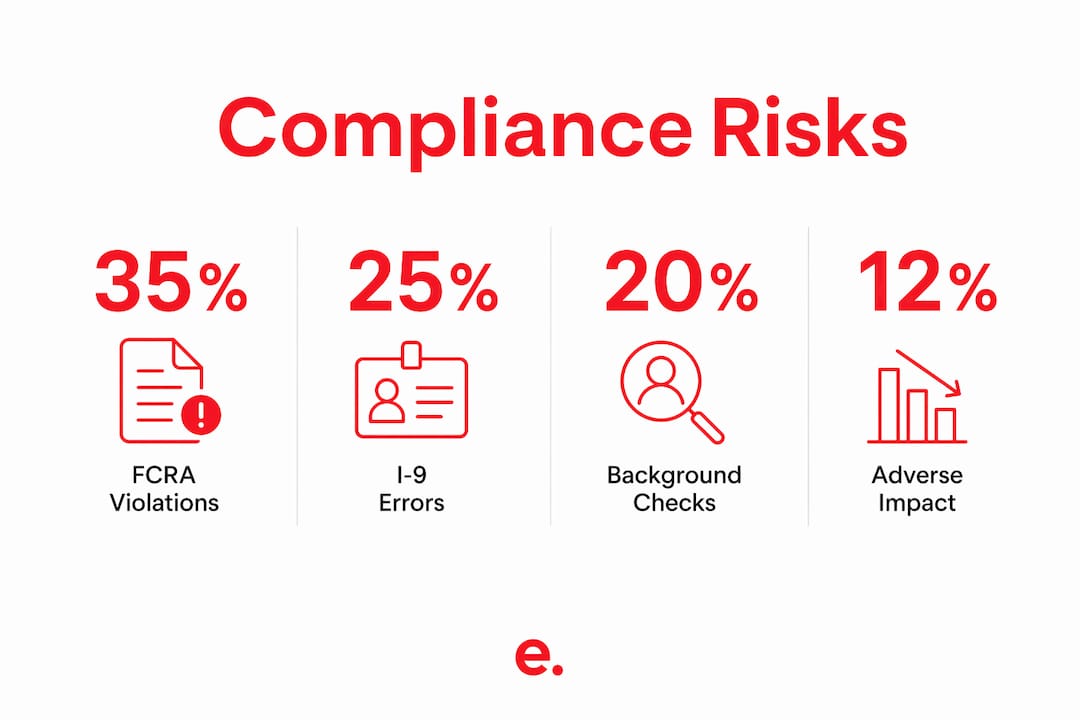
Multi-state and high-volume employers face compounded risk. A single process error replicated across thousands of hires creates systemic liability. Compliance audits identify legal exposure early before regulators detect it, which is why they function as a primary risk management tool for any organization hiring at scale.
How often should organizations audit their hiring process?
Annual comprehensive audits are the baseline standard. Best practice calls for a full recruitment compliance audit at least once per year, combined with quarterly reviews that analyze adverse impact ratios across hiring stages segmented by race, sex, age, and disability status. The annual audit catches structural problems. The quarterly reviews catch emerging patterns before they become systemic.
Three audit schedules work best in practice:
- Annual comprehensive audit. Review all hiring documentation, job descriptions, interview guides, offer letter templates, I-9 records, and background check processes. This is your full legal exposure check.
- Quarterly metrics review. Pull selection rate data by demographic group at each hiring stage. Calculate adverse impact ratios using the 4/5ths rule from the Uniform Guidelines on Employee Selection Procedures. Flag any stage where a protected group’s selection rate falls below 80% of the highest-selected group.
- Event-driven scoped audit. Conduct a targeted review after a regulatory change, a merger, a new hiring market, or a significant increase in hiring volume. High-volume employers benefit from scoped audits after peak hiring periods to catch systemic I-9 timing errors before penalties compound.
Pro Tip: Set a calendar reminder for your quarterly metrics pull the week after each quarter closes. Waiting until the annual audit to review adverse impact data means you are always looking at problems that are already three to twelve months old.
The offshore staffing risk mitigation checklist from Remotee provides a practical framework for organizations that hire across multiple jurisdictions and need to layer international compliance requirements on top of domestic audit schedules.
What best practices help integrate compliance audits into hiring workflows?
Compliance readiness is built into the process, not bolted on at audit time. The most defensible hiring programs treat every hiring decision as a document that may one day be reviewed by a regulator or a plaintiff’s attorney.
- Treat your ATS as a record keeper, not a compliance tool. An Applicant Tracking System stores recruitment data and logs timestamps, but it does not perform adverse impact analysis, provide legal advice, or flag FCRA sequencing errors. HR professionals must maintain compliance controls separately from the ATS.
- Document every candidate interaction consistently. The strongest defense against a discrimination claim is proof that every candidate went through the same process. Consistent, documented procedures for every applicant create the paper trail that makes your hiring process defensible.
- Build audit checkpoints into hiring stages. Assign a compliance checkpoint to each stage: job posting review before posting, interview guide approval before scheduling, offer letter review before sending, and I-9 completion verification on day one. Each checkpoint takes minutes and prevents the errors that take months to resolve.
- Manage AI tool compliance as your own responsibility. Annual independent bias audits for AI employment decision tools are mandatory in some jurisdictions. Employers bear full responsibility for vendor compliance documentation and candidate disclosures. Vendor reliance does not transfer liability.
Pro Tip: When evaluating any AI-powered screening or assessment tool, ask the vendor for their most recent independent bias audit report before deployment. If they cannot produce one, that is a compliance gap you will own.
Global talent acquisition best practices reinforce that compliance is a defensibility strategy. The goal is not to prove you had no discriminatory intent. The goal is to prove you ran a consistent, documented process for every candidate. Those are different standards, and only one of them holds up in court.
Compliance also extends to how you vet and manage staffing vendors. Common offshore staffing vendor mistakes frequently involve gaps in documentation handoffs and unclear responsibility for regulatory filings. Audit your vendor relationships with the same rigor you apply to internal processes.
Key Takeaways
Compliance audits in hiring are the most reliable mechanism for identifying legal exposure before it becomes a regulatory or litigation event.
| Point | Details |
|---|---|
| Audit scope covers all hiring stages | Reviews span job postings, interviews, offers, I-9 forms, background checks, and data retention. |
| Financial penalties are significant | A single EEOC charge costs $75,000–$125,000 to defend, with systemic cases exceeding $300,000. |
| Annual plus quarterly cadence is standard | Run a full audit annually and pull adverse impact metrics every quarter to catch patterns early. |
| ATS is not a compliance tool | Applicant tracking systems log data but do not replace human compliance controls or legal assessments. |
| AI tool liability stays with the employer | Employers must conduct independent bias audits for AI hiring tools regardless of vendor claims. |
Compliance audits are a strategic asset, not an annual checkbox
I have watched organizations treat compliance audits as something you do when you are worried about a lawsuit. That framing is exactly backwards. The organizations that get hit hardest by enforcement actions are the ones that only look at compliance reactively.
The trend line is clear. ICE, the EEOC, and the OFCCP have all increased enforcement activity. Regulators are not waiting for complaints. They are running proactive audits, and they are targeting high-volume employers first. If you are scaling your hiring, you are moving up the enforcement priority list whether you realize it or not.
What I have seen work consistently is treating compliance as a strategic business asset rather than a back-office burden. Organizations that build audit readiness into their hiring workflows spend less time in crisis mode and more time actually hiring. They also retain clients better because they can demonstrate documented, defensible processes on demand.
The documentation discipline that compliance audits require also produces a secondary benefit most HR leaders overlook. When your hiring process is fully documented and consistently applied, you make better hiring decisions. Bias has less room to operate when every stage has a written standard. That is not just a legal benefit. It is a talent quality benefit.
The shift I would encourage every HR leader to make is this: stop asking “are we compliant?” once a year and start asking “can we prove it?” every quarter. Those are different questions, and the second one is the one that actually protects you.
— Rajkumar
How Remotee supports compliant offshore hiring
Compliance complexity multiplies when you hire across borders. Remotee’s Employer of Record service in India handles the full compliance stack for offshore hires, including payroll, HR documentation, and local regulatory adherence, so your internal team does not have to become experts in Indian labor law.
Remotee clients report up to 32% savings on hiring costs compared to traditional recruitment models. More importantly, they hire with confidence because the compliance infrastructure is already in place. If your organization is scaling offshore and wants to avoid the audit exposure that comes with managing compliance across multiple jurisdictions, Remotee’s offshore hiring solutions are worth a close look.
FAQ
What is the role of compliance audits in hiring?
Compliance audits in hiring are systematic reviews that verify your recruitment process meets federal, state, and local legal requirements. They identify legal exposure early, before regulators or plaintiffs do.
How often should a company run a hiring compliance audit?
Best practice calls for a full compliance audit at least annually, combined with quarterly adverse impact metric reviews segmented by race, sex, age, and disability status.
What are the biggest financial risks of non-compliance in hiring?
Defending a single EEOC discrimination charge costs between $75,000 and $125,000 in legal fees, with systemic cases carrying fines exceeding $300,000. I-9 paperwork errors carry per-form penalties starting at $252.
Does an ATS handle hiring compliance automatically?
No. An ATS stores and timestamps recruitment data but does not perform adverse impact analysis or provide legal compliance functions. HR professionals must maintain compliance controls separately.
Who is responsible for AI hiring tool compliance?
The employer bears full responsibility for AI hiring tool compliance, including independent bias audits and candidate disclosures. Vendor reliance does not transfer liability to the tool provider.