How to Retain Offshore Employees Long Term in 2026
TL;DR:
- Retaining offshore employees long term depends on operational discipline, not just benefits or pay.
- A clear management structure, career growth, cultural integration, and proactive engagement reduce attrition more effectively.
Retaining offshore employees long term is the defining challenge for tech companies that build distributed teams across India, Vietnam, the Philippines, and similar markets. Top-performing offshore teams achieve 96% retention by prioritizing employee experience over cost reduction. The industry term for this discipline is offshore talent retention management, and it covers compensation design, cultural integration, lifecycle governance, and proactive engagement. Companies that treat it as an ongoing operational practice, not a one-time onboarding task, see measurably lower attrition and higher productivity from their distributed teams.
How to retain offshore employees long term: the core framework
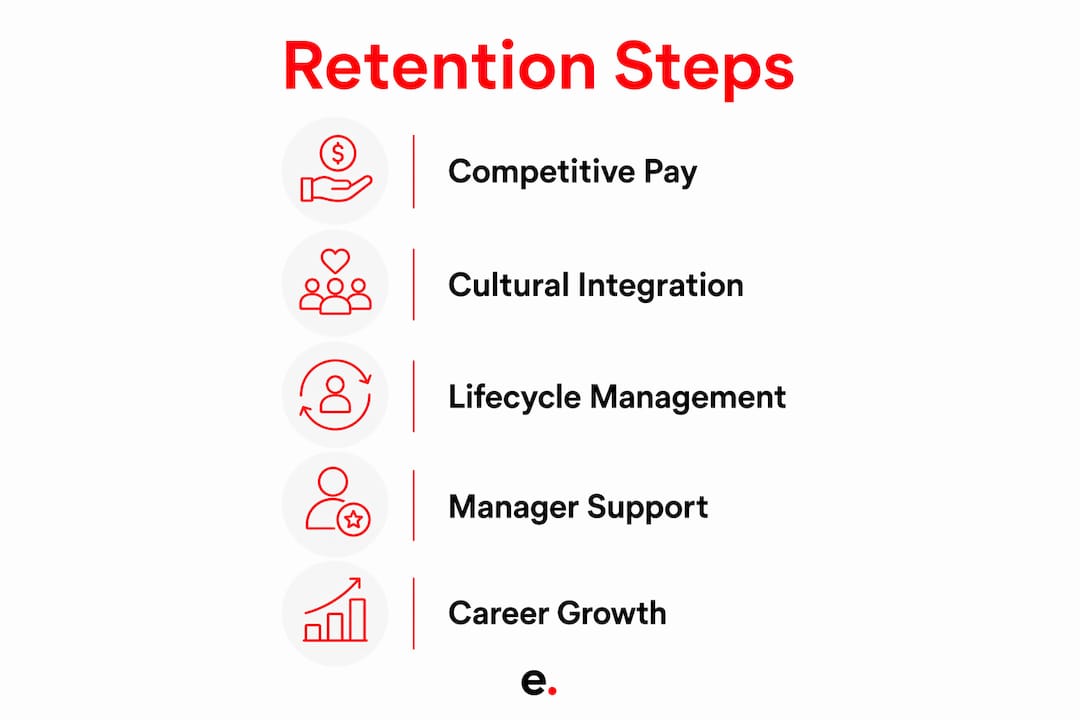
The biggest misconception in offshore staffing is that pay drives attrition. Attrition data tells a different story: 67% of offshore employees leave due to lack of growth, 61% cite poor manager support, and 58% point to lack of recognition. Compensation is foundational, but it rarely explains why strong performers quit. That means your retention framework needs four pillars: competitive pay, cultural integration, lifecycle management, and ongoing engagement. Each pillar addresses a distinct attrition risk, and skipping any one of them creates a gap that the others cannot fill.

How does compensation affect offshore employee retention?
Competitive pay is the floor, not the ceiling, of any offshore retention strategy. Top talent expects salaries in the regional top quartile, and companies that benchmark against local market rates consistently outperform those that anchor to the lowest available rate. Paying below the top quartile signals to high performers that they are undervalued, which accelerates departure.
A total rewards approach extends well beyond base salary. The most effective packages combine:
- Performance bonuses tied to project milestones or annual reviews
- Health coverage that meets or exceeds local statutory minimums
- Paid training and certifications funded by the employer
- Tenure-based retention bonuses paid at 12, 24, and 36 months of service
Retention bonuses tied to tenure milestones are particularly effective. They create a financial reason to stay through the periods when attrition risk is highest, typically months 4 through 9 of an engagement. They also signal that the company values long-term commitment, not just immediate output.
Pro Tip: Review local salary benchmarks every six months, not annually. Offshore markets like India and the Philippines move fast, and a salary that was competitive in january can fall below the top quartile by july.
Why does cultural integration reduce offshore team turnover?
The employment model you use determines how integrated your offshore staff feel. Full employment with benefits and direct integration produces 95% retention compared to a 68% industry average for contractor-based models. That 27-point gap is entirely explained by how included employees feel in day-to-day operations. Contractors receive tasks. Employees receive belonging.
Treating offshore workers as integrated team members drives retention 40% above industry averages. The practical difference shows up in small but consistent decisions about access and inclusion. Here is what that looks like operationally:
- Give offshore staff direct access to your primary communication channels, such as Slack or Microsoft Teams, alongside onshore colleagues.
- Include them in sprint planning, product roadmap reviews, and retrospectives, not just execution.
- Assign onshore mentors or peer buddies during the first 90 days to accelerate cultural onboarding.
- Invite offshore team members to present their work in all-hands meetings.
- Recognize offshore contributions publicly in the same forums where onshore work is celebrated.
The distinction between a full-time offshore employee and a contractor is not just legal. It shapes every interaction the person has with your organization. When offshore staff attend planning meetings, they develop context. Context creates investment. Investment creates retention.
Pro Tip: Schedule a monthly virtual coffee or informal team call that includes offshore staff. Informal connection builds trust faster than any formal program.
How should you manage the offshore employment lifecycle to prevent attrition?
Offshore engagements have predictable attrition spikes, and most companies are caught off guard by them. Attrition risk peaks between months 4 and 9, then rises again during any transition or handover period. Managing the lifecycle proactively means addressing both windows before they become crises.
For long-term engagements running 24 months or more, the handover window is the most dangerous. Announcing handover plans around month 18 of a 30-month lifecycle reduces attrition caused by ambiguity. Employees who do not know what happens to their role after a transition will start looking for alternatives. Transparency about the plan removes that uncertainty.
Contract structure matters as much as communication. Vietnam’s labor codes allow tenure, leave, and social insurance transfers under defined contract conditions. Improper contract design during a transition causes a tenure reset, which triggers an attrition spike. The same principle applies across most offshore markets: compliant contract continuity preserves the employment relationship that retention depends on.
“During offshore team handover windows, operational governance must assign exclusive decision rights to either vendor or client. Concurrent management reduces engineer trust and undermines retention.” — Long-Term Offshore Engagement Lifecycle Playbook
Dual-management during transitions is one of the most overlooked attrition drivers. When an offshore engineer receives conflicting instructions from two managers, trust erodes quickly. The fix is simple: designate a single operational decision-maker for each 30-day window during any transition period. Clarity of authority protects employee confidence in the organization.
Key lifecycle management practices to implement:
- Map your engagement timeline and flag months 4–9 and any transition windows as high-risk periods.
- Communicate handover plans to offshore staff at least 12 months before the transition date.
- Audit contract structures with local legal counsel before any transition to preserve tenure continuity.
- Assign a single named decision-maker for each phase of a handover.
- Use compliant employment transitions to protect both the employee relationship and your legal standing.
What engagement tools keep offshore workers loyal over time?
Recognition and manager support are the two most cited retention drivers in offshore settings, yet both are chronically underfunded in practice. Engaged offshore teams show an 8% rework rate compared to 31% for low-retention teams. That difference in rework rates translates directly into delivery speed and project cost. Engagement is not a soft metric. It has a hard financial return.
Stay interviews are the most underused tool in offshore talent retention management. Stay interviews explore what causes employees to stay or leave, unlike performance reviews which focus on past output. A stay interview asks forward-looking questions: What would make you consider leaving? What would make you stay for another two years? What is one thing we could change about how you work?
These conversations are especially valuable in cultures where employees are unlikely to raise concerns unprompted. Proactive stay interviews detect early disengagement that standard performance reviews miss entirely. In the Philippines, for example, direct confrontation is culturally uncomfortable, so disengagement often goes unspoken until a resignation letter arrives.
Practical engagement practices that work:
- Run stay interviews every six months, separate from performance reviews.
- Assign managers a weekly recognition habit: one specific, public acknowledgment per team member per week.
- Track engagement signals in day-to-day work, such as response times, initiative on tasks, and participation in meetings, not just annual survey scores.
- Build growth signals into regular work, such as assigning a junior engineer to lead a small feature, rather than waiting for a formal promotion cycle.
Pro Tip: Frame stay interviews as career conversations, not retention checks. Offshore employees respond better when the discussion centers on their growth rather than the company’s need to keep them.
What career growth frameworks secure long-term offshore commitment?
Career growth contributes more to long-term retention than compensation once base pay is competitive. Lack of growth drives 67% of offshore attrition, making it the single largest attrition driver in the data. A visible career path answers the question every high performer asks: “Where do I go from here?”
The most effective career frameworks share three characteristics. They are transparent, meaning every employee can see the criteria for advancement. They are attainable, meaning promotions happen on a defined timeline rather than at manager discretion. They are tied to real responsibility, meaning a new title comes with new scope, not just a new label.
A healthcare client created a Lead Associate tier as an intermediate step between senior and manager roles. The result was zero voluntary attrition over 24 months. The tier gave high performers a visible next step without requiring a management vacancy to open up. That is the core insight: career progression does not always require a new headcount slot. It requires a new level of recognized responsibility.
A practical career framework for offshore tech teams looks like this:
| Role tier | Advancement criteria |
|---|---|
| Junior engineer | 12 months tenure, core skill certification |
| Mid-level engineer | 24 months tenure, independent project delivery |
| Senior engineer | 36 months tenure, mentoring two junior staff |
| Lead engineer | 48 months tenure, technical ownership of a product area |
| Principal or staff | Defined by business need and demonstrated impact |
Pair this structure with a mentorship program that connects junior offshore staff to senior engineers, onshore or offshore. Mentorship accelerates skill development and creates a social bond that makes leaving feel costly. Offshore retention strategies that combine visible tiers with active mentorship consistently outperform those that rely on compensation alone.
Key Takeaways
Retaining offshore employees long term requires career growth frameworks, cultural integration, lifecycle governance, and proactive engagement working together as a continuous operational discipline.
| Point | Details |
|---|---|
| Growth drives attrition more than pay | 67% of offshore employees leave due to lack of growth, not compensation gaps. |
| Full employment beats contractor models | Full-time employment with benefits produces 95% retention vs. a 68% industry average. |
| Lifecycle timing is critical | Announce handover plans by month 18 and assign single decision-makers to prevent attrition spikes. |
| Stay interviews surface hidden risk | Forward-looking stay interviews detect disengagement that performance reviews miss, especially in indirect communication cultures. |
| Visible career tiers eliminate voluntary attrition | A structured Lead tier eliminated voluntary attrition entirely for one healthcare client over 24 months. |
What I’ve learned about offshore retention that most guides won’t tell you
Most offshore retention guides focus on what to add: more benefits, more recognition programs, more career tiers. After working closely with companies building distributed teams across India and Southeast Asia, I’ve found the bigger problem is what companies fail to remove. Ambiguity is the real attrition driver.
When an offshore engineer does not know who their real manager is during a transition, they start interviewing elsewhere. When a career path exists on paper but promotions never happen, the framework becomes a source of cynicism rather than motivation. When stay interviews are introduced but managers do not act on what they hear, the next stay interview produces silence.
The companies I’ve seen sustain high retention over three or more years share one trait: they treat offshore staff management as an operational discipline with the same rigor they apply to product delivery. They have named owners for retention metrics. They review attrition data monthly, not annually. They act on stay interview findings within 30 days.
The uncomfortable truth is that retention is not a culture initiative. It is an operational system. Culture supports it, but process sustains it. If your offshore retention rate is declining, the first question to ask is not “Are we being nice enough?” It is “Do our offshore employees have clarity about their future here?” That question, asked honestly and acted on consistently, changes outcomes faster than any benefits package.
— Rajkumar
Remotee’s EOR services support your offshore retention goals
Building a high-retention offshore team starts with the right employment structure. When offshore staff are hired as full employees with compliant contracts, continuous benefits, and clear tenure rights, retention improves before you run a single engagement program.
Remotee’s Employer of Record service in India handles payroll, compliance, and HR administration so your offshore staff are employed correctly from day one. Clients report up to 32% savings on hiring costs while gaining access to top-tier talent. Remotee manages the employment infrastructure that makes long-term offshore staff management possible, including benefits continuity and compliant contract design that protects tenure during transitions. If you are building or scaling an offshore team in India, explore offshore hiring with Remotee to see how the right employment foundation drives retention from the start.
FAQ
What is the biggest driver of offshore employee attrition?
Lack of career growth drives 67% of offshore attrition, outranking poor compensation. Manager support and recognition are the second and third most cited factors.
How often should you conduct stay interviews with offshore staff?
Run stay interviews every six months, separate from performance reviews. In cultures with indirect communication styles, such as the Philippines, these conversations are the primary way to detect disengagement early.
What employment model produces the highest offshore retention?
Full-time employment with benefits and direct team integration produces 95% retention, compared to a 68% industry average for contractor-based models.
How do you prevent attrition during an offshore team transition?
Announce the transition plan at least 12 months in advance, audit contracts to preserve tenure continuity under local labor codes, and assign a single operational decision-maker for each phase of the handover.
Does compensation alone retain offshore employees long term?
Competitive pay in the regional top quartile is necessary but not sufficient. Growth opportunities, recognition, and manager support consistently outweigh compensation as reasons offshore employees stay or leave.