How Offshore PPC Specialists Are Hired: 2026 Guide
TL;DR:
- Hiring offshore PPC specialists involves a four-stage process that verifies real campaign results before committing funds. Proper onboarding and embedded team integration lead to better performance and substantial cost savings, especially in Latin America. Conducting practical tests and maintaining clear communication are essential for long-term success and maximizing business outcomes.
Hiring offshore PPC specialists is a structured, four-stage process that moves from defining platform requirements to setting 30-day performance milestones. Marketing managers who follow this process verify real campaign results, not just credentials, before a single dollar of ad spend is handed over. Done right, outsourcing PPC management cuts annual talent costs by up to 70% compared to U.S.-based hires while maintaining the same level of campaign accountability. This guide walks through every stage, the financial benchmarks, and the integration practices that determine whether an offshore hire succeeds or stalls.
How offshore PPC specialists are hired: the four-stage process
The offshore PPC recruitment process follows four sequential stages, and skipping any one of them is the most common reason companies end up with underperforming hires. Each stage filters out a different category of risk.
Stage 1: Define platform requirements and budget history
Start by documenting which ad platforms the role requires: Google Ads, Meta Ads, Microsoft Advertising, or a combination. Specify the monthly ad spend the candidate will manage, the industries they need experience in, and the reporting tools your team uses. This document becomes the filter for every resume that follows. Candidates who cannot show direct experience managing budgets at your scale get removed before the first call.
Stage 2: Screen on real ad spend data, not certifications
Google Ads certifications are insufficient as a hiring signal. Candidates must submit screenshots of campaign dashboards, performance summaries showing cost-per-acquisition (CPA) and return on ad spend (ROAS), and a brief written explanation of decisions they made during those campaigns. This screen separates candidates who have managed real budgets from those who have only studied for exams.

Stage 3: Paid real-work test using anonymized campaign data
The paid real-work test is the most critical predictor of an offshore PPC specialist’s actual capabilities. Give shortlisted candidates anonymized data from a real campaign and ask them to diagnose performance issues, propose bid adjustments, and outline a 30-day improvement plan. Pay candidates for this test. It signals professionalism on your end and attracts serious applicants who respect their own time.
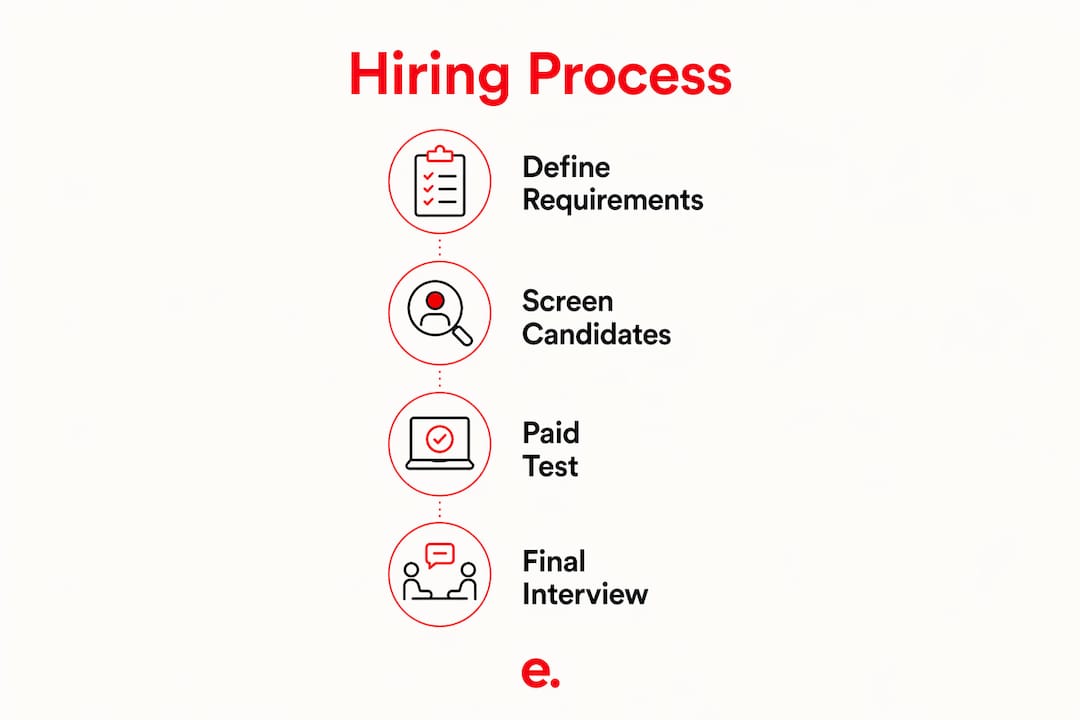
Stage 4: Final interviews and 30-day performance milestones
The final interview focuses on business outcome thinking: how does the candidate connect ad performance to revenue, not just clicks? Set documented 30-day performance milestones before the hire starts. These milestones define target ROAS, CPA benchmarks, and reporting cadence from day one, giving both sides a clear standard to measure against.
Pro Tip: Ask every finalist to walk you through one campaign they would have run differently. Candidates who give specific, data-backed answers are the ones who think like business owners, not just ad technicians.
How do cost savings and timeline efficiencies benefit companies?
The financial case for hiring offshore PPC talent is direct. Companies can hire full-time specialists from Latin America at $7–$9 per hour compared to $30–$55 per hour for equivalent U.S.-based talent. That translates to annual savings of $50,000 or more per role when you account for salary, benefits, and overhead.
The timeline advantage is equally significant. Standard offshore recruitment takes 3–6 weeks, but specialized hiring firms can deliver shortlists in 48 hours and complete the full hiring process in 11–15 days. For marketing teams running time-sensitive campaigns, that speed difference is material.
The table below shows cost and timeline benchmarks across three common offshore regions.
| Region | Typical hourly rate | Equivalent U.S. rate | Avg. hiring timeline |
|---|---|---|---|
| Latin America | $7–$9/hr | $30–$55/hr | 11–15 days with a specialist firm |
| Philippines | $8–$12/hr | $30–$55/hr | 2–4 weeks |
| Eastern Europe | $15–$25/hr | $30–$55/hr | 3–6 weeks |
Remotee clients report up to 32% savings on total hiring costs when compliance, payroll, and HR management are bundled into a single service. That figure reflects the full cost of employment, not just the salary line. Understanding the full cost-per-hire offshore is the only way to make an accurate comparison against domestic hiring.
What skills and qualities should you prioritize when vetting offshore PPC candidates?
The best offshore PPC candidates think in business outcomes, not platform metrics. A candidate who reports on impressions and click-through rates without connecting them to revenue is not ready to manage your budget independently.
Prioritize these qualities during vetting:
- Proven campaign management history. Candidates must share screenshots and performance summaries from real accounts. Accounts with monthly spend above $10,000 are a meaningful benchmark for mid-market advertisers.
- Business outcome thinking. Look for candidates who discuss ROAS, CPA, and revenue impact in their first conversation. Candidates who lead with clicks and impressions are optimizing for the wrong signal.
- Automation and tool proficiency. Competent specialists use Google Ads scripts, automated bidding strategies, and third-party reporting tools. Ask which tools they use and why.
- Platform breadth. A specialist who has only managed Google Search campaigns will struggle with a cross-channel brief. Confirm platform experience matches your actual media mix.
- Communication discipline. Offshore hires work across time zones. Candidates who respond to test communications promptly and clearly are demonstrating a skill that matters as much as their technical ability.
High-quality offshore PPC talent shows campaign management experience through data, not credentials. Certifications confirm that a candidate passed an exam. Performance data confirms they can run a campaign.
Pro Tip: Request a written audit of a fictional underperforming campaign as part of your screening. The depth and specificity of the response tells you more than any interview question.
How to set expectations and integrate an offshore PPC specialist for long-term success
Integration determines whether an offshore hire delivers on their potential. Treating offshore specialists as isolated contractors rather than embedded team members is the most common reason performance falls short of expectations.
The following practices build the structure that makes integration work:
- Set KPIs before day one. Define target ROAS, CPA benchmarks, and weekly reporting formats in writing before the hire starts. Ambiguity in the first 30 days creates misalignment that is hard to correct later.
- Run documented 30-day performance reviews. Documented milestones give both sides a shared reference point. They also create a paper trail that protects the business if performance does not meet expectations.
- Embed the specialist in your marketing team. Give offshore hires direct access to your creative team, analytics platform, and marketing calendar. A PPC specialist who cannot see what creative assets are available or what promotions are planned cannot build effective campaigns.
- Use direct communication channels. Slack, Google Meet, or Microsoft Teams with defined response windows work better than email chains for cross-timezone collaboration. Set expectations about response times in writing during onboarding.
- Choose dedicated over shared models. Dedicated full-time offshore specialists deliver higher accountability than agency-managed models where attention is split across many clients. A dedicated hire focuses exclusively on your accounts and builds institutional knowledge over time.
Expanding agency capacity with offshore talent works best when the offshore hire is treated as a full team member with the same access, context, and communication norms as an in-office employee.
Key takeaways
Hiring offshore PPC specialists succeeds when companies follow a structured four-stage process, vet candidates on real campaign data, and embed hires as full team members with documented KPIs from day one.
| Point | Details |
|---|---|
| Four-stage hiring process | Define requirements, screen on real data, run a paid test, then set 30-day milestones. |
| Cost savings are substantial | Offshore PPC specialists in Latin America cost $7–$9/hr versus $30–$55/hr in the U.S. |
| Certifications are not enough | Candidates must show campaign screenshots and performance data, not just platform credentials. |
| Integration drives performance | Embedding offshore hires in your marketing team with direct communication channels improves results. |
| Dedicated models outperform shared ones | Full-time dedicated hires build deeper account knowledge than agency-managed, shared resources. |
What I have learned about hiring offshore PPC talent
The biggest mistake I see marketing managers make is treating the offshore PPC hire as a cost-cutting exercise rather than a talent acquisition decision. They rush the vetting, skip the practical test, and hand over a live account to someone whose only proof of skill is a Google Ads certification. Then they are surprised when performance drops.
The practical test is non-negotiable. Every time I have seen a company skip it, they regret it within 60 days. The test does not need to be elaborate. Give the candidate anonymized data, a clear brief, and 48 hours. What they produce tells you everything about how they think under realistic conditions.
The integration piece is where I see the second-biggest failure. Companies hire a strong candidate, then treat them like a vendor. They do not share the marketing calendar. They do not give access to creative assets. They do not include the specialist in strategy calls. Then they wonder why the campaigns feel disconnected from the broader business.
The offshore PPC specialists who deliver the best results are the ones who feel like part of the team. That is not an accident. It is the result of deliberate onboarding, clear communication norms, and a manager who treats the hire as a colleague, not a contractor.
Cost savings matter. But the real value of a well-hired offshore PPC specialist is the compounding effect of someone who knows your accounts deeply, thinks about your business outcomes, and improves every quarter.
— Rajkumar
Remotee makes offshore PPC hiring straightforward
Finding a qualified offshore PPC specialist is only part of the challenge. Managing compliance, payroll, and HR across borders adds complexity that pulls marketing leaders away from their core work.
Remotee handles the full employment infrastructure for offshore hires, including payroll, compliance, and HR management, so your team focuses on campaign performance instead of paperwork. Clients report up to 32% savings on total hiring costs when using Remotee’s Employer of Record service compared to building the same infrastructure independently. Remotee presents only pre-vetted candidates and includes replacement guarantees for hiring confidence. If you are ready to build your offshore PPC capability without the administrative burden, Remotee’s offshore hiring solutions are built for exactly that.
FAQ
How long does it take to hire an offshore PPC specialist?
Standard offshore PPC recruitment takes 3–6 weeks, but specialized hiring firms can deliver shortlists in 48 hours and complete the full process in 11–15 days.
What is the cost of offshore PPC services compared to U.S. hires?
Offshore PPC specialists in Latin America cost $7–$9 per hour versus $30–$55 per hour for U.S.-based equivalents, representing savings of up to 70% on annual salary costs.
Are Google Ads certifications enough to evaluate a PPC candidate?
No. Certifications confirm exam knowledge but not execution ability. Candidates must provide campaign screenshots and performance summaries showing real ROAS and CPA results.
What is the best way to vet an offshore PPC specialist?
The most reliable method is a paid real-work test using anonymized campaign data. This separates candidates who understand theory from those who can execute under realistic conditions.
Should I hire a dedicated offshore PPC specialist or use an agency?
Dedicated full-time hires deliver higher accountability and deeper account knowledge than agency-managed models, where specialist attention is divided across multiple clients.