Why India for Software Outsourcing: 2026 Business Guide
TL;DR:
- India remains the top destination for software outsourcing due to its vast talent pool, infrastructure, and cost advantages. Its shift from task-based outsourcing to strategic product ownership and AI integration makes it highly competitive by 2026. Operational success depends on clear governance, dedicated teams, and partnership models like Remotee’s Employer of Record services.
India is the world’s leading destination for software outsourcing, combining 40–70% cost savings over U.S. rates with a developer talent pool that no other country currently matches at scale. The case for outsourcing software development to India has never been stronger. FDI inflows surged 73% to $47 billion in 2025, driven by IT, R&D, and data center investments. That capital signals what global enterprises already know: India is not just a cost play. It is a strategic engineering hub that now supports AI-driven product development, platform ownership, and global capability centers at a scale that Eastern Europe and Southeast Asia cannot replicate.
What are the main advantages of outsourcing to india?
The advantages of outsourcing to India go well beyond a lower invoice. They compound across cost, talent, time, and infrastructure in ways that directly affect your product velocity.
Cost savings that actually hold up
Development costs in India run 40–70% cheaper than equivalent U.S. rates. That gap is not a race to the bottom on quality. It reflects lower living costs, a competitive local labor market, and a mature supply of mid-to-senior engineers who command global-standard skills at local salaries. Remotee clients report up to 32% savings on total hiring costs when you factor in compliance, payroll, and benefits management through an Employer of Record model.
A talent pool built for 2026
India produces more than 1.5 million engineering graduates annually. The country’s IT outsourcing combines large developer depth, strong English proficiency, and increasing automation to deliver quality at scale. That English fluency matters more than most buyers admit. It removes a full layer of translation overhead that quietly kills timelines in non-English outsourcing markets.

The follow-the-sun advantage
A 10.5-hour time zone difference between India and the U.S. East Coast enables overnight build and next-morning review cycles without paying premium shift rates on either side. Your team in New York writes requirements at 5 p.m. The Bengaluru team ships code by the time you pour your morning coffee. That is a genuine velocity multiplier, not a scheduling workaround.
Infrastructure that supports serious engineering
India ranks among the top 10 global data center hosts in 2025. Greenfield investments in cloud infrastructure, fiber connectivity, and AI compute capacity mean that Indian engineering teams operate on the same technical stack as their counterparts in San Francisco or London. This is not the India of slow VPNs and patchy video calls from a decade ago.
Pro Tip: When evaluating Indian vendors or hires, ask specifically about their cloud certifications (AWS, GCP, Azure) and CI/CD tooling. Teams with mature DevOps practices close the last gap between offshore and in-house delivery quality.
How has india’s outsourcing model evolved beyond low-cost labor?
The most important shift in why companies choose India for IT services is the move from task execution to product ownership. This is not a marketing claim. It is documented at scale.
India hosts 2,117 Global Capability Centers (GCCs) employing 2.36 million professionals, generating $98.4 billion in revenue, with 32% growth since FY2021. GCCs are not outsourcing vendors. They are wholly owned engineering arms of global enterprises, running product roadmaps, AI platforms, and digital transformation programs from Indian cities. Companies like Google, Microsoft, Goldman Sachs, and JPMorgan Chase operate significant GCCs in Bengaluru, Hyderabad, and Pune.
AI has become central to GCC growth, with many centers embedding AI capabilities and shifting to product ownership models. Nearly 75% of India’s GCCs are projected to evolve into transformation hubs by 2030. That projection reflects a structural change, not an aspiration.
Deloitte’s 2026 research frames outsourcing as a response to talent scarcity and AI transformation, not just cost savings. Organizations integrating AI in delivery are actively sourcing specialized skills from India because the talent concentration exists there at a depth unavailable in most Western markets.
| Outsourcing Era | Primary Driver | Typical Engagement | Outcome Focus |
|---|---|---|---|
| Pre-2015 | Cost reduction | Fixed-scope projects | Deliverable completion |
| 2015–2022 | Scale and speed | Staff augmentation | Team capacity |
| 2023–2026 | AI and product ownership | Dedicated capability centers | Business outcomes |
Pro Tip: If a vendor pitches you purely on hourly rates, that is a signal they are operating in the 2015 model. Ask instead about their AI tooling, product ownership experience, and how they handle architecture decisions. The answer tells you everything about their maturity level.
What collaboration models optimize outsourcing success in india?
Getting the most from India-based software teams is an operational discipline, not a vendor selection exercise. The structure you build around the engagement determines the outcome more than the talent you hire.
-
Choose dedicated teams over fixed-scope projects. Dedicated teams with ownership and continuity consistently outperform fixed-scope project-based outsourcing for product development. Hidden coordination costs erode savings in re-scoped or transactional engagements. A dedicated team learns your codebase, your users, and your priorities. A project team learns your statement of work.
-
Treat governance as a delivery system. Poor alignment causes more outsourcing failures than offshore location ever does. Clear product requirement documents (PRDs), decision logs, and structured async reviews are not bureaucracy. They are the operating system of a high-performing distributed team.
-
Build async-first communication habits. The time zone offset is an asset only if your communication does not require real-time resolution for every decision. Write requirements with enough context that a Bengaluru engineer can act at 9 a.m. their time without waiting for your 8 a.m. standup.
-
Invest in architecture alignment early. The most expensive offshore mistakes happen when a team builds confidently in the wrong direction for three sprints. A shared architecture decision record, reviewed weekly, prevents that pattern entirely.
Pro Tip: Use tools like Notion for decision logs, Linear for sprint tracking, and Loom for async video walkthroughs of complex requirements. Indian engineering teams are already fluent in these tools. The discipline has to come from your side.
You can find a practical breakdown of offshore hiring operations that covers the governance structures most startups skip and later regret.
How does india compare to other outsourcing destinations in 2026?
The honest answer is that India leads on most dimensions that matter for software product companies, but the comparison is not uniform across every use case.
| Factor | India | Eastern Europe | Southeast Asia |
|---|---|---|---|
| Cost vs. U.S. rates | 40–70% cheaper | 30–50% cheaper | 35–60% cheaper |
| Developer talent pool | Largest globally | Strong, smaller scale | Growing, mid-tier depth |
| English proficiency | High | Moderate to high | Moderate |
| AI and GCC maturity | Highest globally | Emerging | Early stage |
| Time zone (U.S. overlap) | Minimal overlap, follow-the-sun | Partial overlap | Partial overlap |
| Data center infrastructure | Top 10 globally | Strong in Poland, Germany | Growing in Singapore |
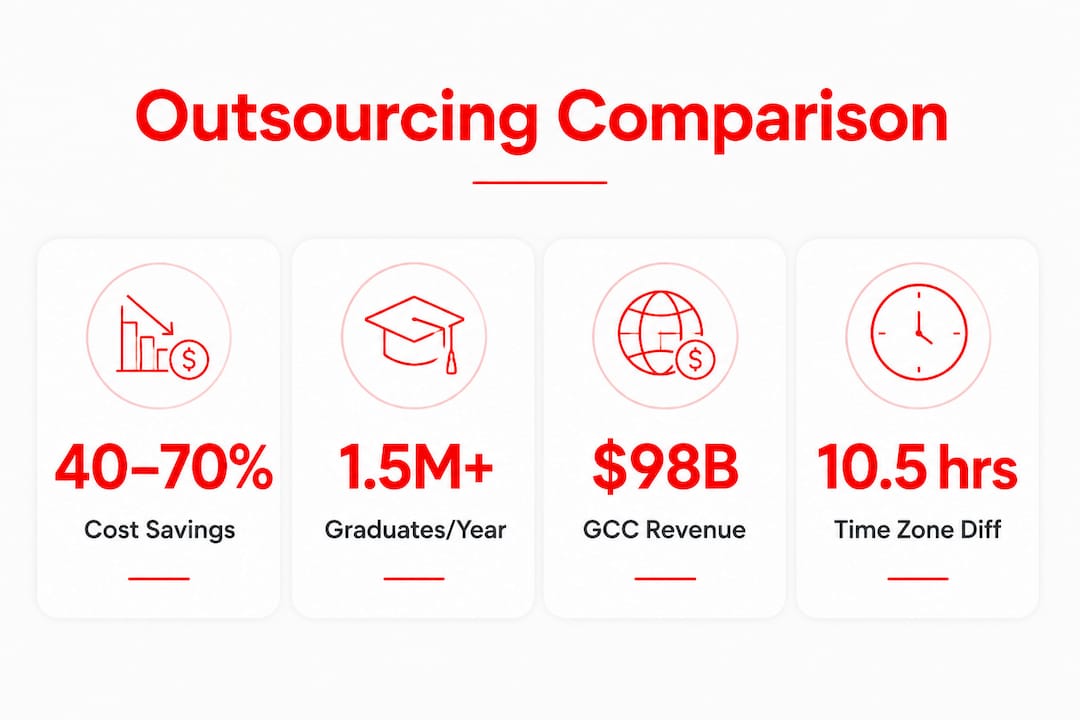
India’s cost advantage, talent pool depth, and infrastructure investments outpace leading outsourcing countries including Eastern Europe and Southeast Asia. Eastern Europe offers strong engineering talent, particularly in Poland, Romania, and Ukraine, but the talent pool is smaller and AI-specific depth is still developing. Southeast Asia, particularly Vietnam and the Philippines, offers competitive rates but trails on GCC maturity and AI engineering concentration.
For startups building a product from zero to Series A, India offers the best combination of cost, English fluency, and access to senior engineers with product experience. For enterprises running AI transformation programs, India’s GCC ecosystem is simply unmatched. The one scenario where Eastern Europe competes more directly is when real-time collaboration with European headquarters is a hard requirement.
Key takeaways
India’s combination of cost efficiency, AI-ready talent, and mature delivery models makes it the strongest software outsourcing destination available to startups and enterprises in 2026.
| Point | Details |
|---|---|
| Cost savings are real and durable | Indian development costs run 40–70% below U.S. rates without sacrificing senior engineering quality. |
| GCCs signal strategic depth | India’s 2,117 GCCs generating $98.4B in revenue prove the country supports product ownership, not just task execution. |
| Governance determines outcomes | Clear PRDs, decision logs, and async-first communication matter more than vendor selection for outsourcing success. |
| Dedicated teams outperform projects | Fixed-scope engagements hide coordination costs; dedicated teams with continuity deliver better ROI over time. |
| India leads on AI readiness | No other outsourcing destination matches India’s concentration of AI engineering talent and infrastructure investment. |
India’s outsourcing edge: what the numbers miss
By Rajkumar
I have watched companies make the same mistake for years. They evaluate India purely on rate cards and time zone math, then wonder why the engagement underdelivers. The numbers are real. The 40–70% cost savings are real. But they are not the reason the best engagements succeed.
The reason is ownership culture. The Indian engineers I have worked with most effectively are not executing tasks. They are solving problems. That shift happens when you give them context, not just tickets. When you treat the offshore team as an extension of your product organization rather than a vendor fulfilling a contract, the output changes completely.
The AI angle is the part most buyers are still underestimating. Modern outsourcing addresses talent scarcity and AI transformation, not just cost. India’s engineering community has absorbed AI tools faster than almost any other market. The engineers coming out of Bengaluru, Hyderabad, and Pune right now are building with GitHub Copilot, fine-tuning models, and architecting RAG pipelines. That is not a future trend. It is the current baseline.
My honest advice: stop optimizing for the cheapest rate and start optimizing for the highest-context engagement. Write better requirements. Share your business goals, not just your sprint backlog. Invest in technology talent in India the same way you invest in your in-house team. The return on that investment is where the real advantage lives.
— Rajkumar
How Remotee makes india outsourcing operationally simple
Knowing why India works for software outsourcing is one thing. Building a compliant, well-managed team there is another problem entirely.

Remotee’s Employer of Record service in India handles every operational layer that slows companies down: payroll, compliance, HR administration, and local labor law. You focus on the product. Remotee handles the infrastructure that makes the hire legal and sustainable. Clients report up to 32% savings on total hiring costs compared to traditional recruitment and entity-setup approaches. For startups that cannot afford to set up a legal entity in India before validating the model, this is the fastest path to a fully compliant offshore engineering team. Learn more about offshore hiring with Remotee to see how the model works in practice.
FAQ
How much cheaper is software development in india vs. the u.s.?
Development costs in India are 40–70% cheaper than equivalent U.S. rates. The gap reflects lower local living costs and a competitive engineering labor market, not a reduction in skill level.
What is a GCC and why does it matter for outsourcing?
A Global Capability Center (GCC) is a wholly owned offshore engineering arm of a global enterprise. India hosts 2,117 GCCs employing 2.36 million professionals, which signals that the country supports full product ownership, not just vendor-based task execution.
Is the time zone difference with india a problem or an advantage?
The 10.5-hour offset between India and the U.S. East Coast enables follow-the-sun development cycles. Your team reviews work in the morning that was built overnight, increasing velocity without premium shift costs.
What is the biggest operational risk in outsourcing to india?
Poor requirement alignment and weak governance cause more failures than offshore location. Clear PRDs, async communication practices, and decision logs reduce this risk significantly.
How does Remotee help companies outsource software development to india?
Remotee acts as an Employer of Record, managing compliance, payroll, and HR so businesses can hire full-time Indian engineers without setting up a local legal entity. Clients report up to 32% savings on total hiring costs.