How to Evaluate Offshore Staffing Vendors in 2026
TL;DR:
- Evaluating offshore staffing vendors requires a structured, data-driven process across eight key dimensions to ensure reliable partnership selection. Conduct thorough due diligence by verifying certifications, client references, and developer profiles, and implement a real-world pilot to validate vendor capabilities. Clear contractual safeguards, regular governance, and avoiding common pitfalls like price-based selection help establish successful long-term offshore relationships.
Evaluating offshore staffing vendors means systematically assessing their technical vetting quality, compliance posture, communication standards, and pricing transparency to identify a reliable partner for scaling operations. Most businesses that struggle with offshore hiring do so because they treat vendor selection as a single comparison rather than a structured, repeatable process. A weighted scorecard across eight dimensions, as outlined by Pangea.ai and Acquaint Softtech, gives project managers a defensible, data-driven method to rank candidates. Getting this right upfront protects your budget, your IP, and your team’s time. The offshore staffing assessment process covered here applies whether you are hiring software developers, customer support agents, or back-office specialists.
What key criteria should you use to evaluate offshore staffing vendors?
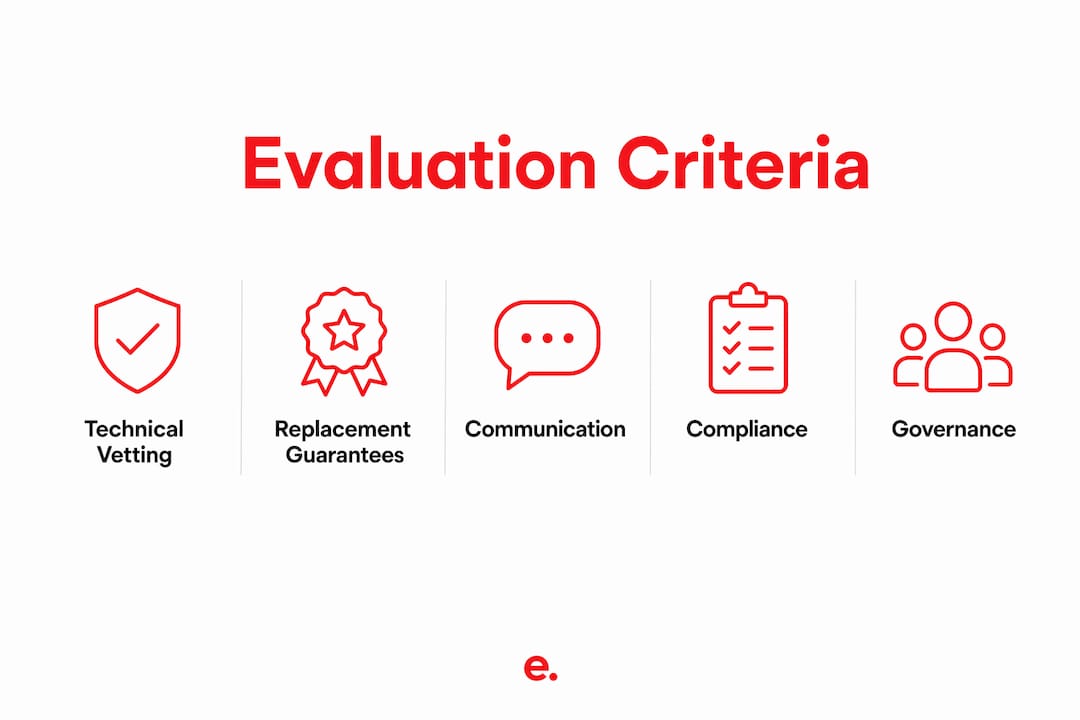
A structured scorecard across eight weighted dimensions is the most reliable framework for comparing offshore staffing providers. The eight dimensions are: technical vetting quality, talent pool depth, speed to match, replacement guarantees, compliance infrastructure, contract flexibility, communication quality, and pricing transparency. Each dimension carries a different weight depending on your business priorities, but none should be scored at zero.

Here is a practical starting point for weighting those dimensions:
| Evaluation criterion | Suggested weight | What to look for |
|---|---|---|
| Technical vetting quality | 25% | Multi-stage assessments, code tests, live interviews |
| Replacement guarantees | 20% | Free first replacement within 10 business days |
| Compliance infrastructure | 15% | Local labor law coverage, payroll accuracy, tax handling |
| Communication quality | 15% | Overlap hours, response SLAs, English proficiency |
| Talent pool depth | 10% | Number of vetted candidates per role, niche coverage |
| Pricing transparency | 10% | All-in rate cards, no hidden fees |
| Contract flexibility | 5% | Month-to-month options, scope change clauses |
Replacement guarantees deserve special attention. Replacement timelines should be capped at 10 business days, and the first replacement should cost you nothing. Vendors who cannot commit to this in writing are signaling that developer turnover will become your financial problem, not theirs.
Communication quality and operational processes matter as much as cost, particularly for teams requiring 24/7 coverage or real-time collaboration. A vendor with a 30% lower rate but a 48-hour response window will cost you more in lost productivity than the savings justify.
Pro Tip: Score each vendor on a 1-to-5 scale per criterion, multiply by the weight, and sum the totals. Any vendor scoring below 3.0 overall should be removed from your shortlist regardless of price.
How to perform effective due diligence on offshore staffing vendors
Due diligence on offshore vendors goes well beyond reading their website. Independent verification including checking LinkedIn profiles, validating certification authenticity, and speaking with named client references is the only reliable way to uncover misrepresentation before you sign anything.
Follow these steps in sequence:
- Verify team size and structure. Cross-reference the vendor’s claimed headcount against LinkedIn company pages. A vendor claiming 200 engineers but showing 40 LinkedIn profiles warrants a direct explanation.
- Authenticate certifications. ISO 27001, SOC 2, and similar certifications should be verified through the issuing body, not just accepted as PDF attachments. SOC 2 compliance is necessary but not sufficient. Periodic audit trails and third-party integration controls are equally critical for EOR providers.
- Request named developer profiles. Ask for the actual LinkedIn profiles and GitHub accounts of the developers who would be assigned to your project. Generic “sample profiles” are a red flag.
- Call at least two client references. Ask specifically about replacement experiences, communication breakdowns, and billing disputes. Positive references who cannot recall a single challenge are often coached.
- Review contract terms before any demo. Vendors who resist sharing contract templates before a signed NDA are often hiding unfavorable terms.
Pro Tip: Request a sample of code or a completed technical task from the specific developer proposed for your role. Reviewing actual output from that individual is more predictive than any vendor-level certification.
Use your offshore staffing risk checklist to track each verification step systematically across all shortlisted vendors. Keeping a shared document ensures your team does not duplicate effort or miss a critical check.
What contract terms and operational safeguards should you require?
A contract with an offshore staffing vendor is your primary protection against cost overruns, IP disputes, and service failures. Key contract components include scope definitions, hourly or monthly rates, IP ownership clauses, confidentiality terms, replacement guarantees, SLA definitions, liability caps, and termination provisions. Missing or vague language in any of these areas is a risk indicator, not a minor oversight.
| Contract clause | What it protects | Red flag to watch for |
|---|---|---|
| IP ownership | Your code and data belong to you | Vendor retains rights to work product |
| Replacement guarantee | Free, timely developer swap | No timeline specified or cost charged |
| Liability cap | Limits your exposure to vendor failures | Uncapped liability on either side |
| SLA definitions | Measurable response and delivery standards | Vague “best efforts” language |
| Termination provisions | Exit without penalty under defined conditions | 90-day notice with no cause exception |
| Confidentiality | Protects proprietary business information | Excludes subcontractors from NDA scope |
For long-term engagements, governance structure matters as much as the initial contract. Governance cadence including weekly syncs, monthly reviews, and quarterly steering committees keeps engagement health visible and prevents small issues from becoming expensive problems. When a vendor relationship eventually transitions or ends, a transitional services agreement covering 90 to 180 days protects continuity.
Assign a single operational decision-maker on your side for the vendor relationship. Clear decision rights during transition phases reduce attrition spikes and eliminate the dual-management confusion that derails otherwise solid offshore partnerships.
Pro Tip: Never accept a contract where the replacement clause uses the phrase “reasonable efforts.” Require a specific number of business days and confirm in writing that the first replacement carries no additional fee.
You can review the full range of offshore staffing contract types to understand which model fits your engagement before entering negotiations.
What common mistakes should you avoid when choosing offshore vendors?
The most expensive errors in offshore vendor selection are predictable, and most of them stem from skipping steps in the evaluation process rather than making genuinely difficult judgment calls.
- Selecting on price alone. A vendor offering rates 40% below market is almost always cutting corners on vetting, compliance, or talent quality. The offshore staffing cost-benefit analysis must account for replacement costs, ramp-up time, and productivity loss, not just the headline rate.
- Ignoring replacement guarantee terms. Developer turnover in offshore markets is real. A vendor without a defined replacement clause leaves you absorbing the full cost of re-hiring and re-onboarding when a developer exits.
- Skipping the pilot engagement. Accepting a vendor based on proposals and demos alone is the equivalent of hiring a full-time employee after one phone screen. Pilots exist precisely because vendor presentations do not reflect actual delivery quality.
- Evaluating too many or too few vendors. Shortlisting 3 to 5 vendors balances thorough comparison against evaluation fatigue. Fewer than three limits your negotiating leverage. More than five creates decision paralysis.
- Treating vendor selection as a one-time event. Offshore staffing assessment should include a 90-day post-hire review and annual vendor performance scoring. Vendors who perform well in year one can deteriorate significantly without structured oversight.
Pro Tip: Build a simple vendor scorecard in a shared spreadsheet before your first vendor call. Scoring vendors in real time during demos prevents post-hoc rationalization of a preferred choice.
For a deeper look at recurring selection errors, the common vendor mistakes guide covers patterns that experienced procurement teams still fall into.
How to implement a pilot engagement to validate a shortlisted vendor
Pilot engagements with one or two developers under real project conditions reveal fit and performance more reliably than any proposal or reference call. A well-structured pilot takes two to four weeks and produces measurable data you can use in final scoring and contract negotiations.
- Define the pilot scope precisely. Choose a real but bounded task: a feature build, a data migration module, or a documented QA cycle. Avoid synthetic tests. Real work surfaces real behavior.
- Set explicit success criteria before the pilot starts. Define delivery quality, communication responsiveness, code review outcomes, and deadline adherence as measurable targets. Ambiguous criteria produce ambiguous results.
- Assign an internal point of contact. Your team member should interact with the pilot developer as they would in a live engagement, including daily standups, code reviews, and feedback loops.
- Track replacement process speed if needed. If the assigned developer underperforms during the pilot, request a replacement and time the vendor’s response. This is the single best test of whether their replacement guarantee is real or theoretical.
- Score the pilot against your weighted scorecard. Update each dimension score based on observed behavior, not vendor claims. Use the pilot data to finalize your vendor ranking and enter contract negotiations with specific performance evidence.
A pilot also gives you leverage. Vendors who know you are running a structured evaluation with documented scoring are more likely to assign their best available talent and respond quickly to issues.
Key takeaways
Selecting the right offshore staffing vendor requires a structured scorecard, verified due diligence, airtight contract terms, and a real-world pilot before any long-term commitment.
| Point | Details |
|---|---|
| Use a weighted scorecard | Score vendors across eight criteria with defined weights to remove bias from selection. |
| Require replacement guarantees | Demand free first replacement within 10 business days in writing before signing. |
| Verify independently | Check LinkedIn, certifications, and named references rather than accepting vendor-supplied materials. |
| Protect yourself contractually | Require IP ownership, defined SLAs, liability caps, and clear termination terms in every contract. |
| Run a pilot before committing | Test one or two developers on real work for two to four weeks to validate vendor claims. |
What I’ve learned from watching offshore vendor decisions go wrong
I have seen project managers spend six weeks evaluating vendors and still end up with a bad hire because they weighted price at 50% and called it a “balanced scorecard.” The framework matters, but so does the honesty with which you apply it.
The dimension most consistently underweighted is governance cadence. Businesses negotiate hard on rates and replacement clauses, then set up no formal review rhythm after onboarding. Six months later, communication has drifted, delivery quality has slipped, and the vendor relationship is quietly failing. Weekly syncs and monthly performance reviews are not bureaucracy. They are the mechanism by which you catch problems before they become contract disputes.
I also think the industry underestimates how much replacement guarantee terms reveal about a vendor’s confidence in their own talent pool. A vendor who hesitates to commit to a 10-day free replacement is telling you something important: they either do not have a deep enough bench to replace quickly, or they expect turnover to be high enough that free replacements would hurt their margins. Either answer should concern you.
The best offshore partnerships I have observed share one trait: both sides treated the relationship as an ongoing operational system, not a transaction. That starts with the evaluation process. If your vendor selection feels like a procurement exercise rather than a partnership assessment, the relationship will reflect that from day one.
— Rajkumar
How Remotee simplifies offshore staffing decisions for growing teams

Remotee’s Employer of Record service in India removes the most complex parts of offshore vendor evaluation by handling compliance, payroll, and HR directly. You do not need to negotiate local labor law compliance or build your own replacement frameworks. Remotee manages those layers so your team focuses on candidate quality and project fit. Clients report up to 32% savings on hiring costs compared to traditional recruitment models. If you are ready to move from vendor evaluation to actual hiring, Remotee’s offshore hiring solutions provide the transparency and structure that make the process faster and lower risk.
FAQ
What are the most important criteria for evaluating offshore staffing vendors?
Technical vetting quality and replacement guarantees carry the most weight in a structured offshore vendor evaluation. Communication quality and compliance infrastructure are close behind, particularly for long-term or regulated engagements.
How many vendors should you shortlist before making a decision?
Shortlisting 3 to 5 vendors balances thorough comparison against evaluation fatigue. Fewer than three limits your negotiating leverage, while more than five typically produces diminishing returns in differentiation.
What should a replacement guarantee clause include?
A replacement guarantee should specify a maximum timeline of 10 business days and provide at least one free replacement. Vague language like “reasonable efforts” is not an acceptable substitute for defined terms.
Is a pilot engagement worth the time investment?
A two-to-four-week pilot with one or two developers on real project work is the most reliable predictor of vendor performance. Proposals and demos do not surface communication gaps, delivery quality, or replacement process speed the way a live engagement does.
What contract clause is most commonly overlooked?
IP ownership is the most frequently underspecified clause in offshore staffing contracts. Confirm in writing that all work product, code, and data belong to your organization, and verify that the clause explicitly covers subcontractors the vendor may use.