Offshore Workforce Contingency Planning: A 2026 Guide
TL;DR:
- Offshore workforce contingency planning is essential for maintaining business continuity amid infrastructure, geopolitical, and labor risks. Building detailed, practiced plans that include redundancy, clear communication protocols, and regular reviews ensures resilience during disruptions. Incorporating AI augmentation and legal safeguards further strengthens offshore operations against unforeseen challenges.
Offshore workforce contingency planning is no longer optional for business leaders who rely on distributed global teams. When a critical developer in Bangalore loses internet connectivity during a product launch sprint, or a geopolitical event freezes hiring in your primary offshore location, the absence of a documented contingency plan converts a manageable disruption into an operational crisis. This guide walks you through the prerequisites, step-by-step execution, and monitoring strategies that project managers and business leaders need to build genuinely resilient offshore operations in 2026.
Table of Contents
- Key takeaways
- Offshore workforce contingency planning: the essential prerequisites
- Building your offshore contingency plan step by step
- Common pitfalls in offshore contingency planning
- Monitoring and adapting your contingency plan
- Hybrid workforce models and AI in contingency planning
- My perspective on what most leaders get wrong
- How Remotee helps you build resilient offshore teams
- FAQ
Key takeaways
| Point | Details |
|---|---|
| Plan before disruption hits | Identify critical offshore roles and document escalation paths before any incident occurs. |
| Respect the ramp-up timeline | Offshore teams reach full productivity by month 3, so planning must account for realistic onboarding windows. |
| Diversify jurisdictional exposure | Concentrating all critical roles in one location creates correlated risk that one event can collapse entirely. |
| Protect your overlap window | A mandatory daily synchronous window prevents communication fragmentation across time zones. |
| Monitor KPIs continuously | Track sprint velocity, attrition rate, and incident response times to catch problems before they become crises. |
Offshore workforce contingency planning: the essential prerequisites
Before writing a single contingency plan document, you need to understand what you are actually protecting against. Offshore workforce disruptions cluster into four categories: infrastructure failures such as power outages and connectivity loss; geopolitical events including visa restrictions, regulatory changes, and labor law shifts; labor dependencies like high attrition or single-person knowledge concentration; and vendor or partner failures. Each category requires a different response, which means your risk assessment must come first.
A foundational reality that many leaders underestimate: offshore teams reach full productivity around month 3, with roughly 60% output by month 2. If your contingency plan assumes a replacement hire will be fully productive in two weeks, that plan will fail under real conditions.
The four prerequisites you must have in place:
- A written inventory of critical roles and the individuals currently filling them
- Defined infrastructure redundancy requirements, including backup power and secondary connectivity protocols for geopolitical disruptions and cybersecurity incidents
- Jurisdiction diversification: critical roles should not all sit in one city or one country
- A communication charter specifying which tools handle what, response time expectations, and escalation contacts
Pro Tip: Before you assess risk, map dependencies. Draw a simple chart showing which offshore roles block which deliverables if they go offline. The roles with three or more downstream dependencies are your highest-priority contingency targets.
| Prerequisite | Why it matters | Minimum viable action |
|---|---|---|
| Role criticality inventory | Prevents surprise when a key person leaves | Document quarterly |
| Infrastructure redundancy | Keeps teams operational during outages | Define backup protocols in writing |
| Jurisdiction diversification | Reduces correlated geographic risk | Spread critical roles across 2+ locations |
| Communication charter | Maintains team cohesion across time zones | Publish and train on it before hiring |
Technology for monitoring and collaboration matters here too. Project management platforms, async video tools, and uptime monitoring dashboards are not luxuries for offshore teams. They are the infrastructure that makes contingency plans executable. Remotee’s perspective on offshore staffing technology covers how these tools specifically reduce operational risk.

Building your offshore contingency plan step by step
The difference between a plan that works and a plan that sits in a folder is specificity. Generic contingency documents do not survive contact with real disruptions. Here is a sequence that project managers and business leaders can follow to build one that does.
-
Conduct an offshore-specific risk assessment. Generic risk frameworks miss offshore nuances. Your assessment must cover absenteeism patterns in specific regions, infrastructure reliability in your vendor’s city, geopolitical stability trends, and labor law changes that could affect contracts. Score each risk by probability and operational impact.
-
Develop written scenarios for your top five disruption types. Common ones include mass absenteeism during a regional holiday or illness event, a single critical developer departing, connectivity failure across your primary site, a legal or regulatory change affecting payroll, and a vendor financial collapse. For each scenario, write a one-page response brief with decision owners and timelines.
-
Create staffing redundancy and cross-training plans. Every critical role should have a documented backup. This does not always mean a second hire. It can mean cross-training, thorough documentation, or a pre-negotiated agreement with a secondary vendor. High-performing offshore models](https://medium.com/predict/offshore-software-development-in-2026-the-definitive-guide-d81f3e warmup95) blend onshore leadership with offshore execution to distribute risk intelligently. Keeping [developer retention above 90% directly reduces how often these backup plans get activated.
-
Design a communication charter with escalation paths. The best offshore models enforce a 4-hour mandatory daily overlap window for synchronous collaboration. This window is not negotiable during a disruption. Your charter should specify which channels handle urgent blockers versus async updates, who the escalation contacts are at each level, and what the expected response time SLA is for critical issues.
-
Embed legal and compliance safeguards into every vendor contract. Offshore contracts should include 30 to 90 day exit clauses and 2-week paid pilot periods before long-term commitments. These provisions are not just cost controls. They are contingency tools that let you exit a failing vendor relationship without operational collapse. Include IP protection clauses and data handling requirements explicitly.
-
Define your monitoring metrics and review cadence. A plan without verification is wishful thinking. Set a quarterly review date in your calendar the day you finalize the plan.
Pro Tip: Run a tabletop exercise before your plan goes live. Pick one of your five disruption scenarios and walk your team through the response brief in real time. You will find three gaps in the first 15 minutes that no amount of document review would have caught.
| Plan element | What weak plans do | What strong plans do |
|---|---|---|
| Risk assessment | Generic, annual, not offshore-specific | Offshore-specific, scored by probability and impact |
| Staffing backup | Assumes fast replacement hiring | Includes cross-training, documentation, and secondary vendor |
| Communication charter | Informal Slack norms | Written, published, trained on before disruption |
| Contract structure | Standard terms with no exit flexibility | 30 to 90 day exit clauses with pilot provisions |
Common pitfalls in offshore contingency planning
Even experienced project managers make the same mistakes when building contingency plans for offshore teams. Knowing them in advance is the fastest way to avoid them.
Rushing offshore team maturity is the most expensive mistake. Phased onboarding ramp-ups prevent quality problems. Pushing an offshore team into full production before month 3 consistently produces defects, communication breakdowns, and burnout that take months to fix. Your contingency timeline must respect this reality.
Ignoring asynchronous communication discipline creates invisible fragmentation. Teams that have no written norms for async updates drift toward whoever responds fastest, not whoever has the right answer. Strict documentation of incident response procedures protects teams from this drift.
- Failing to protect the daily synchronous overlap window, especially during high-pressure sprints
- Underestimating legal and regulatory risk in your offshore location, particularly around data privacy and employment law
- Concentrating all critical roles in a single city or vendor, which creates correlated risks similar to flood exposure at a single site
- Defining escalation paths only at the project manager level, with no executive backup contacts
- Neglecting retention strategies until someone resigns, at which point losing a ramped-up developer costs 3 to 6 months of productivity
“The biggest gap I see is not in the plan document itself but in whether the team has actually practiced it. A contingency plan is a muscle, not a policy.”
Hiring for communication independence, not just technical skill, is a principle that separates offshore teams with low turnover from those that churn constantly. A developer who can identify blockers early, communicate them clearly, and work through ambiguity is far more resilient under disruption conditions than one who is technically superior but communication-dependent.
Monitoring and adapting your contingency plan
A contingency plan that is never tested or updated becomes a false sense of security. The goal is a living document tied to real performance data.
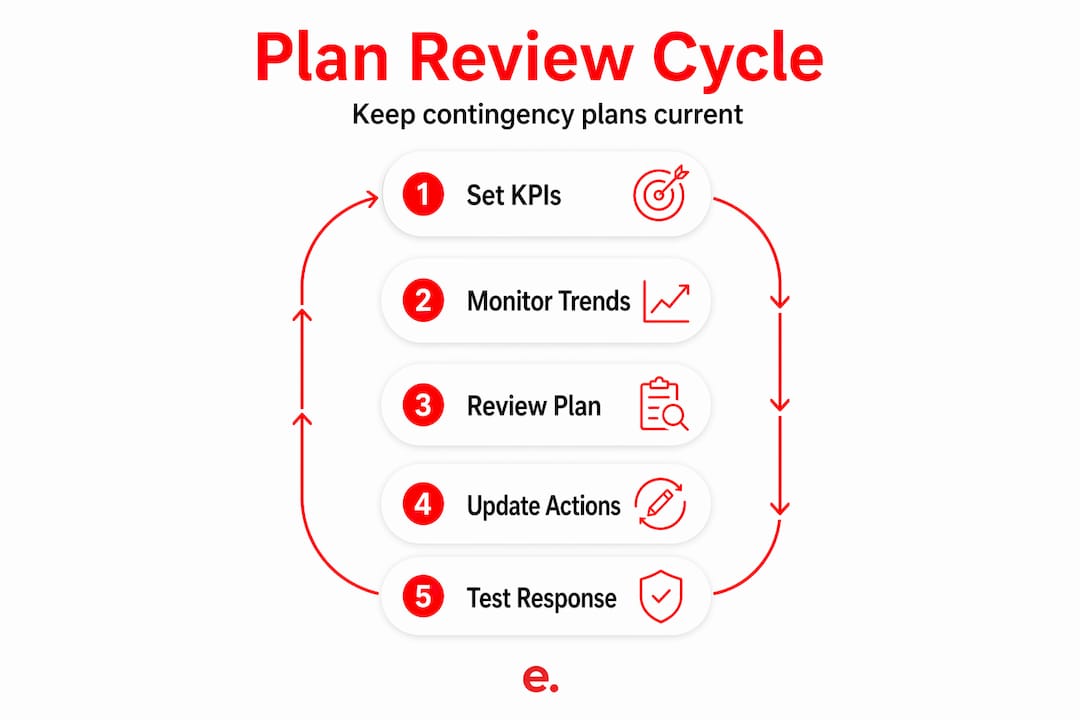
Pro Tip: Set a recurring calendar reminder every quarter to review your offshore KPIs alongside your contingency plan. If any metric is trending in the wrong direction, treat it as an early warning signal, not just a performance issue.
| KPI | What it measures | Alert threshold |
|---|---|---|
| Sprint velocity trend | Productivity and team stability | Greater than 15% drop over 2 sprints |
| Attrition rate | Retention health and operational fragility | Below 85% annually |
| Async response time | Communication discipline | Greater than 4 hours for critical blockers |
| Incident response time | Crisis management readiness | Greater than 2 hours for P1 issues |
| Defect density | Output quality and ramp-up status | Rising trend over 3 sprints |
Beyond dashboards, your monitoring strategy needs a human layer. Schedule monthly check-ins specifically about team health, not just deliverables. Ask offshore leads about morale, workload balance, and any external factors affecting the team. Geopolitical shifts, local regulatory changes, and infrastructure investments in your offshore city often surface in informal conversations months before they become formal disruptions.
Your adaptation protocol should cover three triggers:
- A KPI crossing a defined alert threshold
- A significant change in the political, regulatory, or infrastructure environment of your offshore location
- A team size change of more than 25%, either through growth or attrition
Each trigger should prompt a formal plan review, not just a conversation. Document what changed, what the plan change is, and who approved it.
Hybrid workforce models and AI in contingency planning
The traditional binary of onshore versus offshore is dissolving. Workforce strategy now operates across three dimensions: onshore leadership and oversight, offshore execution, and AI-agent augmentation for repeatable tasks. This shift changes how you plan for contingencies.
When an AI agent handles first-pass code review or data processing, losing a single offshore developer has a smaller blast radius. The work partially continues. Planning your offshore workforce strategy to include automation buffers for lower-complexity tasks creates genuine resilience, not just redundancy headcount.
Hybrid models also change the compliance picture. When AI tools process data alongside offshore teams, your contracts and governance frameworks need to address data residency, access controls, and audit trails. These are not afterthoughts. They belong in the contingency plan alongside your staffing and communication protocols. A phased scale-up that introduces AI augmentation gradually allows you to test governance and quality controls before they are load-bearing.
My perspective on what most leaders get wrong
I have spent years watching well-resourced companies build offshore teams that crack under the first real disruption. The pattern is almost always the same.
What I have seen consistently is that leaders treat contingency planning as a document exercise. They write the plan, file it, and consider the risk managed. What they are actually managing is the appearance of risk management. The plan is not the protection. The practiced response is the protection.
The second thing I have noticed is how badly leaders underestimate geopolitical risk until it lands on them. Visa policy changes, sudden currency controls, and local regulatory shifts are not rare. They are a normal feature of operating in multiple jurisdictions. You need to read the political and regulatory news from your offshore locations the same way you read your product metrics.
My strongest recommendation for any business leader building offshore operations: hire for communication independence before hiring for technical skill. The offshore team members who keep operations stable during disruptions are not always the best developers. They are the people who surface problems early, document clearly, and escalate without ego. That quality is not listed on a resume. You have to screen for it deliberately.
Offshore planning is a management skill, not a one-time problem to solve. The leaders who build genuinely resilient global teams are the ones who treat it as a continuous practice, not a project with a completion date.
— Rajkumar
How Remotee helps you build resilient offshore teams
Offshore workforce contingency planning depends on having a hiring and compliance foundation that does not introduce its own risks. Remotee’s Employer of Record service in India handles payroll, compliance, and HR so your contingency plans are not undermined by legal exposure or regulatory gaps. When a disruption hits, the last thing you need is a compliance question slowing your response.
Remotee also structures hiring to support the offshore hiring risk controls your plan requires. That means access to top-tier talent with the communication and documentation practices that contingency-ready teams need, along with the flexibility to scale up or adjust team composition as your risk profile changes. Clients report up to 32% savings on hiring costs alongside the compliance confidence that makes genuine workforce resilience planning possible.
FAQ
What is offshore workforce contingency planning?
Offshore workforce contingency planning is the process of identifying risks to your distributed team’s operations and building documented response protocols to maintain business continuity when disruptions occur, such as attrition, infrastructure failures, or geopolitical events.
How long does it take an offshore team to reach full productivity?
Offshore teams typically reach 60% productivity by month 2 and full operational productivity by month 3, which means contingency timelines must account for this ramp-up period when planning replacements or expansions.
What KPIs should I track for offshore workforce health?
The most reliable KPIs are sprint velocity, defect density, attrition rate, async response time, and incident response time. A drop in sprint velocity greater than 15% over two sprints is a strong early warning signal.
How do exit clauses protect offshore operations?
Contracts with 30 to 90 day exit clauses and paid pilot periods let you exit a vendor relationship that is not performing without leaving your operations exposed during a transition period.
How does AI integration affect offshore contingency planning?
AI-agent augmentation reduces the operational impact of individual offshore team member disruptions by handling repeatable tasks, but it also introduces new governance and compliance requirements that your contingency plan must explicitly address.