Talent Shortlisting Process: A Complete HR Guide
TL;DR:
- A structured talent shortlisting process is essential for selecting the most qualified candidates and reducing bias. Using clear criteria, blind screening, and multiple evaluation methods improves accuracy and shortens hiring times. Targeting a shortlist of three to five candidates within two weeks enhances hiring quality and candidate experience.
The talent shortlisting process is defined as the structured method of narrowing a broad applicant pool down to the most qualified candidates for interview. It sits between resume receipt and interview scheduling, and it determines the quality of every hiring decision that follows. A well-run shortlist applies talent selection criteria consistently, reduces unconscious bias, and gives hiring managers a focused group of candidates worth their time. Done poorly, it wastes recruiter hours, introduces bias, and produces hires that underperform within months.
What is a talent shortlisting process and why does it matter?
Candidate shortlisting is the formal stage in recruitment where recruiters apply predefined criteria to separate qualified applicants from those who do not meet the role’s requirements. The goal is not to find the perfect candidate on paper. The goal is to identify the candidates most likely to succeed in the role and the organization.

Effective selection criteria for shortlisting generally include 6 to 10 items, structured across three tiers: mandatory, preferred, and desirable. Mandatory criteria are non-negotiable. A candidate who does not meet them is removed immediately. Preferred criteria separate strong candidates from average ones. Desirable criteria help rank finalists when the field is close.
This three-tier structure matters because it forces recruiters to think clearly before a single resume arrives. When criteria are vague, shortlisting becomes subjective. When criteria are precise, the process becomes repeatable and defensible.
What are the key criteria used in talent shortlisting?
Strong talent selection criteria cover five categories: technical qualifications, relevant experience, certifications, soft skills, and cultural fit. Each category should map directly to a specific job requirement, not to a general sense of what a “good employee” looks like.
Technical qualifications and certifications are the easiest to verify. Experience is more nuanced. A candidate with five years in a related field may outperform one with ten years in an identical role, depending on the depth and variety of that experience. Soft skills like communication, adaptability, and problem-solving are harder to assess from a resume but critical to long-term performance.
Cultural fit and growth potential are the criteria most often ignored at the shortlisting stage. They should not be. A candidate who meets every technical requirement but cannot collaborate across teams will create friction that costs more than the hire saved.
- Mandatory criteria: Minimum qualifications, required licenses, non-negotiable experience thresholds
- Preferred criteria: Industry-specific knowledge, familiarity with relevant tools or methodologies
- Desirable criteria: Cross-functional experience, leadership potential, language skills
- Soft skills: Communication style, conflict resolution, adaptability under pressure
- Cultural fit: Alignment with team values, work style, and long-term organizational direction
Pro Tip: Write your job description as an outcome document, not a task list. Describe what success looks like in 90 days. A precise job description filters out unsuitable applicants before the shortlisting process even begins, cutting recruiter workload significantly.
How can structured evaluation methods enhance the shortlisting process?
Structured evaluation is the single most effective way to improve shortlist accuracy. Structured methods reduce mis-hires by 30–40% compared to unstructured hiring practices. That figure reflects the difference between a process built on consistent criteria and one built on gut feel.
A structured approach has four core components:
- Predetermined questions. Every candidate answers the same questions in the same order. This creates a direct comparison baseline and removes the variability that comes from conversational interviews.
- Behavioral rubrics. Each question has a defined scoring scale. A score of 1 means the candidate gave no concrete example. A score of 4 means they described a specific situation, action, and measurable result.
- Independent scoring. Each interviewer scores candidates separately before discussing results. Group discussion before scoring produces conformity bias, not consensus.
- Immediate rating. Rate answers immediately after each question, not at the end of the interview. Recency bias causes evaluators to overweight the last thing they heard.
Google’s structured interviewing program uses vetted questions and shared behavioral rubrics to score candidates consistently across interviewers. The approach also emphasizes cognitive potential and emergent leadership through hypothetical questions, not just past experience. That shift matters because it identifies candidates who can grow into a role, not just those who have already done it.
Blind screening adds another layer of protection. Removing names, photos, and graduation years from resumes during initial review minimizes unconscious bias and improves fairness. This practice has moved well beyond large organizations. Any recruiter can apply it with basic document editing.
No single evaluation method predicts job performance reliably on its own. Combining structured interviews, skills assessments, and behavioral rubrics achieves predictive validity of 0.60–0.65. Unstructured interviews alone predict performance at r=0.20. Structured interviews alone reach r=0.42. The combination is what produces consistently accurate shortlists.
Pro Tip: Never rely on resumes and a single interview to make a shortlisting decision. Combine at least two evaluation methods. The predictive accuracy gap between one method and three is not marginal. It is the difference between a hire that works and one that does not.
What are common shortlisting mistakes and how to avoid them?
Most shortlisting failures trace back to the same small set of errors. Recognizing them before they happen is the only reliable way to avoid them.
- Vague job descriptions. When the role is not clearly defined, recruiters cannot apply consistent criteria. Every reviewer fills the gap with their own assumptions, and the shortlist reflects personal preference rather than job requirements.
- Over-reliance on resumes. A resume shows what a candidate has done. It does not show how they think, how they work with others, or whether they can handle the specific challenges of this role. Common shortlisting mistakes include treating resume review as a complete evaluation rather than a first filter.
- Unconscious bias without blind screening. Recruiters who review resumes with names, photos, and school names visible make decisions influenced by factors unrelated to job performance. Blind screening is not optional for a fair process.
- Unstructured interviews. Conversational interviews feel natural but produce inconsistent data. Two candidates may give equally strong answers, but the one who interviewed later in the day scores lower because the interviewer was fatigued.
- Shortlists that are too long or too short. A shortlist of 12 candidates wastes interview resources. A shortlist of 1 candidate removes the comparison that makes selection meaningful.
- Homogeneous candidate profiles. Shortlists filled with identical backgrounds produce teams that think alike. Strategic wildcards bring cross-industry experience and unconventional skills that drive innovation.
The fix for most of these errors is the same: define criteria before reviewing applications, apply them consistently, and use structured scoring to document every decision.
What are effective practical steps to implement a talent shortlisting process?
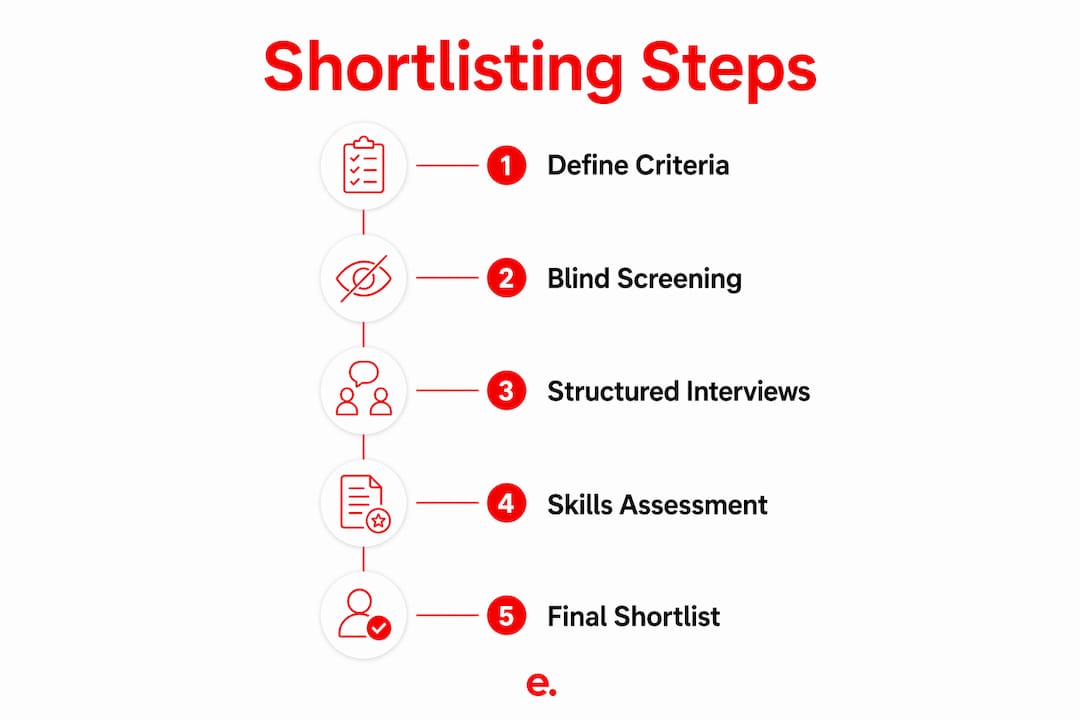
A repeatable shortlisting workflow follows a clear sequence. Skipping steps does not save time. It creates rework later when a poor hire needs to be replaced.
- Define criteria before applications open. Separate must-have criteria from nice-to-have criteria in writing. Share the list with every person involved in the process before a single resume is reviewed.
- Build a candidate scorecard. Create a simple scoring sheet with each criterion listed and a 1–4 rating scale. Every reviewer uses the same sheet for every candidate.
- Apply blind screening to the first review pass. Remove identifying information from resumes before distributing them to reviewers. This step takes minutes and meaningfully reduces bias.
- Use an Applicant Tracking System (ATS) to filter and rank. ATS tools apply keyword and criteria filters at scale, surfacing candidates who meet mandatory requirements and flagging those who do not.
- Target a shortlist of 3 to 5 candidates. Shortlists of 3 to 5 candidates balance thorough evaluation with the practical limits of interview scheduling. Fewer than three removes meaningful comparison. More than five strains hiring manager time.
- Conduct initial phone or video screenings. A 20-minute call confirms basic fit, communication skills, and candidate interest before committing to a full interview. It also gives candidates a chance to ask questions that reveal their priorities.
- Communicate timelines clearly. Tell candidates when they will hear back and stick to that timeline. Slow processes drive dropouts.
The table below shows how to balance candidate types within a shortlist of five.
| Candidate type | Role in the shortlist | Evaluation focus |
|---|---|---|
| Technical fit | Core of the shortlist (2–3 candidates) | Skills, certifications, direct experience |
| High potential | Growth-oriented candidate (1 candidate) | Learning speed, adaptability, trajectory |
| Strategic wildcard | Cross-industry or unconventional profile (1 candidate) | Transferable skills, fresh perspective |
Pro Tip: Cover letters reveal candidate motivation in a way resumes cannot. A candidate who explains why this specific role at this specific organization matters to them is signaling engagement. That signal predicts retention better than most technical criteria.
How does strategic shortlisting impact overall hiring success?
A well-constructed shortlist does more than fill a seat. It shapes the quality of every interview, the speed of the final decision, and the long-term performance of the hire.
Speed is a direct outcome of shortlist quality. When hiring managers receive five well-matched candidates instead of twenty loosely filtered ones, interview preparation improves and decision timelines shrink. Slow processes carry a measurable cost: 57% of candidates drop out of hiring processes that exceed 21 days, according to Talent Board 2025 data. The target window for the full shortlisting process is 10–14 business days.
Strategic shortlisting also supports diversity and long-term organizational health. A shortlist built from identical profiles produces a team with identical blind spots. Including candidates with diverse backgrounds and cross-industry experience introduces perspectives that improve problem-solving and reduce groupthink.
- Recruiter and hiring manager collaboration during shortlisting produces better criteria alignment and fewer post-hire surprises.
- Structured shortlists reduce the time hiring managers spend reviewing unsuitable candidates.
- Clear shortlist documentation creates an audit trail that supports compliance and reduces legal risk.
- A balanced shortlist of technical fits, high-potential candidates, and strategic wildcards gives organizations options rather than a single path forward.
Key Takeaways
A structured talent shortlisting process, built on clear criteria, blind screening, and consistent scoring, is the most reliable way to improve hiring quality and reduce mis-hires.
| Point | Details |
|---|---|
| Define criteria in tiers | Use mandatory, preferred, and desirable categories with 6–10 items total before reviewing any applications. |
| Apply structured evaluation | Predetermined questions and behavioral rubrics reduce mis-hires by 30–40% compared to unstructured methods. |
| Use blind screening | Remove identifying information from resumes during the first review pass to reduce unconscious bias. |
| Target 3–5 candidates | This range balances evaluation depth with interview resource constraints and supports meaningful comparison. |
| Move within 10–14 days | Processes longer than 21 days cause 57% of candidates to drop out; speed and quality must both be managed. |
What I have learned about shortlisting after years in recruitment
The most common mistake I see HR teams make is treating shortlisting as a filtering task rather than a selection strategy. They focus on removing candidates instead of identifying the best ones. Those are not the same activity.
A filtering mindset produces shortlists full of candidates who cleared every hurdle but excite no one. A selection mindset produces shortlists where every candidate has a genuine case for the role. The difference shows up in interview energy, in hiring manager engagement, and ultimately in offer acceptance rates.
The second thing I have learned is that job descriptions do more shortlisting work than most recruiters realize. A vague description attracts a wide, poorly matched pool. A precise, outcome-focused description attracts candidates who already understand what success looks like. By the time applications arrive, the shortlist is half-built.
Technology helps, but it does not replace judgment. ATS tools filter at scale. Structured scorecards create consistency. But the decision to include a strategic wildcard, to look past an unconventional resume, or to weight potential over experience still requires a human call. The best shortlisting processes combine both. They use technology to handle volume and human judgment to handle nuance.
My advice to any recruiter refining their process: score candidates during the interview, not after. Rate each answer before moving to the next question. That single habit eliminates recency bias and produces scores that reflect the full conversation, not just the last five minutes.
— Rajkumar
How Remotee helps HR teams build better shortlists
Shortlisting is only as good as the candidate pool it draws from. When that pool is limited by geography, budget, or hiring infrastructure, even the best process produces mediocre results.
Remotee’s recruitment and staffing services give HR teams access to pre-vetted talent from India, with structured evaluation built into the sourcing process. Remotee manages compliance, payroll, and HR administration through its Employer of Record model, so your team focuses on selecting the right candidate rather than navigating local regulations. Clients report up to 32% savings on hiring costs. For teams looking to apply structured shortlisting to an offshore hiring strategy, Remotee provides the infrastructure to do it at scale without the overhead.
FAQ
What is the talent shortlisting process in recruitment?
The talent shortlisting process is the structured method of narrowing a broad applicant pool to a focused group of qualified candidates for interview. It applies predefined criteria across mandatory, preferred, and desirable categories to produce a comparable, manageable candidate list.
How many candidates should be on a shortlist?
A shortlist of 3 to 5 candidates is the standard recommendation. This range supports thorough comparison without overwhelming interview resources or hiring manager time.
How do structured interviews improve shortlisting accuracy?
Structured interviews use predetermined questions and behavioral rubrics to score candidates consistently. Research shows structured interviews predict job performance at r=0.42, more than double the predictive validity of unstructured interviews at r=0.20.
What is blind screening and why does it matter?
Blind screening removes identifying information such as names, photos, and graduation years from resumes before review. It reduces unconscious bias and improves the fairness of the initial shortlisting pass.
How long should the shortlisting process take?
The full shortlisting process should target 10–14 business days. Processes that exceed 21 days see significantly higher candidate dropout rates, with Talent Board 2025 data showing 57% of candidates withdraw from slow-moving hiring pipelines.