How Offshore Scriptwriters Are Contracted: 2026 Guide

TL;DR:
- Contracting offshore scriptwriters involves clear rights transfer and milestone-based agreements to prevent disputes.
- Legal classification risks and fair compensation are essential considerations in international labor law and streaming industry shifts.
Contracting offshore scriptwriters is defined as the process of establishing legally binding agreements that specify writing services, deliverables, payment terms, intellectual property rights, and compliance with international labor law. How offshore scriptwriters are contracted has grown more complex in 2026, as streaming platforms reshape compensation models and cross-border classification risks multiply. A screenwriter agreement governs all of these elements, protecting both the producer’s creative investment and the writer’s right to fair compensation. Producers who skip any of these layers face disputes over ownership, unpaid taxes, and stalled distribution.
What are the typical contract types and key clauses for offshore scriptwriter agreements?
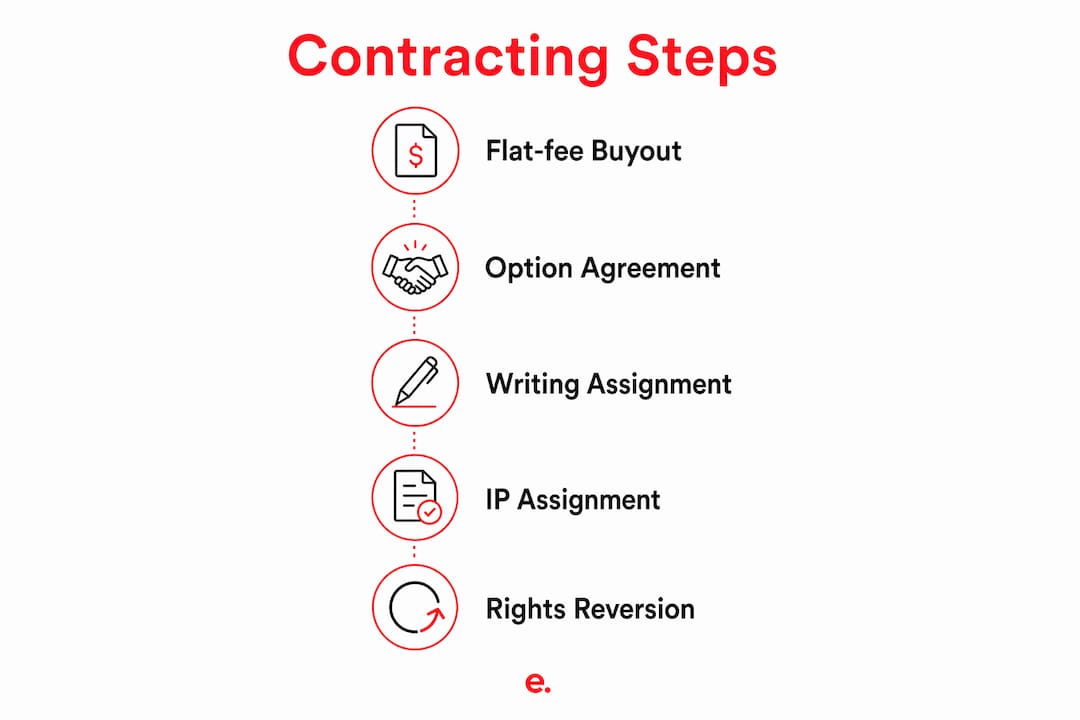
The four contract structures producers use most often are flat-fee buyouts, option agreements, writing assignments, and producer-attached deals. Each structure carries a different risk profile and payment logic. Writing assignments are the most common source of income for working screenwriters, focusing on milestone payments tied to specific deliverables rather than a single lump sum.
A flat-fee buyout transfers all rights to the producer in exchange for one payment. Option agreements give the producer the right to purchase a script within a set window, usually 12–18 months, for a negotiated price. Producer-attached deals tie the writer to a specific production entity and often include backend participation, though streaming platforms have largely eliminated that model.
Every offshore scriptwriter agreement needs these core clauses:
- Deliverables: Treatment, first draft, second draft, and polish. Define page counts and format standards.
- Payment terms: Milestone-based payments tied to each deliverable, not a single upfront sum.
- Timeline: Hard deadlines for each draft with grace periods stated explicitly.
- Credit: Screen credit determination process and arbitration rights if applicable.
- Termination: Producer’s right to terminate and the writer’s right to retain a kill fee.
- Intellectual property: Explicit written assignment of all rights, including moral rights waivers where local law permits.
The intellectual property clause deserves special attention. Proper copyright transfer requires an explicit written assignment. Payment alone does not transfer ownership. A chain-of-title document package is also required for distribution clearance, and producers who skip it face rejection from distributors and errors-and-omissions insurers.
Pro Tip: Add a “rights reversion” clause that returns IP to the writer if the producer fails to commence production within a defined period. This protects the writer and signals good faith, which makes offshore talent more willing to accept lower upfront fees.
| Contract type | Typical deliverables | Payment model | IP transfer |
|---|---|---|---|
| Flat-fee buyout | Full script, revisions | Single payment | Full, immediate |
| Option agreement | Existing script | Option fee plus purchase price | Conditional on exercise |
| Writing assignment | Drafts, rewrites, polish | Milestone payments | Full upon delivery |
| Producer-attached deal | Full script, development work | Fee plus backend | Full, with backend carve-out |
How do international labor and classification laws affect contracting offshore scriptwriters?
Contractor classification is the single most underestimated risk in contracting international writers. Local laws in many countries apply their own tests to determine whether a worker is truly an independent contractor or a de facto employee. The label in your contract does not control the outcome.
Countries with strict classification tests include:
- Germany: Applies a “bogus self-employment” test. A writer working exclusively for one producer over a sustained period is likely reclassified as an employee.
- Poland: Courts look at economic dependence. If the scriptwriter earns the majority of income from one client, employee status is probable.
- Sweden: Prioritizes the nature of the work relationship over the contract label. Regular, directed work triggers employment protections.
- India: The Contract Labour Act and state-level shops-and-establishments laws can impose employer obligations on production companies engaging long-term contractors.
Misclassification carries real costs. Producers can face back taxes, mandatory benefits payments, pension contributions, and statutory severance. These liabilities can exceed the original contract value on a multi-episode project.
Contractor of Record providers operate in 150 or more countries and absorb the classification risk by becoming the legal employer of record. They handle locale-specific onboarding, compliant contracts, and payment processing. This model is now the standard approach for producers working with writers in high-risk jurisdictions.
Pro Tip: Before signing any offshore scriptwriter agreement, have local counsel in the writer’s country review the contract. A $500 legal review can prevent a $50,000 misclassification penalty.
The offshore staffing risk checklist published by Remotee covers classification exposure across the most common offshore hiring markets and is worth reviewing before you finalize any international writing contract.
What practical steps and best practices ensure effective contracting with offshore scriptwriters?
The scriptwriting outsourcing process works best when producers treat the contract as a project management tool, not just a legal formality. Every ambiguity in the contract becomes a dispute later. Contractual ambiguity over deliverables and scope is the leading cause of legal disputes in screenwriter agreements.

Start with an NDA before sharing any creative materials. A jurisdiction-specific NDA signed before idea sharing provides stronger IP protection than relying on employment contract clauses alone. This is especially true for unproduced concepts, which are the hardest category of IP to protect across borders.
Follow this checklist when managing offshore scriptwriter contracts:
- Sign a standalone NDA before sharing any brief, treatment, or story concept.
- Define each deliverable with a page count, format, and deadline.
- Use milestone-based payments tied to delivery and approval of each draft.
- Include an escrow or payment protection mechanism, particularly for writers in countries with limited legal recourse.
- Specify the revision limit per draft. Three rounds is the industry standard for a writing assignment.
- State the governing law and dispute resolution jurisdiction explicitly. Arbitration in a neutral jurisdiction is preferable to litigation.
- Include a termination clause with a kill fee schedule. A common structure is 25% of the remaining fee upon termination after first draft delivery.
- Require the writer to provide a warranty that the work is original and does not infringe third-party rights.
Pre-vetting writers before contracting reduces risk significantly. Platforms that offer skill verification badges and escrow payment protection give producers a structured way to assess quality before committing to a full contract. The offshore developer vetting process outlined by Remotee applies directly to creative talent and provides a repeatable framework for qualification.
Pro Tip: Build a two-stage payment hold into your escrow arrangement. Release 50% on first draft delivery and 50% on final approval. This keeps both parties motivated through the revision process without creating cash flow problems for the writer.
For producers managing multiple offshore writers across different countries, payroll and compliance solutions that handle multi-jurisdiction contractor payments reduce administrative burden and keep payment records audit-ready.
How do 2026 streaming platform practices affect offshore scriptwriter compensation?
Streaming platforms have fundamentally changed how scriptwriters are paid, and those changes flow directly into offshore scriptwriter agreements. Flat-fee buyout contracts now pay 100% to 145% of initial script fees and eliminate residuals entirely. This shift transfers long-term value away from writers and concentrates it with the platform.
“Streaming platforms’ contracts often pay a single buyout amount, detaching long-term value from creators and undermining the residual income streams historically guaranteed by guild agreements. For offshore scriptwriters without guild protection, this model is the default, not the exception.”
WGA minimums set a useful benchmark even for non-guild offshore contracts. WGA minimums for original screenplays start at $77,495 for low-budget productions and $145,469 for high-budget productions. Offshore writers typically earn below these figures, but producers who use WGA rates as a floor build goodwill and reduce turnover on long-form projects.
| Project type | Typical fee range | Payment model | Residuals |
|---|---|---|---|
| Streaming feature (low-budget) | $20,000–$60,000 | Flat-fee buyout | None |
| Streaming feature (high-budget) | $60,000–$145,000 | Flat-fee buyout | None |
| TV pilot (streaming) | $15,000–$40,000 | Milestone payments | None |
| Independent film | $5,000–$25,000 | Milestone payments | Negotiable |
| Corporate or branded content | $1,500–$8,000 | Per-project flat fee | None |
The elimination of residuals shifts bargaining power toward producers. Offshore writers, who rarely have guild representation, are particularly exposed. Producers who recognize this and build fair compensation into their contracts attract better talent and face fewer mid-project disputes. The offshore creative talent hiring guide covers how to structure compensation packages that remain competitive without exceeding production budgets.
Key Takeaways
Contracting offshore scriptwriters requires explicit written rights assignments, milestone-based payment structures, jurisdiction-specific compliance review, and a standalone NDA signed before any creative materials are shared.
| Point | Details |
|---|---|
| Written IP assignment is mandatory | Payment alone does not transfer copyright; a chain-of-title document is required for distribution. |
| Classification risk is real | Countries like Germany, Poland, and Sweden may reclassify contractors as employees regardless of contract labels. |
| WGA minimums are a useful benchmark | Even for non-guild offshore contracts, WGA rates ($77,495–$145,469) set a credible compensation floor. |
| NDAs must precede creative sharing | A jurisdiction-specific NDA signed before idea sharing provides stronger protection than contract clauses alone. |
| Flat-fee buyouts now dominate streaming | Offshore writers rarely receive residuals; producers should account for this when negotiating upfront fees. |
What I’ve learned from watching offshore scriptwriter deals go wrong
The contracts that blow up are almost never missing a clause. They fail because the language is vague. I’ve seen producers hand a writer a two-page “letter of agreement” for a six-episode series and then spend eight months in email arguments about what “final draft” actually means. The contract said “final draft.” It did not say how many revision rounds that included, who had approval authority, or what happened if the producer changed the creative direction entirely.
The IP issue is the other recurring disaster. Producers assume that because they paid, they own the script. That assumption is wrong in most common law jurisdictions and actively dangerous in civil law countries. The chain-of-title requirement is not a formality. Distributors and errors-and-omissions insurers will ask for it, and if you cannot produce it, your film does not get sold.
The streaming buyout model has made things harder for offshore writers in a way that producers do not always acknowledge. When you eliminate residuals and pay a flat fee, you are asking the writer to accept all the downside risk of a project that underperforms and none of the upside if it becomes a hit. That is a legitimate business decision, but producers who pretend it is neutral are not being honest with themselves or their writers. Fair contracts attract writers who stay engaged through the hard revision rounds. Exploitative contracts attract writers who deliver the minimum and move on.
My practical advice: use a Contractor of Record service for any offshore writer in a jurisdiction where you are not certain of the classification rules. The cost is modest. The alternative, a misclassification audit two years after the project wraps, is not.
— Rajkumar
Remotee simplifies compliant offshore scriptwriter hiring
Producers who want to hire offshore scriptwriters without building a compliance infrastructure from scratch have a direct path through Remotee.

Remotee’s Employer of Record service handles contracts, payroll, IP documentation, and onboarding across multiple countries, including India, where a large pool of experienced English-language scriptwriters is available. Clients report up to 32% savings on hiring costs compared to traditional recruitment approaches. Remotee presents only pre-vetted candidates, so producers spend time on creative decisions rather than compliance paperwork. For productions that need to move fast and stay legally protected, Remotee’s offshore hiring service is built for exactly that situation.
FAQ
What is a scriptwriter agreement?
A scriptwriter agreement is a contract that governs writing services, deliverables, payment, and the transfer of screenplay rights between a writer and a producer. It covers drafts, revision rounds, deadlines, credit, and IP ownership.
Does paying a scriptwriter automatically transfer copyright?
No. Copyright transfer requires an explicit written assignment. Payment or possession of the script does not transfer ownership under most national copyright laws.
What is the risk of misclassifying an offshore scriptwriter as a contractor?
Misclassification can trigger back taxes, mandatory benefits obligations, and statutory penalties in the writer’s country. Countries like Germany and Sweden apply strict tests that can override the contract label entirely.
How do WGA minimums apply to offshore scriptwriter contracts?
WGA minimums ($77,495 for low-budget and $145,469 for high-budget original screenplays) apply directly only to WGA signatory productions. For non-guild offshore contracts, they serve as a widely recognized industry benchmark for fair compensation.
When should a producer sign an NDA with an offshore scriptwriter?
A standalone NDA should be signed before sharing any creative brief, story concept, or treatment. This provides stronger IP protection than relying on confidentiality clauses inside the main writing agreement.