Global Talent Acquisition Best Practices for HR Teams

TL;DR:
- Effective global talent acquisition combines centralized processes, cultural adaptation, AI sourcing, and compliance into a repeatable system. Proper workforce planning ensures regional needs align with business goals, preventing delays and mismatched hires. Speed, flexibility, and integrated governance are essential for successful international recruiting and onboarding.
Global talent acquisition best practices are defined as the structured methods organizations use to source, evaluate, hire, and retain top candidates across multiple countries while balancing consistency with local adaptation. The most effective international hiring strategies combine centralized data management, cultural localization, compliance governance, and AI-powered technology into a single repeatable system. Platforms like iCIMS and AI-driven recruiting tools have made it possible to track metrics like time-to-fill and cost-per-hire by geography, giving HR teams the precision they need to compete for talent worldwide. This guide breaks down each practice so you can build a global workforce strategy that actually scales.
1. Global talent acquisition best practices start with workforce alignment
Before you post a single job description, you need to know exactly what your business requires from each region. Workforce planning that skips this step produces mismatched hires, bloated budgets, and slow ramp-up times.

Start by mapping talent demand against your strategic objectives for the next 12–24 months. Which markets need senior engineers? Where do you need customer-facing roles that require native language fluency? Answering these questions before you open a requisition saves weeks of wasted effort.
Auditing hiring metrics by geography, specifically time-to-fill and cost-per-hire by location, reveals where your recruiting engine is underperforming. A region with a 90-day average time-to-fill signals either a sourcing gap or a broken interview process, not a talent shortage.
- Define headcount needs by region and function based on revenue targets and product roadmaps.
- Audit current hiring metrics across each geography to identify bottlenecks.
- Build a 12-month global workforce plan that anticipates attrition, expansion, and skill gaps.
- Assign regional recruiting owners who report into a centralized global TA function.
Pro Tip: Use a shared workforce planning dashboard in tools like Workday or Greenhouse so regional HR leads and global TA leaders see the same data in real time. Misaligned headcount plans are the single biggest cause of delayed hiring cycles.
2. Standardize your hiring process without ignoring local realities
A centralized recruitment framework is the backbone of any scalable international hiring strategy. Without it, each regional team invents its own process, and you end up with inconsistent candidate experiences, legal exposure, and data you cannot compare across markets.
Standardizing interview rubrics, scorecards, and onboarding checklists reduces regional workflow chaos and the operational risk that comes from disconnected processes. Every hiring manager in every country should evaluate candidates against the same competency framework, even if the interview language differs.
That said, local customization is not optional. Labor laws in Germany, India, and Brazil are fundamentally different. Your global framework must include built-in flexibility for local legal requirements, notice periods, and statutory benefits.
| Element | Global standard | Local adaptation |
|---|---|---|
| Interview rubric | Competency-based scoring | Language and format adjusted by region |
| Job description | Core role requirements | Salary framing and benefits localized |
| Onboarding checklist | Day 1 to Day 90 milestones | Timezone-friendly scheduling and documentation |
| Compliance review | Standard governance policy | Country-specific labor law requirements |
| ATS workflow | Unified pipeline stages | Regional requisition approval chains |
Pro Tip: Run a quarterly process audit with your regional TA leads. Ask them to flag every step where they deviate from the global standard. Those deviations are either legitimate local needs or process failures. You need to know which is which.
3. Build cultural competence into every stage of recruiting
Localization is not a nice-to-have feature in global recruitment. Adapting recruitment messaging and your employer value proposition to local norms prevents both ineffectiveness and cultural offense. What reads as confident and direct in the United States can come across as arrogant in Japan or the Netherlands.
Cultural competence in recruiting covers several dimensions:
- Employer branding: Adjust your EVP messaging by market. Candidates in India often prioritize career growth and learning opportunities. Candidates in Scandinavia weight work-life balance and social responsibility more heavily.
- Salary framing: In some markets, publishing a salary range increases application volume significantly. In others, it creates negotiation friction. Know the norm before you post.
- Interview style: Structured behavioral interviews work well in North America and Western Europe. In some Asian markets, candidates expect more relationship-building conversation before diving into competency questions.
- Communication cadence: Candidates in competitive markets like Singapore or Germany expect fast, clear communication. Silence after an interview is interpreted as rejection. Speed matters.
Localized recruitment marketing also means translating job postings into local languages, using region-specific job boards, and featuring employees from that market in your employer brand content. Generic global campaigns consistently underperform localized ones.
4. Leverage AI and analytics to sharpen global sourcing
AI-powered recruiting technology is the most significant shift in global talent acquisition over the past three years. AI-powered candidate matching and resume screening accelerate the interview funnel and improve sourcing quality at a scale no human team can replicate manually.
The practical impact is measurable. Teams using AI screening tools reduce time-to-first-interview by eliminating the manual review of unqualified applications. That time savings compounds across hundreds of open roles in multiple countries.
Beyond sourcing, analytics give you the visibility to improve continuously:
- Time-to-hire by country: Identifies where your process slows down.
- Cost-per-hire by region: Reveals where your sourcing channels are inefficient.
- Offer acceptance rate: A low rate signals a compensation or candidate experience problem.
- Engagement scores by location: Flags onboarding and culture fit issues before they become attrition.
Centralizing this data into a single platform, rather than leaving it fragmented across regional HR systems, creates a single source of truth for your global TA function. Tools like iCIMS, Lever, and Workday Recruiting all support multi-country data consolidation. The role of HR in offshore hiring increasingly depends on this kind of data infrastructure to make defensible decisions.
5. Build proactive talent pipelines before you need them
Reactive hiring is expensive hiring. Leading companies build candidate databases proactively through networking, referral programs, and talent communities before a role opens. This approach cuts time-to-hire and gives you access to passive candidates who never respond to job postings.
A proactive pipeline strategy works differently by region. In India, employee referral programs consistently produce high-quality candidates because professional networks are dense and trust-based. In Eastern Europe, developer communities on GitHub and Stack Overflow are more productive sourcing channels than traditional job boards.
The payoff is significant. When a critical role opens, a warm pipeline means you are scheduling interviews within days, not weeks. Speed in communication and decision-making is a direct competitive advantage because top candidates in any market typically hold multiple offers simultaneously.
Referral programs, alumni networks, and talent community newsletters are low-cost ways to keep candidates engaged between active hiring cycles. Treat your talent pipeline as a long-term asset, not a short-term sourcing tactic.
6. Prioritize compliance and governance across every market
Multi-country labor law is the area where global hiring most often goes wrong. Misclassifying a worker as a contractor in Brazil or failing to register as an employer in Germany can result in fines, back taxes, and reputational damage that takes years to recover from.
Integrating HR, payroll, and finance with clear governance policies is the structural requirement for long-term international expansion. This is not a one-time setup task. Labor laws change, and your compliance framework must change with them.
- Map the legal requirements for each country where you hire: employment contracts, statutory benefits, termination rules, and worker classification standards.
- Embed compliance checkpoints into your ATS workflow so no offer letter goes out without a legal review.
- Standardize payroll inputs across regions to reduce errors and audit exposure.
- Align HR, legal, and finance on a shared governance calendar that tracks regulatory changes by country.
Compliance in international hiring is not just about avoiding penalties. It is also a candidate experience issue. Candidates who receive incorrect contracts or delayed payroll lose trust in your organization before they have even started their first week.
7. Design onboarding that works across time zones
Onboarding is where global hiring either delivers on its promise or falls apart. Structured global onboarding with timezone-friendly support, detailed documentation, and onboarding buddies drives faster ramp-up and improves retention, especially for remote hires.
The failure mode is treating onboarding as a paperwork exercise. A new hire in Manila who receives a 40-page PDF and a calendar invite for a kickoff call at 2 AM local time is not being onboarded. They are being set up to disengage.
Effective global onboarding has three non-negotiable elements. First, all documentation must be available asynchronously so new hires can complete it on their schedule. Second, every new hire needs a local or regional buddy who can answer informal questions that never make it into the official handbook. Third, the first 30 days must include structured check-ins with both the direct manager and HR to catch problems early.
The offshore staffing risk mitigation dimension of onboarding is often overlooked. A poor onboarding experience for an offshore hire does not just affect that individual. It affects your employer brand in that market and your ability to hire there again.
Key takeaways
The most effective global talent acquisition strategy combines centralized process standards, localized cultural adaptation, AI-powered sourcing, proactive pipeline building, and embedded compliance governance into one repeatable system.
| Point | Details |
|---|---|
| Align workforce planning first | Map regional talent needs against business objectives before opening any requisition. |
| Standardize with local flexibility | Use global rubrics and scorecards while adapting for local labor laws and cultural norms. |
| Localize your employer brand | Adjust EVP messaging, salary framing, and interview style by market to improve conversion. |
| Use AI and centralized analytics | Track time-to-hire and cost-per-hire by region to identify bottlenecks and improve continuously. |
| Embed compliance into workflows | Integrate HR, payroll, and finance governance to prevent legal exposure across every market. |
What I have learned about global hiring that most guides get wrong
Most articles on international hiring treat compliance and culture as separate workstreams. In practice, they are deeply connected, and ignoring that connection is where most global TA programs stall.
I have seen well-funded companies build beautiful global hiring frameworks that collapse the moment they enter a new market. The reason is almost always the same: they standardized the process but not the thinking. They gave regional teams a scorecard but no context for why cultural adaptation matters at the competency level, not just the messaging level.
The other thing most guides understate is speed. In competitive markets like Bangalore, Singapore, or Warsaw, a five-day delay between final interview and offer is enough to lose a candidate. The fastest hiring processes win. That is not a soft observation. It is a hard operational fact that top candidates receive multiple offers simultaneously and make decisions quickly.
My honest advice: treat your global TA function like a product team. Run retrospectives after every hiring cycle. Measure what broke. Fix it before the next cycle. The organizations that do this consistently outperform those that treat hiring as a one-time project.
— Rajkumar
How Remotee makes global hiring simpler and faster
Applying these best practices across multiple countries is complex work. Remotee removes the hardest parts.
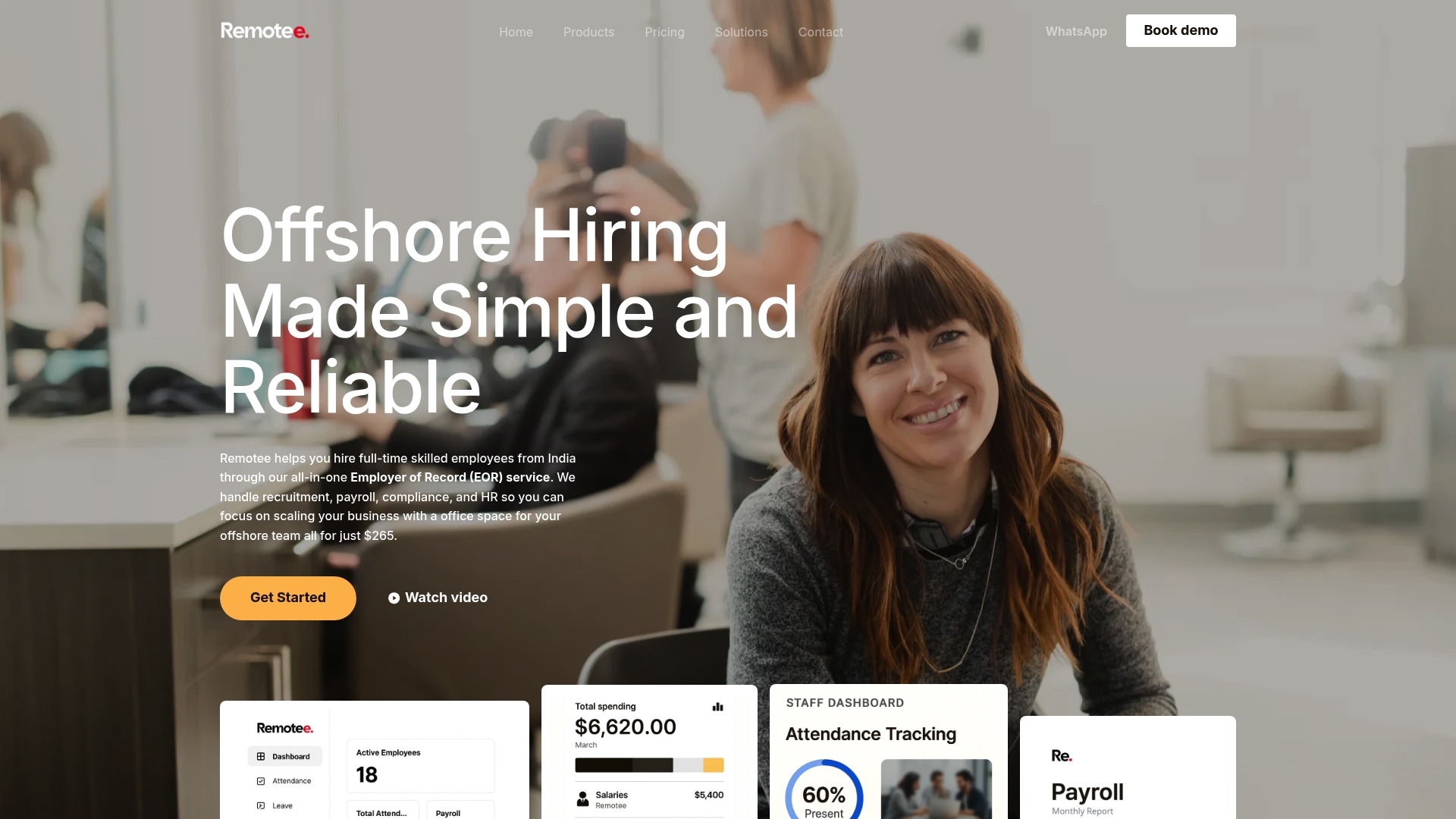
Remotee’s Employer of Record service in India handles employment contracts, statutory compliance, payroll processing, and HR administration so your team can focus on finding the right people. Clients report up to 32% savings on hiring costs compared to traditional recruitment models. For companies scaling offshore hiring without the overhead of a local legal entity, Remotee provides the governance infrastructure that makes it safe and repeatable. If you are ready to build a global team without the compliance risk, Remotee is built for exactly that.
FAQ
What is a global talent acquisition strategy?
A global talent acquisition strategy is a structured plan for sourcing, hiring, and retaining employees across multiple countries. It combines workforce planning, localized recruiting, compliance governance, and technology into a repeatable system.
How do you attract top talent internationally?
Attracting global talent requires localizing your employer value proposition, using region-specific job boards and referral programs, and moving quickly from interview to offer. Speed and cultural relevance are the two biggest differentiators in competitive markets.
What metrics should HR track in global recruitment?
The most important metrics are time-to-fill, cost-per-hire, offer acceptance rate, and new hire retention rate, all tracked by country or region. Auditing these metrics by geography reveals where your process needs improvement.
Why is compliance critical in international hiring?
Misclassifying workers or failing to meet local labor law requirements can result in fines, back taxes, and reputational damage. Embedding compliance checkpoints into your ATS workflow and aligning HR, legal, and finance prevents these risks before they occur.
How does AI improve global talent sourcing?
AI-powered candidate matching and resume screening reduce manual workload and accelerate the interview funnel. This allows global TA teams to process more applications across more markets without proportionally increasing headcount.