Why Offshore Staffing Improves Scalability for Growing Businesses
TL;DR:
- Offshore staffing enhances scalability by providing flexible, cost-effective full-time teams that integrate seamlessly into operations. It enables rapid addition of specialized roles, supports round-the-clock productivity, and reduces communication overhead with proper governance. Successful models require strategic planning, structured onboarding, and disciplined management to avoid common pitfalls and maximize long-term resilience.
Scaling a business is not simply about hiring more people. It is about building a workforce model that grows with you without breaking under pressure. That is precisely why offshore staffing improves scalability in ways that traditional hiring simply cannot match. Most leaders still confuse offshore staffing with outsourcing work to a vendor and losing control of the output. The reality is the opposite. Done right, offshore staffing gives you a fully integrated team that extends your operations, expands your capacity, and does so at a fraction of the cost of building locally.
Table of Contents
- Key takeaways
- Why offshore staffing improves scalability more than local hiring
- How offshore staffing enhances operational capacity
- Governance strategies that protect your scalability
- Comparing offshore staffing models for scaling
- Building your scalable offshore staffing model step by step
- My take on what actually separates successful offshore scaling from expensive mistakes
- Scale faster with Remotee’s offshore hiring solutions
- FAQ
Key takeaways
| Point | Details |
|---|---|
| Scalability requires workforce flexibility | Offshore staffing lets you add or reduce headcount fast without the overhead of domestic hiring cycles. |
| Cost savings enable reinvestment | Labor cost savings of 45–70% free up capital to fund growth initiatives rather than payroll. |
| Governance is non-negotiable | Without clear oversight structures, rapid offshore scaling leads to technical debt and project fragmentation. |
| Model choice shapes outcomes | Direct hire, agency, and BOT models each suit different stages of growth and levels of needed control. |
| Offshore is a strategic pillar | Leading companies treat offshore staffing as core to operational resilience, not just a cost-cutting measure. |
Why offshore staffing improves scalability more than local hiring
Scalability in staffing means your team structure can grow or contract in response to business demand without creating operational chaos. Most companies discover their limits the hard way: a new contract lands, a product launch accelerates, or a seasonal spike hits, and suddenly the hiring process becomes the bottleneck.
Local hiring is slow, expensive, and often inflexible. A typical senior hire in the US or UK takes 60 to 90 days from job post to start date. During that window, your existing team absorbs the gap, quality dips, and delivery timelines slip.
Offshore staffing for growth solves this through pre-built talent pipelines, lower cost-per-hire, and a workforce model designed for fluctuation. Consider what scalability actually requires:
- The ability to add specialized roles quickly without a 90-day runway
- Cost structures that do not collapse margins when headcount doubles
- Systems and processes that hold together across distributed teams
- Continuity of knowledge when business conditions shift
Companies that build scalable offshore staffing models address all four simultaneously. They are not outsourcing a project. They are expanding their permanent capacity through a different geography.
Pro Tip: Before you hire offshore, map the specific roles that create bottlenecks in your current growth plans. Offshore staffing delivers the most scalability value in high-volume, process-dependent, or skills-scarce functions.
How offshore staffing enhances operational capacity
The mechanics of why offshore staffing improves scalability come down to six specific advantages that compound over time.
-
Full team integration. Offshore hires under an Employer of Record model work exclusively for your business. They attend your standups, use your tools, follow your processes, and report to your managers. This is not a vendor relationship. It is an employment relationship, which means loyalty, institutional knowledge, and long-term alignment.
-
Labor cost savings that fund growth. Offshore staffing delivers 45 to 70% savings on labor costs compared to equivalent onshore roles. For a team of ten engineers or analysts, that differential pays for a product roadmap, a marketing push, or a new market entry.
-
Access to deep talent pools. Countries like India graduate hundreds of thousands of engineers, accountants, data scientists, and operations specialists annually. For niche skills that are chronically scarce in Western markets, offshore hiring for growth gives you access to candidates who simply are not competing in your local labor pool.
-
24/7 productivity through time zone strategy. Follow-the-sun models mean your offshore team progresses work while your onshore team sleeps. A software bug reported in New York at 6 PM gets worked on in Bangalore through the night and lands in your inbox resolved by 8 AM. That cycle time compression is a genuine competitive advantage.
-
Reduced communication overhead. Many leaders assume offshore teams create more communication friction. The data says otherwise. Communication overhead drops by 30 to 40% after six months with stable, dedicated offshore teams, as workflows mature and trust builds. The key word is stable. Churning vendors creates overhead. Building a dedicated team eliminates it.
-
Rapid workforce flexibility. Offshore workforce for scalability means you can add three engineers in 30 days or scale a customer operations team from five to twenty in a quarter. That flexibility is structurally impossible with domestic hiring in most markets.
Companies that use global staffing also report 15% fewer defects and 23% higher customer satisfaction scores, which points to a quality benefit that most cost-focused conversations miss entirely.
Governance strategies that protect your scalability

Here is where most offshore expansion efforts fail. Leaders invest in the talent side and neglect the management architecture. Rapid scaling without governance leads directly to architecture drift, technical debt, and rising coordination costs that eventually erase the efficiency gains.
The answer is not to slow down. It is to build the right operational structure before you scale, not after.
The hub-and-spoke model works consistently well. Your onshore leadership team acts as the hub: setting priorities, owning the roadmap, managing stakeholder relationships, and maintaining quality standards. Your offshore teams are the spokes: executing with autonomy within clearly defined lanes. Hybrid operational models that combine internal leadership with external scalable execution improve both resilience and responsiveness during demand spikes.
Key governance practices that actually hold up in practice:
- Backlog hygiene. Every offshore team member should know exactly what they are working on, why it matters, and what comes next. Ambiguous backlogs create idle time and misaligned output.
- Clear ownership boundaries. Define who makes decisions at every tier. Offshore teams should not be waiting on approvals that could be delegated locally.
- Structured onboarding. Cultural alignment and process fluency take intentional effort. Companies that invest two to three weeks in onboarding offshore hires see significantly lower turnover and faster productivity curves.
- Technology as the connective tissue. Project management platforms, async communication tools, and shared documentation reduce dependency on synchronous meetings. You can explore remote collaboration tools to build a stack that supports distributed teams without excessive meeting overhead.
Pro Tip: Assign a dedicated onshore liaison for every offshore team of five or more people. This person is not a manager in the traditional sense. They are a context translator, removing blockers and ensuring priorities stay aligned in real time.
High-performance offshore teams integrate into financial and operational workflows to boost reporting, decision-making, and capacity without increasing risk. The prerequisite is structured roles and clean oversight systems, not proximity.
Comparing offshore staffing models for scaling
Not all offshore arrangements are built for the same kind of growth. Choosing the right model shapes how fast you can scale, how much control you retain, and what your management overhead looks like.
| Model | Control | Speed to deploy | Cost | Best for |
|---|---|---|---|---|
| Direct hire (via EOR) | High | Moderate (2–6 weeks) | Low ongoing | Long-term team integration |
| Agency/partner model | Moderate | Fast (1–2 weeks) | Moderate | Short-term surges or specialized projects |
| Build-Operate-Transfer (BOT) | Very high | Slow (3–6 months) | High setup, low long-term | Large-scale offshore captive centers |
| Multi-location follow-the-sun | High | Moderate | Varies | 24/7 operations and global coverage |
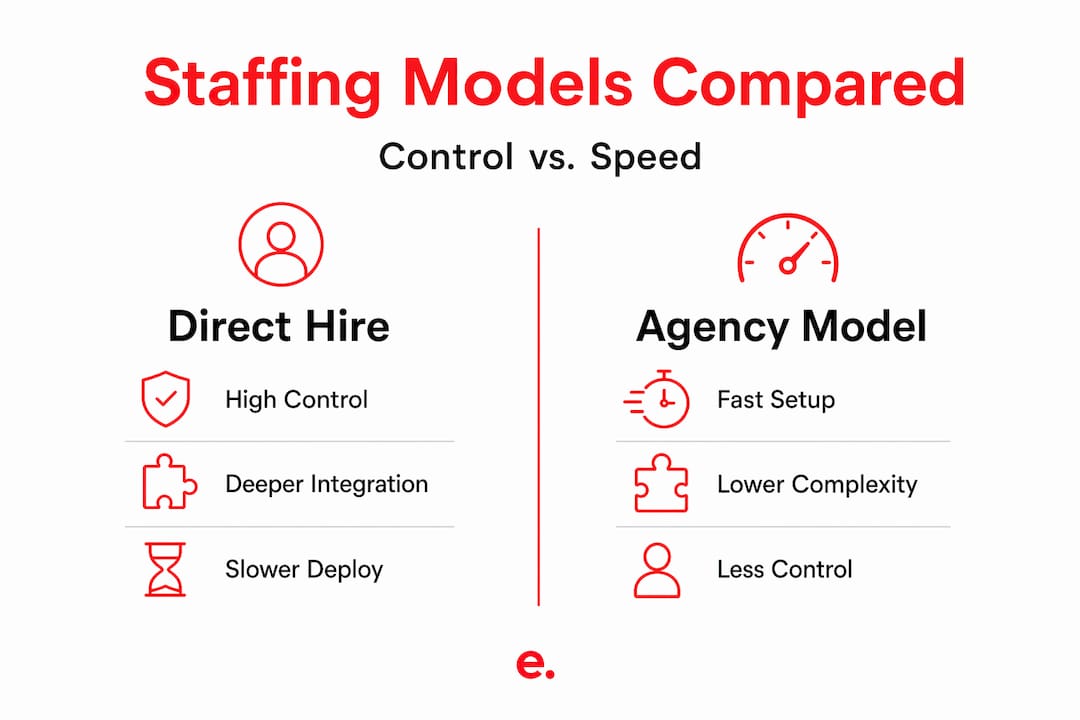
Direct hire offshore models offer deeper integration and control at the cost of higher setup complexity. Agency models deploy faster but create dependency on third-party management layers. For most scaling businesses, the direct hire route via an Employer of Record delivers the best combination of speed, control, and cost efficiency.
The BOT model suits companies planning to build a significant offshore presence of 50-plus people over a multi-year horizon. You start with an operator managing the setup, then transfer full ownership once the team matures. It is a long game, but it produces a fully owned offshore operation.
Refer to Remotee’s offshore contract types guide for a practical breakdown of which model fits your specific stage of growth.
Building your scalable offshore staffing model step by step
Knowing why offshore staffing improves scalability is one thing. Getting there requires a structured approach that most organizations skip in their rush to hire.
-
Define your scalability goals first. What does growth actually require from your workforce over the next 12 to 18 months? More engineers? Back-office capacity? Customer support coverage? Clarity on this shapes every subsequent decision.
-
Identify roles suited to offshore staffing. Not every function belongs offshore. Strong candidates include software development, QA, data analysis, finance operations, content, design, and customer support. Roles requiring constant physical presence or highly localized knowledge are poor fits.
-
Build your hiring criteria beyond technical skills. Communication ability, self-direction, and adaptability to async work matter as much as qualifications. Screening for these early reduces turnover and integration friction.
-
Invest in your technology stack before your first hire. Documentation systems, project tracking, communication platforms, and access management should be in place before your offshore team logs in on day one.
-
Plan for compliance from the start. Payroll regulations, tax obligations, data privacy rules, and employment law vary significantly by country. An Employer of Record handles this infrastructure so your legal and finance teams are not learning local labor law on the fly. The cost and compliance factors involved deserve serious analysis before you commit.
-
Measure, iterate, and scale. Set 30, 60, and 90-day performance benchmarks for offshore hires. Track communication quality, output volume, and integration progress. Use that data to refine your model before you multiply it across larger teams.
My take on what actually separates successful offshore scaling from expensive mistakes
I have seen companies get this right and I have watched others spend two years and significant capital trying to unwind poorly built offshore structures. The pattern is consistent.
Leaders who succeed with offshore staffing treat it as a core operational strategy from day one. They assign real onshore leadership attention, build governance early, and view their offshore teams as permanent extensions of the business, not a cost line to manage down.
Leaders who fail treat it as a vendor problem. They hire offshore to reduce headcount costs, assign minimal oversight, and then wonder why quality dips or turnover spikes after twelve months.
What I have learned is that the communication challenge is real, but it is not about time zones or language. It is about management clarity. When offshore teams lack clear priorities, defined ownership, and regular feedback, they drift. That drift costs more than the salary savings gained.
The other mistake I see consistently is underestimating onboarding. Most companies give offshore hires one week of orientation and assume productivity follows. The companies getting the most value from their offshore workforce for scalability invest four to six weeks in structured onboarding, including cultural context, product knowledge, and team relationship building.
Offshore staffing is increasingly viewed by modern leaders as essential for operational resilience. I agree with that framing completely. But resilience is built through discipline, not just headcount.
— Rajkumar
Scale faster with Remotee’s offshore hiring solutions
Improving business scalability offshore starts with getting the hiring and compliance infrastructure right. Remotee exists precisely for this.
Remotee’s Employer of Record service in India handles everything that typically slows offshore expansion: payroll, compliance, HR management, and local employment law. You focus on growth. Remotee handles the operational foundation beneath it. Clients consistently report up to 32% savings on total hiring costs, with access to pre-vetted, top-tier talent across engineering, operations, finance, and more.
If you are ready to build a team that scales with your business rather than behind it, explore offshore hiring with Remotee to see how the process works and what roles fit your current growth stage.
FAQ
Why does offshore staffing improve scalability specifically?
Offshore staffing improves scalability by giving businesses access to large talent pools, lower labor costs, and flexible hiring structures that respond faster to growth demands than domestic recruitment cycles allow.
What is the difference between offshore staffing and outsourcing?
Offshore staffing means hiring full-time employees who work exclusively for your company from another country, while outsourcing typically involves contracting a vendor to deliver a defined output with their own team and management.
How long before offshore teams become productive contributors?
Most offshore hires reach full productivity within 60 to 90 days. Companies that invest in structured four to six week onboarding programs typically see faster integration and significantly lower early-stage turnover.
What roles work best in a scalable offshore staffing model?
Software development, QA, data analysis, finance operations, content production, and customer support consistently perform well offshore due to their process-driven nature and compatibility with async work models.
How do you manage communication overhead with offshore teams?
Communication overhead decreases by 30 to 40% after six months with stable, dedicated offshore teams. The key is investing in clear workflows, async documentation, and consistent onshore liaison roles rather than relying on excessive meetings.