Offshore Developer Vetting Process: A 2026 Guide

TL;DR:
- The offshore developer vetting process involves evaluating communication, technical skills, legal contracts, and paid trials to reduce risks. Proper sequencing, especially legal review before technical assessment, is essential to prevent privacy and IP breaches. A structured paid trial and targeted reference checks provide critical insights into long-term performance and communication behavior.
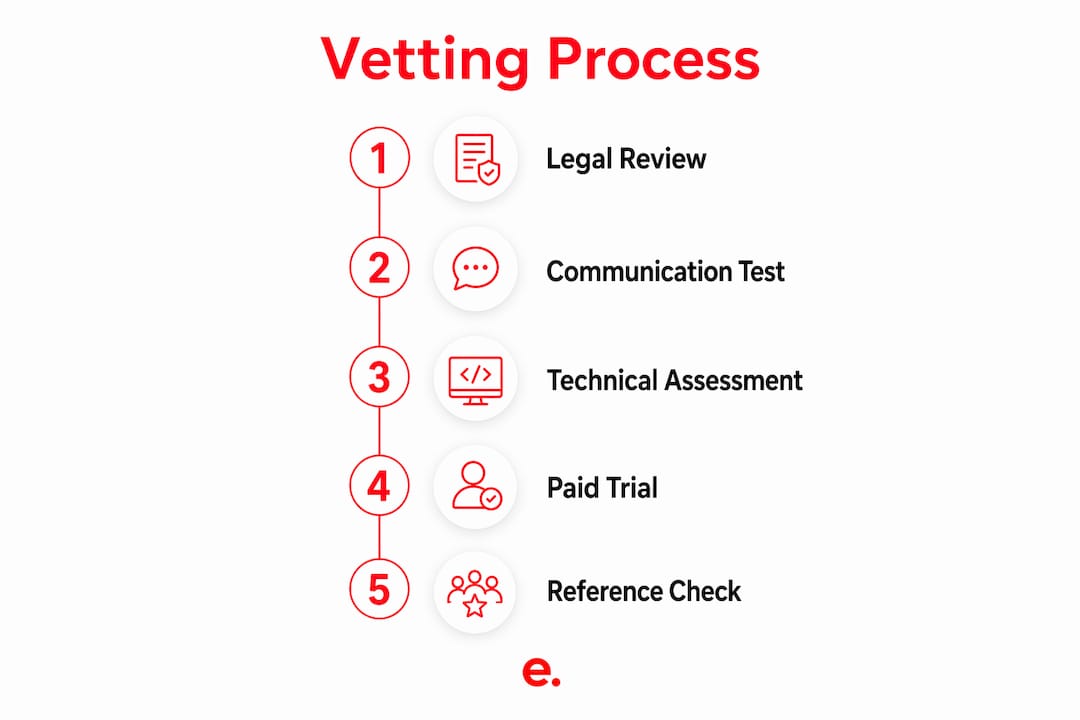
The offshore developer vetting process is a systematic evaluation framework that screens candidates across four stages: communication quality, technical skills, legal contract review, and paid trial performance. Companies that skip or compress any of these stages face predictable outcomes: missed deadlines, IP disputes, and costly re-hires. This guide walks tech entrepreneurs and business leaders through each stage with specific methods, tools, and decision criteria to identify offshore developers who will actually perform in production environments.
How does the offshore developer vetting process work?
The offshore developer vetting process works by filtering candidates through progressively deeper evaluation layers before any long-term commitment is made. Each layer eliminates a different category of risk. Communication screening removes candidates who cannot function in async environments. Technical assessment removes those who lack real engineering ability. Legal review removes vendors whose contracts expose your IP. Paid trials remove candidates who interview well but deliver poorly.

The order matters. Running technical interviews before reviewing contract terms is a common mistake. You may invest hours evaluating a developer only to discover their vendor’s NDA does not cover subcontractors, making every technical detail you shared a potential liability. The offshore talent selection process should treat legal diligence as a gate, not a formality.
Platforms like HackerRank and tools like standard NDA templates are entry points, not complete solutions. The frameworks below show how to use them correctly.
How do you assess communication skills in offshore candidates?
Communication failure is the most common reason offshore engagements collapse, and it rarely shows up in a resume. Async responsiveness is the metric that matters most: how clearly and promptly does a candidate communicate without real-time prompting?
The evaluation criteria to apply during remote developer screening include:
- Written clarity: Can the candidate explain a technical decision in plain English without jargon overload?
- Prompt response: Do they reply within a reasonable window when given an async task?
- Documentation quality: Do they write comments, notes, and handover summaries that a teammate could follow?
- Technical explanation: Can they describe a complex problem to a non-technical stakeholder without losing accuracy?
A practical method is to assign an async coding task that requires a written explanation of the approach. Async coding assessments reveal time management and communication style without the pressure of a live session. Ask candidates to document their reasoning as if handing the work to a colleague. The quality of that documentation tells you more than the code itself.
Communication failures in offshore projects typically follow a pattern: a developer goes silent for two days, resurfaces with a question that should have been asked on day one, and the sprint is lost. Screening for async work ethic before technical skills prevents this.
Pro Tip: Send the async task outside your normal business hours. A candidate who responds thoughtfully the next morning, without prompting, demonstrates the self-management your distributed team needs.
What makes a technical assessment actually predictive?
Generic coding puzzles measure exam skills, not engineering ability. Realistic technical tasks that mirror real development artifacts show a stronger correlation with production success than abstract algorithm tests.
The most effective offshore developer evaluation combines three components:
- Stack-relevant take-home assignment: A task using the actual languages and frameworks in your codebase, completed over 24–48 hours
- Code review exercise: Ask the candidate to review a pull request with intentional bugs and design issues. Their comments reveal how they think about quality.
- Live architecture discussion: A 30-minute conversation about a system design problem. This tests how they communicate trade-offs, not just whether they know the answer.
| Assessment Type | What It Measures | Time Required |
|---|---|---|
| Take-home coding task | Real-world problem solving, code quality | 24–48 hours |
| Pull request review | Code review ability, attention to detail | 1–2 hours |
| Live architecture discussion | System thinking, communication of trade-offs | 30–45 minutes |
| Async documentation review | Writing clarity, technical explanation | 1 hour |
The live architecture discussion is the component most teams skip, and it is the most revealing. A developer who writes clean code but cannot articulate why they chose one database schema over another will struggle when your team needs to make fast decisions under pressure.
Pro Tip: Use a real (anonymized) problem your team has already solved. You already know the right answer, which makes evaluation faster and more objective.
Why does legal due diligence belong early in the vetting process?
Legal review belongs at the start of the offshore vetting process, not at the end. Verify IP and NDA terms before sharing any technical details with a vendor. A legal gap cannot be fixed by a strong technical interview.
The specific contract provisions to check before proceeding:
- IP assignment clause: Confirm that all code, designs, and deliverables transfer to you upon payment. Vague language like “work product” without explicit assignment creates disputes.
- NDA subcontractor coverage: NDAs must explicitly cover subcontractors to prevent leakage down the chain. Offshore vendors frequently use subcontractors without disclosing it.
- Termination and handover obligations: The contract should specify what the vendor delivers upon termination: source code, credentials, documentation, and transition support.
- Scope change process: Confirm how change requests are handled and priced. Ambiguity here is the source of most billing disputes.
- Governing law and jurisdiction: Verify which country’s law governs the contract and where disputes are resolved.
| Contract Element | Risk If Missing | Action Required |
|---|---|---|
| IP assignment clause | You may not own the code you paid for | Require explicit written assignment |
| NDA subcontractor coverage | Sensitive data exposed to unknown third parties | Amend NDA to name subcontractors |
| Termination obligations | No clean handover of assets | Add specific handover checklist to contract |
| Scope change process | Cost overruns and disputes | Define written approval process |
Request the vendor’s standard contract template before any technical discussion begins. Reviewing offshore staffing contract types in advance gives you a clear baseline for negotiation and flags vendors who resist standard IP protections.
How should you run a paid trial with an offshore developer?
A paid trial is the most reliable signal in the entire offshore talent selection process. Paid trials typically run 1–4 weeks and use real but non-critical deliverables to validate fit before a long-term commitment.
The trial works best when you treat it as a structured observation period, not just a code delivery exercise. The deliverable matters less than the process signals it generates.
What to observe during the trial:
- Autonomy: Does the developer work independently, or do they require constant direction?
- Status update quality: Are updates clear, timely, and written for a non-technical reader?
- Blocker handling: When they hit an obstacle, do they flag it early with a proposed solution, or go silent?
- Sync call frequency: How often do they need a live call to unblock themselves? High frequency signals poor async capability.
Process telemetry signals like these are more diagnostic than pass/fail code correctness. A developer who delivers average code but communicates proactively will outperform a brilliant coder who disappears for three days and resurfaces with a question.
Pro Tip: Assign the trial task with intentionally incomplete requirements. Observe whether the developer asks clarifying questions upfront or makes assumptions and builds the wrong thing. The former is the behavior you need.
Pay the developer for the trial at a fair rate. Unpaid trials attract candidates who are desperate, not candidates who are good.
What do reference checks actually reveal about offshore developers?
Reference checks are the most underused tool in vetting offshore teams. Most hiring managers ask generic questions and get generic answers. Structured reference checks focused on communication and problem handling reveal what interviews cannot.
Contact at least 2–3 recent clients or employers, and ask questions in this sequence:
- Describe a situation where the developer missed a deadline or delivered something unexpected. How did they handle it?
- How did they communicate when they were blocked or uncertain?
- Would you hire them again for a remote, async-heavy project? Why or why not?
- Did they work with subcontractors? Were you aware of who had access to your codebase?
- How did they handle scope changes or requirement shifts?
The fourth question is one most hiring managers never ask. It connects directly to your NDA and IP exposure. A reference who pauses before answering it is telling you something important.
Verify employment history and project timelines independently where possible. Use background check best practices to confirm dates and roles before extending an offer. Ongoing vetting does not stop at hire. Build quarterly check-ins into long-term engagements to catch performance drift before it becomes a delivery crisis.
Key takeaways
A thorough offshore developer vetting process requires legal contract review before technical assessment, async communication screening, realistic coding tasks, and a paid trial that measures process behavior as much as code quality.
| Point | Details |
|---|---|
| Legal review comes first | Request the vendor’s contract template before sharing any technical details or project scope. |
| Async communication is a primary filter | Assign a documented coding task outside business hours to reveal real work ethic and writing clarity. |
| Technical tests should mirror real work | Use pull request reviews and architecture discussions, not algorithm puzzles, to predict production performance. |
| Paid trials measure process, not just code | Track autonomy, update quality, and blocker handling during the trial to predict long-term fit. |
| Reference checks need targeted questions | Ask specifically about communication under pressure and subcontractor access to uncover risks interviews miss. |
What i’ve learned from watching offshore hires succeed and fail
Most offshore hiring failures I have seen share one pattern: the legal and communication stages were treated as checkboxes, and the technical assessment was treated as the real evaluation. That is exactly backwards.
The developers who caused the most damage were technically strong. They passed every coding test. What they could not do was communicate a blocker before it became a crisis, or operate without daily hand-holding. Those traits never showed up in a HackerRank score.
The legal piece is where I see the most avoidable risk. Teams share architecture diagrams, database schemas, and API documentation during technical discussions before they have reviewed a single contract clause. By the time they discover the NDA does not cover the vendor’s subcontractors, the sensitive information is already out. Reviewing offshore staffing risk factors before the first technical call costs nothing and prevents a lot.
The paid trial is the one stage I would never skip, even under time pressure. Two weeks of structured observation tells you more than six rounds of interviews. The key is watching process behavior, not just deliverable quality. A developer who flags a blocker on day two with a proposed workaround is worth more than one who delivers clean code on day fourteen after going silent for a week.
One more thing: calibrate your vetting depth to your team’s communication culture. If your team runs on Slack threads and async updates, test for that specifically. A developer who thrives in a synchronous, co-located environment will struggle in yours, regardless of their technical skill level.
— Rajkumar
How Remotee makes offshore hiring faster and lower risk
Building a rigorous vetting framework is the right move. Executing it while managing compliance, payroll, and contracts across borders is where most teams run into friction.
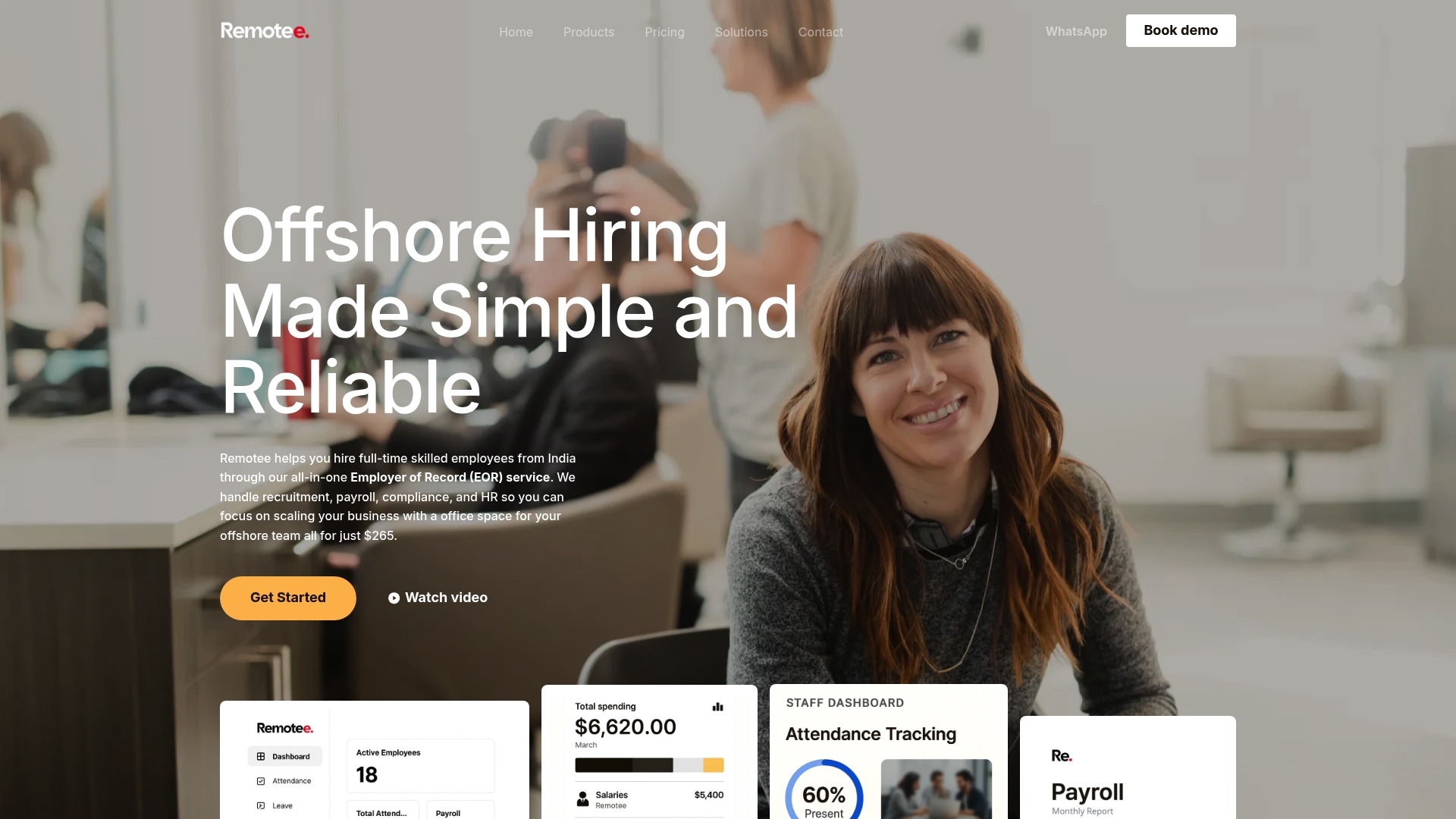
Remotee’s Employer of Record service handles the legal and operational complexity of hiring full-time developers from India, covering compliance, payroll, and HR so your team can focus on evaluation and delivery. Clients report up to 32% savings on hiring costs compared to traditional recruitment. Remotee presents only pre-screened candidates, which means your vetting process starts from a stronger baseline. If you want to build an offshore development team without the administrative overhead, explore Remotee’s offshore hiring solutions to see how the model fits your growth plans.
FAQ
What is the offshore developer vetting process?
The offshore developer vetting process is a structured evaluation framework covering communication screening, technical assessment, legal contract review, and a paid trial. Each stage filters a different category of risk before a long-term commitment is made.
How long should a paid trial with an offshore developer last?
Paid trials typically run 1–4 weeks, using real but non-critical deliverables. The goal is to observe communication patterns, autonomy, and blocker handling, not just code output.
Why must legal review happen before technical interviews?
Sharing technical details before reviewing NDA and IP assignment clauses exposes your codebase and architecture to potential leakage. A legal gap cannot be corrected after sensitive information has already been shared.
How do you assess async communication in remote developer screening?
Assign a documented coding task outside business hours and evaluate the written explanation of the approach. Clarity, promptness, and documentation quality are the primary signals to measure.
How many references should you check for an offshore developer?
Contact at least 2–3 recent clients or employers. Focus questions on how the developer communicated under pressure and how they handled unexpected problems, not just whether they delivered on time.