Why Hire Indian Software Developers: 2026 Guide

TL;DR:
- Hiring Indian software developers provides cost-effective access to large pools of compliant, English-speaking talent. Their 24/7 productivity cycle accelerates product delivery, especially with AI tools enhancing output. Careful vetting and partnership focus ensure high-quality hires and successful offshore collaboration.
Hiring Indian software developers is the single most cost-effective way for US and European companies to access senior engineering talent at scale. Over 62% of US companies already outsource software development to India, drawing from a pool of more than 5 million IT professionals. The reasons go beyond price. Indian developers bring compliance expertise, strong English communication, and a mature delivery culture that supports global product teams. This guide breaks down every major advantage, compares India to other offshore destinations, and gives you a practical framework for getting started.
What are the main benefits of hiring indian software developers?
The benefits of hiring Indian developers are concrete, measurable, and well-documented across industries. Cost savings alone make the case for most companies, but the full picture is more compelling.
- Talent supply at scale. India produces over 1.5 million engineering graduates annually, covering cloud computing, AI, blockchain, and cybersecurity. No other offshore market matches that volume of specialized, English-speaking engineers.
- Cost savings of 40–70%. Outsourcing to Indian developers delivers typical savings of 40–70% compared to US and European labor costs. That gap lets you reinvest directly into product development or go-to-market speed.
- Compliance readiness. Indian developers work regularly with GDPR, HIPAA, SOC 2, and PCI-DSS, building telemedicine platforms, fintech apps, and SaaS products that meet global regulatory standards. This is not a niche skill. It is standard practice across India’s top engineering firms.
- English proficiency. Strong English communication reduces friction on complex projects where stakeholder alignment matters. Misunderstandings that derail offshore projects in other markets are far less common with Indian teams.
- 24/7 productivity cycle. The time zone gap between the US and India is not a problem. It is a structural advantage. Your US team closes out the day, and the Indian team picks up the next sprint item overnight. Releases move faster.
Pro Tip: When evaluating Indian developers, prioritize candidates from firms with active GitHub repositories and documented CI/CD pipelines. Visible output is a stronger signal than certifications alone.
India’s tech ecosystem is mature. Cities like Bengaluru, Hyderabad, and Pune have produced engineering cultures that rival Silicon Valley in depth, if not in cost. That combination of scale, quality, and price is why the Indian software development advantages are difficult to replicate elsewhere.

How does indian developer talent compare to other offshore destinations?
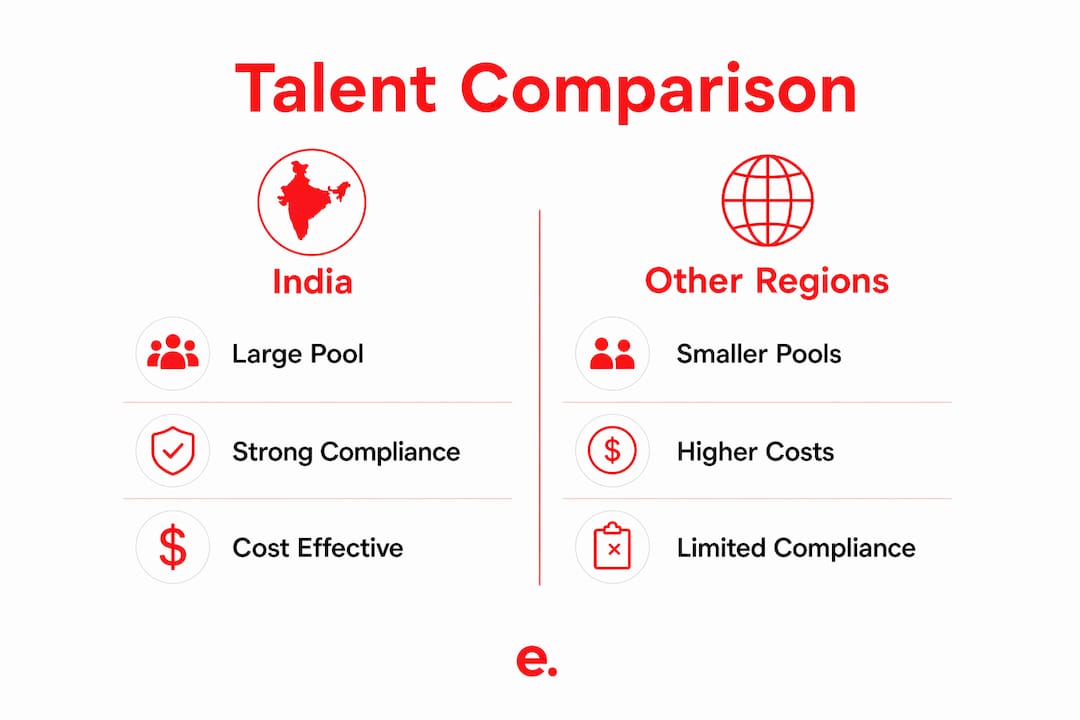
India is not the only offshore option. Vietnam, Eastern Europe, and Latin America each have real strengths. The comparison below shows where India leads and where trade-offs exist.
| Factor | India | Vietnam | Eastern Europe | Latin America |
|---|---|---|---|---|
| Talent pool size | 5 million+ IT professionals | ~500,000 | ~1.2 million | ~700,000 |
| Cost savings vs. US | 40–70% | 35–60% | 20–45% | 25–50% |
| English proficiency | High | Moderate | High | Moderate to High |
| Compliance expertise | GDPR, HIPAA, SOC 2, PCI-DSS | Limited | Strong in EU regulations | Moderate |
| Scalability | Very high | Moderate | Limited by population | Moderate |
| Time zone overlap (US) | Async advantage | Async | Partial overlap | Strong overlap |
Eastern Europe offers strong technical depth, but talent supply is constrained by smaller populations and rising costs post-2022. Latin America suits companies that need real-time overlap with US hours. Vietnam is growing fast but lacks the compliance track record that regulated industries require.
India’s edge is scalability combined with compliance maturity. A fintech startup building a HIPAA-compliant product cannot afford to train an offshore team on regulatory basics. Indian firms already know the requirements. That saves months of onboarding time.
Tier-2 and tier-3 Indian cities like Coimbatore, Indore, and Jaipur offer senior developer talent at 30–50% less than Bengaluru or Mumbai, with comparable quality. Companies that look beyond the major metros get better value without sacrificing output.
Pro Tip: Ask shortlisted Indian vendors which city their engineers are based in. Tier-2 city teams often have lower attrition rates than metro teams, which directly reduces your project continuity risk.
How do indian developers accelerate global software development?
Speed is where the benefits of Indian developers become most visible in day-to-day operations. The mechanism is straightforward: a 24/7 development cycle means your product moves forward while your US team sleeps.
Here is what that looks like in practice:
- A US product manager closes a sprint review at 6 PM EST. The Indian backend team picks up the next batch of tickets at 8 AM IST, roughly 9 PM EST. By the time the US team logs back in, a full overnight cycle of development is complete.
- QA engineers in India run regression tests overnight, so US developers start each morning with a clean test report rather than waiting half a day for results.
- DevOps teams in India handle deployment pipelines and infrastructure monitoring during US off-hours, reducing downtime windows.
AI augmentation has made this even more powerful. Indian developers now produce 2–3x the output of 2023 levels using tools like GitHub Copilot, Claude, and Cursor. That productivity gain does not come with a proportional cost increase. You get more code, more tests, and faster iteration at the same billing rate.
India’s remote-first work culture makes asynchronous collaboration effective. Indian engineers are accustomed to working with distributed teams, using tools like Jira, Confluence, Slack, and Notion without needing process hand-holding. That maturity shortens the ramp-up period significantly compared to markets where remote work is newer.
For startups, this means faster time to market. For enterprises, it means parallel workstreams that compress release cycles. Either way, the output per dollar spent is higher than any comparable offshore market.
What are best practices when you hire software developers in india?
Knowing why to hire Indian software developers is only half the equation. How you hire matters just as much. Variable talent quality is the most common complaint from companies that have had poor offshore experiences, and it is almost always a vetting problem, not an India problem.
Follow these steps to get the engagement right from the start:
- Define the engagement model before you search. India offers three primary structures: fractional hours for part-time needs, dedicated teams for ongoing product development, and project-based contracts for fixed-scope work. Flexible engagement models like fractional engagements are growing fast among startups, while enterprises typically prefer dedicated teams with SLA-backed delivery.
- Vet for output, not credentials. Request GitHub profiles, code samples, and references from prior clients in your industry. A developer with three years of experience building HIPAA-compliant APIs is more valuable than one with a longer resume but no regulated-industry exposure.
- Establish communication rhythms early. Schedule one daily async standup via Loom or Slack, plus one live video call per week for sprint reviews. This structure prevents the drift that kills offshore projects.
- Address compliance before day one. If your product handles health data, financial records, or EU user data, confirm that your Indian partner has documented SOC 2 or HIPAA compliance processes. Remotee’s payroll and compliance services cover the employment law side, but your technical contracts must address data handling separately.
- Plan for continuity. Indian engineering firms maintain bench staffing models, meaning a senior engineer departure causes weeks of disruption rather than the 3–4 months of lost productivity typical in US hiring. Confirm your vendor has a bench before you sign.
- Use an Employer of Record for full-time hires. If you want a dedicated employee rather than a vendor relationship, an EOR handles local employment contracts, payroll, and statutory benefits without requiring you to set up a legal entity in India.
The companies that get the most from offshore hiring in India treat their Indian teams as extensions of their core team, not as external contractors. That mindset shift changes how you onboard, communicate, and retain talent.
Key takeaways
Hiring Indian software developers delivers measurable cost savings, compliance-ready talent, and a 24/7 development cycle that accelerates product delivery for US and global companies.
| Point | Details |
|---|---|
| Cost savings are substantial | Outsourcing to India cuts labor costs by 40–70% compared to US and European markets. |
| Talent supply is unmatched | India produces 1.5 million engineering graduates annually across AI, cloud, and cybersecurity. |
| Compliance expertise is built in | Indian developers regularly build GDPR, HIPAA, SOC 2, and PCI-DSS compliant products. |
| AI tools multiply output | GitHub Copilot and similar tools give Indian developers 2–3x the output of 2023 levels. |
| Engagement model selection matters | Choose between fractional, dedicated, or project-based models based on your scope and timeline. |
What i’ve learned after years of watching offshore hiring succeed and fail
The companies that struggle with Indian developers almost always made the same mistake: they treated the engagement as a transaction rather than a partnership. They sent a spec sheet, expected delivery, and skipped the relationship-building that makes distributed teams actually work.
The companies that succeed do something different. They invest two to three weeks in onboarding, share product context, and include Indian engineers in sprint planning from day one. That investment pays back within the first month.
One thing most articles do not tell you: the quality gap between the top 20% of Indian developers and the bottom 40% is enormous. The market is large enough that both ends exist in abundance. Rushing vendor selection to save two weeks of evaluation time is the single most expensive mistake I see business leaders make. A bad hire in India is not cheaper than a bad hire in the US. It costs you time, trust, and momentum.
The AI productivity story is also real, but it requires the right engineers to capture it. A developer who knows how to use GitHub Copilot and Cursor effectively is not the same as one who just has access to those tools. Ask candidates to walk you through how they use AI in their daily workflow. The answer tells you everything about their actual output potential.
India’s tech ecosystem is deep enough that you can find specialists in almost any domain, from embedded systems to large language model fine-tuning. The constraint is not supply. The constraint is knowing how to find and retain the right people. That is exactly the problem a well-structured EOR or offshore hiring partner solves.
— Rajkumar
How Remotee makes hiring indian developers simple and compliant
Remotee’s Employer of Record service in India handles every employment complexity so you can focus on building your product. Remotee manages local contracts, payroll, statutory benefits, and compliance with Indian labor law, covering GDPR, HIPAA, and SOC 2 requirements for regulated industries. Clients report up to 32% savings on total hiring costs compared to traditional recruitment models.
Remotee presents only vetted, senior candidates matched to your technical requirements. You get a dedicated team member who operates as a full extension of your core team, without the legal overhead of setting up an Indian entity. Whether you need one engineer or a full cross-functional team, Remotee scales with you. Explore technology talent hiring in India to see how quickly you can bring the right people on board.
FAQ
Why hire indian software developers over other offshore options?
India offers the largest English-speaking engineering talent pool in the world, with over 5 million IT professionals and compliance expertise in GDPR, HIPAA, and SOC 2. No other offshore market combines that scale with regulatory maturity.
How much can i save by hiring developers from india?
Outsourcing to Indian developers typically delivers cost savings of 40–70% compared to US and European labor costs. The exact figure depends on seniority, tech stack, and engagement model.
What engagement models are available when hiring in india?
India supports fractional hours, dedicated team structures, and fixed-price project contracts. Fractional models suit startups with part-time needs, while dedicated teams work best for ongoing product development.
How do indian developers handle compliance requirements?
Indian engineering firms regularly build HIPAA-compliant telemedicine platforms, SOC 2-certified SaaS products, and PCI-DSS fintech applications. Compliance experience is standard, not a specialty add-on.
What is the biggest risk when outsourcing to indian developers?
Variable talent quality is the primary risk, and it stems from insufficient vetting rather than a market-wide quality problem. Requesting code samples, GitHub profiles, and regulated-industry references before signing eliminates most of this risk.